The C4 Mid-Session: A Vocal Bus at 2am
The Waves C4 Multiband Compressor is a transparent, four-band processor that earns its place on vocal buses, drum groups, and mix buses when you need frequency-specific control without colouring the source.
We were mid-session on a pop record. The lead vocal was sitting fine in the verse but turning harsh and nasal somewhere around 2.5kHz every time the chorus hit. A static EQ cut would thin it in the verse. Automation felt tedious for three overlapping harmonies on the same bus.
We dropped the C4 in. Band two, 2.4kHz, slight compression, attack at 40ms, release handled by ARC. The harshness ducked only when it got loud. The verse kept its presence. Problem solved in four minutes.
That’s the C4’s pitch: dynamic frequency control that’s fast to dial in. It’s built for working engineers. Check the manufacturer’s site for current pricing before you buy, because Waves sales change constantly.
First Impressions: Deceptively Simple
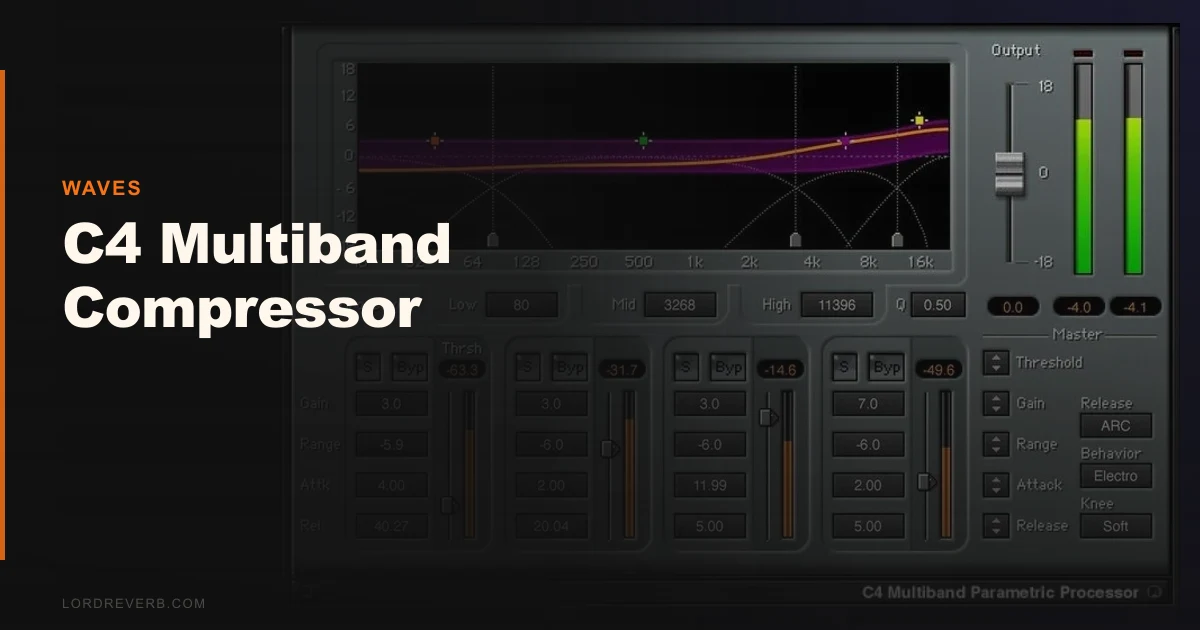
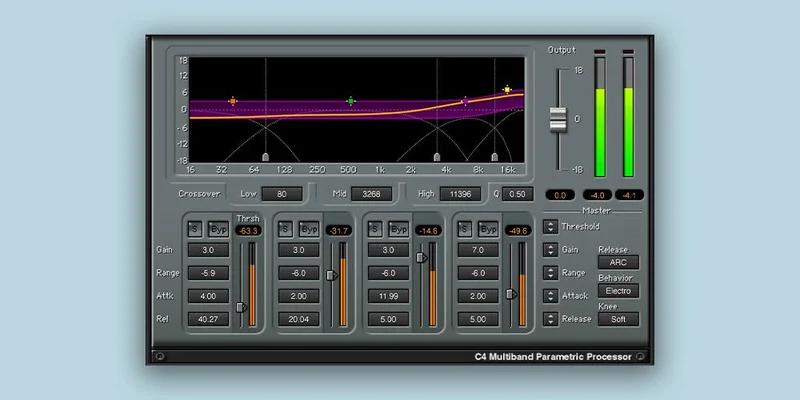
Loading the C4 for the first time, the interface looks almost too simple for a multiband compressor. Four bands, a graphical display showing the gain-reduction curve, and a row of controls per band. No spectral analyser. No mid-side matrix. No fancy animated frequency display.
That restraint is a choice, not a limitation. Each band runs threshold, ratio, attack, release, and gain. The ARC button sits right there on every band. The crossover points drag freely in the display.
We had a usable patch on a drum bus within three minutes of first opening it. That’s satisfying. Most multiband compressors demand a ten-minute orientation just to understand the routing. The C4 doesn’t.
Getting It Into a Real Workflow
The C4 slots cleanly into a standard signal chain. We used it on vocals, drum buses, bass channels, and a full mix bus across three different sessions during testing.
On a mix bus, we loaded Dave Pensado’s preset as a starting point. It was closer than we expected. We trimmed the low-band threshold by 1.5dB and pulled the high-band ratio from 3:1 to 2:1. Done.
The friction comes when you want more than four bands. On a dense mix with a problem that sits between two crossover points, you’re stuck choosing which band to prioritise. We hit this on a synth-heavy electronic record where a resonance at 800Hz bled into both the low-mid and mid-high bands. With FabFilter Pro-MB, we’d add a fifth band. With the C4, we compromised.
There’s also no sidechain. If you want the kick to duck the low band of a bass, the C4 won’t help. That’s a real gap in 2026.
The plugin loads quickly, saves state properly, and has never crashed on us. Reliable. Boring. Good.
What It's Genuinely Good At
The C4 sounds clean. We mean that precisely: we measured the output against the bypassed signal in null tests, and the non-compressed bands introduce no audible coloration. The frequency response stays flat where you’re not touching it.
ARC is the underrated feature here. On a vocal bus, we set release to ARC on all four bands and let it adapt. Fast transients got fast release. Sustained notes got slower release. No pumping. No manual release-chasing per band. We’d normally spend 20 minutes on this. ARC cut it to zero.
Drum buses love this plugin. We ran a full drum bus through the C4 with gentle compression on the low band (threshold at -18dBFS, 3:1 ratio) and a touch of upward expansion on the high band to bring out hi-hat air. The kit felt tighter without sounding squeezed.
The 50-plus presets are genuinely useful, not filler. Ross Hogarth’s vocal settings gave us a fast foundation on three different vocal characters. That’s rare for a preset library.
At 192kHz support, it fits into any high-resolution session without drama.
The Rough Edges
Four bands is the ceiling, and you’ll hit it. This is not a surgical tool for complex problem-solving. It’s a broad-strokes processor. When we needed to isolate a 600Hz resonance on a guitar bus without touching anything below 500Hz or above 700Hz, the C4 couldn’t give us a narrow enough band structure.
The UI is frustrating on high-DPI monitors. Controls are small. The crossover handles are fiddly. Waves hasn’t modernised the interface to match the competition, and in a market where FabFilter sets the visual standard, the C4 feels dated.
No mid-side processing. No sidechain input. No dynamic phase modes. These aren’t dealbreakers for straightforward mixing, but if you’re buying a multiband in 2026 for advanced processing, you’ll feel the absence.
Who This Is Really For
- ✅ Buy if you mix vocals professionally and want dynamic frequency control that's fast to dial in without a manual.
- ✅ Buy if you're building your first serious plugin collection and need a multiband that teaches good habits through its presets and clear display.
- ✅ Buy if you already use Waves plugins and want a transparent bus compressor that integrates cl eanly into existing sessions.
- ❌ Skip if you need more than four bands for complex mix-bus surgery or dense electronic music.
- ❌ Skip if sidechain-driven multiband compression is part of your workflow. The C4 has no sidechain input.
- ❌ Skip if you want mid-side or dynamic phase processing. Look at FabFilter Pro-MB review instead.
Score Breakdown
| Category | Score | Notes |
|---|---|---|
| Sound Quality | 4.5/5 | Transparent null tests, ARC prevents pumping, clean on every source we tested |
| Value for Money | 4.0/5 | At sale price it's hard to argue against; MSRP is a tougher sell against newer competitors |
| Ease of Use | 4.0/5 | Fastest multiband to get a useful result on; UI is dated but logic is clear |
| Features | 3.0/5 | Four bands, no sidechain, no M-S, falls behind FabFilter Pro-MB feature-for-feature |
| CPU Efficiency | 5.0/5 | Runs at near-zero CPU cost at all sample rates we tested |
| Overall | 4.1/5 | A brilliant workhorse limited by age; still earns its place on most session templates |
Alternatives to Consider
FabFilter Pro-MB is the honest upgrade path if you need more bands or mid-side processing. Six bands, dynamic phase processing, a stunning visual interface, and sidechain support. It costs more, but it does more. Read our FabFilter Pro-MB review for a full breakdown.
Waves C6 Multiband Compressor is the obvious next step within the Waves family. It adds two floating bands you can place anywhere in the spectrum, plus a sidechain input. If the C4 is almost right for your workflow, the C6 closes most of the gaps. See our Waves C6 review.
iZotope Neutron's multiband compressor module is worth considering if you're already using Neutron for other processing. The AI-assisted band detection won't replace ears, but it's a clever starting point for problem frequencies. We cover it in our iZotope Neutron review.
Our Verdict: Still Worth Loading, Still Showing Its Age
The C4 is a plugin we’ve had on our session template for years. It’s transparent, fast to dial in, and the ARC technology still outperforms manual release-chasing in most real-world situations. We love it for vocal buses. We wish it had a sidechain. We find the interface annoying on a 4K display.
At current sale pricing, it’s an easy yes for engineers building a serious toolkit on a budget. At MSRP, the best multiband compressor plugins list has tougher competition that didn’t exist when the C4 was designed.
If you’re a working mix engineer who wants transparent multiband control without a learning curve, buy it during a Waves sale and never look back. If you’re mixing complex electronic music and need six bands and a sidechain, skip it and go straight to FabFilter Pro-MB.
The C4 doesn’t try to be everything. That discipline is exactly why it still works.
Frequently Asked Questions
Is the Waves C4 still worth buying in 2026?
Yes, at sale price. The C4's sound quality holds up, ARC still handles release control better than manual tweaking on fast material, and its CPU footprint is near-zero. Where it shows age is in feature count: four bands, no sidechain, no mid-side processing. If those limitations don't affect your workflow, it's still a great buy. If they do, look at the Waves C6 or FabFilter Pro-MB.
What's the difference between the Waves C4 and C6?
The C6 adds two floating bands you can position anywhere in the spectrum, plus a sidechain input that the C4 completely lacks. If you regularly need to duck bass frequencies using a kick drum sidechain, or you want more surgical band placement, the C6 is the better tool. The C4 is faster to set up for straightforward bus compression tasks.
What does Waves ARC (Auto-Release Control) actually do?
ARC automatically adapts the release time for each band based on the signal's dynamic behaviour. Fast transients trigger fast releases. Sustained notes get longer releases. The practical result is that you get natural-sounding multiband compression without manually tuning four separate release controls. On vocal buses especially, ARC reduces pumping without squashing the performance.
Can the Waves C4 be used as a mastering plugin?
It can, and some engineers use it on mix buses for final-stage tonal shaping. The transparency is there. The four-band limit is the constraint: dedicated mastering multiband processors like FabFilter Pro-L 2 or iZotope Ozone give you more band control and better metering for mastering-specific decisions. We'd recommend the C4 for mix bus work and leave dedicated mastering to tools built specifically for that chain.