The honest doubt about Tapewave is whether Wave Alchemy's cassette emulation actually sounds different from every other "lo-fi tape" plugin sitting in your abandoned folder, and the answer is yes, in ways that matter. Released October 31, 2024, Tapewave is built for producers who want cassette texture as a creative tool, not just a one-knob vibe filter. It works best when you're shaping synths, drums, and full mixes that need organic imperfection without sounding like a YouTube lo-fi beats thumbnail. The current price is shown in the buy box on this page.
Does It Actually Deliver on the Cassette Promise?
Wave Alchemy built Tapewave by physically analyzing real cassette machines rather than modeling generic tape curves. That distinction shows up fast.
We loaded a Juno-106 pad through the Studio tape style at zero Age with Drive around 40%. No obvious lo-fi. No fake warmth. What happened was a gentle rounding of the top end above 8kHz and a slight density in the low-mids that made the pad sit 20% deeper in a dense mix without touching the EQ. That's the thing about this plugin. It solves problems you weren't planning to solve.
The six tape styles (Studio, Dirty, Home, Old, Dark, Lo-fi) each have a distinct frequency fingerprint. Studio is the least colored. Lo-fi collapses the high end noticeably past 10kHz and introduces mid-range grunge that feels period-correct. Old sits somewhere between them, adding gentle saturation with a slight low-end softness that's satisfying on acoustic sources.
It delivers. Not perfectly, but solidly.
Where Tapewave Shines
The wow and flutter engine is the standout feature and we love it without reservation. Most tape plugins route pitch modulation through a basic LFO and call it done. Tapewave runs two engines simultaneously: a smooth cosine curve for the predictable warble, and a custom Perlin noise generator for the organic, non-repeating drift that real tape produces.
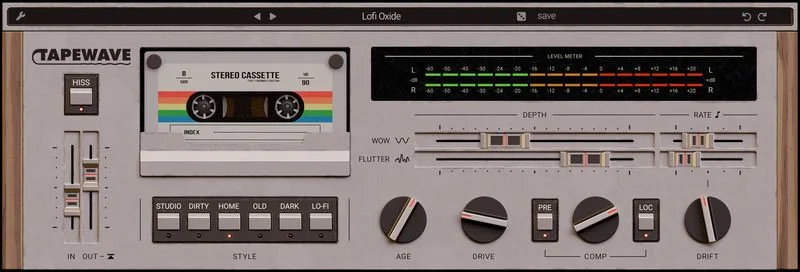
We tested this on a lead vocal at moderate Drift settings. The pitch movement didn't follow a pattern. It wandered the way a tape deck wanders when the heads are slightly worn. Drop it subtle enough and listeners won't identify it as an effect. They'll just feel like the vocal was tracked to tape.
The Loc Mode compression is brilliant and worth the price alone for drum producers. We ran a snare bus through it at moderate input, and it crushed the transient hard within the first 5ms while the body swelled up behind it. It sounds like a drum machine that's been slammed into a cheap recorder. Aggressive, intentional, and very difficult to fake with standard compression.
Being able to audition compression pre or post tape processing is a clever workflow choice. Post-tape compression on saturated material sounds like a different unit entirely.
Where It Falls Short
The CPU cost at 16x oversampling is annoying. On an M2 Mac with 12 instances stacked across a session, we saw meaningful overhead. Wave Alchemy does offer standard and efficient oversampling modes, and the efficient mode holds up reasonably at lower drive amounts. But if you're stacking Tapewave on every bus, expect to bounce stems or drop to 8x.
The pricing transparency issue is frustrating. There's introductory pricing available, but you won't know the number until you're on the checkout page. For a plugin in a competitive category, that creates hesitation where there shouldn't be any.
The compression modes are also fixed in character. You get two modes: standard and Loc. There's no attack or release control. For producers who want Loc-style aggression with a slower attack, there's no middle setting. You get what you get.
None of these are deal-breakers. But they're real.
How It Stacks Up Against the Competition
The two plugins Tapewave gets compared to most are SketchCassette II and WaveFactory Cassette. Here's the honest breakdown.
SketchCassette II is more immediately charming. It's visual, tactile, and great for quick lo-fi aesthetics. But its pitch modulation is LFO-based, and after a few bars you can hear the pattern. Tapewave's Perlin engine doesn't repeat. That's a measurable difference on sustained material.
WaveFactory Cassette goes deeper on transport controls and machine-specific detail. It's the better choice for obsessive tape machine recreation. Tapewave wins on workflow speed and the Loc Mode compression, which WaveFactory Cassette doesn't match.
For most producers, Tapewave is the practical middle ground. It's not the deepest and not the prettiest. It's the one that actually sounds right on the first patch.
Is the Price Fair?
Check the manufacturer's site for current pricing, as introductory rates were available at launch and may still apply.
Based on what the plugin delivers, including 100 presets, 16x oversampling, a dual-engine wow and flutter system, and the Loc Mode emulation, it's priced right for what it does. If you catch it on intro pricing, it's a clear buy. At full price, it still competes. The value holds because the Loc compression alone would justify paying for a dedicated transient plugin.
Score Breakdown
| Category | Score | Notes |
|---|---|---|
| Sound Quality | 4.5/5 | Perlin noise wow engine and Loc Mode set it apart from template-style tape plugins |
| Value for Money | 4.0/5 | Strong at intro price; still justifiable at full price given the feature depth |
| Ease of Use | 4.5/5 | Streamlined interface gets you to a result fast; 100 presets cover most starting points |
| Features | 4.0/5 | Dual wow engines, six tape styles, Tape Age, and Loc Mode are all genuinely useful; compression lacks parameter control |
| CPU Efficiency | 3.5/5 | Efficient mode helps but 16x oversampling stacks up across a session |
| Overall | 4.2/5 | Solid, characterful cassette emulation with a genuinely clever pitch engine and one compressor mode you won't find elsewhere |
Alternatives to Consider
If Tapewave's compression-forward approach isn't what you need, SketchCassette II review is worth your time. It's more playful, more visual, and better for pure lo-fi aesthetics where machine accuracy matters less than mood.
For deep tape machine emulation with transport controls and machine-specific head modeling, WaveFactory Cassette review goes further technically. It's the right pick if you're recreating a specific deck's sound rather than adding cassette character broadly.
If you're after general tape saturation without the cassette-specific coloring, best tape saturation plugins covers studio-machine emulations from Studer and Ampex-style units that sit differently in a mix. Also worth comparing against our lo-fi plugin roundup if texture rather than fidelity is the goal.
The Verdict
Tapewave earns its place in your signal chain because it solves a specific problem better than its competition: making organic, non-repeating pitch drift that doesn't reveal itself as a pattern after eight bars.
The Loc Mode compression is a bonus we didn't expect to love this much. We ran it on a drum bus, backed off the Drive to about 30%, and left it there. It added density without killing the transient punch. That's hard to do with a two-mode compressor and no attack knob.
Buy it if you're working in lo-fi, indie, bedroom pop, or any genre where cassette texture is a creative asset rather than a mistake to fix. Buy it if you've already tried LFO-based wow and flutter and found it mechanical.
Skip it if you want a dedicated studio tape machine emulation with wow and flutter you can fully automate, or if you need compression with adjustable attack and release in your tape plugin. It's wrong for clinical applications where any pitch drift is a problem.
The cassette era was full of imperfection that nobody could control. Tapewave is the first plugin that makes that imperfection feel deliberate.
Related reviews: Cassette Bunny Review · Reelight PRO Review 2026
Frequently Asked Questions
What are the six tape styles in Tapewave and how different do they actually sound?
The six styles are Studio, Dirty, Home, Old, Dark, and Lo-fi. Studio is the cleanest, with subtle saturation and minimal top-end roll-off. Lo-fi is the most aggressive, collapsing clarity above 10kHz and adding mid-range grunge. The differences between them aren't just brightness adjustments. Each style has its own compression behavior and saturation character, which becomes more pronounced as you push the Tape Age control toward its worn-out end.
Does Tapewave work on Apple Silicon Macs without Rosetta?
Yes. Tapewave runs natively on Apple Silicon for VST3, AU, and AAX formats. No Rosetta translation layer needed. That matters for CPU overhead, especially when you're running multiple instances at higher oversampling rates.
What is Loc Mode in Tapewave?
Loc Mode is Tapewave's emulation of the Shure Level Loc, a vintage compressor/limiter known for its fast, aggressive transient crushing. It's particularly effective on drums and percussive material where you want the attack smashed and the body of the sound pushed forward. Unlike standard compression, Loc Mode has a fixed character that you control mainly through input drive level, not attack and release times.
Can you use Tapewave without adding obvious lo-fi character?
Absolutely, and this is one of the underrated uses of the plugin. On the Studio tape style with low Drive and minimal Tape Age, Tapewave adds subtle harmonic density and very gentle high-end softening without any obvious degradation effect. We've used it this way on soft synths and clean acoustic guitars where the goal was just to take the digital edge off, not to make anything sound old.