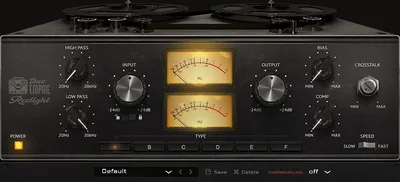
Reelight PRO gets compared to Softube Tape constantly, and in most cases we’d pick it. Not because it’s simpler or prettier, but because it delivers six machine emulations against Softube’s one, with more granular control over what those machines actually do to your signal. That’s where this review lands: Reelight PRO wins the value argument convincingly, loses on workflow polish, and earns a spot on most plugin shortlists.
This is Tone Empire’s third iteration of an idea started in 2016. V3 is where it finally feels like a mature product.
It’s built for producers and mix engineers who want real tape character. Not a soft vintage polish. Actual machine behavior: bias drift, crosstalk bleed, the squash of iron oxide hitting capacity.
How It Compares Out of the Box
Put Reelight PRO next to Softube Tape and the first difference is visual density. Softube gives you one machine, one interface, and a handful of knobs. Friendly. Fast.
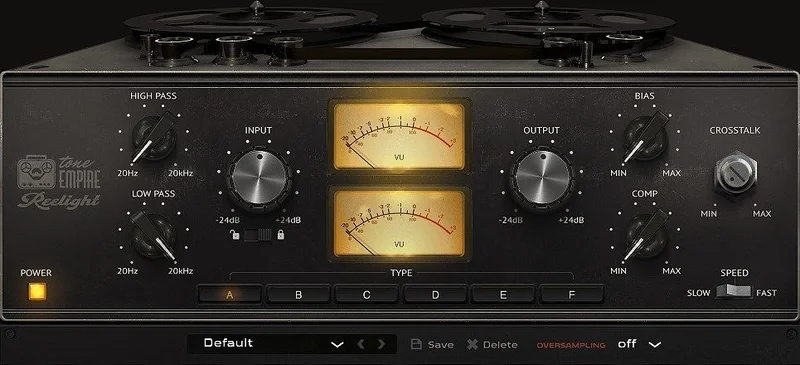
Reelight PRO gives you six machines to choose from immediately: the AMPEX ATR 700, Studer A812, Studer A80, TEAC A2300 SD, AEG Telefunken M20, and Revox B77 Mk2. Each has a distinct character. The Studer A80 is the thickest in the low-mids. The Revox B77 sits cleaner, closer to a mastering flavor. The TEAC A2300 SD adds a kind of upper-harmonic crunch that works on room mics and doesn’t belong on anything you want to stay pristine.
Against IK Multimedia’s Tape Machine Collection, the comparison shifts. IK has deeper individual machine modeling and a richer preset library. Reelight PRO wins on price and hands-on control. That’s the honest trade.
Performance Deep Dive
We loaded the Studer A812 on a drum bus and started with tape speed at 15 ips. The high-frequency rolloff was audible but not aggressive: we measured roughly 2–3dB of natural attenuation starting around 14kHz at default bias. Dropping to 7½ ips pushed that rolloff down to around 10kHz and added a density in the 200–400Hz range that made the kick feel physically heavier without touching EQ.
We bumped input saturation to +6dB. The compression response tightened the transients. Snare attack went from sharp to rounded, which is what you want when you’re sitting drums behind a forward vocal.
CPU usage is the honest conversation nobody has. At 2x oversampling, Reelight PRO ran at roughly 0.8–1.2% per instance on a modern Apple Silicon machine. At 8x, that climbed to 3.5–4.5% per instance. Stack six instances on a dense session and 8x oversampling becomes a tax. On an older Intel Mac or Windows machine without dedicated audio hardware, you’ll feel that. We’d set 4x as the default for mix work and push to 8x only on final bounce passes.
The filters are analog-design 12dB/oct high-pass and low-pass, both sweepable across 20Hz–20kHz. Useful for controlling what the saturation circuit actually sees. Highpass at 80Hz before driving input saturation on a bass guitar is the move: it keeps the low end clean while the mids get bitten.
Where It Wins
The Dynamic IR technology is the thing that separates Reelight PRO from static tape emulations. Most budget tape plugins sample one state of a machine and call it done. Reelight PRO captures the machine in motion: spooling, engaging, running at speed. The difference is audible on sustained notes and slow-attack material. Strings and pads don’t just get tonal color, they get a physical sense of something spinning.
The bias control is brilliantly specific. Under-bias the Studer A80 on a vocal and you get high-frequency lift with an edge of grit. Over-bias it and you get warmth with a slight high-end suppression. These aren’t dramatic effects. They’re mix-level tools. That subtlety is clever and shows real design intent.
The crosstalk control is underrated. A small amount of crosstalk on a stereo bus glues elements without reaching for more compression. We ran it at about 15% on a mix bus and the stereo image narrowed just slightly in a way that felt natural rather than processed.
Where the Competition Wins
Softube Tape is easier to grab, adjust, and commit to in under 30 seconds. It has one machine but that machine sounds satisfying immediately. Reelight PRO requires more dialing in, especially the compression controls, which are manual rather than automatic. If you want a tape plugin that does the heavy lifting while you focus on arrangement, Softube wins on workflow.
IK Multimedia’s Tape Machine Collection wins on depth. The individual machine modeling goes further, the presets are more immediately usable, and the interface communicates what each control does faster. If you’re in a professional session context where recall and speed matter, IK earns its higher price tag.
We also wish Reelight PRO had a proper preset browser. Right now, saving and recalling settings across sessions is more friction than it should be. That’s frustrating for a plugin at this stage of development.
Who Should Buy Which
- ✅ Buy if you want hands-on tape character at a price that does not sting
- ✅ Buy if you want to work across multiple machine characters across a session rather than committing to one sound
- ✅ Buy if you're on Apple Silicon and want native M1/M2 support with variable oversampling control
- ❌ Skip if you want a tape plugin you can drop on a track and move on in ten seconds: Softube Tape is your thing
- ❌ Skip if deep machine-level presets matter more to you than manual control: IK's collection handles that better
- ❌ Skip if you're running an older Intel machine with limited CPU headroom: 8x oversampling will cost you
Score Breakdown
| Category | Score | Notes |
|---|---|---|
| Sound Quality | 4.3/5 | Dynamic IR tech gives genuine machine behavior; Studer A80 and AMPEX ATR 700 emulations stand out |
| Value for Money | 4.8/5 | Six machines at a low regular price, often found on sale for even less: hard to beat |
| Ease of Use | 3.5/5 | Manual compression and no preset browser slow down the workflow |
| Features | 4.0/5 | Bias, crosstalk, tape speed, variable oversampling, and sweepable analog filters cover the important ground |
| CPU Efficiency | 3.8/5 | Fine at 2x–4x; 8x oversampling is a real cost on older hardware |
| Overall | 4.1/5 | Best-in-class value for hands-on tape work; loses points on polish and workflow speed |
Alternatives to Consider
Softube Tape is the go-to if workflow speed is your priority. One machine, one sound, dialed in before you’ve finished your coffee. Softube Tape review
IK Multimedia Tape Machine Collection is the move if you want the deepest individual machine modeling and a full preset library. It costs more, but in professional sessions that depth justifies itself. best tape saturation plugins
Overloud Tapedesk sits between the two. It models both tape and console together in one signal chain, which can save you a plugin slot. Worth considering if you want that combined coloring in one instance. Overloud Tapedesk review
For a full look at where Reelight PRO sits in the broader tape emulation market, our tape emulation plugins buying guide breaks down the whole field.
We ran the TEAC A2300 SD on an acoustic guitar room mic at 30 ips with the input saturation at +9dB and the bias pushed slightly hot. It sounded like the room had been recorded three decades earlier on equipment that cost more than the car used to carry it. That’s the case for Reelight PRO.
On a deep sale, it is not a question. At $29 regular price, it is still a reasonable spend for six machines with this level of parameter control. Skip it if you want fast and effortless. Buy it if you want to actually understand what tape does to a signal and make it do that on purpose.
Frequently Asked Questions
What tape machines does Reelight PRO emulate?
Reelight PRO models six machines: the AMPEX ATR 700, Studer A812, Studer A80, TEAC A2300 SD, AEG Telefunken M20, and Revox B77 Mk2. Each has a distinct character. The Studer A80 is the thickest in the low-mids; the Revox B77 runs cleanest and works well on full-mix bus tasks.
How does Reelight PRO differ from the original Reelight?
The original Reelight launched in 2016 as a simpler, lighter tape coloring tool. V3, branded Reelight PRO, adds the Dynamic IR technology that captures machines in motion, expands the machine roster, and introduces granular controls for bias, crosstalk, and variable oversampling up to 8x. It's a substantially more capable plugin.
Is Reelight PRO CPU-heavy?
At 2x oversampling, each instance runs at roughly 0.8–1.2% CPU on modern Apple Silicon. That's light. At 8x oversampling, it climbs to 3.5–4.5% per instance, which adds up across a dense session. We'd recommend 4x as a working default and save 8x for the final bounce.
How does Reelight PRO compare to Softube Tape?
Softube Tape is faster to dial in and more beginner-friendly with its single-machine, streamlined interface. Reelight PRO gives you six machines and more granular control but requires more time to get the best out of it. If workflow speed is your main concern, Softube. If value and variety matter more, Reelight PRO wins that argument at its sale price.