
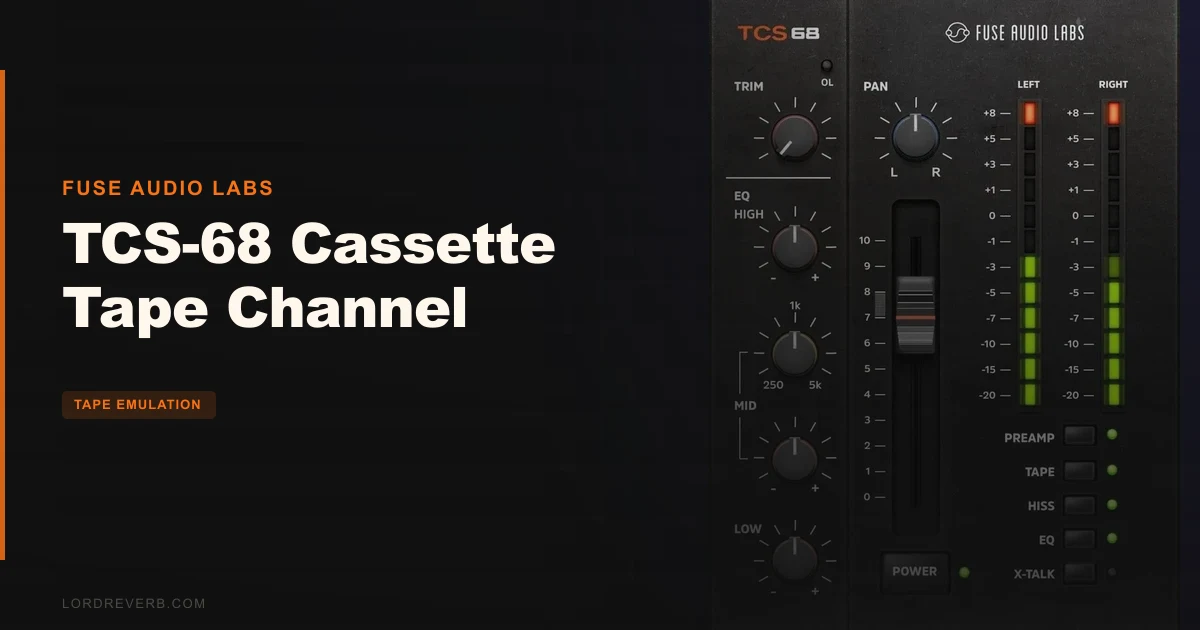
The TCS-68 Cassette Tape Channel review answer is this: Fuse Audio Labs built a credible, low-CPU cassette emulator at $19 that earns its place on drum buses and synth channels, but if you need the wobbly, saturated chaos of real analogue tape, it'll frustrate you.
Quick verdict: At $19, TCS-68 is a clever, focused tool. The preamp section is genuinely satisfying to push, the anti-aliasing quality is a talking point, and the CPU overhead is so small you can park it on 20 channels without a second thought. The cassette emulation itself is convincing at low-to-moderate settings. Push harder and the saturation starts sounding polite where you want ugly. No wow and flutter, no wet/dry blend. Score: 4.0/5. Best for producers who want that early-90s multitrack crunch sitting in the mix, not splattered across it.
The Catch Up Front
There's no wet/dry mix control. That one missing knob is the reason TCS-68 is awkward on a master bus. You can't blend the processed signal back against the dry one, so you're committed to whatever the plugin does to your full mix.
For individual tracks and stems, that's fine. For the master? Annoying. You'd need to run it on a parallel channel instead, which adds steps most people don't want on a finisher.
The noise section has its own issue. It runs independently of the preamp, so pushing the preamp harder doesn't make the noise breathe the way it does on a real deck. Some owners describe the noise as surprisingly clean, almost inaudible when toggled. That's not what you're after if you want grit and cassette dirt. One reviewer called the hiss too pronounced and the saturation uninspiring once you push beyond subtle settings. That's the core tension with this plugin: it does restrained tape colouration well, and not much else.
No wow and flutter either. If that modulation is part of your sound, TCS-68 won't get you there.
What You Get If You Clear It
TCS-68 emulates a multitrack cassette tape recorder from 1990. The signal path breaks into three sections you can run together or separately: preamp, tape, and a 3-band EQ with sweepable mids.
The preamp is the headline. At default trim it's flat and clean. Push it and the top end gets gritty, the low-mids fill out, and instruments start occupying more space in the mix. That colour is the reason people stack this on every drum channel.
The tape section adds compression and that specific cassette texture. Owners describe it as a glue effect: bypass it on a drum bus and there's a noticeable loss of cohesion. That bypass test is the classic sign a tape plugin is doing real work, not just adding noise.
The EQ exists to compensate for what the tape section introduces. Bass bump from tape saturation, high-frequency rolloff, preamp edge. The sweepable mid band gives you the control to either correct those artefacts or lean into them. Three bands isn't deep, but it's the right three for this workflow.
Formats cover VST2, VST3, AAX, and AudioUnits on Mac. Windows gets VST2, VST3, and AAX. Both 32-bit and 64-bit Windows are supported.
Where It Shines
Stack it on your drum bus and push the preamp past noon. The low-mids thicken, the transients get a slight softening from the tape compression, and the whole kit starts sounding like it was recorded to something physical. That cohesion is hard to fake with just saturation or compression alone.
The anti-aliasing quality is the technical standout. Users rate it above almost every competing plugin at this price. What that means in practice: when you push the preamp hard, the harmonics that come back are musical, not harsh digital artefacts. You get colour, not aliasing noise.
Synths and pads respond well to the tape section specifically. A pad that's sitting too clean and wide in the mix runs through TCS-68's tape section and suddenly has more front-to-back depth. The slight high-frequency rolloff takes the digital sheen off without EQing out the air entirely.
A reviewer achieved nearly exact tone matching to UAD Helios plugin within minutes. That's a meaningful comparison: Helios emulations sit at a very different price point, and getting close to that character for $19 is worth flagging.
CPU is legitimately low. Run it on 20 channels. It won't argue. For producers on older machines or those with dense sessions, that matters more than any single feature.
Against the Field
Flywheel is the most direct comparison owners make. One user prefers TCS-68 to Flywheel for saturation specifically, citing the preamp colour as more convincing. If you're deciding between the two as your main saturator, that's a data point worth having.
Softube Tape on 1 7/8 ips is the alternative when you want a fuller tape emulation. It goes places TCS-68 doesn't. If wow, flutter, and a more complete mechanical tape simulation matter to your sound, Softube Tape is the direction to look.
Lemon with the Anti-digital preset is cheaper and comparable in some ways, but owners describe it as less convincing. If budget is the only factor, Lemon gets you there. If you want the emulation to hold up under close listening, TCS-68 pulls ahead.
Airwindows Mackity sits in the same lane with a softer tonality. It's functionally similar but doesn't have the same preamp aggression. If you want something that pushes back a little less, Mackity is the gentler option.
TCS-68 wins on anti-aliasing quality and preamp colour. It loses on completeness: no modulation, no wet/dry, thinner noise section.
Who Should Buy This
- ✅ Buy if you want convincing cassette crunch on individual tracks and buses without touching your CPU budget.
- ✅ Buy if you're after preamp colour that goes from flat and clean to genuinely gritty, with EQ to control the results.
- ✅ Buy if you're stacking tape saturation across a full session and need something that runs light on every channel.
- ❌ Skip if you need a wet/dry blend for master bus parallel processing.
- ❌ Skip if wow and flutter are part of the lo-fi aesthetic you're chasing.
- ❌ Skip if you need the saturation to get wild and abrasive at high drive settings. It doesn't.
Specs & Technical Details
| Specification | Detail |
|---|---|
| Developer | Fuse Audio Labs |
| Price | $19 |
| Plugin Format | VST2, VST3, AAX, AudioUnits (Mac); VST2, VST3, AAX (Windows) |
| OS Support | Mac (macOS 10.12 or newer, 64-bit Intel or Apple Silicon); Windows 7 or newer (32-bit and 64-bit) |
| Activation | N/A |
| CPU Usage | Light |
| Trial Available | N/A |
| Version Reviewed | N/A |
Score Breakdown
| Category | Score | Notes |
|---|---|---|
| Sound Quality | 4.0/5 | Preamp and tape glue are convincing at moderate settings; saturation loses character when pushed hard |
| Value for Money | 4.5/5 | Anti-aliasing quality and preamp colour at this price point is difficult to argue with |
| Ease of Use | 4.5/5 | Three focused sections, no learning curve, dial in and move on |
| Features | 3.5/5 | Missing wet/dry, wow and flutter, and a dynamic noise module that responds to the preamp |
| CPU Efficiency | 5.0/5 | Genuinely stackable on 20-plus channels; owners confirm it's not a CPU hog |
| Overall | 4.0/5 | A focused, honest cassette emulator that earns its place on tracks and buses, not on the master |
Alternatives to Consider
Flywheel
Flywheel is the alternative some owners landed on before switching to TCS-68. At least one user prefers TCS-68's preamp colour over Flywheel's saturation character. If you're choosing your primary channel saturator and cassette texture matters, TCS-68 is the more specific tool. Flywheel is worth auditioning if you want something with a different saturation flavour rather than a tape-specific signal path.
Softube Tape (1 7/8 ips setting)
When you need a more complete mechanical tape simulation, Softube Tape (1 7/8 ips setting) goes further than TCS-68. It's the option to look at if the absence of wow and flutter in TCS-68 is a dealbreaker for your sound. The two plugins are solving different problems. TCS-68 is a channel tool. Softube Tape is a fuller tape machine emulation.
Airwindows Mackity
Airwindows Mackity is functionally similar to TCS-68 but with a softer tonality. If you love the concept of TCS-68 but wish the preamp pushed a little less aggressively, Mackity is worth checking. It won't give you the same EQ section or the same level of anti-aliasing quality, but it's a legitimate alternative when you want tape texture that sits further back.
The Verdict
You're choosing TCS-68 for a specific reason: you want cassette-era multitrack colour on your tracks without the CPU overhead and without spending serious money. At $19, it delivers exactly that.
Put it on your snare room mic and push the preamp until the top end starts to bite. That's where you hear what this plugin actually does. The tape section catches it, compresses the transient slightly, and what comes back sits differently in the mix. Owners don't bypass it by accident. The bypass test is real.
Push the saturation past subtle settings and it starts to feel polite. That's a frustrating ceiling if you wanted something that gets ugly on purpose. It won't. The noise section doesn't respond to the preamp envelope, so you can't get the floor noise breathing with the signal the way a real deck would. Wish that was different. It's not a small omission.
What it does brilliantly: stack it everywhere. Put it on your drum bus, your synth pads, your DI bass. The CPU cost is so low it barely registers. The anti-aliasing is cleaner than plugins with bigger reputations. The EQ section with sweepable mids means you're not fighting the tape coloration, you're shaping it.
Skip it if the master bus is the target and you can't live without wet/dry control. Skip it if you need modulation. For everything else at this price, it's a clever, underrated tool that a lot of producers have on every channel and wouldn't give up. That's the honest answer.
Frequently Asked Questions
Does TCS-68 work on a master bus?
It works, but it's awkward there because there's no wet/dry mix control. You can't blend the processed signal against the dry one, which is usually how you'd use a tape plugin on a master bus at low mix percentages. Running it on a parallel return channel is the workaround most people land on.
Does TCS-68 include wow and flutter?
No. TCS-68 doesn't include wow or flutter controls. The emulation covers the preamp coloration, tape compression, and noise floor of a multitrack cassette recorder introduced in 1990, but the pitch modulation that characterises old cassette playback isn't part of the plugin. If that effect is central to your sound, you'll need a different tool or a separate modulation plugin in your chain.
How does the preamp section behave when pushed?
At default trim the preamp is flat and clean, with almost no coloration. Push it past that and the character changes noticeably: the top end gets gritty, the low-mids add presence, and the signal starts sounding like it passed through something physical. Owners describe the colour as satisfying rather than harsh, which tracks with the anti-aliasing quality users consistently praise.
Can you use TCS-68 on multiple channels without CPU issues?
Yes. Low CPU usage is one of the most consistently praised aspects of the plugin. Owners report running it across many channels simultaneously without performance problems. Mac requires 64-bit Intel compatible or Apple Silicon CPU, a minimum of 2GB RAM, macOS 10.12 or newer, and a display resolution of 1280x1024 pixels or more; Windows supports both 32-bit and 64-bit, requires Intel compatible CPU at 2 GHz recommended, 2GB RAM minimum, Windows 7 or newer, and 1280x1024 pixels or more.
How does TCS-68 compare to other tape emulation plugins?
TCS-68 sits in a focused lane: low cost, low CPU, convincing cassette coloration at moderate settings. Owners who've compared it to pricier options note that the anti-aliasing quality is competitive above its price bracket. Where it falls short is completeness: no wow and flutter, no wet/dry blend, and saturation that runs out of character before more fully-featured emulations do. It's a track and bus tool, not a comprehensive tape machine replacement.
Is the EQ section useful or just compensation?
Both, depending on how you use the tape section. The 3-band EQ with sweepable mids is there specifically to handle what the tape processing introduces: bass bump from tape saturation, high-frequency rolloff, and any preamp edge. Used as compensation, you dial back what the tape added too much of. Used creatively, you can shape the mid frequency that sits in the saturation to fit the track. It's a small but genuinely useful section.