
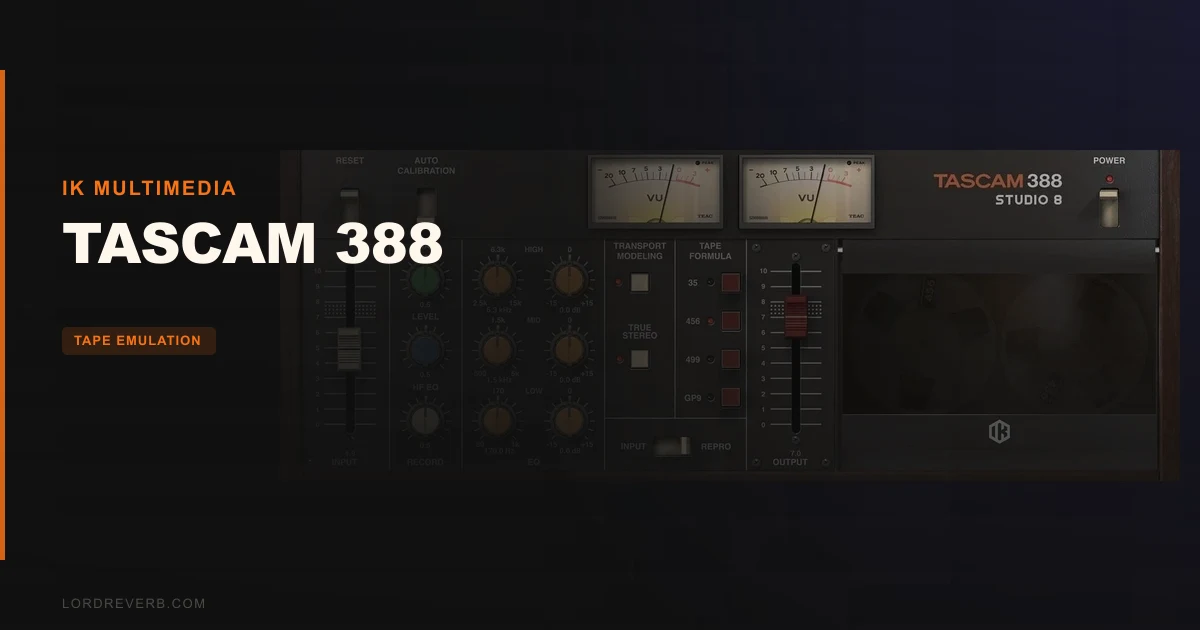
The claim is that the TASCAM 388 gives you easy, magic vintage tape character, and for grit it holds up. For low-end clarity it doesn’t. At $99.99, this is a lo-fi character plugin first and a polite glue plugin second, and it’s built for producers who want attitude, not transparency.
Here’s the scene. You’ve got a drum bus that sounds tidy and lifeless. You want it to feel like a record from 1985, not a sample pack.
Insert the 388 and you’ll hear it fast. The grit shows up with barely any tweaking.
Then you check the kick. That’s where the story gets complicated.
The Claim: Magic in a Box?
The original TASCAM 388 was a 1985 studio-in-one-unit: an 8-track tape machine and an 8-channel mixer in a single chassis. IK Multimedia says many musicians describe it as magic. Kelley Stoltz made it famous again around 2001, and the developer’s pitch is that tape adds musicality and movement to audio.
The plugin models the tape deck behaviour and a 1-channel mixer path with a 3-band parametric EQ. You get four tape formulas, 35, 456, GP9 and 499, plus Transport Modeling and True Stereo mode.
That’s the promise. Now the receipts.
What Holds Up
The grit holds up. Owners report it makes a cool vintage sound with almost no effort, especially on a drum bus, and it works on guitars and anything that needs dirt.
Snares are the highlight. Owners say heavily driven, underbiased settings sound great there, and bias moves in both directions give you interesting results. Push the Record Bias control into overbiased territory and you get the warmer, softer tone the developer describes.
The tape formulas are a real choice, not window dressing. 456 is the warm, round, saturating one, modeled on the Ampex 456 from around 1974. GP9 and 499 take higher levels with minimal distortion, and 499 keeps high-frequency definition. Tape 35 follows the BASF LPR35 formula.
Owners also call it a great lo-fi tool with more life than comparable emulations. We love that it feels like an instrument, not a polite coat of varnish.
What Doesn't
The pre-ringing is the problem, and it’s not subtle. Users describe an awful pre-ringing that leaves the low end blurry and without punch.
Picture it. You’ve got a tight 808 or a kick that needs to hit the chest. You push the 388 and the transient loses its edge. Annoying.
Used sensibly, with lower bias and moderate levels, users say it gels a mix without significant audible issues. So the damage is a function of how hard you lean on it. Push it, and the low end pays.
The mixer side is also a simplification. A 1-channel path stands in for an 8-channel console, so don’t expect to recreate the whole machine. Windows users need an ASIO compatible sound card, and Custom Shop operations need an internet connection. It also wants 9 GB of drive space, which is a lot for a character plugin.
Who Should Buy It, and Who Should Skip It
The lo-fi and bedroom producer
Buy it. This is the plugin you wanted when your tracks sounded too clean. Drum bus, guitars, snares, vintage texture on tap.
The working mix engineer
Wait. If your job is clean low end and tight transients, the pre-ringing is a daily irritation. You can tame it with lower bias and moderate levels, but then you’re using a character box as a mild glue plugin, and that’s a waste of its strengths.
The mastering or reference-minded user
Skip it. A blurred low end is the last thing you want on a full mix. Pick something built for transparency.
The sound designer
Buy it. Underbiased, over-driven, deliberately ugly: that’s the 388’s lane. Pre-ringing becomes a feature when you want smeared, degraded texture.
The Verdict
Buy the TASCAM 388 for what it is: a grit and attitude machine that delivers on drum buses, snares and guitars. At $99.99, it’s a fair deal if lo-fi character is the goal. Treat the low end with suspicion, keep the bias low and the levels moderate on full mixes, and it behaves.
If you wanted tape you could leave across the whole master, look elsewhere. For colour you can hear at a glance, it earns its slot.
Specs & Technical Details
| Spec | Detail |
|---|---|
| Developer | IK Multimedia |
| Price | $99.99 |
| Plugin Format | VST2 / VST3 / AAX (Windows); AU / VST2 / VST3 / AAX (Mac), 64-bit |
| OS Support | macOS 10.15 or newer / Windows 10 64-bit or newer |
| Activation | N/A |
| CPU Usage | N/A |
| Trial Available | N/A |
| Version Reviewed | N/A |
Score Breakdown
| Category | Score | Notes |
|---|---|---|
| Sound Quality | 3.5/5 | Great grit, but pre-ringing blurs the low end |
| Value for Money | 4.0/5 | Four tape formulas and strong character at $99.99 |
| Ease of Use | 4.0/5 | Owners get a vintage sound with little effort |
| Features | 4.0/5 | Bias, record-head EQ, 3-band EQ, Transport Modeling, True Stereo |
| CPU Efficiency | N/A | No CPU figures to judge from |
| Overall | 3.8/5 | A strong lo-fi colour tool with a real low-end weakness |
Buy It for the Dirt, Not the Low End
Pay $99.99 if you want a drum bus that sounds like it lived in a bedroom studio in 1985, and you’re happy to babysit the kick. If you need pristine bottom end or you mix for a living with zero tolerance for smear, this is the wrong tool. Everybody else gets a lot of character for the money.
Frequently Asked Questions
Is the TASCAM 388 worth buying?
Yes, if you want lo-fi grit on drum buses, snares and guitars. Owners report an easy vintage sound with little effort. It's a weaker pick if you need a clean, punchy low end on full mixes.
Does the TASCAM 388 plugin hurt the low end?
It can. Users report pre-ringing that blurs the low end and reduces punch. Used sensibly, with lower bias and moderate levels, users say it gels a mix without significant audible issues.
What tape formulas does the TASCAM 388 include?
Four: 35, 456, GP9 and 499. Tape 35 follows the BASF LPR35 formula, 456 follows the Ampex 456 from around 1974, GP9 follows Quantegy GP9, and 499 follows the Ampex 499.
What are the system requirements for the TASCAM 388?
You need macOS 10.15 or newer, or Windows 10 64-bit or newer, with 8 GB RAM and 9 GB of free drive space. Mac needs an Apple M1 or Intel Core i5. Windows needs an Intel Core i5 or equivalent and an ASIO compatible sound card.
Does the TASCAM 388 need an internet connection?
Only for Custom Shop operations. It also runs as a standalone plugin or inside the T-RackS 5 shell, and supports AU, VST 2, VST 3 and AAX on Mac, with VST 2, VST 3 and AAX on Windows.