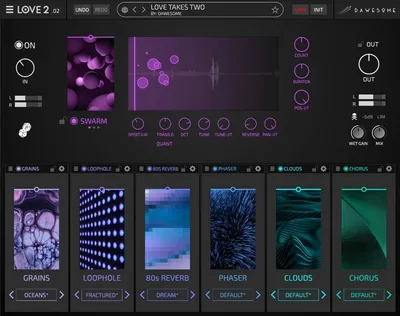
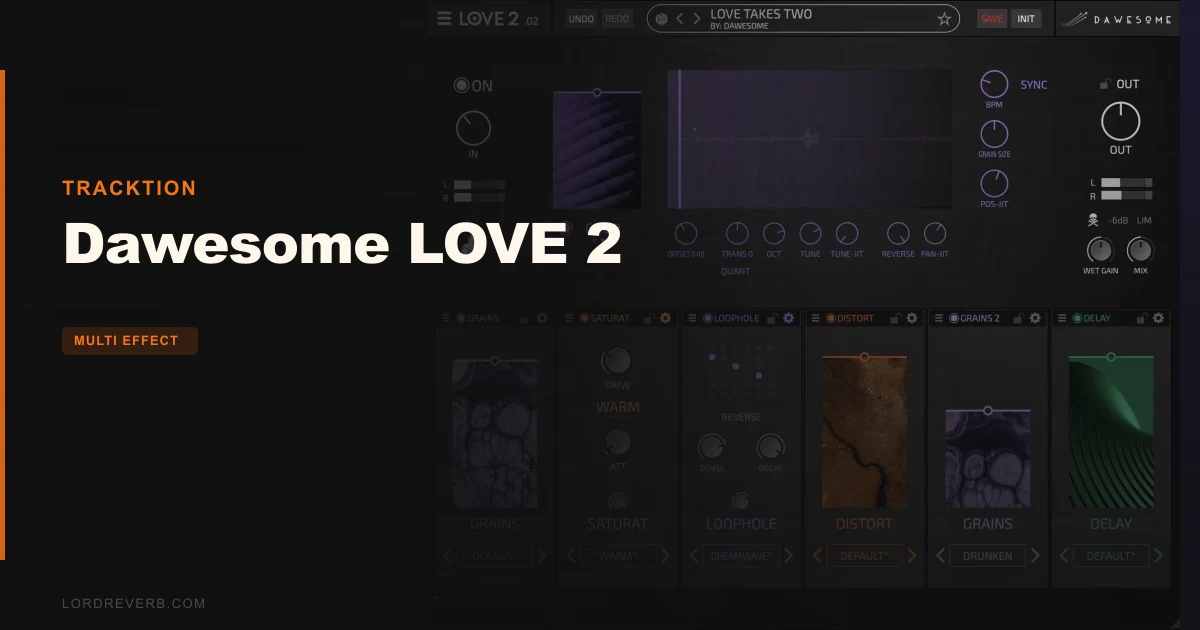
Dawesome LOVE 2 is a dual-architecture multi-effect plugin that pairs a musically tuned granular engine with a modular, drag-and-drop effects rack, and it's one of the most satisfying texture tools we've had open in a session this year.
We dropped it across a dry lead vocal that had been sitting in a mix for two days, refusing to sit anywhere interesting. Within four minutes of loading a preset from the Swarm section and tweaking the granular density, the vocal had texture we hadn't found in two days of EQ moves. That's the honest version of what LOVE 2 does best.
At $69 for new users, it's not an impulse buy. But it's close. If you spend sessions trying to make static sounds feel alive, this belongs in your signal chain. If you want a standard multi-effect for surgical processing, it probably doesn't.
What LOVE 2 Actually Does (and Where It Stops)
LOVE 2 is built around two stacked sections. The top half is the granular engine. The bottom half is a six-slot modular effects rack with 20+ algorithms you can arrange however you want.
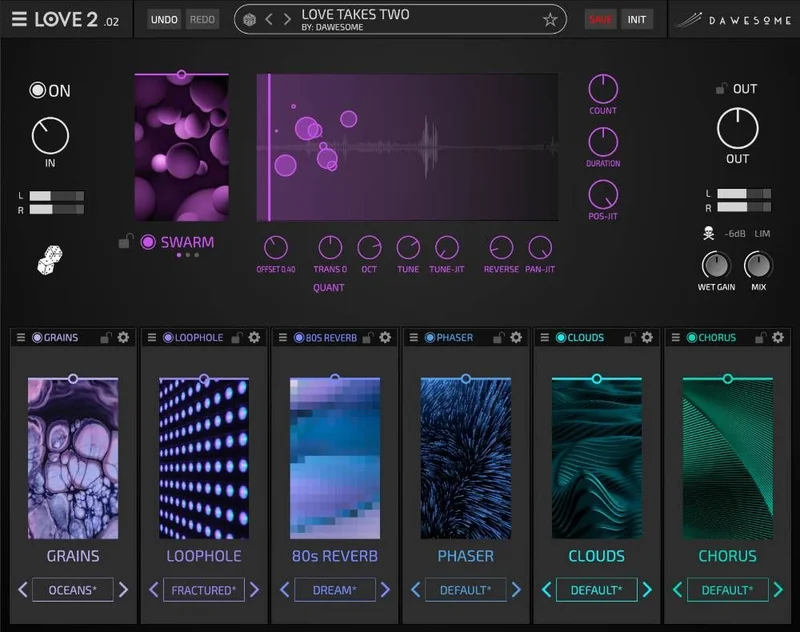
These two halves feed into each other. The granular engine processes your incoming signal first, generating particles and motion. What comes out of that feeds directly into your effect chain below. It's a one-directional flow, and that matters: you're not routing freely between every module. You're working with a fixed top-to-bottom signal path.
That's not a flaw. It's a design choice that keeps things coherent. But know it going in.
What LOVE 2 is NOT: a general-purpose mixing chain. It won't replace a dedicated compressor bus or a transparent EQ. The dynamics and filtering modules that sit in the lower rack are tuned to complement the granular output, not to function as clinical utility tools. If you want 0.5dB surgical cuts, look elsewhere.
What it IS: a texture machine. Vocals, synths, guitars, ambient field recordings. Anything you feed it comes out with more dimension, weight, and movement. That's the whole point.
The Three Granular Modes: Where the Character Lives
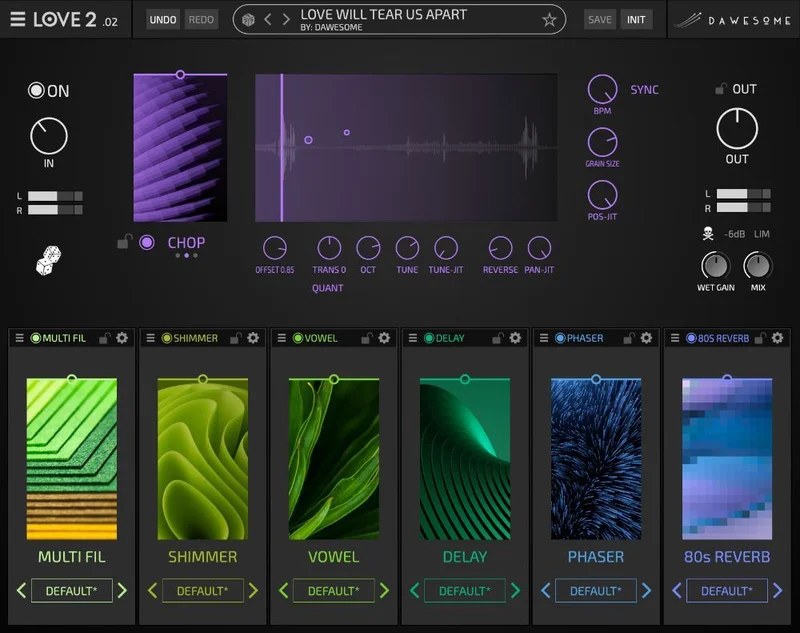
The granular engine runs in three modes. They're called Swarm, Chop, and Robot. Each one changes the fundamental character of how particles are generated from your incoming signal.
Swarm
Swarm generates smooth grain clouds. Think gentle pitch dispersal, overlapping particle tails, the kind of shimmer that sits behind a sustained pad or opens up a vocal without obviously processing it.
We ran a dry acoustic guitar loop through Swarm at a medium grain density and watched the attack transients blur into something that sounded like the guitar was recorded in a large room. It wasn't reverb. It was grain dispersion doing the heavy lifting. Satisfying in a way that's hard to explain until you hear it.
Chop
Chop slices your signal rhythmically. It breaks audio into timed segments and rearranges them. This is where LOVE 2 gets useful for creative sound design rather than subtle texture work.
We ran a synth pad through Chop synced to 1/8 notes. The result was a stuttered, moving texture that felt like the pad was breathing in time. Not robotic. Not a simple tremolo. Something in between that we kept in the arrangement.
Robot
Robot applies harmonic sequencing. It imposes pitch-based structure onto the granular output, which gives you tonal, almost melodic artifacts that work brilliantly on sustained notes and less well on percussive material.
We tried Robot on a snare bus. Annoying. The harmonic content sat wrong against the transient and made the snare sound like it was being processed by something confused. On a string pad, though? Brilliant. The harmonic sequencing added subtle movement that made the pad feel composed rather than static.
Know your mode. Wrong mode on the wrong source is the most common mistake reviewers report making on first load.
The Modular Effects Rack: From Six Fixed to Twenty Flexible
This is the biggest upgrade from LOVE 1. The original had six fixed effects slots. LOVE 2 opens those slots up to 20+ curated modules you can assign and rearrange by dragging.
The module list covers granular processing, modulation, filtering, delay, dynamics, distortion, and reverb. Every slot can hold any module. You drag to reorder. The signal flows top to bottom through whatever you've placed.
The word "curated" matters here. These aren't generic VST-style modules with every parameter exposed. Each one is tuned to complement the granular engine output. The reverb algorithms, for example, have been voiced to extend particle tails rather than wash them out. The distortion modules add harmonic content that sits with grain dispersion rather than fighting it.
Per-module sub-presets mean you can save a favourite setting for a specific module and recall it across different full presets. That's a workflow detail we love and don't see enough in multi-effect plugins.
The intelligent randomization is worth mentioning. You can lock specific modules from randomization while letting others change. This means you can find a granular engine setting you like, lock it, then randomize the effect chain below to find new colour combinations. Fast and genuinely useful, not just a gimmick.
Living With LOVE 2 Across a Real Session
Setup is fast. Install, activate, load. The 250+ factory presets are organized well enough that you can browse by character rather than alphabetically. We found three useful starting points in under ten minutes.
Daily use is where LOVE 2 earns its place. It's the plugin we started reaching for after a compressor and EQ, before committing to a reverb or delay send. Drop it on a sound, hit randomize with the granular engine locked, and find something in 30 seconds that would take ten minutes to build manually.
The drag-and-drop effect routing becomes natural quickly. We didn't have to think about it after the first session.
The advanced panel opens deeper parameter control on each module. Most of the time we didn't need it. That's good design.
One real annoyance: the 5ms latency introduced by the output limiter in LOVE 2. This is new and wasn't in LOVE 1. Users keep running into this when monitoring in real-time. For production work, bounced audio, or printed stems, it's invisible. For live monitoring during tracking, it's not acceptable. Know this before you buy.
CPU behaviour is another genuine gap. Tracktion doesn't publish system requirements or CPU benchmarks anywhere we could find. Stacking the granular engine with four or five heavy effect modules presumably costs something, but we can't give you a number. Light use felt fine on our test machine. Heavy, stacked presets felt heavier. That's as specific as we can be without published specs.
The Trade-Offs Worth Talking About
The depth of each granular mode is real. But that depth comes with a learning curve that can feel frustrating when you just want a quick result. Swarm is intuitive fast. Chop and Robot take more time to dial in correctly.
The fixed top-to-bottom signal flow is a creative constraint. For some sessions, that constraint is exactly what keeps you moving. For others, you'll wish you could route the delay before the granular engine, or sidechain one module from another. You can't. Accept it or don't buy it.
The module count is 20+, which is genuinely enough variety. But a few gaps exist. There's no obvious mid-side processing module, no dedicated pitch correction, and the dynamics modules are creative rather than clinical. If your use case needs precise control, these gaps matter.
The upgrade from LOVE 1 to LOVE 2 is handled reasonably. Existing presets import directly. The workflow changes are substantial enough that you'll need a session to relearn the rack section, but users report the transition feeling worthwhile, not jarring.
The value question is real at $69. For what LOVE 2 does within its lane, it earns the price. Outside that lane, it earns nothing.
Against the Field: What Else You Should Consider
The honest comparison is hard because LOVE 2 sits in an odd spot. It's not competing with granular tools like Stutter Edit 2 review on rhythmic power. It's not competing with iZotope Iris on spectral depth. It's competing on speed-to-interesting-texture, and there it wins.
Native Instruments' granular options within Komplete offer more control and more complexity. They take longer to learn and longer to dial in. If you want precision granular synthesis rather than musical texture processing, that's the direction to go.
For best multi-effect plugins, something like Soundtoys Effect Rack gives you more routing freedom and more studio-workhorse processing. It's a better call if bread-and-butter effects are your primary need. LOVE 2 is not a bread-and-butter tool.
Portal by Output covers similar shimmer-and-texture territory and is worth comparing directly. Portal leans more dramatic by default. LOVE 2 feels more controlled and musical at similar settings. Portal vs LOVE 2 comparison would be its own article, but our short take: Portal for cinematic drama, LOVE 2 for detailed texture work that sits in a mix.
For granular plugins for producers, LOVE 2 sits near the top of the accessible tier.
The Real Verdict
Buy LOVE 2 if you spend sessions trying to make sounds feel alive. It's one of the fastest routes from a dry signal to something dimensional that we've had in the plugin folder. The three granular modes cover enough character range, the modular rack is genuinely flexible, and the randomization workflow is the best time-to-result tool in the plugin.
Skip it if you need a real-time monitoring chain (that 5ms latency will irritate you daily), if you want surgical multi-effect processing, or if your sessions don't involve texture and atmosphere at all. It's a specific tool. It's brilliant at what it does. It won't pretend to do anything else.
The upgrade path from LOVE 1 is clean enough that existing users should treat it as an easy decision.
Specs & Technical Details
| Developer | Tracktion / Dawesome |
| Price | $69 |
| Plugin Format | VST3 / AU / AAX |
| OS Support | Mac / Windows |
| Activation | N/A (not publicly specified) |
| CPU Usage | Not published; moderate to heavy under stacked modules |
| Trial Available | N/A |
| Version Reviewed | LOVE 2 (2025/2026 release) |
Score Breakdown
| Category | Score | Notes |
|---|---|---|
| Sound Quality | 4.5/5 | Three granular modes deliver genuinely musical, mix-ready texture across diverse sources |
| Value for Money | 4.0/5 | Strong within its lane; less compelling if you only need it occasionally |
| Ease of Use | 4.0/5 | Swarm is instant; Chop and Robot take real time to learn correctly |
| Features | 4.0/5 | 20+ modules and per-module sub-presets are genuinely useful; no mid-side processing is a gap |
| CPU Efficiency | 3.5/5 | No published benchmarks; stacked heavy presets feel costly in testing |
| Overall | 4.2/5 | A focused, musically intelligent texture tool that earns its place in the right workflow |
Alternatives to Consider
Soundtoys Effect Rack is the call if you need a workhorse multi-effect with flexible routing and reliable studio processing. Soundtoys Effect Rack review More routing freedom. Less texture character.
Portal by Output covers similar shimmer territory with a more cinematic default voice. If you want drama over detail, Portal wins.
Native Instruments Komplete granular tools (including Granular Clouds and the modular options) offer deeper synthesis control for producers who want to build rather than find. More ceiling, steeper climb.
LOVE 2 sits between all three. Faster than Komplete to a musical result. More controlled than Portal. More focused than Soundtoys. That middle ground is exactly where it belongs.
If you're building textures in almost every session, LOVE 2 at $69 is worth it. If you're reaching for it once a month, it isn't. That's the honest line.
Frequently Asked Questions
What is the difference between LOVE 1 and LOVE 2?
LOVE 2 replaces the six fixed effects slots from the original with 20+ freely assignable drag-and-drop modules. The granular engine carries over with the same three modes but the modular rack is substantially more flexible. Existing LOVE 1 presets import directly into LOVE 2, so your previous work doesn't disappear.
Does LOVE 2 introduce any latency?
Yes. LOVE 2 introduced a 5ms latency from its output limiter, which was not present in LOVE 1. For bounce-and-print workflows this is invisible. For real-time monitoring during tracking it's noticeable and annoying. Factor this in before using it in a live monitoring chain.
What granular modes does LOVE 2 have?
Three: Swarm, Chop, and Robot. Swarm creates smooth grain clouds. Chop slices audio rhythmically. Robot applies harmonic sequencing to granular output. Each suits different source material and each has a distinct character that takes time to learn correctly.
Can I use LOVE 2 on guitars and live instruments, not just synths?
Yes, and it works well. Reviewers and the plugin's own marketing highlight guitars and vocals alongside synths as primary use cases. The granular engine responds to any incoming audio signal. Live instruments with dynamic transients can behave unpredictably in Robot mode, so Swarm is the safer starting point for live source material.
How does the intelligent randomization work in LOVE 2?
The randomization generates new parameter and module combinations across the effects rack. The key feature is module locking: you can lock individual modules from being randomized, so if you've found a granular engine setting you like, you lock it and randomize only the effect chain below. This makes discovery fast without losing your starting point.