The honest question about S-Quick Strip isn't "is it good?" It's "is a $34.99 channel strip actually usable on a professional mix, or is it a toy?" After running it on drums, vocals, and a few busses, our answer is: it's usable, and on drums specifically it's more than that.
Kiive Audio built this as a Neve-flavored channel strip designed for speed. The whole pitch is fewer decisions, faster results. Drop it on a snare, dial the saturation, nudge the one-knob compressor, done in 20 seconds.
That pitch mostly holds up. With one real caveat that we'll get to.
S-Quick Strip runs VST3, AU, and AAX. It's built for Mac and Windows. At $34.99, it's aimed squarely at producers who want console character without paying SSL prices. best channel strip plugins under a certain price
Does It Actually Deliver Neve Character?
Kiive Audio has a track record of punching above their price point. Their Warmy EP1A and Masterdesk Classic both earned real respect in the plugin community. S-Quick Strip follows the same logic: take one workflow, simplify it aggressively, price it where people will actually buy it.
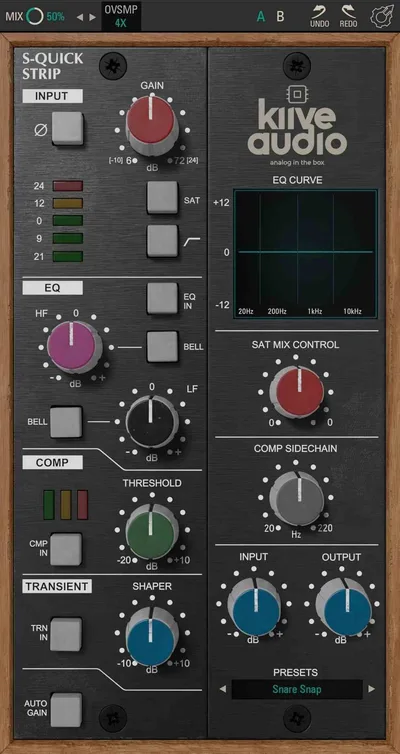
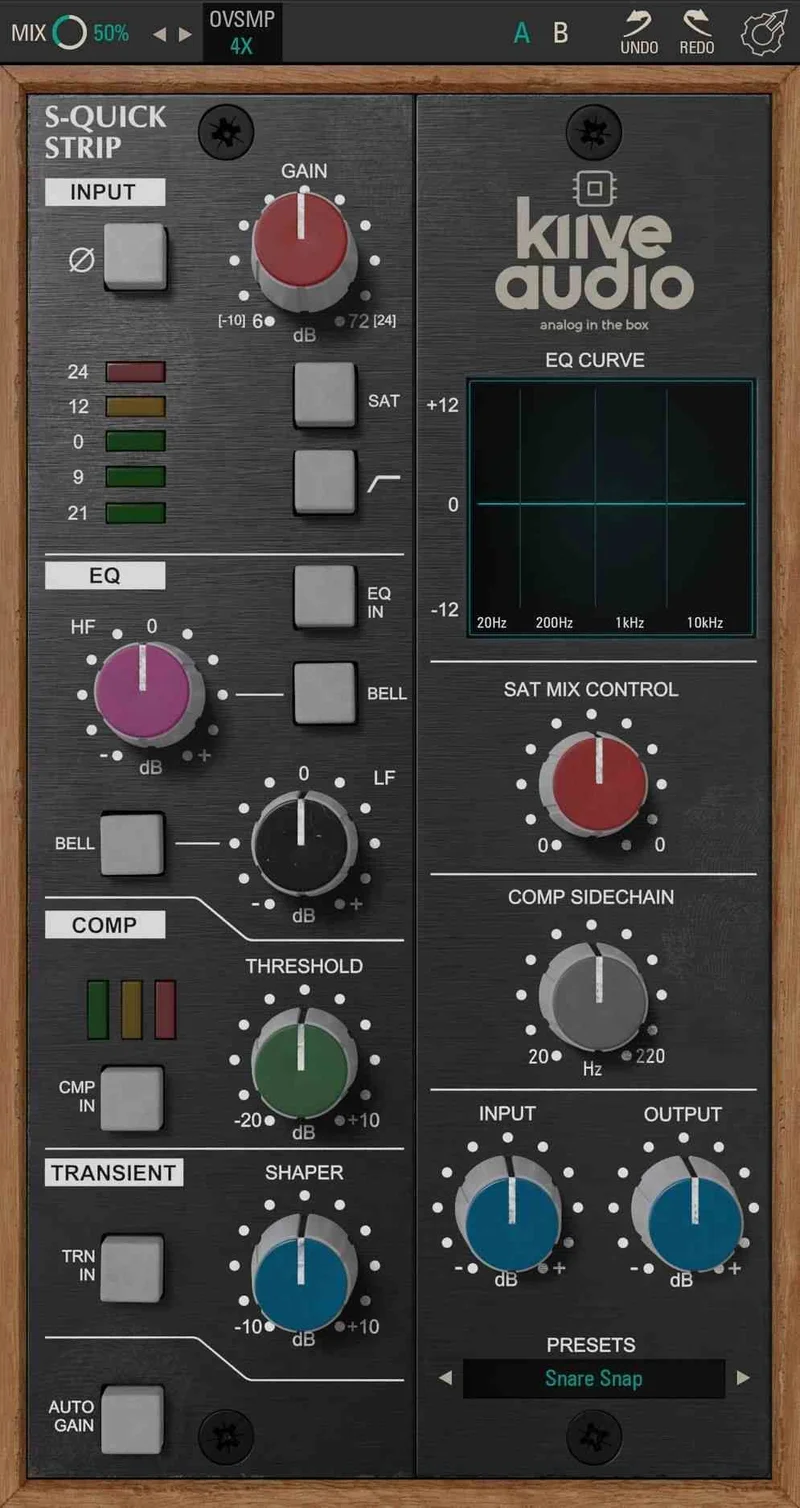
The signal chain runs polarity flip, two saturation circuits, a highpass filter at 75Hz, two-band EQ, a one-knob compressor with auto makeup gain, a transient designer, and sidechain controls. That's a complete channel strip. Nothing is missing.
The Neve emulation doesn't hit like a pricier Waves or UAD plugin. We're not going to pretend it does. But it adds harmonic content in a way that sounds like iron, not plastic. Drive it into the saturation and you hear the second and third harmonics thickening up in the low-mids, roughly 200-400Hz. That's the Neve thing. It's here.
The presets from producers Sam Guiana and Jesse Ray Ernster are genuinely helpful. Not throwaway factory presets. Actual starting points that show you how the tool is meant to be used.
Where S-Quick Strip Shines
Drums. Full stop. This is where we'd reach for it first and reach for it again.
We dropped S-Quick Strip on a snare bus with a sample-heavy hip-hop session. The highpass at 75Hz cleaned up the low-end rumble immediately. We pushed the high shelf at 8kHz about 2.5dB, hit the saturation circuit on circuit two, and bumped the transient designer to add about 15% more attack. The snare went from swimming in reverb wash to sitting hard on the grid. That took under 30 seconds.
The one-knob compressor is satisfying in a way that more complex compressors often aren't. You turn it clockwise, the compressor kicks in, the auto makeup gain compensates, and you A/B by bypassing. It's not surgical. It's not meant to be. It glues without strangling.
We also ran it on a male vocal. Set the low bell at 200Hz to cut about 1.5dB to clean up chest buildup, added 1dB at 2kHz for presence, and let the compressor handle the dynamics. The vocal sat in the mix without needing a second compressor on the bus. Clever design, executed well.
The two saturation circuits give you real choice. Circuit one is cleaner and adds air. Circuit two is dirtier and adds weight. Different tools for different sources. how saturation affects your mix
Where It Falls Short
The dropout bug is real and it's annoying. During playback, S-Quick Strip occasionally stops processing audio completely. No warning, no crash. The plugin just goes silent in the signal chain. The fix is to bypass it and unbypass it. That resets the processing and audio returns.
This is not a dealbreaker for most sessions, but it's a dealbreaker for live situations. Do not use this on a live input monitor chain or in any setup where you can't catch and fix a silent plugin.
We couldn't find any documented CPU usage or latency specifications from Kiive. That's frustrating when you're trying to decide how many instances you can run. We tested roughly 12 instances on a MacBook Pro M2 before we heard any strain, which suggests it's light. But "we guessed from a test" isn't the same as a spec sheet.
The sidechain functionality is listed in the feature set and then essentially disappears from any real conversation about the plugin. We tested it on a kick/bass relationship and it worked, but the controls are minimal. Don't buy this for advanced sidechain work.
How It Stacks Up Against the Competition
The closest real comparison at a higher price is the SSL Native Channel Strip 2. The SSL gives you more precise EQ control, a better-documented compressor with attack and release controls, and zero dropout issue s. If you need precision, pay more for the SSL.
Eventide UltraChannel costs more and is a different beast entirely. Five compressor modes, pitch correction, harmonics control. It's overkill for the "quick fix" use case but worth every dollar if you're building complex vocal chains.
At this price range, nothing else we've tested gives you a full channel strip with Neve-flavored saturation, a transient designer, and curated presets. Harrison Vocal Flow comes close for vocals specifically, but it's narrower in scope. SSL Native Channel Strip 2 review
S-Quick Strip wins on price and speed. It loses on reliability and depth. That's the honest trade.
Is $34.99 a Fair Price?
Yes. Bluntly, yes.
A channel strip with two saturation circuits, a transient designer, and a working one-knob compressor at $34.99 is genuinely hard to find. We'd buy this ourselves at that price. The dropout bug knocks value down, but it doesn't wipe it out because the bug is annoying, not catastrophic.
At the introductory price it was a no-brainer. At $34.99 it's still a reasonable call. Watch for sales. Kiive Audio regularly runs promotions that bring it down considerably.
Score Breakdown
| Category | Score | Notes |
|---|---|---|
| Sound Quality | 4.0/5 | Neve character is real; saturation adds the right harmonics for the price |
| Value for Money | 4.5/5 | Full channel strip at $34.99 with pro presets is hard to beat. |
| Ease of Use | 4.0/5 | One-knob compressor and clear layout make this fast to dial in |
| Features | 3.5/5 | Solid feature set but sidechain controls are underdeveloped |
| CPU Efficiency | 3.5/5 | Appears light but no official spec; dropout bug docks a point |
| Overall | 3.8/5 | Strong tool held back by an unfixed reliability bug |
Alternatives to Consider
SSL Native Channel Strip 2: More precise EQ, documented specs, no dropout issues. Worth the extra spend if reliability matters more than price. SSL Native Channel Strip 2 review
Eventide UltraChannel: Five compressor modes, pitch control, deeper routing. Overkill for quick sessions but excellent for complex vocal production. best channel strip plugins for vocals
Harrison Vocal Flow (check manufacturer's site for pricing): Narrower scope than S-Quick Strip but more focused on vocal-specific processing. A better call if drums aren't in your workflow. Harrison Vocal Flow review
If the dropout bug gets fixed in a future update, S-Quick Strip becomes an easy recommendation for almost everyone at this price. Right now, it's a confident recommendation for producers whose workflow can tolerate the occasional reset.
Buy it for drums. Love it for the one-knob compressor. Keep the bypass key close.
Frequently Asked Questions
What is S-Quick Strip and what does it do?
S-Quick Strip is a channel strip plugin by Kiive Audio that emulates a Neve-style console signal chain. It combines a polarity flip, two saturation circuits, a 75Hz highpass filter, two-band EQ, a one-knob compressor with auto makeup gain, a transient designer, and sidechain controls in a single interface. It's built for fast mixing rather than deep editing sessions.
Does S-Quick Strip have a known bug?
Yes. S-Quick Strip has a documented audio dropout issue where the plugin stops processing audio mid-session without crashing. The current workaround is to bypass and unbypass the plugin, which resets processing and restores audio. As of 2026, there's no confirmed fix from Kiive Audio. We wouldn't use it in any live or real-time monitoring context because of this.
What formats does S-Quick Strip support?
S-Quick Strip supports VST3, Audio Units (AU), and AAX. That covers all major DAWs including Ableton Live, Logic Pro, Pro Tools, FL Studio, and Studio One. Check Kiive Audio's site for the latest system requirements before buying.
How does S-Quick Strip compare to more expensive channel strips?
At $34.99, S-Quick Strip is significantly cheaper than SSL Native Channel Strip 2 or Eventide UltraChannel. The SSL wins on precision and reliability. The Eventide wins on depth. S-Quick Strip wins on speed and price, especially for drum processing where its Neve saturation and transient designer do real work fast.