The honest question about RETROCRAFT isn't whether it sounds good. It's whether a plugin that does amplifiers, cassette, vinyl, megaphone, glitch, reverb, delay, modulation, and chop all at once actually does any of them well enough to matter. It does. At $39, UJAM has built a multi-effect that earns its place on instrument and vocal tracks by being fast, flexible, and genuinely fun to dial in.
Quick verdict: RETROCRAFT sits at 4.2 out of 5. It's a clever creative tool for producers who want vintage texture and lo-fi character without assembling a stack of dedicated emulations. At $39, the value is real. The two honest caveats: the consolidated interface will frustrate engineers who like to isolate what each processor is doing, and you should keep it off your master bus.
Does It Actually Deliver?
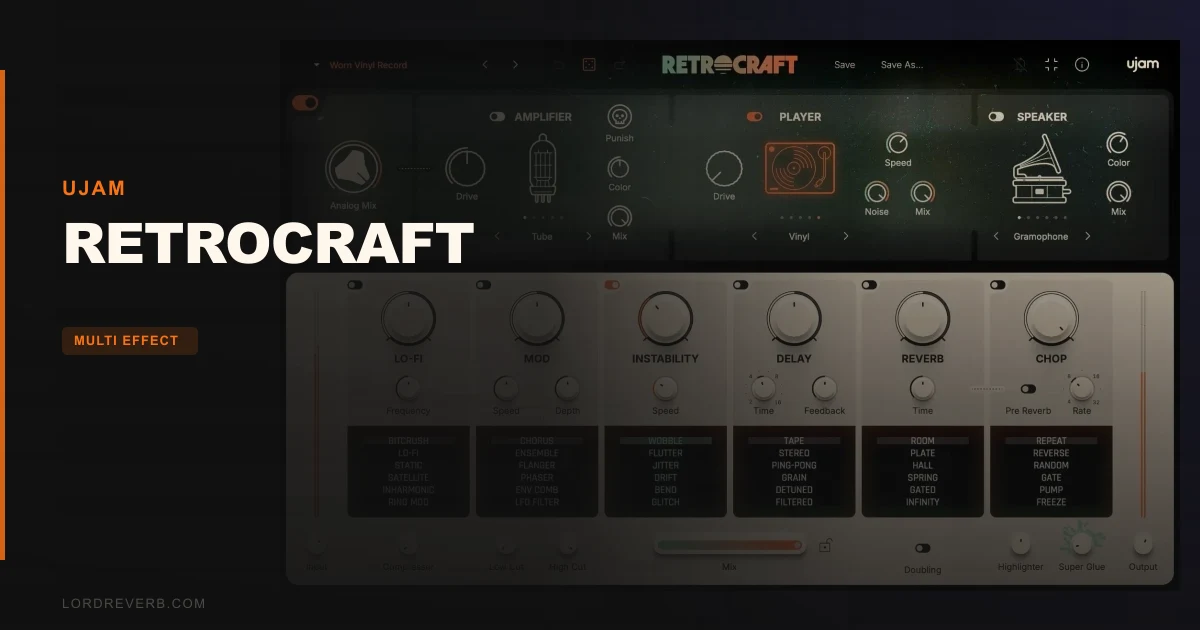
RETROCRAFT is UJAM's attempt to collapse a lot of separate hardware nostalgia into one plugin. Amplifier emulation covers tube and transistor. Player emulation handles cassette and vinyl. Speaker emulation includes megaphone and telephone. Then six FX modules layer on top: Lo-Fi, Modulation, Instability, Delay, Reverb, and Chop. That's 62 algorithms total and 150 presets sorted into categories like Aging, Vocals, Retro Gear, and Glitchy.
What UJAM promises is that each stage adds drive, noise, and character in a way that feels cumulative and intentional. Owners confirm it delivers on that. The plugin earns its vintage-vibe reputation without being fussy about which sources it works on. Vocals, drums, synths, guitars: the architecture is built to be instrument-agnostic.
What it doesn't promise is surgical accuracy. This is a workflow tool, not an emulation tool. If you want to match the exact frequency response of a 1963 Ampex 350, look elsewhere. If you want your synth pad to feel like it came off a warped cassette in someone's glove box, RETROCRAFT can get you there quickly.
Where It Shines
Drop it on a dry vocal loop. Activate the Instability module and ease in the melancholic vibrato. The pitch starts to breathe unevenly in a way that sounds organic rather than mechanical. Push the Lo-Fi module and add some digital crunch. What you had is now aged by about a decade.
The Surprise Dice randomizer is smarter than it sounds. Owners report it surfaces combinations they'd never reach through deliberate patching, and experienced engineers find it genuinely useful as a learning tool. It won't hand you a finished preset every time. You'll usually need a wet/dry adjustment or one module dialed back. But the starting points it generates are worth the cleanup time.
The Chop module's six glitch variants are where RETROCRAFT gets interesting for electronic production. Run a sustained string pad through the rhythmic chop effects and you've got movement without automation. The fact that all this processes at 1.5ms latency means you can use it on a live vocal without watching your singer flinch at the monitoring delay.
Where It Falls Short
Here's the real problem. When you stack the Amplifier emulation, the Lo-Fi module, and the Reverb simultaneously, something might not be sitting right in your mix. Good luck knowing which module to touch first.
The consolidated design is the tradeoff for that convenience. Owners acknowledge it directly: cause-and-effect relationships get murky when multiple processors run at once. That's not a dealbreaker for quick sound design. It's annoying if you're trying to surgically correct a specific sonic issue mid-session.
Keep it off the master bus. This is non-negotiable. Full-mix processing through RETROCRAFT softens transients and can destabilize stereo imaging. That's a known limitation, confirmed by owners. It's built for individual tracks and buses, not the two-bus. Mastering engineers should skip it entirely for that stage of the chain.
The granular control ceiling is also real. Dedicated single-purpose emulations will always give you more parameter access than a multi-effect designed for speed. If you need to fine-tune a specific harmonic characteristic down to a narrow frequency range, RETROCRAFT probably won't satisfy you.
How It Stacks Up
RC-20 Retro Color from XLN Audio is the most direct comparison. It goes deeper on lo-fi and vintage coloration within a narrower scope. If your sessions are almost entirely about adding vintage texture and nothing else, RC-20 might serve you better in that one lane.
Aberrant DSP SketchCassette II owns the cassette-specific sound. It doesn't pretend to be anything broader than that, and within cassette processing it goes further than RETROCRAFT's Player module.
What RETROCRAFT trades for depth in those narrower categories is breadth. The glitch and chop capabilities alone go places RC-20 can't. The modulation suite adds Chorus, Flanger, and Phaser that neither cassette-specific tool even attempts. If your sessions pull you in multiple textural directions, RETROCRAFT covers more ground per dollar.
Is the Price Fair?
At $39, this is not a complicated value judgment. Six effect module types, 62 algorithms, 150 presets, and 1.5ms latency for the price of two takeout dinners. The consolidated design is a philosophical choice, not a budget compromise. You'd pay more than this for a single dedicated emulation that covers half the sonic territory.
If you work in pop, hip-hop, or any genre where lo-fi texture is a regular creative move, $39 is a satisfying spend.
Specs & Technical Details
| Developer | UJAM |
| Price | $39 |
| Plugin Format | VST3 / AU / AAX |
| OS Support | Windows 10–11 / macOS Big Sur–Tahoe (Intel & Apple Silicon) |
| Activation | N/A |
| CPU Usage | N/A |
| Trial Available | N/A |
| Version Reviewed | N/A |
Score Breakdown
| Category | Score | Notes |
|---|---|---|
| Sound Quality | 4.5/5 | Owners confirm genuine vintage character from tube, cassette, and vinyl emulations |
| Value for Money | 4.5/5 | 62 algorithms and 150 presets at this price is hard to argue with |
| Ease of Use | 4.0/5 | Fast to dial in; troubleshooting multi-module issues takes patience |
| Features | 4.0/5 | Broad coverage across categories; granular control per module is limited |
| CPU Efficiency | N/A | Not verifiable from available data |
| Overall | 4.2/5 | A strong creative tool for texture and character work at a fair price |
Alternatives to Consider
XLN Audio RC-20 Retro Color is worth looking at if vintage coloration is your primary focus and you want more depth in that one lane. Its scope is narrower, but it goes further within lo-fi and analog degradation territory.
Aberrant DSP SketchCassette II is the pick if cassette is your specific obsession. It doesn't attempt anything beyond cassette processing, which is exactly its strength.
Cableguys ShaperBox handles precision modulation and rhythmic control better than RETROCRAFT's Chop module if that's your priority. The learning curve is steeper, though, and it won't give you the amp and tape coloration.
None of these cover the same combined ground at the same price. If you need one plugin to handle multiple texture types across a session, RETROCRAFT wins the breadth argument cleanly.
The buy recommendation is clear: if you produce anything where lo-fi texture, vintage warmth, or rhythmic glitch effects are recurring moves in your signal chain, RETROCRAFT at $39 is a satisfying and low-risk addition to your toolkit. Skip it if you're the kind of engineer who needs to know exactly which processor is doing what at every moment, or if you thought you'd use it on the master bus. It's not built for either of those situations, and it won't pretend to be.
Frequently Asked Questions
Can RETROCRAFT be used on a full mix or master bus?
Owners and reviewers report that full-mix processing through RETROCRAFT causes softened transients and imaging instability. It's built for individual tracks and instrument or vocal buses. Keep it off the master bus and your two-bus chain, especially in a mastering context.
How does the Surprise Dice randomizer work?
The randomizer generates new preset combinations across the plugin's modules on the fly. RETROCRAFT also includes an undo function, so you can step back if a randomized result is unusable. Owners note that results often need some manual tweaking before they're session-ready, but the combinations it surfaces can push your sound design in directions you wouldn't reach deliberately.
Is RETROCRAFT good for vocal processing?
Yes. The 1.5ms latency keeps it viable on live vocal tracks without noticeable monitoring delay. The Instability module's vibrato effects, the Lo-Fi module's crunch and ring modulation, and the Speaker emulations including telephone and megaphone all work directly on vocals.