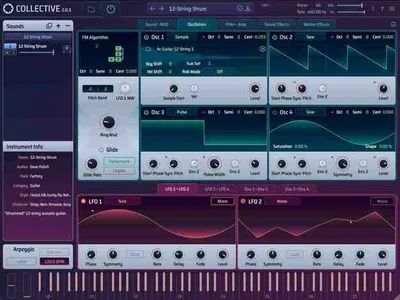
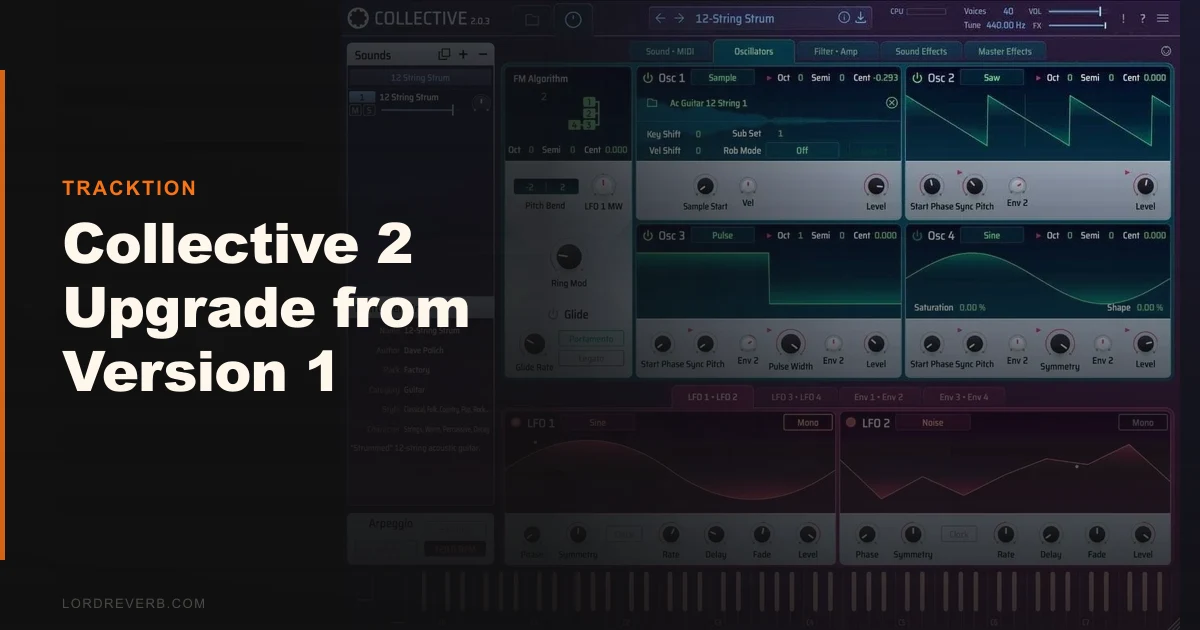
The upgrade from Collective 1 to Collective 2 is one of the best-value moves a Tracktion user can make right now. We sat down with V2 for a full week of sessions and came away with a clear picture: it's not a rebuilt synth, it's a rebuilt experience, and for existing owners that distinction is almost entirely good news.
We loaded it on a Thursday afternoon, skipped the manual, and started scrolling presets. That was the first surprise. The old V1 browser felt like navigating a filing cabinet someone knocked over. V2's new navigation snapped us straight to the 100 new instruments from sound designer Miclop, and within fifteen minutes we'd found a lead that sat in a mix without fighting the upper mids.
That's what V2 does well: it gets you to usable sounds faster. If you own V1 and have not upgraded yet, you are leaving a lot of quality-of-life on the table for very little money.
What Collective 2 Actually Is (And Where It Stops)
Collective 2 is a multi-engine synth plugin from Tracktion, combining sample playback, wavetable, and subtractive synthesis under one interface. V2 isn't a new synth. The core engine hasn't been rebuilt from the ground up.
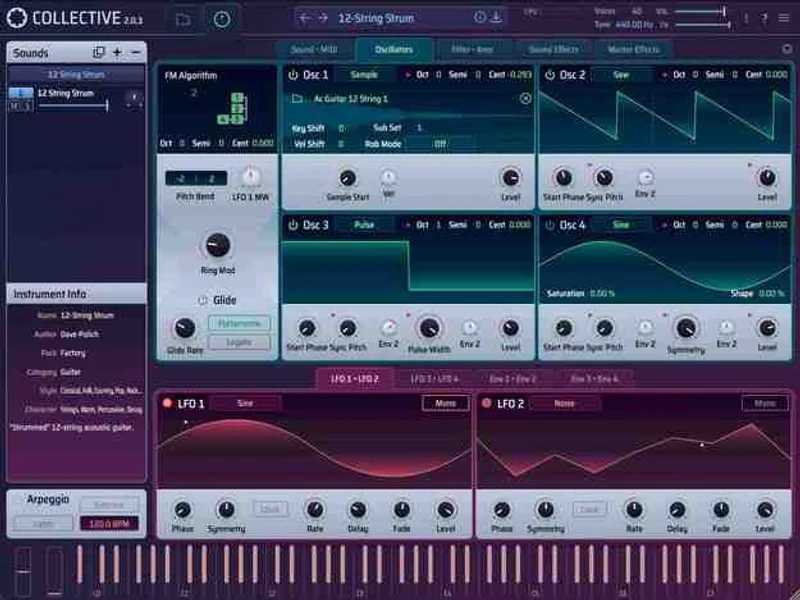
What's changed is everything around that engine: a modernised UI, a new Master FX panel, right-click MIDI Learn on every parameter, and a dramatically expanded preset library. The bundled expansions, Beta Maxed, Son of a Beta Maxed, and Platforms, add 256 presets. Combined with Miclop's 100 new instruments and the existing library, total preset count hits 928.
What it's not good for: if you want deep modulation routing on par with something like Serum or Vital, you won't find it here. This is a preset-forward instrument. Patch creation from scratch is possible but clunky. It's built for producers who browse and tweak, not those who architect sounds from a blank oscillator page.
New buyers evaluating it against other synths at full price should read our synth plugin types guide before committing. For V1 owners? Different conversation entirely.
Living With Collective 2 Through a Full Week of Sessions
Day one was mostly joy. The new preset browser is genuinely satisfying to use. We filtered by category, found a plucked electric sound in the Platforms expansion, dropped it at 95 BPM over a sparse drum groove, and it locked in without touching the EQ. The transient was already shaped right. That doesn't always happen with preset synths.
Day two hit a frustrating wall. We'd bought the upgrade, installed it, and couldn't locate the Beta Maxed and Son of a Beta Maxed banks. They weren't showing up. The interface gave no error, no indication they were missing, nothing. We eventually found the fix in a forum thread: the expansion content sometimes requires a manual re-point of the content folder location in Tracktion's settings. It worked once we knew that. But there's no in-app guidance. That's annoying and avoidable, and Tracktion should fix it.
Day three onward was smoother. The Master FX panel is a real workflow win. Having a quick-access chain of EQ, compression, and reverb at the instrument level means you can dial in a sound without leaving the plugin or opening your DAW's send bus. Right-click MIDI Learn works exactly as advertised. We mapped the filter cutoff to a mod wheel in about four seconds.
CPU behaviour is light to moderate. We ran eight instances on a mid-spec session without issues. That's respectable for a multi-engine instrument.
The Trade-Offs You Should Know Before Upgrading
The value case for V1 owners is almost unarguable. Ten dollars for 928 presets curated partly by Klaus Peter Rausch, who spent three decades designing sounds for Korg, Alesis, Clavia, and Yamaha, is not something you pass on. The quality shows. These aren't filler sounds padded to inflate a number. The Miclop instruments in particular have a consistency of character.
But the trade-off is honesty about what V2 isn't. The synthesis engine hasn't evolved enough to change how you'd describe Collective as a product category. It's still a preset instrument with light editing, not a deep synthesis environment. If V1 felt limiting in that way, V2 won't change your mind.
The content delivery issue is a genuine gap. An upgrade where the new content silently fails to appear, with zero in-app feedback, is a support problem. Not a dealbreaker for a patient user, but worth knowing before you download and expect instant results.
We also wish the modulation matrix had been opened up. Remapping LFO targets or building even a basic mod envelope chain is more restricted than what you'd expect in 2026. That's the one area where V2 feels like it left something on the table.
Against the Field: Where Collective 2 Wins and Loses
For V1 owners, Collective 2's only real competition is doing nothing. That comparison, it wins easily.
Against new purchases at full price, the field gets tougher. SynthMaster One offers deeper modulation routing and a stronger wavetable engine if you want to build sounds from scratch. Collective 2 wins on ease of use and out-of-the-box preset quality.
Zero 1 by Loot Audio is worth a look if you want a preset-forward synth with a more polished sound design pedigree in its library. Similar philosophy, different flavour. Collective 2 beats it on preset volume and the backing of Rausch's curation.
Vital Free is the obvious free-tier comparison. It's a deeper synthesis environment but ships with fewer usable ready-to-play sounds. Collective 2 wins on "open it and get a good noise fast."
The Real Verdict on the Collective 2 Upgrade
If you own Collective 1: buy the upgrade. Right now. Ten dollars for 928 well-curated presets, a cleaner UI, Master FX, and MIDI Learn is not a hard decision. We'd buy it ourselves.
If you are a new buyer evaluating at full price, it is decent but not our first recommendation. At that price, we'd point you toward SynthMaster One for synthesis depth, or wait for Collective 2 to go on sale.
The missing sound bank installation issue is the one thing that stops this from being a perfect low-risk recommendation. Know it's coming and you'll handle it fine.
For V1 owners, the upgrade pays for itself the first time you find a usable sound in under a minute. That happened to us on day one. It'll happen to you too.
Score Breakdown
| Category | Score | Notes |
|---|---|---|
| Sound Quality | 4.0/5 | Rausch-curated presets hold up well; Miclop instruments are consistent and usable straight away |
| Value for Money | 5.0/5 | Upgrade with 928 presets and workflow improvements; hard to argue with. |
| Ease of Use | 4.0/5 | New browser and Master FX panel are genuine improvements; silent content delivery failure is a frustrating exception |
| Features | 3.5/5 | MIDI Learn and Master FX are smart additions; modulation routing still feels limited for a 2026 release |
| CPU Efficiency | 4.0/5 | Eight instances on a mid-spec session ran without issues |
| Overall | 4.1/5 | Outstanding value upgrade for V1 owners; less compelling as a first-time full-price purchase. |
Alternatives to Consider
SynthMaster One (KV331 Audio): Our choice if you want deeper synthesis control and a capable wavetable engine. Read our full SynthMaster One review for the breakdown. It's harder to learn but rewards the time invested.
Zero 1 (Loot Audio): A preset-forward instrument with a different sonic character. Check out our Zero 1 review to see how the libraries compare. Worth considering if Collective's sound palette doesn't click with your genre.
Vital (Matt Tytel): Free tier is genuinely brilliant for synthesis depth. No curated preset library to match Collective's volume, but the modulation routing is far more open. If you want to build sounds rather than browse them, start there.
Still deciding which type of synth fits your workflow? Our synth plugins guide maps out all five core categories before you spend anything.
The upgrade for V1 owners is a no-brainer. Just know the content folder issue is real, keep a forum tab open when you install, and you'll be fine. New buyers at full price should think twice, then wait for a sale. At the intro price, it was an easy yes. At full price, you have better options.
Frequently Asked Questions
Is the Collective 2 upgrade worth it if I rarely used Collective 1?
Yes, and that's partly the point. If V1 felt thin on sounds or slow to navigate, V2 fixes both. The new preset browser and Rausch-curated library are strong enough to make Collective feel like a different instrument. Ten dollars is low enough risk that even light V1 users should take it.
Why aren't my Beta Maxed and Son of a Beta Maxed banks showing up after the upgrade?
This is a known installation issue where expansion content doesn't auto-populate. Go into Tracktion's settings and manually re-point the content folder to where the expansion files were installed. It's a one-time fix that takes about two minutes once you know where to look. Tracktion hasn't yet added in-app guidance for this, which is frustrating.
How does Collective 2 compare to free synths like Vital or Surge XT?
Vital and Surge XT both offer deeper synthesis engines at zero cost. Collective 2's advantage is its curated, ready-to-play preset library and simpler interface. If you want to design sounds from scratch, go free. If you want 928 well-organised presets that work quickly in a session, Collective 2 earns its price.
What formats does Collective 2 support, and does it run on Apple Silicon?
Collective 2 runs as VST3, AU, and AAX across Mac and Windows. Check Tracktion's site for confirmed Apple Silicon native support status, as this can change with point releases. We'd verify compatibility with your specific OS version before purchasing if you're on a newer M-series Mac.