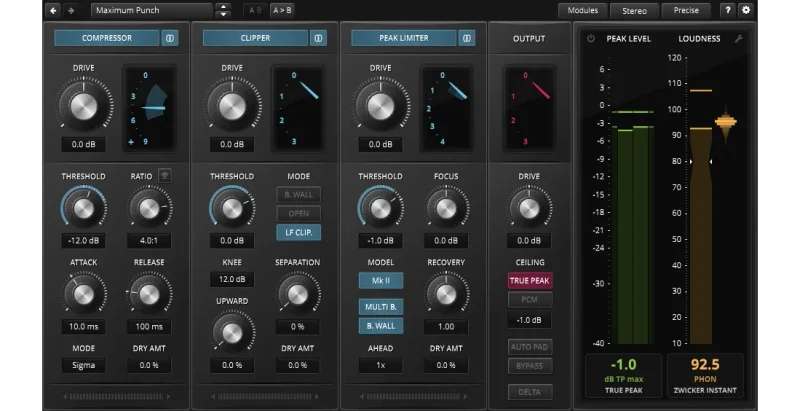
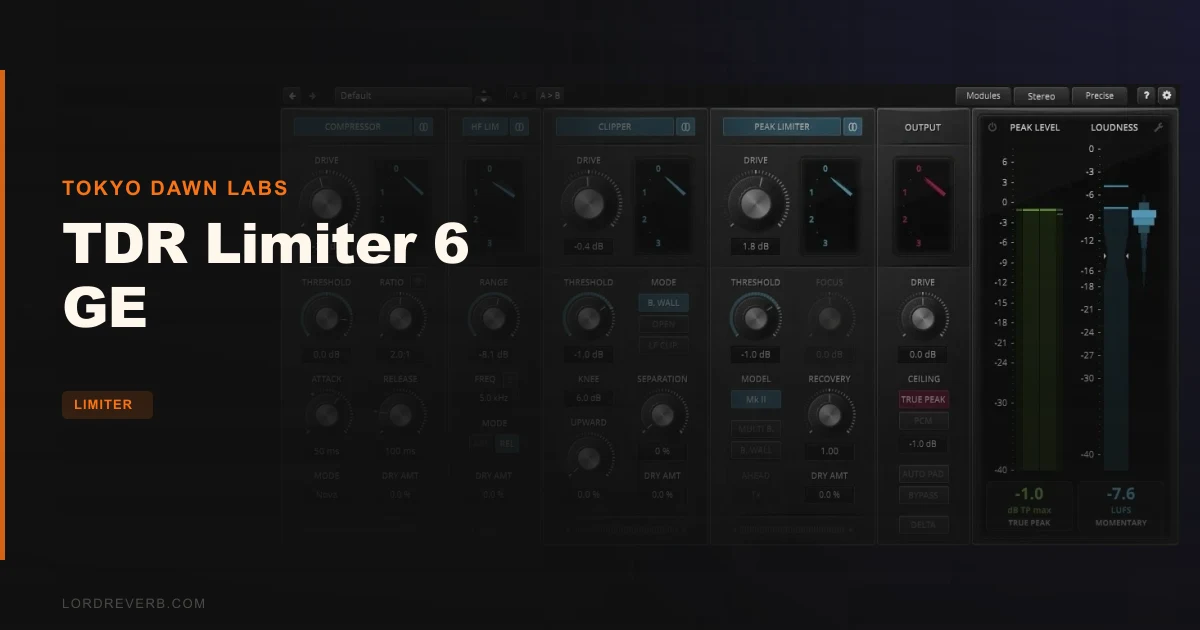
You've bounced your master, it's loud enough on paper, and then you A/B it against a commercial release and something just doesn't hold together. The limiter you used either squeezed the life out of the transients or left true peak overshoots you didn't catch until the streaming platform flagged them. That's the problem TDR Limiter 6 GE exists to solve. It is a modular mastering limiter from Tokyo Dawn Labs that covers every stage of the limiting and metering chain and competes directly with plugins that cost many times as much. It's built for mix engineers ready to work, not for producers who want a single magic knob.
What Problem Does This Actually Solve?
Most limiters make you choose: easy and fast, or precise and flexible. The cheap ones let you slam a ceiling on and call it done. The expensive professional ones give you proper metering, multi-stage processing, and M/S control, but they cost far more.
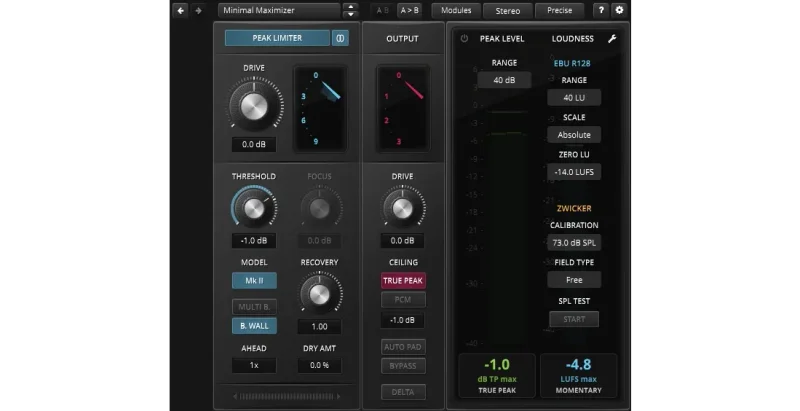
The original free Limiter No. 6 from Tokyo Dawn Labs proved the concept. The GE (Grand Edition) is the paid upgrade that adds the Wide stereo/M/S processing mode per module, the advanced Zwicker Loudness meter, EBU-compliant True Peak metering, and the newer Peak Limiter algorithm introduced in version 2.0.0.
That combination fills a real gap. You get broadcast-ready metering and a modular chain for $60. That's not a sale price. That's the price.
How It Performs in Practice
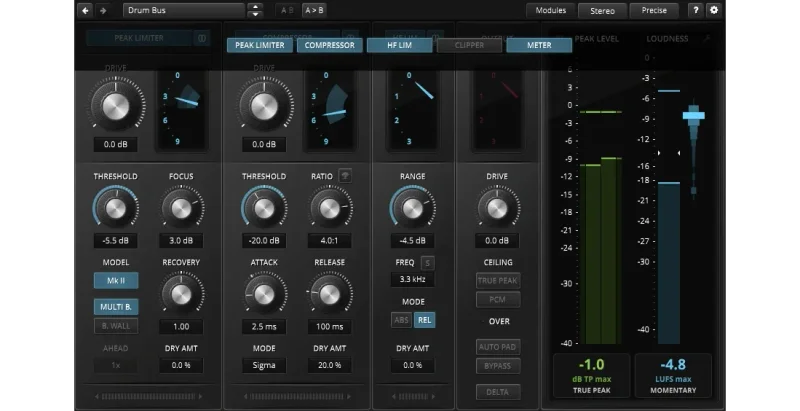
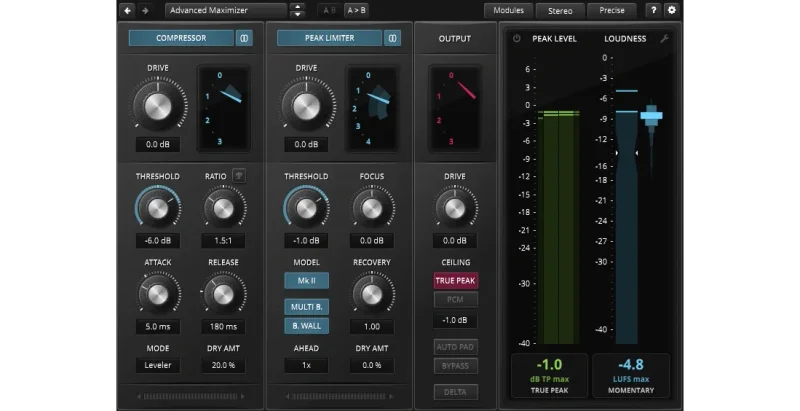
The signal chain has four dynamics modules: a Compressor, a High-Frequency Limiter, a Clipper, and a Peak Limiter. Add the Output module and metering section, and you've got a complete mastering chain in one plugin. The modules are reorderable, which matters more than it sounds.
We put a dense electronic mix through it, peak-heavy in the 5-8kHz range with a kick that was hitting harder than everything else. We pulled the High-Frequency Limiter in front of the Peak Limiter, dialled the HF threshold to catch the air frequencies before the final brick wall saw them, and the top end stopped pumping without losing presence. That kind of surgical routing isn't possible in most single-stage limiters at this price.
In Low Latency mode, the plugin runs at 0.27 milliseconds of latency. That's low enough to use on individual tracks during mixing, not just on the master bus. We ran it on a vocal bus to catch occasional peaks, and the session stayed locked. No PDC nightmares.
The Zwicker Loudness meter was the detail we didn't expect to love. It models perceived loudness rather than just integrated LUFS, which means you hear what a listener hears, not just what your DAW measures. On a mix with a lot of sub content, the difference between integrated loudness and Zwicker output was around 1.5 LUFS. That kind of reading changes decisions.
The Wide mode applies M/S processing per module. We used it on the Compressor to apply slightly heavier compression to the Mid signal while leaving the Sides freer, keeping the stereo image wide without the sides getting untethered. Clean result, zero artifacts on the null test.
Where It Shines and Where It Frustrates
The transparent limiting is the headline. The Peak Limiter algorithm, updated in v2.0.0, genuinely holds together under heavy limiting without the "I know this has been limited" quality you get from cheaper options. We pushed the ceiling hard on a rock mix at -0.3 dBTP. No true peak violations on export. The Clipper ahead of it shaved peaks before they reached the brick wall, which kept the limiter working less aggressively overall.
The M/S flexibility is brilliant. Per-module, not just a global switch. That's a design decision that shows someone thought about actual mastering workflows.
The frustration? The UI. It's dense, and on a laptop screen at 1080p it can feel cluttered. There's no "quick start" preset that sounds professional out of the box, because this plugin is deliberately not built that way. Tokyo Dawn Labs' own developer has acknowledged it's not trying to be a modern loudness maximizer. That's honest. It's also something you need to know before you buy.
New users will spend real time learning what each module does before the results improve their masters. That's not a flaw exactly. It's a trade-off. But it's an annoying one if you expected to load it and go.
Is the Price Justified?
Completely. We'd say yes at an even higher price.
Competing plugins at the professional end of mastering limiting cost considerably more. They're excellent. Some have smoother UIs and better factory presets. But none of them add Zwicker metering, True Peak monitoring, a reorderable four-stage chain, and per-module M/S processing at this price.
A free version of the original Limiter No. 6 still exists. Download it first. If you find yourself wishing for M/S per module and the advanced metering, buy the full version. The upgrade path is satisfying rather than predatory.
Who Should Buy It and Who Should Skip It
- ✅ Buy if you're mastering ITB and want professional metering and a proper signal chain without a big plugin budget
- ✅ Buy if you already understand multi-stage limiting and want more surgical control over each stage
- ✅ Buy if you deliver to streaming platforms and need EBU-compliant True Peak monitoring built into your master bus
- ❌ Skip if you want a one-knob loudness maximizer that sounds good immediately with zero setup
- ❌ Skip if you're new to limiting and don't yet understand why stage order matters in a dynamics chain
- ❌ Skip if you work entirely in the analog domain and only need a digital safety net, there are simpler tools for that
Score Breakdown
| Category | Score | Notes |
|---|---|---|
| Sound Quality | 4.5/5 | Transparent under heavy limiting, Peak Limiter v2 holds transients cleanly |
| Value for Money | 5.0/5 | This feature set is underpriced by any reasonable standard |
| Ease of Use | 3.0/5 | Dense UI, no shortcut to a great result, requires real learning |
| Features | 4.5/5 | Modular chain, per-module M/S, Zwicker metering, True Peak, all at this tier |
| CPU Efficiency | 4.5/5 | 0.27ms Low Latency mode, comfortable on tracks and master bus |
| Overall | 4.5/5 | One of the best-value mastering limiters in the plugin market right now |
Alternatives Worth Considering
If the learning curve is a dealbreaker, McDSP ML8000 Advanced Limiter Native v7 is a more immediate limiter with a cleaner workflow. It costs more, but you'll have a usable result faster.
For track-level limiting rather than mastering, SSL LMC+ handles drum buses and percussive material extremely well with a much simpler interface. Different job, but worth knowing about.
If you're already in the Tokyo Dawn Labs ecosystem, check out TDR Elliptical to run before your limiter. Controlling low-end width before it hits the Limiter 6 GE will improve your results noticeably, especially for streaming and vinyl prep.
And if you're handling vocal dynamics specifically before the master chain, Fuse Audio Labs VCL-515 Vari Mu Limiter pairs well as a front-end character compressor before the clinical precision of the Limiter 6 GE takes over.
TDR Limiter 6 GE is the rare plugin where the value argument is so lopsided it almost feels suspicious. $60 for four reorderable dynamics modules, per-module M/S, Zwicker Loudness metering, and EBU True Peak monitoring. Start with the free Limiter No. 6 to check that the workflow clicks for you, then buy the full chain when you want everything it offers. Just don't buy it expecting a maximizer. It's a precision tool, not a shortcut. If you want a shortcut, we'll say it plainly: skip this and look elsewhere. If you want control, this is one of the best purchases in the mastering plugin market at any price.
Frequently Asked Questions
What's the difference between TDR Limiter 6 GE and the free Limiter No. 6?
The free Limiter No. 6 gives you the same core module architecture but without the Wide stereo/M/S processing mode, the Zwicker Loudness meter, and the newer Peak Limiter algorithm introduced in v2.0.0. It's a legitimate free tool and a good way to test whether the workflow suits you. The GE upgrade is worth it specifically for the M/S per-module control and the advanced metering.
Can I use TDR Limiter 6 GE on individual tracks or just the master bus?
You can use it on individual tracks. The Low Latency mode runs at 0.27 milliseconds, which keeps PDC manageable across a full session. We've used it on vocal buses and drum submixes without issues. It's mastering-focused in its feature set, but the low latency option makes it practical at the track level too.
Is TDR Limiter 6 GE good for streaming platform delivery?
Yes. The EBU-compliant True Peak meter and the integrated loudness monitoring make it straightforward to hit streaming targets like the -1.0 dBTP true peak ceiling required by Spotify and Apple Music. The Zwicker Loudness meter gives you a better sense of perceived loudness than integrated LUFS alone, which helps when you're trying to hit -14 LUFS without losing punch.
Does TDR Limiter 6 GE work on Linux?
Yes, as of version 2.0.0. Linux support was added alongside the new Peak Limiter model in that update. It's one of the few professional-grade mastering limiters that officially supports Linux, which makes it a strong option for producers running Linux-based DAW setups like those built around Ardour or Bitwig.