
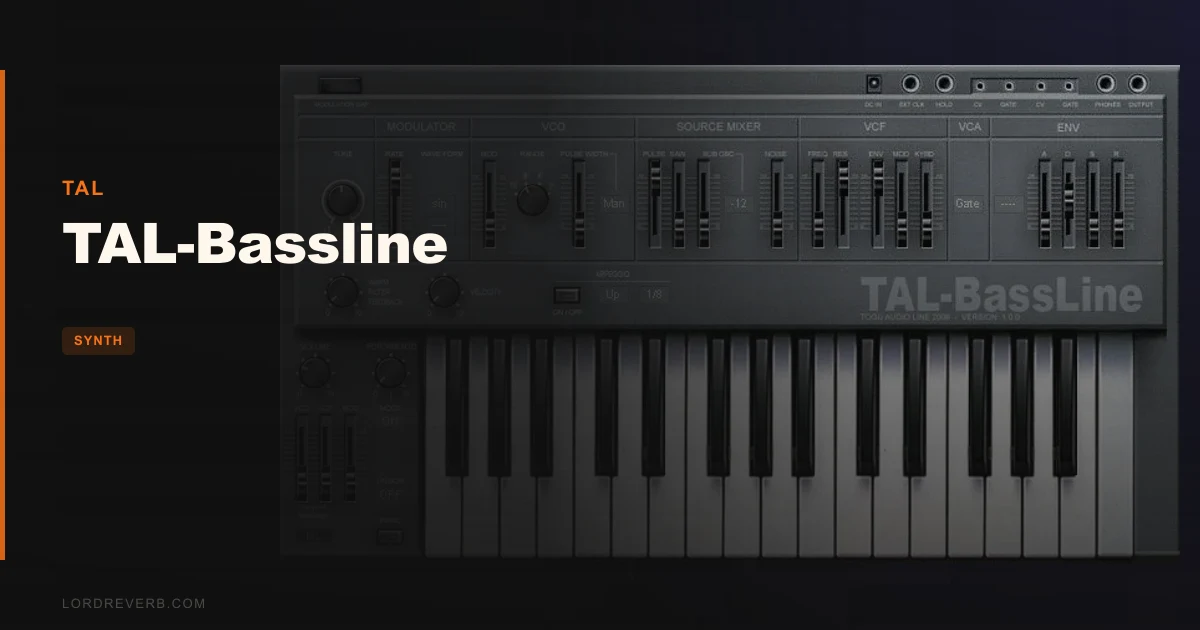
A working Roland SH-101 is expensive used, if you can find one in decent shape. That's before you factor in tuning drift, aging capacitors, and a MIDI implementation that was designed before most current producers were born. The frustration is real: you want that specific tone, the one behind a thousand acid basslines and post-punk sequences, and the hardware is priced like a collector's item. TAL-Bassline is TAL Software's answer to that problem. It's a virtual analog bass synthesizer built specifically for bass, acid, and effect sounds, with an -18 dB self-resonating filter at its core.
This review is for producers who need SH-101 character in their sessions right now, without a vintage gear budget.
The Hardware Gap This Fills
The SH-101 was released in 1982. Roland built it as a beginner synth. History had other plans. Its filter became one of the most copied circuits in electronic music, showing up on acid house records, industrial tracks, and every subgenre in between.
The problem isn't that people don't know what they want. It's that the hardware is expensive, unreliable, and impractical to run inside a modern in-the-box setup. You either spend serious money on a unit that might need service, or you settle for something that sounds close but not right.
TAL-Bassline targets exactly that gap. The filter has asymmetric and random components built in, which is TAL's method for introducing the non-ideal behavior that makes hardware filters feel alive. That's not marketing copy. It's a specific engineering choice, and you hear it when the resonance climbs past noon.
How It Actually Performs
We loaded TAL-Bassline into a session at 44.1kHz, buffer size 1024 samples, and watched the CPU meter. It settled at around 2.5% on a mid-range machine. That's light. You can run several instances across your bass bus and sends without drama.
The filter is the reason to buy this. We pushed the resonance to about 75%, set the cutoff at roughly 800Hz, and ran a saw wave through it. The low-mid bark that came back was satisfying in a way that most virtual analog filters aren't. It didn't sound processed. It sounded like something that had impedance.
We then tried to replicate a classic 303-style acid line: short decay, high resonance, cutoff modulated from the envelope. We set the envelope attack to around 1.5ms, decay to 80ms, and let the filter track the pitch. The result sat in the mix without fighting the kick. That's harder to achieve than it sounds.
The oscillator section gives you bandlimited saw and pulse waves, plus a sub-oscillator with four options: square at minus one octave, square at minus two octaves, pulse at minus one octave, and pulse at minus two octaves. The 2x unisono mode thickens the sound. LFO rate runs from 0.1Hz to 30Hz across five waveforms. The nonlinear envelope moves fast: attack from 1.5ms to 4 seconds, decay from 2ms to 10 seconds.
The LOW bass synthesizer review covers a competing bass synth at a different price point if you want a direct comparison outside the SH-101 world.
Where It Wins and Where It Doesn't
The filter is brilliant. Self-oscillation is clean and controllable, and the asymmetric character TAL has built in means it doesn't respond to every input the same way. That's the right behavior. Hardware doesn't either.
MTS and MPE support are a smart addition. Microtonal producers and anyone running a polyphonic expression controller can actually use this in 2026 workflows, which is more than most vintage-style synths bother to offer.
The arpeggiator is frustrating, though. Up, down, and one octave. That's it. If you want anything more complex, you're writing the sequence yourself in your DAW's piano roll or MIDI editor. For a synth that markets itself partly on its sequencer-friendly character, that's a genuine limitation.
There's also no built-in effects section. To get the full acid texture, the one with distortion and analog-style saturation baked into the signal chain, you need to route TAL-Bassline through external plugins. That's not necessarily a flaw, but it is extra work that competing instruments sometimes handle internally.
The Audio Blast ABX3 Bundle review covers an alternative if you want an acid-focused synth with more built-in texture processing.
Is TAL-Bassline Worth the Price?
Yes. Bluntly, yes.
You're getting a filter that competes with hardware that costs 20 to 30 times more. CPU usage is low enough to treat this as a workhorse rather than a special-occasion plugin. Format support covers VST, VST3, AU, AAX, and CLAP, which means it loads in every major DAW without workarounds.
The arpeggiator limitation is annoying, but it doesn't break the value case. TAL-Bassline is one of the better deals in the synth plugin space. We'd buy it ourselves.
If you want to see how it stacks up against other budget-conscious synth options, the BLEASS Analog FM Synth Bundle review is worth reading for context.
Who Should Buy This (and Who Shouldn't)
- ✅ Buy if you want SH-101 or 303-adjacent bass tones without vintage hardware prices.
- ✅ Buy if you need a low-CPU bass synth that loads in Pro Tools via AAX or any AU/VST3 host.
- ✅ Buy if you're working in microtonal tuning systems and need MTS support in a bass-focused instrument.
- ❌ Skip if you need an onboard step sequencer with more than basic arpeggiator functionality.
- ❌ Skip if you want distortion and saturation built into the plugin. You'll need to build that chain yourself.
- ❌ Skip if you're looking for a polyphonic pad or lead synth. This is built for bass and acid. It does those things well and little else.
For producers exploring different sonic territory, the Tape Synths Expansion review covers a different texture-focused approach worth knowing about.
Score Breakdown
| Category | Score | Notes |
|---|---|---|
| Sound Quality | 4.5/5 | Filter character is the real thing; asymmetric behavior gives it hardware-like feel |
| Value for Money | 4.5/5 | A credible SH-101 emulation at this price is hard to argue with |
| Ease of Use | 4.0/5 | Resizable GUI, Shift key for precise fader control, intuitive layout |
| Features | 3.5/5 | Strong oscillator and filter section; arpeggiator is underdeveloped, no onboard FX |
| CPU Efficiency | 4.5/5 | ~2.5% CPU at standard settings; run multiple instances without stress |
| Overall | 4.2/5 | A focused, honest bass synth that earns its price without overselling itself |
Alternatives to Consider
D-16 Group Phoscyon 2 is the most direct competition for 303-style acid work. It goes deeper into TB-303 territory specifically, with a more developed step sequencer. If your sessions lean more 303 than SH-101, it's worth comparing the two before committing.
BeatSurfing LOW takes a different approach to bass synthesis entirely. Less vintage character, more modern control. Read our LOW review if you want something built for contemporary bass design rather than period-accurate emulation.
Applied Acoustics Chromaphone 3 isn't a direct substitute, but if you're building a bass sound library and want more physical modeling character alongside your analog emulations, our Chromaphone 3 review covers what it does and doesn't do.
Final Word
TAL-Bassline doesn't try to be everything. It's a bass synth with a filter worth caring about, priced honestly, and light enough to leave running all session. The arpeggiator won't replace a proper step sequencer. The lack of onboard effects means more routing work on your end. But the core sound, the thing you're actually buying, is there. It's one of the few plugins where we'd say: stop reading and just buy it. If you wanted the SH-101 sound and balked at four-figure used hardware prices, this is your answer. If you wanted a complete acid workstation in a single plugin, keep looking.
Related reviews: HALO-2 Review 2026 · Atmosia Review
Frequently Asked Questions
Is TAL-Bassline a faithful SH-101 emulation?
It's close enough to be useful, which is different from being a sample-accurate clone. TAL built the filter with asymmetric and random components to mimic the non-ideal behavior of the original hardware circuit. Side-by-side with a working SH-101, experienced ears will hear differences. In a mix, or for composition purposes, the gap is small.
Does TAL-Bassline work in Pro Tools?
Yes. It ships in AAX format alongside VST, VST3, AU, and CLAP. Pro Tools 10.3.6 or higher is required for the AAX version. It runs on both Mac and Windows in 64-bit only.
How many presets does TAL-Bassline include?
The Plugin Boutique product page lists 23 presets. Some versions and bundles have shipped with up to 300 presets depending on the purchase source. Check your download contents and the TAL Software site directly to confirm what your version includes before assuming either number.
Can TAL-Bassline handle microtonal tuning?
Yes. It supports MTS (MIDI Tuning Standard) and MPE (MIDI Polyphonic Expression). That's an unusually modern feature set for a vintage-style instrument and makes it genuinely usable for producers working outside 12-tone equal temperament.