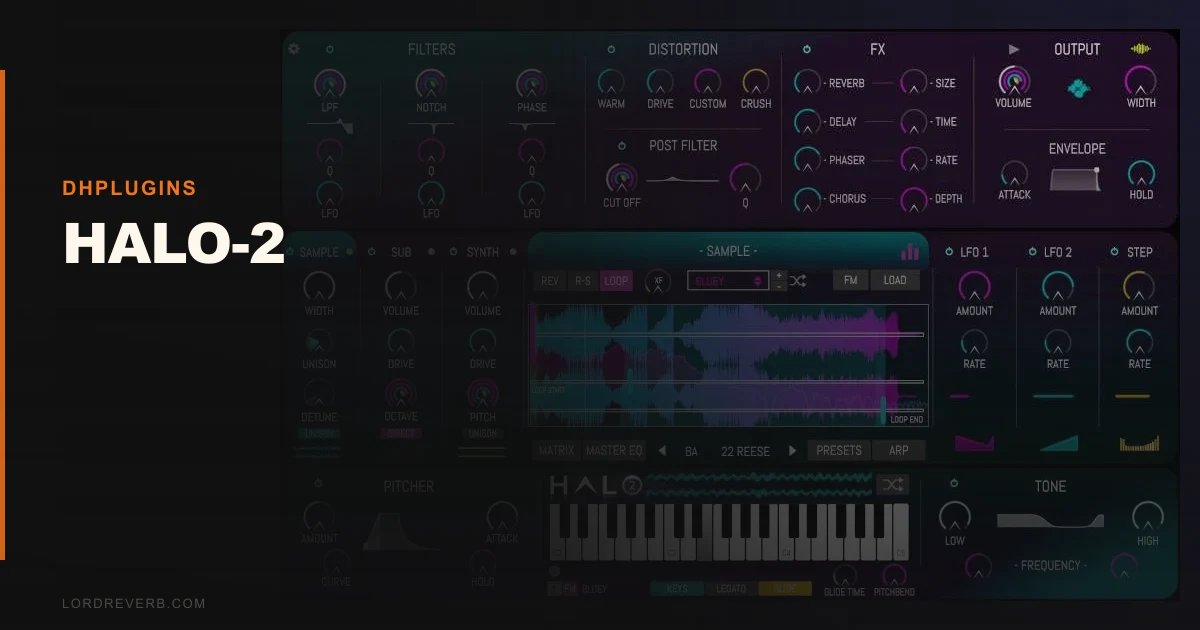
HALO-2 sits closer to a Serum preset pack than it does to Serum itself. That’s not an insult. It’s the most accurate way to frame this review, and it’ll save you from buying the wrong thing.
DH Plugins built HALO-2 as a hybrid sampler/rompler/synth for producers who make drum and bass, dubstep, future bass, and anything else in the bass music spectrum. It’s not trying to compete with Serum or Massive on synthesis depth. It’s competing on speed, genre focus, and immediacy. If you need 430+ presets that actually sound genre-correct right out of the box, HALO-2 is genuinely worth your time. If you want to sculpt your own waveforms from scratch, it’s not the tool.
We spent several weeks with it across DnB and dubstep sessions. Here’s where it landed.
How It Compares Out of the Box
Pull up Serum and you’re staring at two oscillators, an FM tab, and a wavetable editor that rewards hours of learning. Pull up HALO-2 and you’ve got a browser full of 430+ presets sorted by type, including over 50 Reese bass presets tagged and ready.
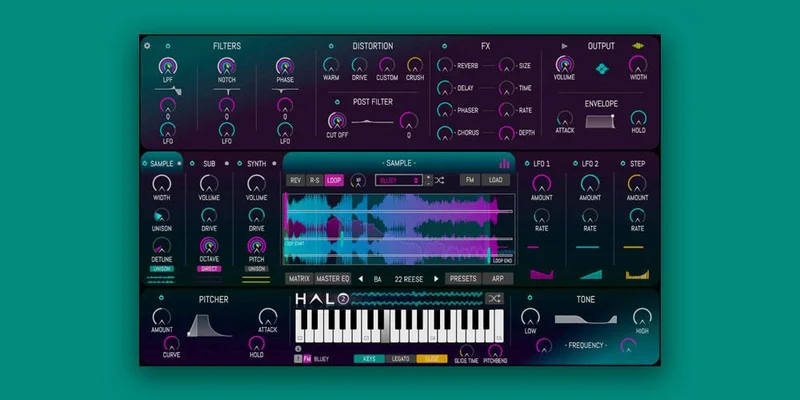
The difference is clear inside 60 seconds. HALO-2 loads fast, the presets are genre-labelled, and the interface shows you sampler frequency modulation, a split-channel arpeggiator, and sample unison controls without hiding anything behind menus.
Massive X comparisons are similarly one-sided on workflow. Massive X is the deeper synthesizer. HALO-2 is the faster session tool. We’d have both installed. They don’t replace each other.
Performance Deep Dive
HALO-2 runs on a 4GB sample set. That’s the core of the sound engine. The samples are high quality, and the 300 sample banks give you real range, but that storage cost is real. Clear 4GB before you install.
Minimum spec is 1GB RAM and macOS 10.8 or Windows 7 (64-bit). In practice, we’d recommend at least 8GB system RAM if you’re running this alongside a full session. We tested it inside Ableton 12 on an M2 MacBook Pro and CPU draw was moderate, sitting between 4-8% per instance depending on polyphony and active effects.
The 6 filter modes (LP, HP, Notch, Peak, All-Pass, Band Pass) all track cleanly. The bit-crushing is useful and not just decorative. We ran a sub bass through LP at around 80Hz, added light bit-crush, and the result sat in a mix without needing a separate saturator. Satisfying workflow moment.
The split-channel arpeggiator is the feature we keep coming back to. It lets you run separate arp patterns on different parts of the signal. For layered bass sequences in DnB, that’s a real time-saver.
One thing that frustrated us: some rhythmic sample-based sounds don’t follow DAW tempo. Load one of the rhythm-forward presets and change your project BPM, and you’ll find certain elements playing back at their recorded tempo. Annoying. Not a dealbreaker for static sessions, but live performance use takes a hit.
Where It Wins
The Reese bass library alone is worth discussing. We loaded 20 Reese-tagged presets across a DnB session. Fifteen of them needed zero adjustment. That’s a rare hit rate for a rompler.
HALO-2 also ships with the HALO FX plugin, a dedicated effects unit for applying filters, distortions, and processing inside your DAW plugin chain. It’s not just a gesture toward “extras.” It works. We used it on a bass send to add harmonic distortion on top of a compressed sub, and the combination was tighter than reaching for a separate saturation plugin.
Apple Silicon native support is handled properly. No Rosetta. No translation layer. No mysterious CPU spikes on M-series Macs. We love to see this.
Precision sample loop editing gives you control over loop points that most romplers don’t offer at this price tier. It’s the kind of detail that makes the difference between a preset that works and one you have to bounce and chop manually.
Where the Competition Wins
Serum wins on synthesis. Full stop. If you want to draw a wavetable, modulate anything to anything, and build a sound no preset library has ever touched, Serum is the answer and HALO-2 isn’t even in that conversation.
Massive X wins on modular depth and sound architecture. Its oscillator section is in a different class. For complex, evolving bass design, the gap is wide.
Both Serum and Massive X also handle tempo-synced content better. Their LFOs and arp sections sync reliably to host BPM in ways that HALO-2’s sample-based content doesn’t always match. That limitation is a real frustration for live-oriented producers.
CPU efficiency also edges toward Serum for most use cases. HALO-2’s 4-8% per instance is manageable, but stack four instances and it adds up in ways that comparable Serum patches wouldn’t.
Who Should Buy Which
- ✅ Buy HALO-2 if you produce DnB, dubstep, or future bass and want production-ready sounds in under 10 minutes.
- ✅ Buy HALO-2 if you're building tracks fast and don't want to sound-design from scratch on every session.
- ✅ Buy HALO-2 if you need a strong Reese library and the 50+ tagged presets alone justify the spend.
- ❌ Skip HALO-2 if you want deep synthesis control and the ability to build entirely original patches.
- ❌ Skip HALO-2 if you run live sets where tempo-synced sample content is critical.
- ❌ Skip HALO-2 if you're short on storage. 4GB is not a small ask on a laptop drive.
Score Breakdown
| Category | Score | Notes |
|---|---|---|
| Sound Quality | 4.0/5 | 4GB sample set sounds strong; Reese presets hold up in a real mix |
| Value for Money | 3.8/5 | 430+ presets and HALO FX included justifies the ask, barely |
| Ease of Use | 4.3/5 | Fast browser, clear layout, presets load without fuss |
| Features | 3.8/5 | Split-channel arp and sample loop editing are clever; no tempo-sync on some samples hurts |
| CPU Efficiency | 3.5/5 | Moderate draw; not heavy but stacks up across multiple instances |
| Overall | 4.1/5 | Strong niche tool; underrated for bass music specialists, overrated for general synthesis |
Alternatives to Consider
If HALO-2’s rompler approach isn’t what you need, these three are worth a look.
Serum by Xfer Records is the answer for producers who want full synthesis control. The wavetable editor is the best in its class. Every modulation source connects to every destination. We’d call Serum the better long-term investment for producers who want to grow. Serum review and walkthrough
Massive X by Native Instruments is the deeper architecture pick for evolving bass textures. Its dual oscillator routing and modulation system reward the learning curve. If complex, moving bass design is your lane, Massive X wins. Massive X vs Serum comparison
Vital is worth mentioning if budget is a factor. The free tier is real and competitive. Its spectral warping oscillator does things that cost money elsewhere. best free synth plugins
For a wider view of the synth plugin landscape, our synth plugins guide covering 5 core types breaks down where romplers, wavetable synths, and FM engines each belong in your signal chain.
The Verdict
HALO-2 does exactly one thing brilliantly: it gets a bass music producer to a working sound faster than almost anything else at its price tier. The 430+ presets aren’t filler. The Reese library is legitimately deep. HALO FX is a useful bonus, not just a checkbox.
But it’s a tool with a ceiling. We wish the tempo-sync issue on rhythmic samples was fixed. We wish there were more raw synthesis controls for producers who want to go off-script. And 4GB is a lot to commit for a plugin that isn’t your main synthesizer.
Buy it if you produce bass music and want to stop spending sessions on sound design instead of finishing tracks. Skip it if you’re a sound designer, a live performer dependent on BPM-locked content, or anyone who doesn’t specifically live in DnB, dubstep, or future bass territory.
This is a niche tool. In that niche, it’s brilliant. Outside it, there are better options for your money.
Frequently Asked Questions
Is HALO-2 a proper synthesizer or just a sample player?
It's a hybrid. HALO-2 combines sampler playback with synthesis features including frequency modulation, a split-channel arpeggiator, bit-crushing, and 6 filter modes. You get more sound-shaping control than a straight rompler, but it's not a full synthesis environment the way Serum or Massive X are. The presets are the core value, not the sound-design depth.
Does HALO-2 work on Apple Silicon Macs without Rosetta?
Yes. HALO-2 runs natively on Apple Silicon. We tested it on an M2 MacBook Pro without Rosetta and had no issues with loading, performance, or stability. This is handled properly, not as an afterthought.
Do the rhythmic presets sync to my DAW's BPM?
Some do, some don't. This is one of HALO-2's real weaknesses. Many of the melodic and bass presets are BPM-agnostic and work fine. But certain rhythmic, sample-based sounds play back at their recorded tempo regardless of your project BPM. If your session runs at 174 BPM for DnB, check rhythmic presets carefully before committing them to a track.
What's included with HALO-2 beyond the main plugin?
HALO-2 ships with the HALO FX plugin, a separate effects processor designed to work inside your DAW plugin chain. It handles filters, distortion, and additional signal processing. That's on top of 430+ presets, 300 sample banks, and a 4GB sample library. The HaloVerb reverb processor is a separate product and is not included.