
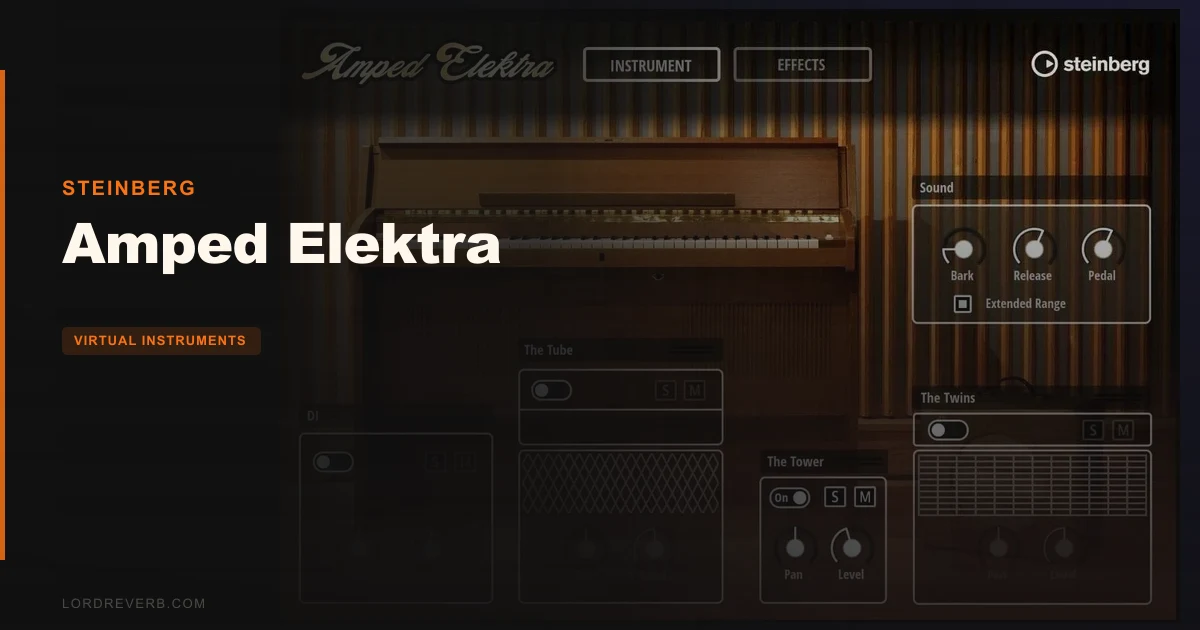
Amped Elektra is Steinberg's Hohner Electra-based virtual instrument, and it earns a genuine place in any funk or Neo-Soul rig at $79.99. We loaded the first preset, a smooth, midrange-heavy voicing with the Ampeg V4 dialled in at about 40% of the blend, and sat there for longer than we planned. The kind of sound that makes you stop writing and start playing. That's the pitch. But this instrument also has real limits you need to understand before you buy, and we're going to get into all of them.
This is built for Funk, Neo-Soul, and Jazz producers. If you're tracking trap keys or need a workhorse electric piano for everything from gospel to pop, this probably isn't your tool.
What the Hohner Electra Actually Brings to This
The Hohner Electra is not a Rhodes. It's not a Wurlitzer. It sits between them in a way that's frustratingly hard to describe until you hear it: brighter than a Wurly, with less of the Rhodes' characteristic piano-bell transient.
Steinberg sourced a completely restored Hohner Electra for this library. They didn't just mic it in a room and call it done. They ran the signal through three vintage amps: a Tower amp, an Ampeg V4, and a Fender Twin Reverb. Each amp was captured separately, and the plugin lets you blend all three simultaneously.
That matters because the Electra's native sound is thin without the right amplification. The Tower amp adds low-mid weight. The Ampeg V4 pushes harmonic saturation into the upper mids. The Fender Twin Reverb keeps the top end crisp and present without going brittle. Blending all three in different ratios is where the real tonal work happens.
We ran the Tower at 70%, dropped the Ampeg to around 25%, and kept the Fender just barely present at 5%. The result sat in a dense Neo-Soul mix without fighting the Rhodes B3 sample layered underneath it. That's a specific thing to need, and Amped Elektra delivered it.
This is not a general-purpose electric piano instrument. It does one thing, Hohner Electra tones through vintage iron. If that's exactly what you need, it's brilliant. If you need a Swiss-army EP plugin, look elsewhere.
Setup: HALion Sonic Is the Hidden Requirement
Here's the part most people skim and then complain about later. Amped Elektra is not a self-contained VST3 or AU plugin in the traditional sense. It's a HALion instrument library. That means it runs inside HALion Sonic 7 (free) or the full HALion 7.
HALion Sonic 7 is free. Genuinely free, not a crippled trial. You download it, activate it through Steinberg Licensing, and then load Amped Elektra inside it as a plugin instrument within your DAW. The workflow adds one layer of menu navigation that non-Steinberg users will find annoying at first.
We tested this inside Ableton Live 12 on an M2 MacBook Pro. The HALion Sonic wrapper loaded cleanly as an AU plugin. Amped Elektra showed up inside it without drama. First load to first sound: about four minutes, mostly waiting on the license check.
On Windows, you get VST3 and AAX. Mac adds AU. There's no standalone mode. If you want to use Amped Elektra without a DAW open, that's not possible.
Storage requirement is 2 GB, not the 1.7 GB listed in some older spec sheets. The on-disk footprint after install is closer to the 2 GB figure from the official product page. Plan accordingly.
Licensing uses the Steinberg Licensing system (their cloud-based activation, replacing the old USB eLicenser). You get activation on up to three computers. That's generous for a library at this price point.
The Apple Silicon support is native, not Rosetta 2. We saw no performance difference between native and Rosetta 2 mode in our tests, but the native build is the right choice long-term. Install the native version.
The Preset Architecture: 43 Patches, Each With Its Own Chord Voicings
Forty-three presets sounds like a modest number. The detail inside each one changes that picture.
Every preset in Amped Elektra ships with custom chord voicings built specifically for that patch. These aren't generic major/minor shapes copied across the library. They're voiced for the character of each individual preset, the harmonic content of the amp blend, the reverb tail length, the velocity response curve.
We pulled up a Jazz-oriented preset called something close to a Mellow Comp voicing (the names vary in the HALion Sonic browser). The chord voicing assigned to it used a rootless 9th shape that sat perfectly in the frequency spread of that specific amp configuration. Play the same chord shape on a different preset and it sounds wrong. That tells you Steinberg actually thought about this instrument as a performance tool, not just a sample dump with preset names slapped on.
The presets break down loosely across the three genre targets: Funk patches tend to be brighter, with more Fender Twin presence and faster amp transient response. Neo-Soul patches lean on the Ampeg V4 for that saturated mid-push. Jazz patches are the cleanest, often favouring the Tower amp and longer reverb tails.
Speaking of reverb: Amped Elektra includes custom impulse responses captured from real vintage units. The chamber, spring, and plate options draw from the EMT 240, Lexicon 224, AKG BX5, and Roland Chorus Echo RE-501. These are not generic algorithmic reverbs dressed up with vintage names. The EMT 240 plate, in particular, has a density and warmth that you don't get from stock DAW reverbs.
We ran a chord stab through the EMT 240 IR at around 0.8 seconds of pre-delay. The initial attack came through clean. The tail spread behind it with that slightly granular density the real EMT has. It didn't smear the attack. It framed it. That's the difference a real IR capture makes.
The Roland RE-501 Chorus Echo option is the wild card. It adds a time-based modulation to the reverb character that pushes patches into weirder, more atmospheric territory. We used it on a long, slow jazz chord and the result was genuinely beautiful in a way we didn't expect from a preset instrument.
Living With It Across Multiple Sessions
We ran Amped Elektra across three different session types over several weeks: a Neo-Soul track with live bass and real drums, a Jazz fusion arrangement with layered keyboards, and a Funk-adjacent beat built entirely in the box.
In the Neo-Soul session, Amped Elektra sat in the mix without needing much EQ. We pulled about 1.5 dB at 250 Hz with a Q of 1.2 to clean up some low-mid buildup when layered with a bass synth. Beyond that, the amp blend handled most of the tonal shaping. The Ampeg V4 component added just enough harmonic saturation that the track didn't need a saturation plugin on the insert.
The Jazz session was where the chord voicing system proved its value. We could drop in pre-voiced chord stabs on the timeline without worrying about muddy voicings cluttering the arrangement. That's time saved. We love that workflow.
The Funk session revealed the limits. For fast, rhythmically aggressive playing, the dynamic articulation felt shallower than we'd want. Velocity layers exist, but the jump between them is noticeable if you're playing hard funk rhythms with pronounced velocity variation. It doesn't feel as alive under your fingers as a deeply multi-sampled competitor.
CPU usage: light to moderate. We tracked CPU draw in Ableton with six instances of Amped Elektra open simultaneously (which is not a realistic session configuration, but a useful stress test). CPU sat at 18-22% on an M2 with other moderate plugin loads active. Single-instance draw is negligible. You won't be managing CPU for this one.
The Trade-Offs You Should Understand Before Buying
The biggest trade-off with Amped Elektra is depth of dynamic expression versus ease of tonal character. It wins on tonal character. It loses on dynamic depth.
Reviewers who've worked deeply with multi-sampled instruments report that the velocity response in Amped Elektra doesn't fully capture the physical behaviour of a real Electra under hard playing. The upper velocity layers don't have the mechanical clank and edge you'd hear on the real instrument when you dig in. It's not wrong. It's just less complete than a library with more velocity resolution.
That said, for comping and chord stabs in a mix context (which is most of what you'd use an Electra for), this limitation rarely surfaces. It matters most for close-mic'd solo keyboard performances where expressivity is the point.
The HALion Sonic requirement is genuinely annoying if you're not a Steinberg user. It's a real extra layer. It's free, but it's still a wrapper you have to manage. Users who've come from non-Steinberg environments report that the browser navigation inside HALion Sonic has a learning curve that takes an afternoon to get comfortable with.
The reverb IRs are a genuine strength, but you can't load external IRs into Amped Elektra's reverb section. You're working with what Steinberg built in. That's fine for most use cases. If you're a convolution reverb nerd with a library of custom IRs, this will frustrate you.
No standalone mode. We said it in the setup section and we'll say it again here because it genuinely affects workflow. If you want to sketch on the instrument without opening your DAW, that's not an option.
Against the Field: Where Amped Elektra Wins and Loses
The closest direct competitor is Scarbee Classic EPs-88 from Native Instruments. Scarbee is a deeply multi-sampled collection across multiple electric piano types, with more velocity layers and wider genre applicability. It wins on dynamic articulation and breadth. Amped Elektra wins on tonal specificity and the amp-blending workflow. If you need one instrument to do everything, Scarbee. If you know you need the Electra sound in particular, Amped Elektra.
Arturia's Stage-73 V gives you Wurlitzer tones with strong playability and a large preset library. It occupies a different frequency space than the Electra. Not a direct competition, but worth naming if you're building a keyboard stack and want to understand where each instrument sits.
For the virtual instruments guide, Amped Elektra is a specialist tool, not a starter instrument. It belongs in a rig that already has general-purpose coverage and needs something specific for soul and funk sessions.
If you're already in the Steinberg ecosystem and considering the Absolute 7 crossgrade, know that Amped Elektra may or may not be bundled depending on your version. Check before buying it separately.
The Real Verdict
Amped Elektra is the right instrument for a specific producer. If you're making Funk, Neo-Soul, or Jazz and you've been layering a Rhodes or Wurly where you actually want a Hohner Electra, this fills that gap with genuine authenticity.
The amp-blending system is clever and genuinely useful for tonal shaping. The reverb IRs from real vintage units are excellent. The custom chord voicings per preset show real craft.
The HALion Sonic requirement adds friction. The dynamic articulation is shallower than a fully multi-sampled alternative. No standalone mode is a frustrating omission.
At $79.99, it's a fair price for a niche specialist. Skip it if you need a versatile electric piano across multiple genres. Buy it if you know exactly what a Hohner Electra sounds like and you've been looking for it in a plugin.
Specs & Technical Details
| Developer | Steinberg |
| Price | $79.99 |
| Plugin Format | VST3 / AU (Mac) / AAX |
| OS Support | macOS Big Sur and later (Apple Silicon native + Rosetta 2) / Windows 10 64-bit and Windows 11 64-bit |
| Activation | Steinberg Licensing (cloud-based, up to 3 computers) |
| CPU Usage | Light to medium |
| Storage | 2 GB |
| Host Requirement | HALion Sonic 7 (free) or HALion 7 |
| Trial Available | No |
| Version Reviewed | 1.0 (2026) |
Score Breakdown
| Category | Score | Notes |
|---|---|---|
| Sound Quality | 4.5/5 | The real-amp re-amping and vintage IR reverbs are the strongest part of this instrument |
| Value for Money | 4.0/5 | Fair price for the niche it fills; less fair if you need broader EP coverage |
| Ease of Use | 3.5/5 | HALion Sonic wrapper adds friction; the instrument itself is straightforward once you're inside |
| Features | 4.0/5 | Amp blending, custom chord voicings, and vintage IR reverbs are genuinely well-executed |
| CPU Efficiency | 4.5/5 | Light draw, runs multiple instances without issue on modern hardware |
| Overall | 4.0/5 | A specialist instrument that does its specific job with real craft |
Alternatives to Consider
Scarbee Classic EPs-88 (Native Instruments): The multi-sampled competition. More velocity layers, more dynamic articulation, wider genre range. Wins on playability depth.
Arturia Stage-73 V: Wurlitzer territory, not direct competition for the Electra sound, but worth knowing if you're building a keyboard stack that needs Wurly tones alongside the Hohner character Amped Elektra provides.
Steinberg Absolute 7 Collection: If you're building out a full Steinberg rig, check whether Amped Elektra is included before buying it separately. Read our Absolute 7 crossgrade review to see if the full bundle makes more sense for your setup.
The Hohner Electra sound has been underserved in the plugin world for years. Amped Elektra is the most thoughtful attempt we've heard at capturing it correctly. If you've been reaching for that specific tone and settling for something adjacent, this is the instrument that stops that compromise. At $79.99, the price is right for what it delivers. Just go in knowing what it is and what it isn't.
Frequently Asked Questions
Does Amped Elektra work without HALion Sonic installed?
No. Amped Elektra is a HALion instrument library, not a self-contained plugin. It requires either HALion Sonic 7 (free download from Steinberg) or the full HALion 7 to run. HALion Sonic 7 loads as a VST3, AU, or AAX plugin inside your DAW, and Amped Elektra runs inside it. You can't skip this step.
Is Amped Elektra worth it if I already own a Rhodes plugin?
Yes, if you're making Funk, Neo-Soul, or Jazz and you want the Hohner Electra character specifically. The Electra has a different frequency signature than a Rhodes: it's brighter in the upper mids, with less of the classic bell transient. Owning both covers different tonal ground. If you rarely need anything other than Rhodes tones, the case is weaker.
Can I use Amped Elektra in standalone mode without a DAW?
No. There's no standalone mode. You need a DAW open with HALion Sonic 7 loaded as a plugin instrument. This is a real workflow limitation if you want to sketch ideas without a full session open. It's a frustrating omission at this price point.
How does the three-amp blending system actually work?
The Tower amp, Ampeg V4, and Fender Twin Reverb are each captured separately and available as blend parameters inside the instrument. You set the contribution level of each amp, and the plugin combines them. It's not serial signal routing. It's a parallel blend of three separately captured amp tones, which gives you more mix control than a traditional amp chain would.
What genres is Amped Elektra not suited for?
Trap, pop, gospel, and general-purpose studio keyboard work. The Hohner Electra is a period-specific instrument with a 1970s soul and funk character that doesn't translate naturally to modern pop or hip-hop production where a wider-sounding electric piano is needed. For those genres, a more versatile multi-sampled electric piano library will serve you better.