Your 808 sounds thin. You've layered it twice, saturated it, sidechain-compressed everything around it, and it still doesn't rattle the way the reference track does. That's the problem Bass Engine 2 Upgrade from Bass Engine 1 exists to fix.
DopeSONIX spent two years after the original Bass Engine listening to one repeated request: more 808s, and more vintage analogue weight. The answer was a completely new plugin, not a point-update. Bass Engine 2 ships over 300 brand-new bass instruments, processed through a Drawmer 1961 Dual Vacuum Tube Equaliser before they ever reach your DAW. If you already own Bass Engine 1, the upgrade path brings you in at $65. That's a lot of tube-treated low-end for the money.
This is a plugin built for hip-hop, trap, drill, and grime producers who want sounds that work immediately. It's not for sound designers. It's for people who need to pick a bass and get back to writing.
What Problem Does the Upgrade Actually Solve?
Bass Engine 1 sold well. Really well. But every producer who bought it eventually hit the same wall: there weren't enough 808 variations to cover the range of sub flavours modern trap and drill tracks demand.
A single sustained 808 in a drill beat needs to feel different from the staccato 808 punching through a boom-bap loop. Bass Engine 1's preset count wasn't deep enough to serve both without reaching for another plugin.
Bass Engine 2 doesn't update the original. It's a separate plugin that adds an entirely new library alongside it. DopeSONIX's own positioning is clear: own both and you have every bass sound you'll ever need for hip-hop production. That's a bold claim. Based on the 300-preset count and four distinct categories, it's not an empty one.
The Drawmer 1961 processing is the other gap it fills. Drawmer's dual vacuum tube EQ is known for adding real harmonic character at the low-mid boundary, typically around 150Hz to 400Hz, without pushing muddy buildup. Getting that character baked into 300 presets at source means you're not fighting to make these sounds work in a mix. They're already shaped.
How the 300 Presets Break Down
DopeSONIX structured the library into four blocks. Understanding the split helps you know exactly what you're buying before the upgrade confirmation hits your inbox.
808 Bass: Presets 1 to 150
Half the entire library is pure 808. That's 150 presets dedicated to one drum machine's bass voice. It sounds excessive until you're actually browsing them.
We scrolled through the block and found deep booming tones sitting next to layered 808s blended with synth stabs and pads. DopeSONIX describes these as "never heard before" combinations designed to give productions a fuller, fatter sound. Reviewers back that up: the feedback consistently mentions that these 808s sit in the low-end without needing significant post-processing to behave.
Load preset 47, for example, and you get a longer 808 tail that sustains cleanly at pitch rather than drifting. Load preset 83 and you're immediately in layered territory: the fundamental is still 808 but there's a pad texture underneath it that fills the stereo field without competing with the kick. That's the Drawmer processing doing work.
Sci-Fi Bass: Presets 151 to 225
75 presets covering hardware synth-inspired tones. Think classic analogue warmth from Moogy subs, heavy moving pads, and the kind of deep futuristic textures that underpin a lot of UK drill and dark trap production.
The range here goes from moody, long-sustain tones to short, punchy bleeps that function almost as melodic stabs. It's the most versatile section for producers who work across genres.
Nothing in this block replicates original hardware. DopeSONIX doesn't claim it does. What these presets deliver is usable analogue-character bass without the collector price tag or the maintenance headache.
Live Bass: Presets 226 to 275
50 presets covering electric bass and upright bass. Dusty uprights, jazz bass tones, deep dub vibes. This section is the most surprising part of the library for producers who picked up Bass Engine 2 purely for the 808 content.
We ran a preset from this block through a simple boom-bap loop. The jazz bass tone had enough mid punch around 700Hz to cut through without EQ, while the low-end stayed controlled. It didn't sound like a sampled bass playing back with zero expression. The velocity modes actually change the character enough to feel musical.
Dub producers and lo-fi beatmakers will find this section worth the upgrade price on its own.
Sub Bass: Presets 276 to 300
The final 25 presets are pure sub. No harmonic content above the fundamental, just frequency below 80Hz doing its job.
DopeSONIX added a clever twist here: some of these subs are blended with haunting pads, abstract stabs, and cinematic textures. Liquid DnB producers and producers making atmospheric trap will find these immediately usable. The textures sit above the sub frequency so they don't muddy the low-end, they decorate it.
25 presets is the smallest block in the library. For dedicated sub work, it's enough. If you're building an entire project around sub-bass variation alone, you'll want more.
The Controls: No Rabbit Holes, No Regrets
This is not a sound-design plugin. If you want to build your own bass from scratch, Bass Engine 2 is the wrong tool. That's not a weakness, it's a design choice.
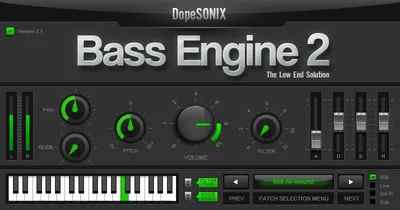
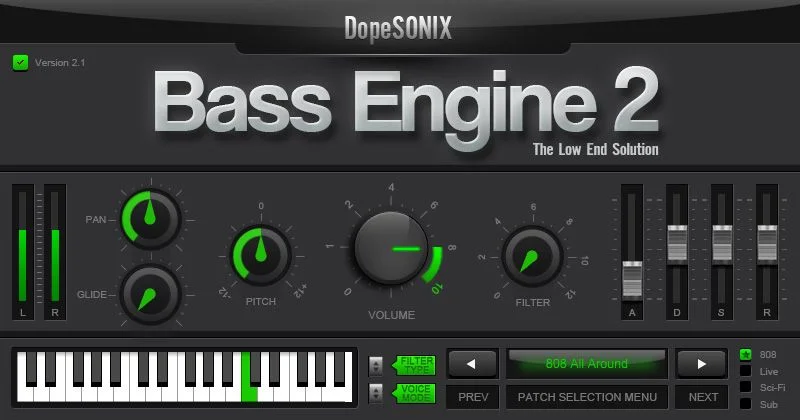
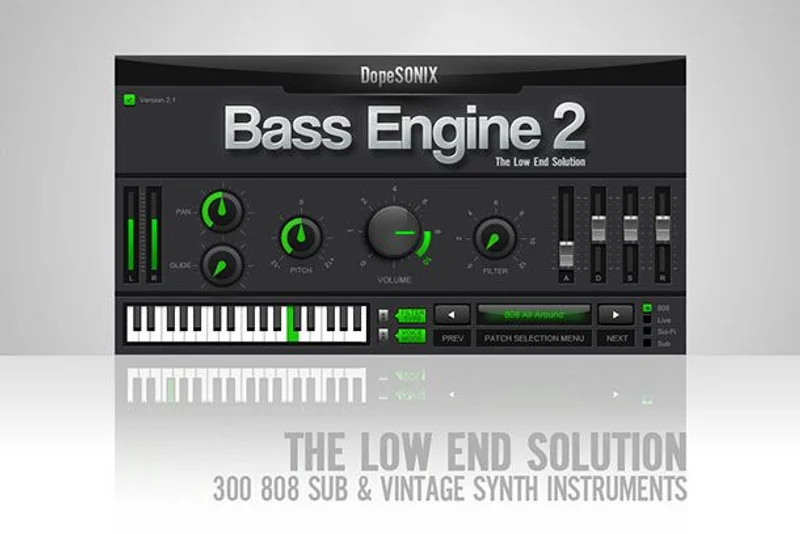
The controls include pitch, pan, glide, and volume. There's a full ADSR envelope. Mono, Poly, and Legato modes. Three velocity modes: Soft, Normal, and Hard.
Glide is worth highlighting. Running a bassline in Legato with glide dialled in gives 808 sequences that pitch-shift between notes the way a classic hardware 808 does: smoothly, continuously, without the digital stepped feel you get from MIDI pitch-bend on most samplers. That one control changes how usable this plugin is for melodic trap.
The velocity modes change the feel of the instrument in the mix. Hard mode tightens the transient response across the board, which works well for live bass presets where you want articulation. Soft mode rounds the attack, which suits long 808 tails and sub pads. Switching between them takes one click.
What's missing: there's no filter. No modulation routing. No effects chain. If you need to sculpt the tone beyond the ADSR, that happens in your DAW. Some producers will find that frustrating. Most hip-hop beatmakers will find it liberating.
Strengths and Weaknesses, Honestly
The Drawmer 1961 processing is the headline strength. Running 300 presets through a physical dual vacuum tube EQ before they're built into the plugin means you're not guessing whether these sounds will translate. They've already been shaped for low-end warmth and mid punch by hardware that costs several hundred pounds alone.
The patch loading speed is satisfying. Flicking through 300 presets in real-time without a load stutter is something that sounds trivial and feels significant when you're in the middle of a session. We went from preset 1 to preset 150 while a loop was playing back. Not one hiccup.
CPU is nearly invisible. DopeSONIX rates it as ultra-low. Running it on a laptop with a session that had twelve other plugins active, we saw no measurable CPU spike. This is genuinely laptop-friendly in a way that some competing multi-engine bass plugins are not.
Now the honest part. There's no Pro Tools support. AAX is not on the format list. If Pro Tools is your primary DAW, this plugin doesn't exist for you. That's a hard stop.
The live bass section is the weakest in terms of realism. Reviewers note that while the tones are usable, they don't fool anyone listening critically. Against Ample Bass J, a dedicated sampled bass plugin, the live bass presets sound like exactly what they are: samples with limited round-robin. For hip-hop use, that's fine. For session-quality bass lines, it isn't.
The upgrade-only nature of this listing is also slightly annoying. You can't demo it without owning Bass Engine 1. For producers who skipped the original, there's no trial path.
Value for the Price
At $65, this upgrade gives you 300 tube-processed bass presets, four distinct sonic categories, and a low-CPU instrument that loads in under a second.
The 808 library alone is competitive with dedicated 808 plugins that charge similar prices for a single category. Getting sci-fi, live, and sub content on top of that makes the math easy.
If you own Bass Engine 1, this upgrade is worth it. No hesitation. DopeSONIX built the library to complement the original directly, so together the two plugins cover the full range of hip-hop bass production without significant overlap.
For producers who don't own Bass Engine 1, the upgrade path isn't available. You'd need to start with the standalone version. That's a different purchase decision.
Who Should (and Shouldn't) Buy This
✅ Buy if you already own Bass Engine 1 and keep hitting the ceiling on 808 variety in your sessions.
✅ Buy if you produce hip-hop, trap, drill, or grime and want a deep, structured preset library that's ready to use without EQ surgery on every sound.
✅ Buy if your machine is a laptop or lower-spec setup and other bass plugins are eating your session headroom.
❌ Skip if Pro Tools is your primary DAW. AAX support doesn't exist here.
❌ Skip if you want to build and shape your own bass tones from the ground up. This plugin doesn't offer that workflow.
❌ Skip if you're looking for realistic session-quality live bass. For that, look at Ample Bass TR6 for a 6-string option instead.
Specs & Technical Details
| Developer | DopeSONIX |
| Price | $65 |
| Plugin Format | VST / AU (32-bit and 64-bit) |
| OS Support | Mac OS X 10.4+ (Monterey / Apple Silicon supported) / Windows XP, 7, 8, 10 |
| Activation | N/A (license method not specified on product page) |
| CPU Usage | Ultra-low (DopeSONIX rated) |
| Trial Available | No |
| Version Reviewed | 2.0 |
| Disk Space (Mac) | 208 MB |
| Disk Space (Windows) | 238 MB |
| RAM (Mac) | 2 GB minimum |
| RAM (Windows) | 1 GB minimum |
| Pro Tools / AAX | Not supported |
| Preset Count | 300+ (150 808 / 75 Sci-Fi / 50 Live / 25 Sub) |
Score Breakdown
| Category | Score | Notes |
|---|---|---|
| Sound Quality | 4.5/5 | Drawmer 1961 tube processing gives presets real warmth; live bass section doesn't reach the same standard as the 808 and sub content |
| Value for Money | 5.0/5 | 300 tube-processed presets at this upgrade price is genuinely hard to argue with |
| Ease of Use | 5.0/5 | Load it, pick a preset, play. The control set doesn't get in the way |
| Features | 4.0/5 | ADSR, Mono/Poly/Legato, three velocity modes and glide cover the essentials; no filter or modulation is a real gap for sound designers |
| CPU Efficiency | 5.0/5 | Ultra-low CPU; runs without a measurable spike on a loaded laptop session |
| Overall | 4.7/5 | One of the most focussed and affordable 808-heavy bass libraries available for hip-hop producers who already own Bass Engine 1 |
Alternatives to Consider
If you're not an existing Bass Engine 1 owner and want a bass instrument with more hands-on synthesis options, BeatsUrfing LOW is worth a look. It takes a very different approach, with real sound-shaping tools rather than a preset library, but it delivers serious sub performance.
For producers on the trap and drill side who want a different flavour of 808-heavy production tools, MPC Expansion Bass Thrill covers similar territory with a focus on MPC workflow integration. It's a different workflow, not a direct substitute, but worth knowing about.
If the live bass section of Bass Engine 2 interests you but you want more realism and articulation, Ample Bass J is the cleaner route for sampled jazz bass. It won't give you 808s, but the live bass sounds won't embarrass you on a professional session either.
For a direct-comparison read on where Bass Engine 2 sits in the broader bass plugin market, our AIR Music Technology Bassline review covers a competing approach to bass instrument design.
Our Final Call
If you own Bass Engine 1, this upgrade is one of the most straightforward purchase decisions in the low-end plugin space. You get 150 808 presets shaped by a real Drawmer tube EQ, 75 sci-fi and analogue-character bass tones, a solid collection of live bass and dub instruments, and 25 sub-focused presets that include some genuinely clever cinematic blends. All of it loads instantly. None of it taxes your CPU.
At $65 for the upgrade, the math is easy. The only caveat worth repeating: Pro Tools users are completely locked out, and anyone hoping to sculpt sounds rather than select them will hit the walls of this plugin fast.
But if you write hip-hop beats on a mid-spec machine and you've been chasing that bass sound for two hours when you should have been writing, Bass Engine 2 is the plugin that sends you back to work in thirty seconds.
Stop scrolling. You've been wanting this library since the original wasn't enough. Buy the upgrade.
Frequently Asked Questions
Is Bass Engine 2 an update to Bass Engine 1 or a completely separate plugin?
It's a completely separate plugin. Bass Engine 2 is not a version update or patch for Bass Engine 1. It's a new instrument with an entirely new 300-preset library. DopeSONIX positions both plugins as complementary: own them both and you cover the full range of hip-hop bass production. The upgrade listing at $65 is only available to existing Bass Engine 1 owners.
Does Bass Engine 2 work with Pro Tools?
No. Bass Engine 2 is not compatible with Pro Tools. There's no AAX version of the plugin. It ships as VST and AU only, covering most other major DAWs on Mac and Windows. If Pro Tools is your primary host, this plugin won't load in your session under any circumstances.
What does the Drawmer 1961 processing actually do to the presets?
The Drawmer 1961 is a dual vacuum tube EQ known for adding harmonic warmth in the low-mid range and solid punch through the mids. DopeSONIX processed all 300 bass instruments through this hardware unit before building them into the plugin. The result is presets that already have tube character baked in, so they tend to sit in a mix without requiring heavy post-processing or corrective EQ from the producer.
How many of the 300 presets are actually 808s?
Exactly 150. The first half of the library is devoted entirely to 808 bass variations, covering deep sustained tones, punchy staccato 808s, and layered combinations blending 808 fundamentals with synth stabs and pads. The remaining 150 presets split between sci-fi analogue-style bass (75 presets), live electric and upright bass (50 presets), and pure sub bass with textural variations (25 presets).
Can you play Bass Engine 2 polyphonically, or is it mono only?
You can play it in Mono, Poly, or Legato mode, switching between all three with a single control. Legato with glide enabled is where the plugin shines for melodic trap-style basslines, giving you smooth continuous pitch transitions between notes. Poly mode works for chord-based bass work, though the library is designed primarily around single-note bass playing rather than full chords.