
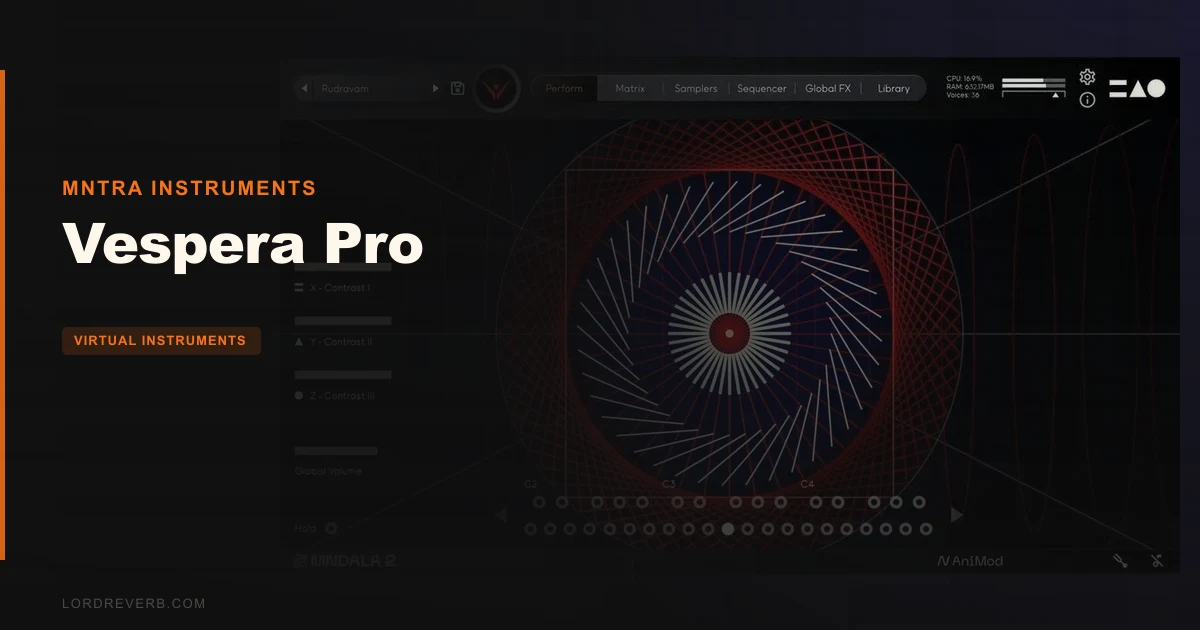
The honest question anyone asks before spending $99 on a virtual instrument they've never heard of is this: is it actually a new sound, or just another processed synth dressed up in clever marketing? With Vespera Pro, the answer is genuinely the former.
MNTRA Instruments ran distorted modular synth signals through vibrational speaker transducers and let them physically resonate through drum skins, metal springs, and rare acoustic instruments including a giant Indian Ezraj and a Swedish Nyckelharpa. Then they sampled the results. That process is either brilliant or ridiculous depending on your perspective, and we'd argue it's a little of both, which is exactly why it works.
At $99, Vespera Pro targets film composers, sound designers, and producers who need textures that don't exist anywhere else in their signal chain. If that sounds like you, read on. If you mostly make radio-ready pop, this probably isn't it.
Does It Actually Deliver What It Promises?
MNTRA Instruments built Vespera around a concept they call acoustic synthesis: taking the grit of tube-driven modular circuits and transforming it through physical resonance before a single note is ever sampled. The Pro edition captures that process at full resolution, with 25,174 samples across 83 sample maps, spanning C0 to C6 across a 6-octave range.
The result sits in a genuinely strange category. It's not a synth you program from scratch. It's not a conventional sample library either. It's a collection of sounds that already went through a complete physical transformation before they were committed to disk, and your job is to play and shape them.
For that promise, it delivers. The Pro edition's 13 round robins mean consecutive note strikes don't sound identical. Reviewers who've worked with both editions consistently report the Pro feels like a living instrument where the Standard feels more like a snapshot. That distinction matters enormously for anything exposed in a sparse arrangement.
Powered by MNTRA's MNDALA 2 engine, Vespera Pro also runs what the company calls Animistic Synthesis, a nonlinear response system that lets patches resonate spontaneously based on your playing nuance. That's not marketing fluff. It's a real behavioral difference in how the engine treats velocity and touch data.
Where Vespera Pro Genuinely Shines
Sample Start Modulation Changes Everything
Standard MIDI velocity gives you 128 steps. SSM, MNTRA's Sample Start Modulation, goes beyond that by modulating where in a sample the playback begins, not just which velocity layer triggers. All 83 sample maps in Vespera Pro are SSM-powered.
We loaded a drone patch from the Ezraj-resonated bank and played it with a light touch, then dug in hard. The light hit catches the initial breath of the resonance. The hard hit jumps past it into the body of the sustain. Same note, same pitch, completely different character. That's the SSM system working exactly as described.
For expressive composers playing in real time, this is a satisfaction that most sample libraries simply don't offer. You're not switching between layers, you're continuously moving through a physical sound event. The difference in musicality is immediate and significant for anyone recording live takes.
The Re-Amping Process Produces Genuinely Unique Source Material
We ran a mid-register patch from the metal springs bank through a clean channel strip with no processing. No EQ. No reverb. Just the raw output.
What came back had metallic shimmer on the attack, a slow sympathetic bloom in the mid frequencies, and a tail that doesn't decay cleanly because the spring is still physically vibrating in the recording. You can't synthesize that behavior from scratch in a normal subtractive or wavetable synth. The harmonic content is too irregular, too tied to a real physical object that doesn't follow clean mathematical decay curves.
That's the core value proposition of Vespera Pro. Its source material is acoustically strange in ways that digital synthesis can't replicate. Reviewers across multiple platforms consistently flag this as the standout quality: the sounds feel real because they physically were.
140 Presets That Actually Cover Range
We'd be annoyed if a 19.3 GB library shipped with mediocre presets. Vespera Pro's 140 presets move across pulsating rhythmic textures, drone and atmosphere pads, gritty harmonic movement, and sounds that don't map neatly onto any of those descriptions. The dark and hauntingly organic character stays consistent without everything sounding like the same patch with a different name.
For film and trailer scoring especially, the preset browser is a legitimate creative tool, not just a starting point you immediately abandon.
Where Vespera Pro Falls Short
The install size is ugly. 19.3 GB once it's sitting on your drive, but you need 40 GB free during setup. If you're working from a 512 GB internal drive with a full DAW session in progress, that's a meaningful chunk of working space.
The 32 GB RAM recommendation for the Pro edition is real, not conservative. Users who've pushed it on 16 GB systems report performance issues under load, particularly when stacking multiple Vespera instances in a complex session. The Standard edition exists partly to address this, but if you're buying Pro, you need the system to match.
Here's the harder criticism: the sonic character is specific to a fault. That hybrid electro-acoustic texture is either exactly what your project needs, or it's completely wrong for it. We've seen this frustrate producers who picked it up expecting a flexible bread-and-butter synth. It isn't that. It's a specialist tool, and if your sessions don't regularly call for organic dark textures or avant-garde sonic design, the preset browser will start repeating the same creative suggestions back at you within a few weeks.
We also wish the documentation was deeper on the MNDALA 2 engine's actual controls. The Animistic Synthesis behavior is compelling, but understanding exactly what's modifiable versus what's baked into the samples requires more trial-and-error than it should at this price point.
How It Stacks Up Against the Alternatives
The two most honest comparisons here are Native Instruments' Kinetic Toys and Spitfire Audio's LABS Frozen Strings series. Neither is a direct competitor, but they're what producers reach for when they want organic-meets-electronic textures.
Kinetic Toys gives you physical object sounds at a fraction of the install burden, but without SSM's continuous velocity behavior and without the tube distortion layer that gives Vespera its grit. It's lighter and faster to work with, but it sounds cleaner and more polished, which is sometimes the wrong thing.
Spitfire's ecosystem offers more orchestral grounding. If you need strings or brass that feel real, Spitfire wins. If you need something that doesn't map to a conventional instrument category, Vespera Pro has no obvious rival at this level of sonic specificity.
For a broader look at where Vespera Pro fits in the virtual instrument landscape, see our virtual instruments overview.
Is the Price Fair for What You're Getting?
At $99 for the Pro edition, you're paying for 25,174 individual samples recorded at 48 kHz / 24-bit, a proprietary engine with SSM across all 83 sample maps, 13 round robins, and a 6-octave range built on a genuinely unusual recording process. The sample mathematics alone justify the price tier if organic synthesis is central to your work.
If it's not central, or if you're testing the concept for the first time, the Standard edition exists for exactly that reason. Start there. Upgrade when you've confirmed the sound world is one you keep coming back to.
The value is real. But only for a specific kind of producer. We'd skip it without hesitation if organic texture design isn't a regular part of our workflow.
Specs & Technical Details
| Developer | MNTRA Instruments |
| Price | $99 |
| Plugin Format | VST / AU / AAX |
| OS Support | Mac (10.14.6+, including M1) / Windows 7+ |
| Activation | N/A (not specified) |
| CPU Usage | Heavy (32 GB RAM recommended for Pro edition) |
| Trial Available | N/A |
| Version Reviewed | Pro Edition |
| Sample Count | 25,174 |
| Sample Maps | 83 |
| Presets | 140 |
| Round Robins | 13 |
| Range | C0–C6 (6 octaves) |
| Format | 48 kHz / 24-bit stereo, .mntra format |
| Install Size | 19.3 GB installed / 40 GB required for setup |
| Minimum RAM | 8 GB (32 GB recommended for Pro) |
| Minimum CPU | Intel i5 or equivalent |
Score Breakdown
| Category | Score | Notes |
|---|---|---|
| Sound Quality | 4.5/5 | Re-amped physical resonance produces textures no standard synthesis path can match |
| Value for Money | 3.5/5 | Fair for specialists; genuinely poor value if organic texture design isn't core to your work |
| Ease of Use | 4.0/5 | Preset browser is intuitive but MNDALA 2 engine depth is underdocumented |
| Features | 4.5/5 | SSM across all 83 sample maps and 13 round robins set a high bar for expressivity |
| CPU Efficiency | 3.0/5 | 40 GB setup footprint and 32 GB RAM recommendation are real system demands |
| Overall | 4.1/5 | A brilliant specialist tool that earns its price for the right producer, frustrating for everyone else |
Alternatives Worth Considering
If Vespera Pro's system requirements are a wall you can't climb right now, the Standard edition of Vespera is the honest first step. Same preset design, same sonic character, cut to one round robin per note and a tighter 4-octave range. The expressivity takes a hit, but the sound world is identical.
For producers who want organic textures with a lighter system footprint, Native Instruments' Kinetic Toys is worth a look. It doesn't have SSM or tube-driven re-amping in its DNA, but it loads fast and sits well in a busy session. Our guide to organic texture instruments covers it alongside Vespera in more detail.
For sound designers working in film or TV who want the broadest possible palette of unconventional instrument sounds, Spitfire Audio's Hans Zimmer Strings or the LABS Strings series offer a different flavor of acoustic-electronic crossover. They're rooted in conventional orchestral source material, which Vespera deliberately isn't, but the atmospheric range overlaps in useful ways. Check our best virtual instruments for film scoring for a deeper breakdown.
If budget is the constraint and you're curious about the concept before committing, Spitfire's free LABS releases are the lowest-risk way to understand whether organic-electronic textures fit your sessions before spending serious money. See also our best free virtual instruments for where to start.
The Bottom Line on Vespera Pro
Vespera Pro solves a specific creative problem with genuine intelligence. When you need a sound that couldn't exist without a vibrational transducer and a Nyckelharpa in the same room, this is the library that has it. The SSM system makes it feel like a real instrument under your hands, the 13 round robins keep repeated notes from going mechanical, and the 140 presets earn their place in the browser.
But it demands a serious system, a big drive, and a production context where its very specific character fits regularly. This isn't a daily driver synth for every session. It's a specialist tool you reach for when nothing else sounds right.
At $99, buy it if dark organic textures are a recurring creative need. Skip it if you're chasing flexibility. The Standard edition is the smarter test drive. The Pro edition is for when you've already decided this is your world.
The Nyckelharpa doesn't lie.
Frequently Asked Questions
What is the difference between Vespera Pro and Vespera Standard?
The Pro edition extends the playable range to 6 octaves (C0 to C6) and includes up to 13 round robins per note, meaning repeated note strikes cycle through different sample variations for a more natural feel. The Standard edition covers a 4-octave range with one round robin per note. Both editions share the same 140 presets and 83 sample maps. The Pro edition requires 32 GB of RAM for optimal performance, while Standard is more forgiving on lighter systems.
What is Sample Start Modulation (SSM) and why does it matter?
SSM is MNTRA's system for going beyond standard 128-step MIDI velocity response by modulating where playback begins within a sample based on how you play. A light touch catches the early breath of a physical resonance event; a harder hit jumps into the sustained body of the same sound. All 83 sample maps in Vespera Pro are SSM-powered. For live recording and expressive playing, this means genuinely continuous response rather than obvious layer-switching between velocity zones.
How much disk space does Vespera Pro actually need?
The installed library sits at 19.3 GB, but you need 40 GB free during the setup process. Once installation is complete you can reclaim that buffer, but you'll need the headroom available at install time. If your drive is tight, clear space before you begin or install directly to an external SSD.
Is Vespera Pro suitable for beginners?
The preset browser is straightforward enough that beginners can get usable results quickly without touching the engine. The harder barrier is the system requirement: 8 GB RAM minimum, 32 GB recommended, on a capable i5-class CPU. If your machine meets those specs and your production context regularly calls for organic or atmospheric textures, the learning curve on the instrument itself isn't steep. If you're just starting in production and want a versatile everyday synth, this isn't the right first instrument.
What DAWs and formats does Vespera Pro support?
Vespera Pro runs in VST, AU, and AAX formats, which covers all major DAWs including Ableton Live, Logic Pro, Pro Tools, Cubase, Reaper, and FL Studio. Mac support runs from macOS 10.14.6 upward including M1 chip compatibility. Windows support starts at Windows 7. Both platforms require a minimum 8 GB RAM and an Intel i5 or equivalent processor.