
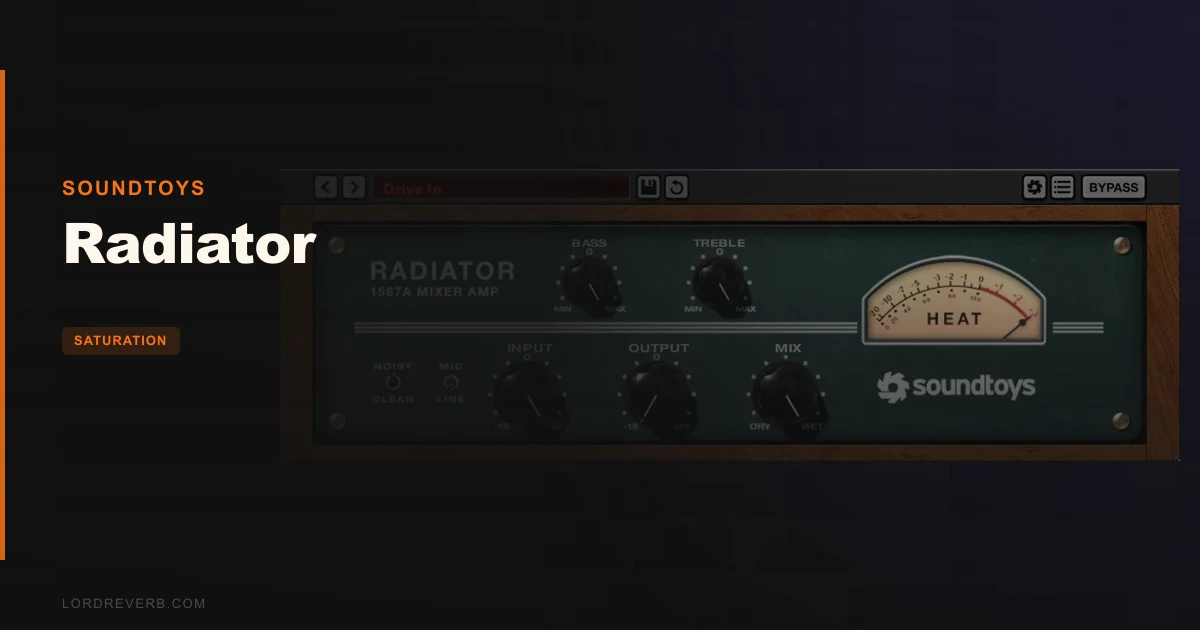
You've got a bass guitar track that's sitting somewhere in the mix. Not bad. Not good. Just there. You stack a compressor on it and it gets controlled. You add some EQ and it gets clearer. But it never gets interesting. That's the problem Radiator exists to solve. SoundToys' Radiator is a tube saturation plugin based on the Altec 1567A mixer, priced at $99, and it's built for producers who want a specific kind of analog character: coloured, gritty, and unashamedly vintage. It's not a general-purpose Swiss Army saturator. It's a very particular flavour of 1960s Motown tube warmth, and if that's what your session is missing, it delivers it with surprising efficiency.
The Specific Problem Radiator Is Solving
Most digital tracks have the same fundamental flaw: they're too clean. Not clean as in "transparent and honest," but clean as in "lifeless and flat." Tube hardware adds harmonic distortion, transformer saturation, and a kind of top-end sheen that's almost impossible to replicate with EQ boosts alone.
The Altec 1567A was a rack-mounted five-input tube mixer from the 1960s, used extensively at Motown Records between 1961 and 1964. Songs by The Supremes, The Four Tops, and The Marvelettes went through this circuit. Russ Terrana, Motown's chief engineer, made it part of the label's sound.
That hardware had 97 dB of available gain, removable transformers, and a simple two-knob EQ. It sounded coloured. It sounded loud. It sounded like something was happening to the signal.
Getting that character digitally is harder than it sounds. Radiator doesn't try to give you a neutral platform and call it "tube emulation." It goes after one specific circuit and models it obsessively. That's a real trade-off, and we'll get into it.
How the Controls Actually Behave
Pop Radiator open and you'll see five dials: Input, Output, Bass, Treble, and Mix. There's also a Mic/Line switch and a noise toggle. That's it. The interface is intentionally minimal, which is either satisfying or annoying depending on your workflow.
The Input dial is where the character lives. Push it past noon and you're feeding the input amplifier stage harder, generating harmonic distortion that stacks second and third harmonics onto your signal in a way that feels musical rather than aggressive. At lower settings, maybe 9 o'clock, Radiator adds a gentle glow that sits under the mix rather than on top of it.
The Output dial is a separate amplification stage with its own character. This matters. It's not a simple volume compensator. Pushing Output while keeping Input moderate gives you a different texture than the reverse. We ran a direct bass guitar DI through the plugin with Input at 2 o'clock and Output at 10 o'clock. The low-mids tightened. The fundamental got fatter without the note becoming wooly. That's the interaction SoundToys is going for.
The Bass and Treble controls are modelled directly from the original hardware's two-knob EQ. They're broad and gentle. You won't find surgical Q values here. A full clockwise turn on Bass adds a wide shelf boost centered roughly around 100-150Hz. Full clockwise on Treble lifts the air above 8kHz with that slightly ragged tube-top-end character. Both controls react differently depending on how hard you're driving the Input stage, which is clever design.
The Mix dial enables parallel processing without needing to set up a send. Blend dry and wet signal directly in the plugin. For drums especially, this is useful: you can push the Input hard for saturation while pulling Mix back to preserve transient punch. We'd set Mix around 40-60% on snare and kick tracks, where the thump from the saturation blends with the original crack rather than replacing it.
The Mic/Line switch changes how the transformer model loads, giving two distinct tonal flavours. Mic setting pushes the transformer harder and adds more low-frequency weight. Line is cleaner and tighter. It's a subtle difference on gentle settings, but at harder drive it becomes a real tonal choice.
Noise is toggleable. The original hardware had significant self-noise. SoundToys lets you keep it for authenticity or kill it for practicality. We'd leave it off on everything except individual showcase tracks where the hiss adds character. Practically speaking, stack this on 30 channels with noise on and your mix floor climbs noticeably.
Little Radiator: The Bonus That's Worth Talking About
Bundled inside is Little Radiator, a single-stage preamp model based on the Altec 1566A, the 1567A's smaller sibling. It has fewer controls: just Input, Output, and Mix. No EQ.
We find Little Radiator more immediately useful for subtle tasks. Throw it on a piano bus. Set Input to 10 o'clock. The pick attack and hammer transients gain a light edge without any frequency shaping to second-guess. It's genuinely one of the more underrated "set it and forget it" saturation tools in our ITB chain right now.
Having two separate plugin interfaces for two slightly different circuit models is a clever way to expand the tool's range without bloating the main interface. Little Radiator is what you reach for when Radiator feels like too much.
Where It Works, Where It Struggles
On bass guitar, Radiator is brilliant. We ran a passive jazz bass DI at Input 1 o'clock, Mix at 70%, Mic mode active. The low-end sat better in the mix with a kick drum without any sidechain processing needed. The harmonic saturation gave the bass note identifiable pitch information at lower volumes, which is exactly what you want.
On drums, the parallel Mix knob makes it practical. We printed a drum bus with Input pushed to 3 o'clock and Mix at 45%. The result had a Bonham-ish thickness without sounding like a distortion effect. Reviewers who've tested it on room mics report similar results: tube saturation on a room mic blend adds presence without the mud you'd get from a broad EQ boost.
On vocals, the results are more context-dependent. Users report excellent results on raw, lo-fi vocal styles and male voices with body in the low-mids. On brighter female vocals, some reviewers note that hard Input settings above 2 o'clock start generating artifacts above 10kHz. That's the aliasing issue. Radiator doesn't include oversampling, which means at aggressive drive settings on high-frequency content, you can hear digital artifacts in the upper registers. It's not catastrophic, but it's real.
For electronic music, the use case is narrower. On analog synth pads, Radiator adds a satisfying grit that feels like tape saturation. On bright digital leads or crisp hi-hats, those same aliasing concerns apply. We'd keep Input below noon on anything with significant content above 8kHz and let Mix do the heavy lifting.
One frustrating limitation: there's no mid-side mode, no channel link, and no oversampling toggle. For $99 in 2026, competitors in this price range have started including at least oversampling options. SoundToys hasn't updated Radiator's core processing model in several versions, and it shows at high frequencies.
Strengths and Weaknesses in Practice
The strengths are real. The dual-stage amplifier design means Input and Output interact rather than just stacking. That interaction is what gives Radiator its depth. You can get a wide range of saturation textures from the same five controls depending on how you balance those two stages.
The Mix knob for parallel processing is a genuine quality-of-life feature that we love. Not every saturator includes it natively. It removes a workflow step and keeps your signal chain tighter.
The historical accuracy of the emulation is hard to verify without the original hardware sitting in front of us, but the character is consistent with what the Altec 1567A is documented to sound like: thick, warm, slightly ragged at the top, and very loud if you want it to be.
The weaknesses are equally concrete. No oversampling is the biggest one. It matters most on bright sources at hard-drive settings. The EQ section is deliberately broad and simple, which is authentic to the original hardware but frustrating if you want to shape the saturation's frequency response more precisely.
The iLok account requirement is annoying. No physical dongle needed, but you still have to create and maintain an ilok.com account. In 2026, with competitors moving to simpler activation, this feels like friction that SoundToys hasn't needed to create.
Value for the Price
At $99, Radiator sits in a competitive bracket where other saturators offer more controls, oversampling, and broader tonal range. So is it worth it?
If the Altec 1567A character is what you're after, yes. Nothing else in this price range models that specific circuit with this level of historical grounding. The inclusion of Little Radiator for the 1566A circuit effectively gives you two tools.
If you want a general-purpose saturator with more flexibility, look elsewhere. The value is specifically in the specificity. Pay for what it is, not for what you wish it did more of.
SoundToys occasionally bundles Radiator into the full SoundToys 5 suite, which is worth checking before buying standalone. If you need other SoundToys alternatives or want to see how it stacks up against the wider field, check our saturation plugins guide before committing.
Who Should (and Shouldn't) Buy This
- ✅ Buy if you track live instruments and want a specific vintage tube colour on bass, drums, or room mics without touching hardware.
- ✅ Buy if you're working in rock, soul, or blues and want Motown-era grit as a consistent starting point in your signal chain.
- ✅ Buy if you're already in the SoundToys ecosystem and want a low-CPU, historically grounded preamp emulation that integrates with Soundtoys 5.
- ❌ Skip if your sessions are primarily electronic with bright digital content above 8kHz. The aliasing at harder drive settings will cost you.
- ❌ Skip if you need a versatile, multi-character saturator. Decapitator gives you five amplifier types to Radiator's one. For that flexibility, see our distortion plugins guide.
- ❌ Skip if iLok account management is a dealbreaker for your studio setup.
Specs & Technical Details
| Developer | SoundToys |
| Price | $99 |
| Plugin Format | VST2 / VST3 / AU / AAX Native / AAX AudioSuite |
| OS Support | Mac (macOS 10.12 Sierra and later, Intel / Apple Silicon) / Windows 7 and later (64-bit only) |
| Activation | iLok account required (no physical dongle needed) |
| CPU Usage | Light |
| Trial Available | Yes (via SoundToys website) |
| Supported Sample Rates | 44.1 kHz to 192 kHz |
| Version Reviewed | SoundToys 5 |
Score Breakdown
| Category | Score | Notes |
|---|---|---|
| Sound Quality | 4.5/5 | Altec 1567A character is genuine and musically useful on the right sources |
| Value for Money | 3.5/5 | Specific and well-built but limited range for the price in 2026 |
| Ease of Use | 4.5/5 | Five knobs and a switch: it's about as simple as saturation gets |
| Features | 3.5/5 | No oversampling, no mid-side, no multi-character modes |
| CPU Efficiency | 4.5/5 | Light footprint; stack it freely without session overhead concerns |
| Overall | 4.1/5 | A brilliantly focused tool that earns its place if you need what it does |
Alternatives to Consider
SoundToys Decapitator is the obvious next step if you want more tonal options. Five amplifier characters, a Punish button, and a tone control that shapes the saturation's frequency emphasis. We'd call it Radiator's more aggressive sibling. See how they compare in our saturation plugins guide.
PSP VintageWarmer2 takes a tape saturation and compression approach rather than tube preamp emulation. It's better for bus and master chain use, where Radiator works best on individual channels and buses. Different tools for different stages of the signal chain.
Karanyi Sounds Technocolor targets producers who want more modern saturation shaping at a lower entry point. We reviewed it directly: Technocolor review. If Radiator feels like too much specificity for the price, Technocolor is worth hearing before you decide.
Also worth reading before you buy: our Can Serato Hex FX replace SoundToys? comparison, which covers the broader SoundToys alternative landscape for 2026.
Radiator doesn't try to be everything. It tries to be one specific circuit, modelled with care, priced at $99, and aimed at producers who know exactly what a 1567A sounds like in their head and want it without the transformers, the rack space, or the maintenance. If that's you, it's worth every cent. If you're still shopping for your first saturation plugin and want range over specificity, start with a broader tool and come back to Radiator when you know what you're missing.
Frequently Asked Questions
What is SoundToys Radiator based on?
Radiator models the Altec 1567A, a rack-mounted five-input tube mixer from the 1960s. The original hardware had 97 dB of available gain, removable transformers, and a two-knob EQ. It was used extensively at Motown Records between 1961 and 1964 by chief engineer Russ Terrana, and it shaped the sound of recordings by The Supremes, The Four Tops, and The Marvelettes.
Does Radiator include oversampling?
No. Radiator does not include oversampling, which is its most significant technical limitation. At hard-drive Input settings on high-frequency content above 10kHz, you can encounter aliasing artifacts. Keep Input below noon on bright sources, or use the Mix knob to blend in less of the wet signal to manage this.
What's the difference between Radiator and Little Radiator?
Radiator models the full Altec 1567A circuit with Input, Output, Bass, Treble, and Mix controls plus a Mic/Line switch. Little Radiator models the simpler Altec 1566A, the 1567A's smaller sibling, with just Input, Output, and Mix. Little Radiator has no EQ section and is better suited to subtle, transparent tube saturation on buses and instruments where you don't want to add any frequency shaping.
Is a physical iLok dongle required to run Radiator?
No physical dongle is needed, but you do need a free account at ilok.com. SoundToys uses iLok License Manager for activation. It's a minor friction point compared to simpler one-click activation systems, but it's manageable for most studio setups.
Is Radiator good for electronic music production?
It's useful in specific contexts. On analog synth pads, warm bass sounds, and low-mid-heavy electronic sources, Radiator adds a satisfying grit that reads as tape or tube warmth. On bright digital leads, crisp hi-hats, or any content with significant energy above 8kHz, the lack of oversampling becomes a practical concern at harder drive settings. We'd reach for a different saturator for high-frequency electronic content.