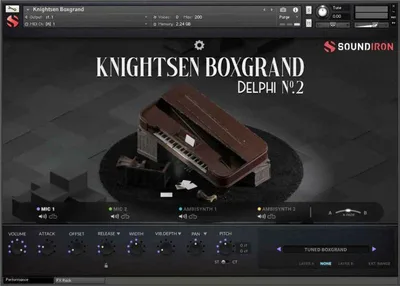
The Delphi Piano #2: The Knightsen Box Grand is a vintage-piano sound design library from Soundiron that's built for cinematic and experimental producers, not for anyone chasing a clean, concert-ready grand at $39.
We pulled it up mid-session on a sparse, tension-heavy cue. The track needed something between a prepared piano and a decayed synth pad. We'd already burned two hours cycling through cleaner libraries that just sat wrong, too polished, too present. The Knightsen Box Grand was the third roll of the dice.
First patch we landed on had this ugly, beautiful bloom to it. The attack came in half-dead, the sustain stretched into something almost orchestral, and the release had this audible rattle that should've been annoying but somehow locked to the mood of the scene. We stopped looking after that.
This is a library for producers who want character over accuracy. If that's you, read on.
First Impressions: Installing a Museum Piece
The download runs to 8.92 GB installed. That's a commitment for what some might call a niche instrument, and we won't pretend otherwise.
Installation is straightforward through Native Access, but you need the full version of Kontakt 6.2.2 or later. The free Kontakt Player locks you into demo mode. No workarounds. If you're running an older Kontakt build or only have the Player, this library is effectively inaccessible. Check your version before purchasing.
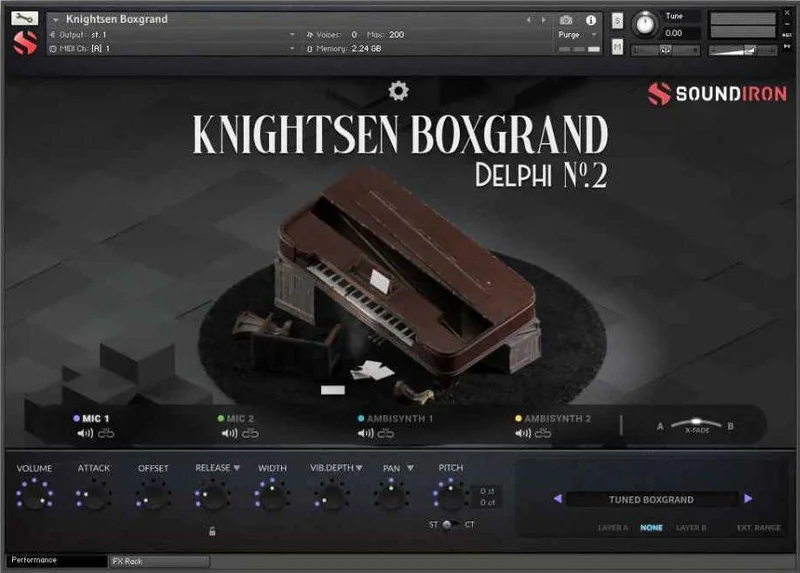
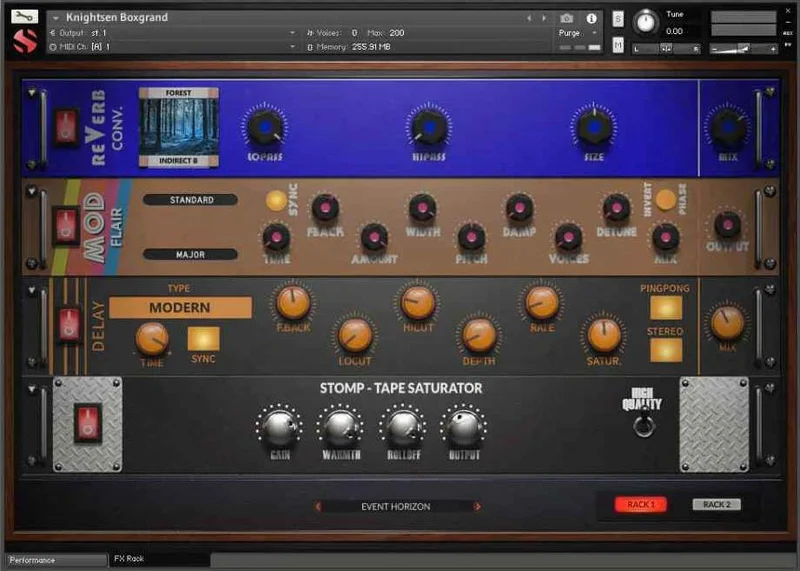
Once it's loaded, the UI hits you immediately. It's layered and dense in a satisfying way. There's clearly a lot going on under the hood, but Soundiron's interface design keeps it readable. The four independent layers are stacked visually, and each one has its own set of controls in a single horizontal strip. It doesn't feel cluttered. It feels like a mixing console for a very strange instrument.
The 37 included .nki presets give you a proper starting point. We'd recommend spending 20 minutes just cycling through them before touching a single knob. Some are immediately usable. Others are deliberately broken in interesting ways.
Getting It Into a Real Workflow
The Knightsen Box Grand isn't a drop-in piano replacement. We want to be direct about that upfront, because the word "piano" in the name might mislead people who need a Steinway.
The core piano recordings cover notes, releases, clusters, glisses, dead keys, and pedal noises. That last category is more useful than it sounds. The dead keys in particular sit wonderfully under tension-heavy cues where you want a melodic gesture that doesn't quite resolve. Sampled at 9 velocities, the dynamic range is solid. You can whisper or hammer and the response feels intentional.
The two microphone positions give you real tonal choice. The close position is direct and present, with the instrument's age visible in the sound. The room position adds space and smooths some of the harsh upper partials. We found ourselves blending the two in the mixer, treating them like close and room mics in a drum session. That approach gives you a third option that neither position delivers on its own.
The friction point we kept hitting: loading times. On a SATA drive, pulling up a new patch takes a beat longer than we'd like mid-session. An SSD is listed as recommended, and we'd call it mandatory. On SSD, patch loads are quick enough to not break flow.
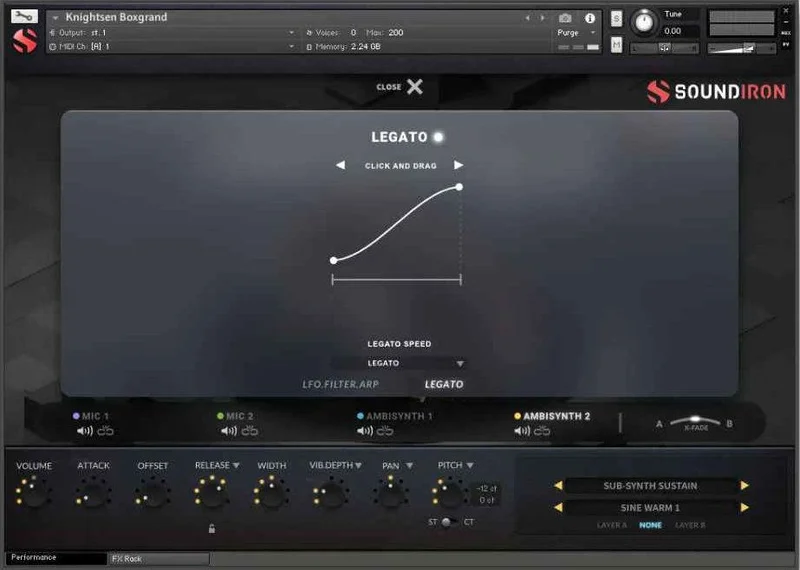
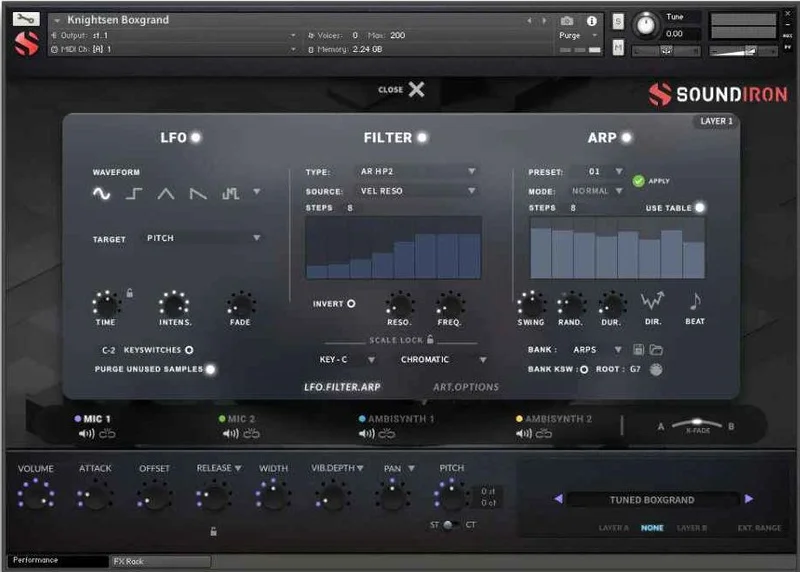
The arpeggiator and glide functions add movement without needing to automate manually. Both are straightforward to dial in, and the LFO assignment is flexible. We used the LFO routed to filter cutoff on one of the pad layers to get slow, breathing motion under a piano melody. Took about 90 seconds to set up.
What It's Genuinely Good At
The four-layer architecture is where the Knightsen Box Grand earns its price. Each layer is fully independent, with controls for swell, attack, start offset, release, vibrato, filter, coarse and fine pitch, sound bank selection, and crossfader assignment. That's not a trimmed-down set of controls. That's a real sound design engine.
We layered one of the ambient pads underneath the close piano mic, brought the pad's start offset forward by about 30%, and crossfaded it against the main piano at the crossfader. The result was a hybrid sound that started as recognisable piano and dissolved into something stranger over the length of the note. That kind of movement is hard to build quickly in a DAW using stock tools. Here it's built into the playback architecture.
The 11 multi-sampled ambient pads are a genuine bonus. They're not throwaway content. Several of them are derived from the piano source recordings, so they share harmonic DNA with the core instrument. The evolving drones particularly impressed us: slow, wide, and tonally consistent enough to underpin melodic content without clashing.
The 36 custom FX and ambient presets extend the library further into sound design territory. Some of these are brilliant, some are too abstract for most use cases, but quantity here works in your favour. We found at least eight presets we'd happily place in a finished track without modification.
The convolution reverb with custom rooms, halls, chambers and FX environments is well-matched to the instrument's character. Soundiron built environments that complement the degraded, historic quality of the source material rather than cleaning it up.
The Rough Edges
The Kontakt dependency is the hardest limitation to argue around. Kontakt 6.2.2 full version, no exceptions. That's a paid licence on top of the library cost. For anyone already running Kontakt, it's a non-issue. For anyone new to the ecosystem, it's a significant additional barrier.
The 8.92 GB installed size deserves honest scrutiny. With 2,264 stereo samples at 24-bit / 48 kHz, the file count is high and the quality is genuinely uncompressed. The size is justified technically. But it's still a large footprint for an instrument you'd reach for on specific sessions rather than daily.
We wish the UI had a randomise function on the layer banks. With four layers and multiple parameters each, discovering happy accidents by hand takes time. A single randomise button for layer combinations would make this a much faster creative tool. It's missing.
The dead keys and pedal noises, while characterful, aren't labelled with enough context in the preset names to know what you're getting before you load. Annoying when you're moving quickly through options mid-session.
Also worth flagging: CPU usage climbs when all four layers are running with LFO and filter modulation active. It's not crippling, but older systems will notice it.
Who This Is Really For
- ✅ Buy if you score for film, TV, or games and regularly need vintage piano textures with sound design depth baked in.
- ✅ Buy if you already own Kontakt full version and want a character instrument that layers well with synth pads and orchestral beds.
- ✅ Buy if you're building a Soundiron collection. This library shares design logic with other instruments in their catalogue, and the workflow knowledge transfers. See our Soundiron M1 Garand Rifle review for a sense of how their sound design sensibility applies across very different source material.
- ❌ Skip if you need a realistic, performable piano for pop or jazz production. This isn't that instrument.
- ❌ Skip if you're running Kontakt Player only. The demo mode restriction makes the library unusable for professional work.
- ❌ Skip if you're SSD-poor. On spinning disk, the load behaviour gets frustrating fast enough to undermine the creative spontaneity this instrument is built around.
Specs & Technical Details
| Developer | Soundiron |
| Price | $39 |
| Plugin Format | Kontakt .nki (requires full Kontakt 6.2.2+) |
| OS Support | Mac OS X 10.9 or higher / Windows 7 or higher |
| Activation | Native Instruments Native Access (serial) |
| CPU Usage | Medium (heavier with all 4 layers + modulation active) |
| Trial Available | No (demo mode only via free Kontakt Player, limited) |
| Version Reviewed | N/A |
| Library Size | 8.92 GB installed |
| Sample Resolution | 24-bit / 48 kHz uncompressed PCM WAV |
| Sample Count | 2,264 stereo samples |
| Presets | 37 .nki instrument presets + 36 FX/ambient presets |
| Velocity Layers | 9 velocities |
| Microphone Positions | 2 (close and room) |
| Recording Location | East Contra Costa Historical Museum, Knightsen, CA |
Score Breakdown
| Category | Score | Notes |
|---|---|---|
| Sound Quality | 4.5/5 | Distinctive, aged character with genuine tonal depth across both mic positions |
| Value for Money | 4.0/5 | Strong at $39, but Kontakt full licence is a hidden cost for newcomers |
| Ease of Use | 3.5/5 | Intuitive layout, but four-layer depth requires time investment to fully exploit |
| Features | 4.0/5 | Four-layer engine, arpeggiator, LFO, convolution reverb, 73 presets total, generous at this price |
| CPU Efficiency | 3.5/5 | Manageable on modern hardware, noticeably heavier when all layers and modulation are running simultaneously |
| Overall | 4.0/5 | A focused, characterful library that delivers on its sound design promise if you own the right Kontakt licence |
Alternatives to Consider
If you want something closer to a playable vintage piano without the heavy sound-design lean, Spitfire Audio LABS Felt Piano is free and sits beautifully in sparse arrangements. It won't give you the layering architecture or the ambient pad content, but it loads fast and plays immediately.
Native Instruments Una Corda is the most direct competitor in the "characterful, non-standard piano" space. It's a Kontakt library built around a single-string felt piano, and it has a polished UI with deeper performance controls. It costs more, and it's less bent toward cinematic sound design, but the tone is extraordinary for intimate writing.
Soundiron's own Angklung shares the same creative philosophy if you want to explore other texture-forward instruments in their catalogue. Soundiron Angklung review The Delphi series sits in the same design family, and if the Knightsen Box Grand appeals, the Angklung is a natural companion for percussive textural beds.
For context on how Soundiron approaches unusual source material more broadly, our Ancient Greek Compendium review covers the full range of their archival instrument philosophy.
Final Verdict
We loaded the Knightsen Box Grand looking for something broken in a useful way. That's exactly what we found.
The library's core strength is its honesty about what it is. Soundiron didn't try to compete with polished concert grand samples. They recorded a deteriorating museum instrument in a specific, irreproducible space, preserved every flaw at 24-bit / 48 kHz, and then built a serious sound design engine around those recordings. The result is a library that sounds like nothing else in your folder, which is exactly the value proposition.
The four-layer architecture is the reason this sits at 4.0 rather than 3.5. Being able to blend close piano, room piano, an evolving drone, and a custom ambient pad, each with independent filter, LFO, pitch, and release controls, in a single Kontakt instrument is clever design. We used it that way on every session we tested.
The dead keys are weird. The pedal noises are weirder. The glisses are occasionally frustrating to trigger musically. We love all of it for the right kind of cue and hate reaching for it on the wrong one.
At $39, the barrier is not the library cost. It's the full Kontakt licence requirement. If you've already paid that entry ticket, this is an easy recommendation for anyone working in cinematic, ambient, or experimental production. If you haven't, factor that in before adding to cart.
Skip it if you want realism. Buy it if you want the ghost of a piano from a California museum to haunt your mixes in exactly the right way.
Frequently Asked Questions
Does Delphi Piano #2: The Knightsen Box Grand work with the free Kontakt Player?
No. The free Kontakt Player runs it in demo mode only, which limits playback and disables saving. You need the full version of Kontakt 6.2.2 or later. This is a hard requirement, not a soft recommendation.
How is the Knightsen Box Grand different from a standard piano library?
It's built for sound design, not performance accuracy. The source instrument is a vintage box grand with obvious age and character, recorded with clusters, dead keys, pedal noises, and glisses alongside standard notes. The four-layer engine and 11 ambient pads push it further into cinematic texture territory than any conventional piano library.
What are the two microphone positions, and how different do they actually sound?
The close position is direct and exposes the instrument's rough edges clearly. The room position adds natural ambience and softens the upper harmonic content. Reviewers report blending both positions in the Kontakt mixer gives the widest tonal range. We'd agree: neither alone is as useful as the combination.
Is 8.92 GB a reasonable size for this type of library?
It's on the larger side for a single instrument library at this price point. The size comes from 2,264 uncompressed 24-bit / 48 kHz stereo samples, plus 11 multi-sampled pads and dozens of FX presets. If storage is tight, factor this in. If you have the space, the uncompressed quality is worth it.
Can the Knightsen Box Grand be used for melodic lead writing, or is it primarily textural?
Both, depending on the preset. The core piano patches are melodically playable across 9 velocity layers and respond well to expressive playing. The ambient and FX presets are more textural. The four-layer engine lets you build hybrid patches that sit somewhere between the two, which is where the library is most satisfying to work with.