We were three hours into a late-night folk-pop session when the producer pointed at the piano track and said “it sounds too new.” He was right. The bright, sterile attack of the stock grand was killing the warmth we’d built with a ribbon mic and a vintage-flavoured vocal chain. That’s when we loaded Sampleson’s 1959, a sampled virtual instrument built around the character of a specific era rather than a specific model. Within two minutes the piano sat differently. Less sheen, more body, a slight roughness in the attack that read as lived-in rather than broken. This review covers whether that first impression holds across a full mix, who this actually serves, and where it falls short.
First Impressions: Opening 1959 for the First Time
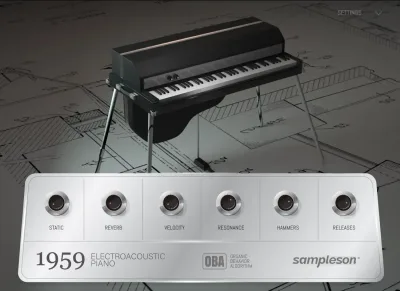
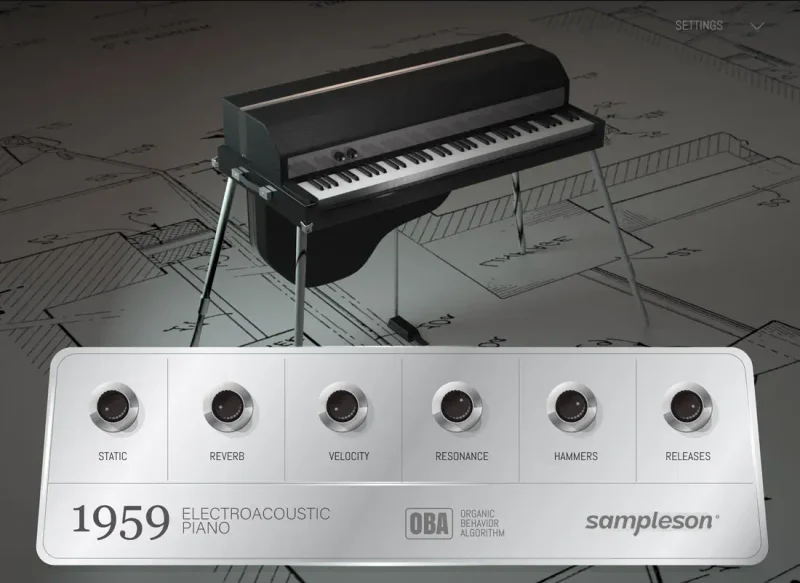
The install is painless. One file, standard format, shows up in your DAW’s instrument browser without drama. The UI fits on a laptop screen without scrolling, which we appreciate more than most reviewers admit. It’s a single-page layout: a visual of the instrument, a handful of macro controls, and a microphone position selector. No deep menu-diving on launch. We played the first chord within 30 seconds of opening it. The sound that came back had a clear 300-400Hz weight that most modern piano libraries thin out to sound “professional.” Annoying how rare that is. The default patch is immediately usable, not a starting point that needs five minutes of tweaking before it’s tolerable.
Getting 1959 Into a Real Workflow
We tested it across three session types: a lo-fi hip-hop beat, a Nashville-style country demo, and that folk-pop session mentioned above. In all three, the drag-and-drop MIDI-to-instrument workflow was frictionless. It plays like a piano, responds to velocity with a natural rolloff, and doesn’t eat your CPU while doing it. We tracked around 4-6% CPU on an M1 Mac at a 128-sample buffer, which is light enough to run multiple instances without a second thought.
The friction shows up when you want to go further. There’s no onboard reverb with tail control, no built-in saturation stack, and no macro-to-MIDI-CC mapping baked in. You’ll be reaching for your own send chain immediately. That’s not a dealbreaker for experienced producers who have a signal chain already built, but if you’re hoping for a self-contained instrument, this isn’t it.
We did find one annoying workflow snag: the mic position selector changes the character significantly, but there’s no A/B toggle. You switch, you wait a beat, you judge. For a plugin built around subtle tonal decisions, a proper A/B comparison tool feels like an obvious omission.
What 1959 Is Genuinely Good At
The midrange character is where this plugin earns its name. We ran a chord voicing through a spectrum analyser alongside a competing modern grand library. The 1959 showed a consistent 2-3dB presence bump between 250Hz and 500Hz that the modern library had rolled off. That’s the frequency range that makes an old upright feel like it’s in the room with you rather than in a recording.
We also love how it handles soft velocity hits. Below velocity 60, the samples have a breathiness that most libraries paper over with a clean, low-volume version of the loud sample. Here, the low-velocity layer sounds different in texture, not just volume. That matters for sparse arrangements where every ghost note needs its own character.
The upper register does thin noticeably above C6. Above that point, samples sound plausible but not convincing. Keep your arrangements in the low-to-mid register and 1959 sounds satisfying throughout. Stray into the top octave and you’ll notice the difference.
The Rough Edges
The sample depth issue above C6 is the main sonic complaint. It’s not unusable, but it’s audible to anyone who plays piano regularly.
Beyond that, the limited routing options become frustrating if you want to push into creative territory. No internal LFO for the mic bleed simulation, no built-in tape wobble, no way to add harmonic saturation without exiting to a separate plugin. Competitors like Noire by Native Instruments and Keyscape by Spectrasonics both offer internal effects chains that let you stay inside the instrument longer.
The price is worth checking directly on Sampleson’s site since it shifts with sales, but in the tier it typically occupies, you’re getting a focused tool, not a feature-rich workstation. That’s a legitimate design choice. But if you need depth as well as character, you’ll feel the ceiling quickly.
Who 1959 Is R
eally For
- ✅ Buy if you produce lo-fi, folk, Americana, or vintage soul and need a piano that sounds aged without excessive post-processing.
- ✅ Buy if you already have a deep effects chain and just need a character source at the instrument level.
- ✅ Buy if CPU overhead is a genuine concern and you need something light that still delivers tonal personality.
- ❌ Skip if you need a full-range concert grand with convincing top-octave response.
- ❌ Skip if you want a self-contained instrument with onboard effects and modulation routing.
- ❌ Skip if your music lives in bright, modern pop production where this character will sound out of place rather than intentional.
Score Breakdown
| Category | Score | Notes |
|---|---|---|
| Sound Quality | 4.0/5 | Excellent in the low-to-mid register; upper range thins above C6 |
| Value for Money | 4.0/5 | Competitive for what it does, especially with a free tier to test first |
| Ease of Use | 4.5/5 | Single-page UI, immediate playability, no learning curve |
| Features | 3.0/5 | Deliberately minimal; no onboard effects chain or modulation routing |
| CPU Efficiency | 4.5/5 | Light enough for multiple instances without buffer issues |
| Overall | 4.1/5 | A focused, honest-sounding tool that knows exactly what it is |
Alternatives Worth Considering
If the upper-register thinning or the lack of onboard effects is a dealbreaker, here are three alternatives we’d point you toward.
Noire by Native Instruments sits in a similar character space but adds a full felt and prepared piano system, plus a built-in particle engine for texture. It costs more and uses more CPU, but the sample depth is consistent across the full range.
Keyscape by Spectrasonics is the obvious upper-end comparison. Over 500 instruments, multi-layer sampling, and an internal effects rig. Significantly heavier on CPU and much more expensive, but it’s the benchmark for this type of vintage-character keyboard library.
For a lo-fi-specific option at a lower price point, Lo-Fi Piano by BABY Audio covers degraded, aged piano tones with tape and vinyl processing baked in. Less versatile than 1959, but more committed to the aesthetic if that’s your whole angle.
If you’re mainly looking for a vintage piano character for sparse, intimate production and you don’t need a full-range instrument, 1959 is a clever buy. Check Sampleson’s site for the current price, grab the free tier first, and load it on a bare acoustic arrangement before deciding. If it doesn’t immediately solve your “sounds too new” problem on that track, it won’t solve it anywhere else either. That’s the honest test.
Frequently Asked Questions
Is Sampleson 1959 a free plugin?
Sampleson offers a free tier of 1959 that lets you audition the core sound before purchasing the full version. The free version has feature limitations, so check the Sampleson site for exactly what's included in each tier. It's enough to know whether the character works for your productions.
What kind of instrument does Sampleson 1959 sample?
1959 is built around the tonal character of a vintage keyboard instrument from the late 1950s era, prioritising aged midrange density and natural imperfections over clinical accuracy. Sampleson doesn't market it as a replica of a specific named instrument, which is part of what makes the character feel less "library" and more "found sound."
Does 1959 work well for lo-fi hip-hop production?
Yes, it's one of the stronger use cases. The built-in tonal weight and slight roughness in the attack sit naturally in lo-fi contexts without needing heavy processing to achieve that aged quality. You'll still want to add your own vinyl saturation or tape warble from a separate plugin, but the source sound is already pointed in the right direction.
How does 1959 compare to other vintage piano plugins in terms of CPU?
Lighter than most comparable character libraries. We tracked 4-6% CPU on an M1 Mac at 128 samples, which is low enough to run multiple instances in a session. Keyscape by Spectrasonics, for comparison, runs noticeably heavier under similar conditions. If CPU overhead matters to your rig, 1959 has a real advantage there.