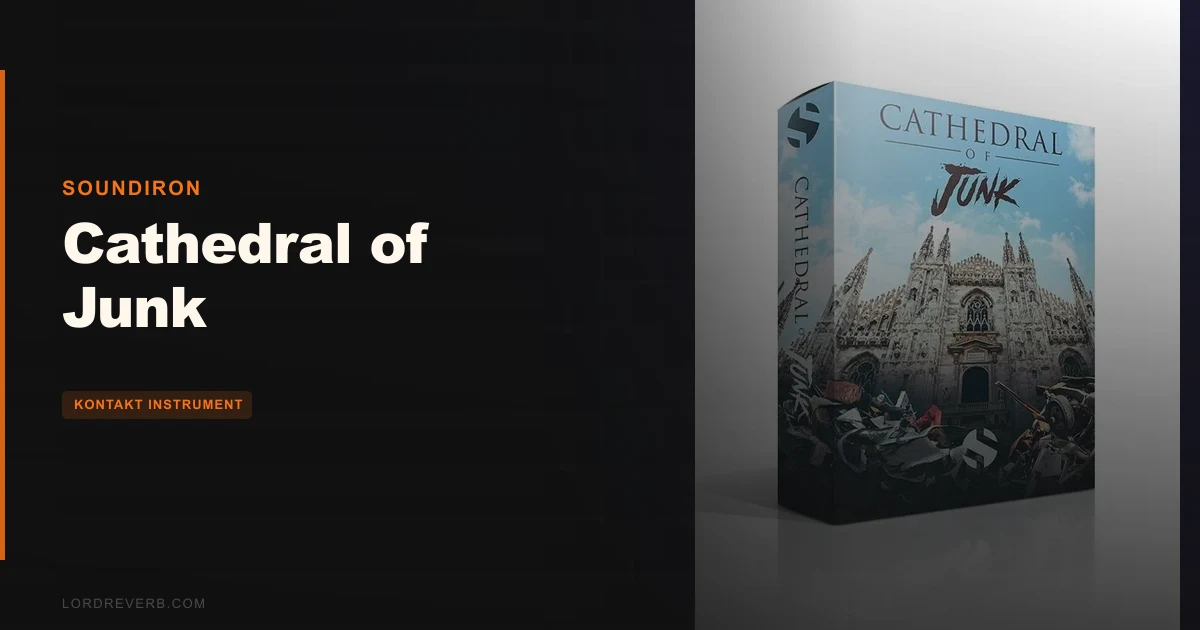
Cathedral of Junk is a Kontakt sample library by Soundiron built from percussion recordings inside Vince Hannemann's real 30-foot junk sculpture in Austin, Texas, and at $19, it's one of the more interesting micro-libraries we've pulled into a session.
We loaded it on a Tuesday afternoon, wedged between finishing a drum bus and stalling on a transition. The first patch we hit was the Saw Blade. One key press and a sharp, shimmering ring cut through the monitors. Not a cymbal. Not a triangle. Something genuinely uncomfortable in the best way possible.
Then we hit the Chandelier. Big, glass-heavy decay. The kind of thing that doesn't sit in a mix so much as hover above it.
That first session told us most of what we needed to know. This library is clever, specific, and completely useless if you need traditional drums. It's built for the producer who needs one weird thing to make a track feel alive.
What It Is (and What It's Not)
This is a percussion texture library. Full stop. It's 23 sampled objects from a backyard junk cathedral: bent cymbals, saw blades, a water cooler, an artificial leg, piano strings, tin cans. Soundiron's team physically visited the structure, pulled sounds out of it with drumsticks, and programmed the results into Kontakt.
It is not a traditional percussion library. You won't find kicks, snares, or anything close to a standard drum kit. It's not a replacement for something like a cinematic orchestral percussion pack either.
What it is: a character source. A tool for rhythmic texture, ambient beds, and transitions. The kind of sound you reach for when everything else sounds too normal.
It's also not Kontakt Player compatible. If you're running the free Player, you'll hit demo mode instantly. You need the full retail version of Kontakt 5.5 or higher. That's a hard wall worth knowing before you buy.
Living With It
Setup is painless. The install lands at 542 MB, which is nothing. Load times in Kontakt are fast. No drama there.
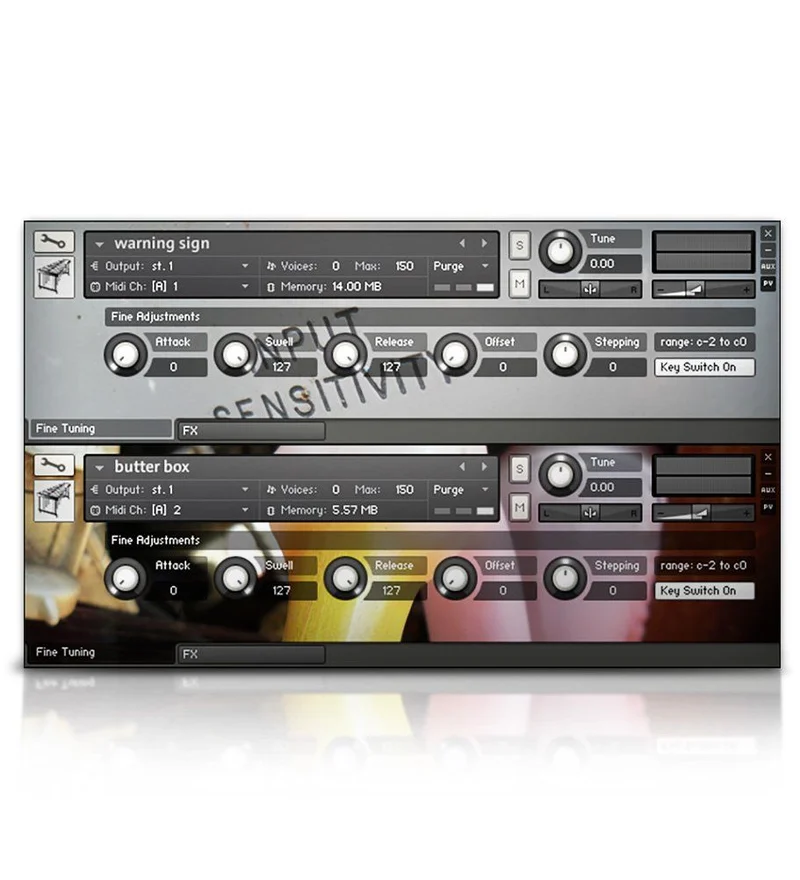
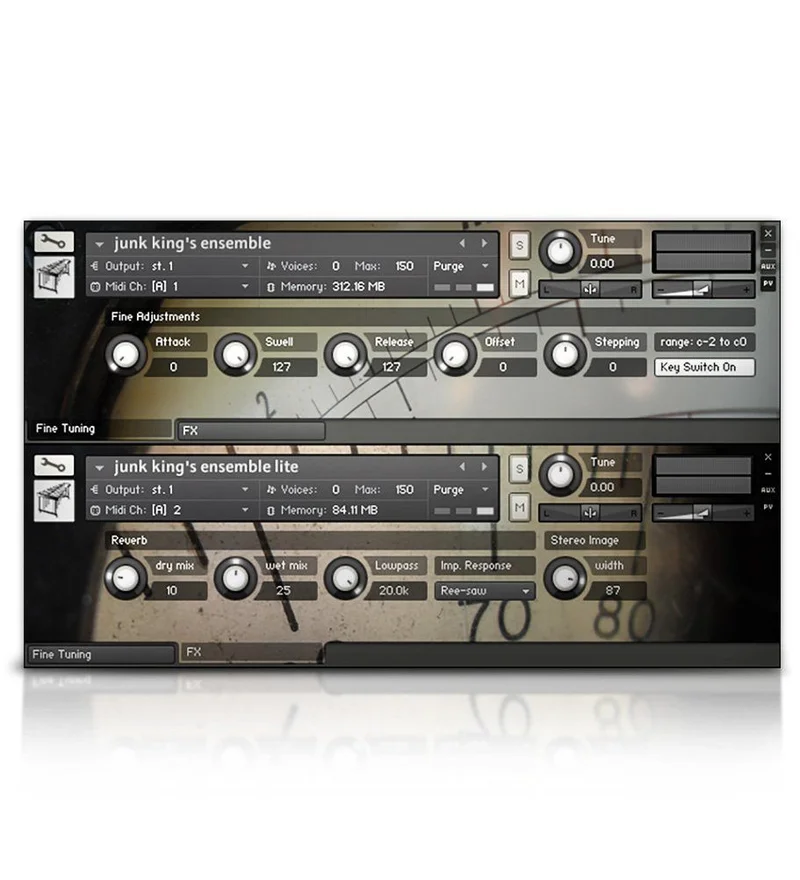
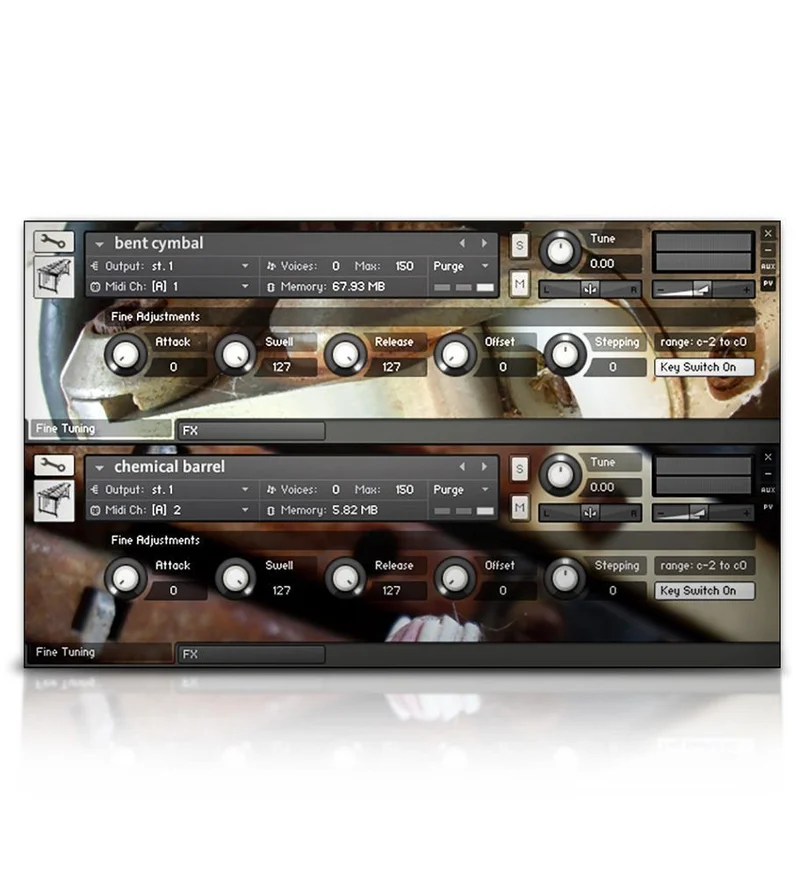
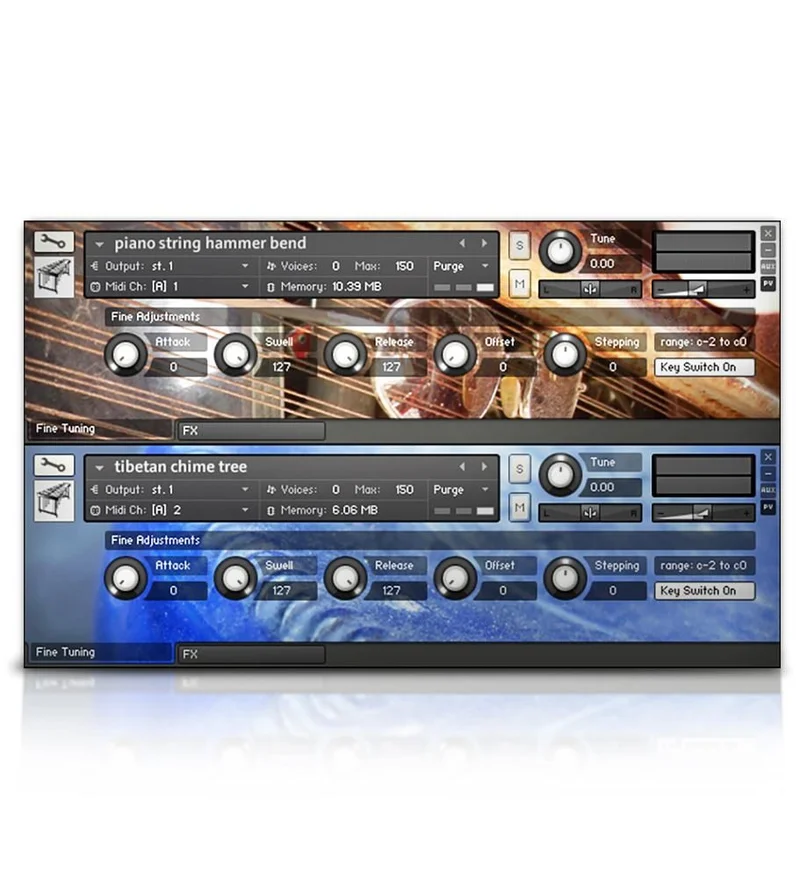
The interface is Soundiron's standard multi-layer layout. You get swell, attack, release, offset, vibrato, filter, coarse and fine pitch controls, articulation switching, and crossfading between layers. The LFO system lets you pick your shape, set modulation target, tempo-sync it, and dial in fade-in time. That's more control than most libraries at this price point offer.
The FX rack is where we spent most of our time. Eighteen DSP modules assignable across 10 slots in any order. Phaser, flanger, delay, distortion, amp and cab sims, compressor, EQ, rotator. The convolution reverb pulls from 99 rooms, halls, chambers, and outdoor environments, plus 40 custom FX impulses.
We ran the Galvanized Bar through the convolution reverb set to a large outdoor space. The result was this wide, metallic shimmer that sat beautifully under a synth pad. That was satisfying. Genuinely satisfying in a way that off-the-shelf percussion rarely is.
The arpeggiator is a nice bonus. Velocity table, direction control, swing, randomization, duration. It turns the Junk Bell or the Tibetan Chime Tree into something rhythmically alive without any additional sequencing.
One frustration: 521 samples split across 23 instruments works out to roughly 22 samples per patch. That's lean. On sustained notes especially, you'll hear the seams. It's not deal-breaking on transient-heavy sources like the Saw Blade, but it shows on anything with a long tail.
The Trade-Offs
The source material is the whole argument for buying this. Nothing else samples this specific structure. That's a real differentiator. If you want the sound of a 50-ton junk cathedral in Austin, this is literally your only option.
But "unique" and "useful" aren't the same thing. This library fits a narrow production zone: left-field electronic, experimental hip-hop, horror and dark ambient scoring, sound design for film. Step outside those and the instruments become decorative at best.
The FX rack depth helps. You can process these sounds far enough from their source that the Chandelier becomes unrecognizable and genuinely versatile. That buys the library extra mileage. But you're working harder for results that a broader library might hand you faster.
The Kontakt Player restriction is the trade-off that stings most. At $19, this is an impulse buy. But if it surfaces after purchase that you only own the Player, it's suddenly a frustrating impulse buy. Soundiron is clear about this requirement, but it catches people.
We'd also love more round-robin samples. The current count makes heavy repetitive use noticeable. For ambient or sparse work, that's fine. For a driving rhythm part that loops, the machine-gun effect creeps in.
Against the Field
If you want broader industrial percussion with more sample depth, look at something like Output's Signal or Spitfire's Felt instruments. They cover more sonic territory with higher round-robin counts. But they're not cheap, and they don't have a Cathedral of Junk patch.
For similarly priced Soundiron micro-libraries, the Angklung covers comparable novelty-instrument territory with tuned melodic content. If you need something that sits more in a harmonic role rather than pure rhythm, that's worth comparing.
Free alternatives exist for industrial percussion in the sample-pack world. But none come with Kontakt's modulation architecture or the FX rack depth that Cathedral of Junk ships with. For sound design flexibility inside Kontakt, the library earns its price.
If you're newer to this kind of instrument, the Kontakt Instruments Guide is worth reading before committing to any open-format library.
The Real Verdict
Cathedral of Junk is a love-it-or-never-load-it-again library. We love it for what it is. We'd also never recommend it as someone's first or main percussion library.
At $19 with 542 MB and 23 playable instruments built from a real structure that no one else has sampled, the value is real for the right producer. The FX rack alone adds flexibility that goes well beyond what the source material implies.
Skip it if you only have Kontakt Player. Skip it if you need a workhorse. Buy it if you're hunting for the one sound that makes someone say "what was that?"
Specs & Technical Details
| Developer | Soundiron |
| Price | $19 |
| Plugin Format | Kontakt Instrument (.nki), open format |
| OS Support | Mac OSX 10.9+ / Windows 7+ |
| Activation | Serial / download, no additional DRM |
| CPU Usage | Light |
| Trial Available | No (Kontakt Player demo mode only, limited) |
| Version Reviewed | Kontakt 5.5+ compatible build |
| Install Size | 542 MB |
| Sample Count | 521 samples, 24-bit / 48 kHz uncompressed PCM WAV |
| Kontakt Requirement | Full retail Kontakt 5.5 or later, Player NOT supported |
| Presets | 20 custom sound-designed FX and ambient presets |
| FX Modules | 18 DSP modules across 10 assignable slots |
| Convolution Reverb IRs | 99 rooms/halls/chambers + 40 custom FX impulses |
Score Breakdown
| Category | Score | Notes |
|---|---|---|
| Sound Quality | 4.0/5 | Source material is genuinely irreplaceable; 521 samples shows on sustained patches |
| Value for Money | 4.0/5 | Strong at $19 if you're in the target use case; weaker if you're not |
| Ease of Use | 3.5/5 | Interface is deep but Kontakt Player lockout is an ugly surprise for some buyers |
| Features | 3.5/5 | FX rack and LFO system are generous; instrument count and round-robins are lean |
| CPU Efficiency | 4.5/5 | 542 MB footprint, light CPU draw, loads and plays without drama |
| Overall | 3.5/5 | Brilliant source, limited range, the right tool for a specific job |
Alternatives to Consider
If you want broader percussion coverage with more sample depth and don't mind spending more, look at Loot Audio Palm Mute Piano for a different kind of character instrument, tuned, specific, and built for texture in a similar niche-but-useful way.
For more Soundiron micro-library comparisons, we've reviewed the Soundiron Angklung, which covers melodic novelty territory at a comparable investment. If you want harmonic content over rhythmic percussion, that's your comparison point.
Soundiron's Ancient Greek Compendium is worth a look if you're buying into the Soundiron ecosystem more seriously. It's a much larger commitment but covers far more sonic ground. And if the M1 Garand Rifle's strange industrial character appeals to you, the Soundiron M1 Garand Rifle sits in adjacent weird-percussion territory.
Cathedral of Junk earns its place in a collection. It doesn't replace a collection. Buy it knowing that, and you won't be annoyed.
Related reviews: Can 1 Plugin Nail Elizabethan Tone? Crumhorn Review
Frequently Asked Questions
Does Cathedral of Junk work with the free Kontakt Player?
No. This is an open-format Kontakt library, which means the free Kontakt Player only runs it in a limited demo mode. You need the full retail version of Native Instruments Kontakt 5.5 or later to access the complete instrument. This is a hard requirement, not a suggestion. Check which version you own before purchasing.
What kind of music is Cathedral of Junk built for?
It works best in left-field electronic, experimental hip-hop, dark ambient, and cinematic scoring. The 23 instruments, saw blades, chandeliers, water coolers, bent cymbals, are rhythmic texture sources, not traditional drums. If you need a conventional percussion library, this isn't it. If you need the one weird sound that no one else has, it might be exactly right.
How big is the Cathedral of Junk download?
The installed size is 542 MB. That's a light footprint by Kontakt library standards. The samples are 24-bit / 48 kHz uncompressed PCM WAV files. You also get 521 individual samples and 20 custom sound-designed presets across the package. Load times inside Kontakt are fast.
Is the Cathedral of Junk a real place?
Yes. Vince Hannemann's Cathedral of Junk is a real structure in the South Congress area of Austin, Texas. It stands roughly 30 feet tall, weighs over 50 tons, and is built from decades of collected scrap: old TVs, car parts, appliances, machinery, and more. Soundiron visited the structure in person, selected objects, and recorded them with drumsticks. The library is built from those actual recordings.