Palm Mute Piano is a 2.6GB Kontakt instrument from Loot Audio that samples a 1960 Danemann Grand Piano with the player's fingers resting against the strings, producing a quiet, stealthy, dampened tone that sits closer to a prepared piano than a standard grand.
We were tracking a late-night noir scene. The brief called for "piano, but wrong." Not detuned. Not lo-fi. Just wrong in a way that felt intentional. We'd already burned an afternoon cycling through prepared piano patches from three different libraries. They all sounded like prepared piano. Obvious. Expected.
Then we loaded Palm Mute Piano. Hit a chord in the middle register. Stopped.
It sounded like someone had put a hand over the strings mid-resonance. Muted but not dead. Present but hushed. That's the technique at work: fingers or palm resting lightly on the strings as the hammer strikes, killing sustain and partial overtones without silencing the note. Guitar and bass players know this move well. On piano it's rarer, stranger, and in this library it's captured with enough nuance to actually be useful.
This review is for composers, film scorers, and jazz producers who are bored of every piano sounding like a piano.
First Impressions: Installing a 2013 Library in 2026
The download is 2.6GB. That's honest. No bloat, no padding. Installation is standard Kontakt drag-and-drop, and the library opens clean in Kontakt 7 with no compatibility warnings.
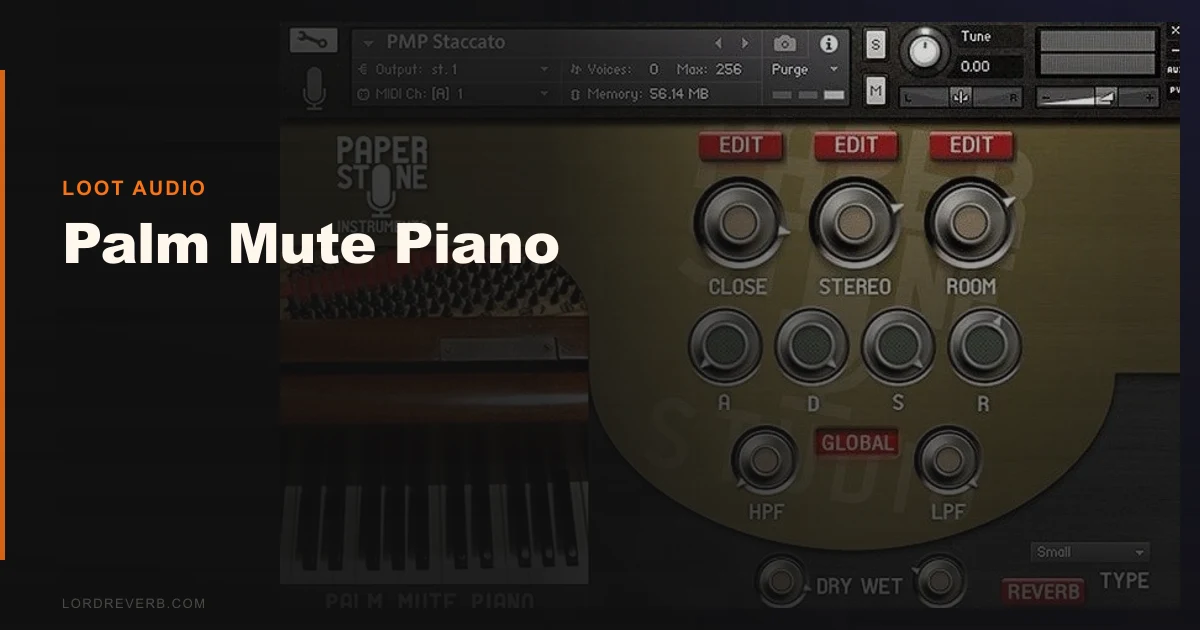
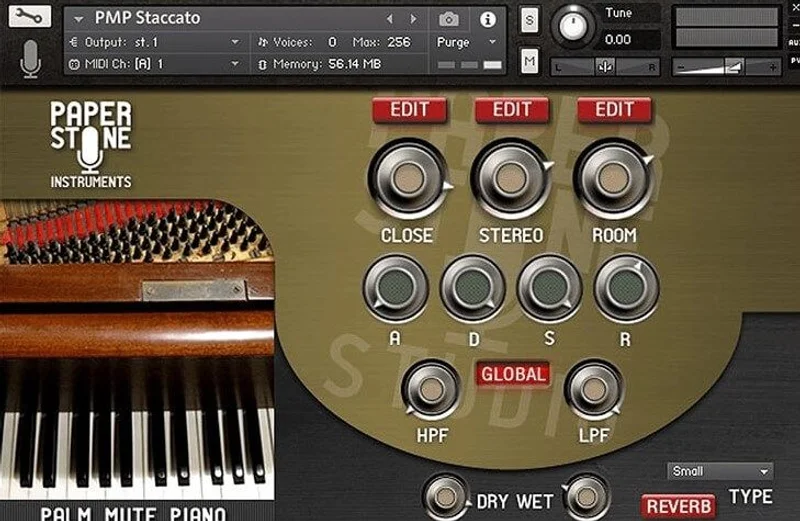
The UI is visibly dated. There's no NKS integration, no browser tagging, no fancy graphics. What you get is a functional instrument page with mic mix controls for Close, Stereo, and Room positions, a basic envelope section, and articulation switching. That's it.
We found it slightly frustrating that there's no built-in preset browser. You're loading one instrument and working from there. For a single-concept library, that's fine. For a first impression in 2026, it feels sparse.
The upside is that it loads fast. Under 10 seconds on a modern system. No complaints there.
Getting It Into a Real Workflow
The library ships with three articulation types: staccato, sustain, and pedalled, each sampled at three velocity layers. That's lean but functional. You're not going to layer 12 articulations here. You pick the one that serves the moment.
We mapped it across a cue that needed a repeating melodic figure, something minimal, something that wouldn't fight a sparse string pad. The sustain articulation at mid velocity hit exactly right. Notes decayed quickly, leaving space without disappearing completely.
The key range stops at C5. That's the friction point. For melodic work in the upper register, that ceiling is annoying. We had to transpose passages down an octave twice to stay within playable range, which changed the harmonic feel of what we'd written. Not a dealbreaker, but a real limitation worth knowing before you buy.
Mic blending is where the workflow gets satisfying. Pushing the Room mic up about 30% behind a dry Close signal adds size without reverb smear. It's a clever design choice for a library this focused.
One genuine snag: this instrument requires the full version of Kontakt 4.2.3 or higher. Kontakt Player won't cut it. If you only own the free Player, you're out. Check before you buy.
For DAW integration, it behaves like any other Kontakt instrument. MIDI learn works, automation works, and CPU draw is light. We saw no spikes on an Apple M2 running Kontakt 7 inside Logic Pro.
What It's Genuinely Good At
The core sound is the strength. 1737 stereo samples at 24-bit/44.1kHz means the multisampling is dense enough that velocity transitions don't betray themselves. Play a melodic line across velocity layers and it tracks smoothly. That's harder to pull off than it sounds on a library this niche.
The Danemann Grand is a 6'8" mahogany instrument built around 1960. That age and that wood show up in the character. The low-mid register has a slight warmth that translates to about a 2-3dB presence bump in the 200-400Hz range compared to a bright modern grand sample. It sits under other instruments naturally, which is rare for piano.
We ran the pedalled articulation through a cue with solo cello. No EQ, no compression. It fit. That's the love you feel when a library doesn't fight you.
The five mic positions give you real control. Close is dry and detailed. Stereo widens the image cleanly. Room adds depth. Blend them to taste. This alone lifts Palm Mute Piano above single-mic budget libraries.
For cinematic underscore, jazz, ambient, and sparse lo-fi work, this is a clever and underrated tool.
The Rough Edges
Three velocity layers is thin. Modern piano libraries ship with five to eight. At extreme dynamics, especially pianissimo passages, the transitions are audible if you listen for them.
The C5 ceiling. We've said it. It's a real constraint.
There's no built-in reverb or effects engine. That's fine philosophically, but given the library is positioned as a creative texture tool, even a basic convolution room would help producers audition sounds faster.
The 2013 build date also means there's been no meaningful update in over a decade. No expanded velocity layers, no additional articulations, no UI refresh. Loot Audio has other releases, including their Blossom instrument, that show what the studio can do with a more modern build. Palm Mute Piano feels like a snapshot rather than a living product.
At $40 USD, none of this is disqualifying. But you should know what you're buying into.
Who This Is Really For
- ✅ Buy if you score for film, TV, or games and need a piano texture that reads as "wrong" without being gimmicky.
- ✅ Buy if you produce jazz or ambient music and want a piano that disappears into a mix at low velocities.
- ✅ Buy if you own Kontakt full version and have been looking for a genuinely unusual single-concept library at an affordable price.
- ❌ Skip if you only have Kontakt Player. It won't load.
- ❌ Skip if you need a full-range piano. The C5 ceiling will frustrate you constantly.
- ❌ Skip if you're after a main piano library. This is a texture tool, not a workhorse.
Score Breakdown
| Category | Score | Notes |
|---|---|---|
| Sound Quality | 4.0/5 | The dampened Danemann character is genuinely distinctive; velocity transitions are the only weak point |
| Value for Money | 3.5/5 | $40 for this niche is fair, but no updates in 13 years hurts the long-term case |
| Ease of Use | 3.0/5 | Simple to load, but dated UI and no preset browser slow the audition process |
| Features | 3.0/5 | 5 mic positions are great; only 3 velocity layers and no effects engine are real gaps |
| CPU Efficiency | 4.5/5 | Loads fast, runs light, zero issues on modern systems |
| Overall | 3.8/5 | A clever, specific, honest-sounding library that serves a narrow brief very well |
Alternatives to Consider
If you need a broader prepared or unconventional piano library, Spitfire Audio LABS offers free textured piano instruments with more articulation depth and a modern UI. Worth loading before you spend anything.
Pianobook has several community-built dampened and prepared piano instruments at no cost. Quality varies, but the best of them rival Palm Mute Piano's character. Check their catalog before committing $40.
If you want a full Loot Audio instrument with a more modern feature set, their Blossom reviewed here is worth comparing. It shows how the developer has grown since 2013. You might find it fits your signal chain better depending on the genre you're working in.
For anyone deep in the cinematic piano library space, it's also worth considering whether a broader niche library like Felt Instruments' offerings covers your dampened-piano need alongside more articulation variety.
Our Verdict
Palm Mute Piano does one thing: it captures what a Danemann Grand sounds like when you put your hand on the strings. It does that thing honestly, with 1737 samples, five mic positions, and a character that genuinely doesn't sound like anything else in a standard library folder.
It's not for everyone. It's not a main piano. It's not a feature-rich modern instrument. It's a 2013 library that hasn't been updated and shows it.
But load it under a string quartet cue, play a quiet minor chord in the middle register, and you'll know within four seconds whether you need this. Most of you will.
At $40, we'd buy it. If you only have Kontakt Player, close the tab.
Frequently Asked Questions
Does Palm Mute Piano work with Kontakt Player?
No. This library requires the full version of Kontakt, minimum 4.2.3. Kontakt Player will open it in a 15-minute demo mode only. If you're using the free Player, this library won't be functional for production work.
What is palm muting on a piano and how does it differ from a standard piano sound?
Palm muting on piano means resting fingers or a palm lightly against the strings before or during the hammer strike. This dampens sustain and suppresses higher harmonics, producing a short, muted tone. It's the same principle used in guitar palm muting, but applied to a grand piano's string bed. The result is a sound closer to a prepared piano or a muted upright than a standard concert grand.
What key range does Palm Mute Piano cover?
The instrument covers A-1 to C5. That stops short of a full 88-key range and cuts the upper octave most pianists rely on. For melodic writing in higher registers, you'll need to transpose passages down or supplement with another library. It's a real limitation for anything outside low and mid-register work.
Is Palm Mute Piano good for lo-fi and ambient music production?
Yes, and it's one of the stronger use cases. The short decay, natural string character, and low-mid warmth from the 1960 Danemann Grand sit well in lo-fi and ambient contexts without needing heavy processing. Run the Close mic at around 70% with a hint of Room, keep velocity in the 40-70 range, and it locks in quickly. You'll likely need a quality reverb plugin behind it to open the space up for ambient work.