
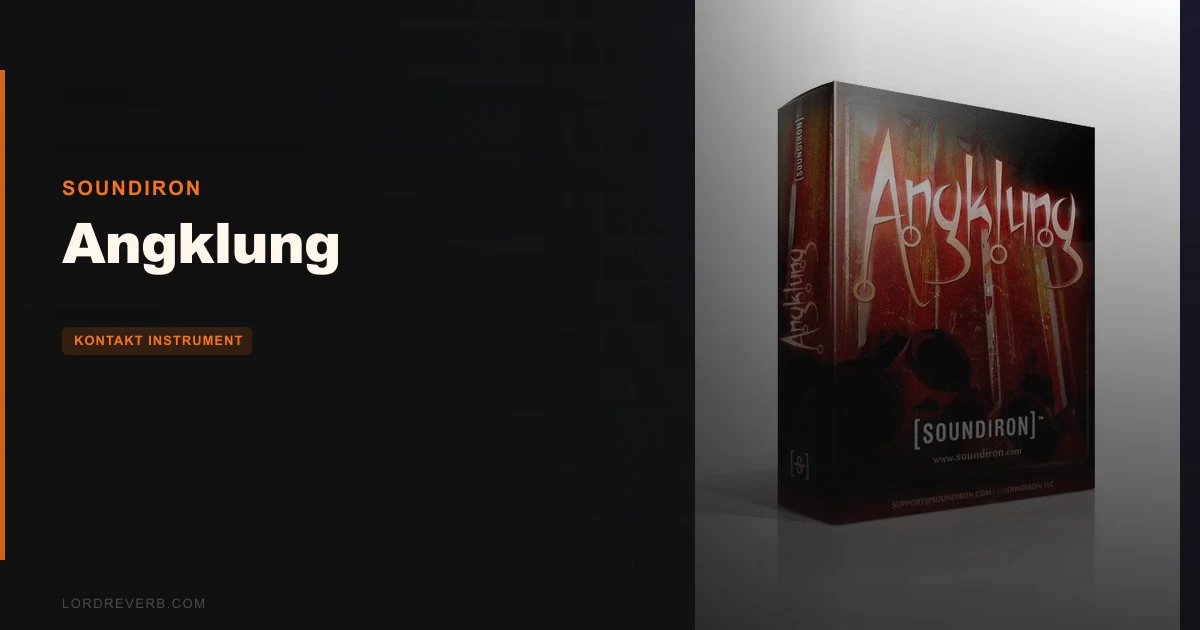
Soundiron's Angklung is a 3.5 GB, deeply-sampled Kontakt library of the Indonesian bamboo rattle instrument, built for composers who need authentic Southeast Asian texture without flying to Bandung to record it themselves.
We were knee-deep in a cue for a documentary set around the Java Sea. The director wanted something that felt handmade and communal, not another marimba or steel pan patch. We loaded Soundiron's Angklung, hit the EZ-Roll mode on the Uberpeggiator, and played a C major arpeggio at 92 BPM. Twenty seconds later, the director stopped talking. That doesn't happen often.
At $49, this sits in a narrow category with almost no direct competition. If you score to picture, produce world-fusion tracks, or just want to add genuine bamboo texture to a production, this library earns serious consideration. It's not perfect. But it's the best sampled angklung we've found in the box.
First Impressions: Opening the Box
Installation is standard Soundiron procedure. Download, extract, point Kontakt's file browser at the folder. It won't show up in the Libraries tab because this is an open-format library, not a Kontakt Player instrument. If you're new to Soundiron's releases, that distinction trips people up. You need full retail Kontakt 4.2.4 or later. No workarounds.
The GUI loads clean. There's a custom Soundiron interface with attack, offset, release, swell, micro-tuning, and width controls all visible without scrolling. The Uberpeggiator sits at the top, clearly labelled. Seven presets load fast from the file browser. Not a huge menu. But what's there is focused.
The dry studio preset is our first stop every session. It sounds exactly like an angklung should: short, clear, slightly buzzy from the bamboo rattle, with a note that dies quickly and honestly.
Getting It Into a Real Workflow
Here's where it gets interesting. We dropped the hall preset onto a strings bed in Logic, sent it to a light reverb bus, and tried to play a melody line. Without the Uberpeggiator, the instrument behaves like any other tuned percussion sampler: one hit per key, short decay, done. That's fine for single-strike accents. But it's not how an angklung actually sounds in an ensemble.
Flipping EZ-Roll mode on was the moment the library clicked. You dial in the tempo sync, set intensity with the mod wheel, and the Uberpeggiator generates a fluid tremolo that crossfades between up and down strokes. We had 48 round-robin variations on the dry samples to pull from, so the machine-gun effect that plagues lesser libraries never appeared in our session.
The friction point is the learning curve for Uberpeggiator itself. It's Soundiron's proprietary system and it doesn't behave like a standard DAW arpeggiator. Budget 30 minutes with the manual the first time. After that, it's fast. That's a one-time investment worth making.
Width control is a feature we've come to love. It spreads individual angklung voices left to right across the stereo field based on key position, simulating the way a real ensemble fans out across a stage. Bring it up to about 70% and the instrument suddenly sounds like 8 players, not a single sampler track.
What It's Genuinely Good At
The round-robin count is where Soundiron earns their price. Forty-eight variations per velocity, per note on the dry samples (24 up-stroke, 24 down-stroke) is serious work. We looped a 4-bar ostinato at 110 BPM for 3 minutes and never heard a repeated sample. That's the test that exposes lazy libraries. This one passed cleanly.
The mic positions matter more than you'd expect. Close mic adds attack and bamboo clatter. Mid hall gives body. Far hall blurs the transient and deepens the room sound. We found a blend of 60% mid, 40% far worked brilliantly on orchestral cues where the angklung needed to sit behind strings. For a foreground solo line, close mic at 80% gave us the necessary presence.
The included ambiences and pads, built from the raw angklung recordings, are a surprise bonus. We've used them as bed textures under dialogue scenes. They carry the character of bamboo without being identifiable as angklung. Underrated part of this library.
Three microphone positions also mean the hall preset alone covers a wide range of placement options. That's flexibility most single-instrument libraries skip entirely.
The Rough Edges
Seven presets. That's it. For a 3.5 GB library, we wish Soundiron had shipped more starting points, particularly for non-major-scale contexts. The instrument is tuned over a major scale spanning nearly 3 octaves. That covers most Western composition needs. But if you're writing in a minor-pentatonic context or trying to evoke a specific regional tuning, you're doing manual micro-tuning work yourself.
The Kontakt Player restriction is frustrating for producers who don't already own full Kontakt. It's a real barrier. The free Player won't open this. No exceptions.
CPU load is light once loaded. But the library sits at 3.5 GB installed, and loading the hall preset with all three mic positions active pulls significant RAM. On older systems with 8 GB or less, we'd recommend working with one or two mic positions blended at source rather than running all three simultaneously.
There's also no legato scripting for melodic lines. Notes don't connect smoothly when played slowly. For fast rolls and rhythmic passages, that's fine. For a slow, expressive melody, you'll hear the gaps. It's the nature of the instrument, but it's worth knowing before you buy.
Who This Is Really For
- ✅ Buy if you score to picture and need culturally specific world percussion that stands up to close listening
- ✅ Buy if you already own full retail Kontakt and produce world-fusion, gamelan-adjacent, or Southeast Asian-influenced music
- ✅ Buy if you want to build custom angklung patches, because the unlocked WAVs let you drag samples into any sampler you like
- ❌ Skip if you only have the free Kontakt Player. It won't load this library at all.
- ❌ Skip if you need minor-scale or chromatic angklung for non-diatonic work. The major-scale tuning is fixed.
- ❌ Skip if your sessions are RAM-constrained. The hall presets with multiple mic positions are hungry.
Specs & Technical Details
| Developer | Soundiron |
| Price | $49 |
| Plugin Format | Kontakt (.nki) open-format library |
| OS Support | Mac OS X 10.6+ / Windows XP+ |
| Kontakt Version Required | Full retail Kontakt 4.2.4 or later (Player not supported) |
| Sample Depth | 24-bit / 48kHz uncompressed PCM WAV |
| Installed Size | 3.5 GB |
| Total Samples | 6,798 |
| Presets | 7 instrument presets |
| Round-Robin (Dry) | 48 variations per velocity/per note (24 up / 24 down) |
| Round-Robin (Hall) | 16 variations per velocity/per note (8 up / 8 down) |
| Mic Positions | 3 (Close, Mid, Far hall) |
| Convolution Impulses | 50+ |
| CPU Usage | Light to medium (hall presets with all 3 mics active use significant RAM) |
| Sample Access | Fully unlocked WAVs for user customization |
| Trial Available | No |
| Version Reviewed | Current release (2026) |
Score Breakdown
| Category | Score | Notes |
|---|---|---|
| Sound Quality | 4.5/5 | 48 round-robins on dry samples; mic blending gives genuine depth |
| Value for Money | 4.0/5 | Strong at $49 given sample depth; only 7 presets holds it back |
| Ease of Use | 3.5/5 | Uberpeggiator has a learning curve; GUI is clean once you know the system |
| Features | 4.5/5 | Width control, 3 mic positions, pads/ambiences, unlocked WAVs |
| CPU Efficiency | 4.0/5 | Light CPU draw; RAM usage climbs with full hall mic stack |
| Overall | 4.2/5 | One of the most thorough bamboo instrument libraries available ITB |
Alternatives to Consider
If you need a broader world percussion library rather than a dedicated angklung instrument, the Modwheel Angklung library offers 1,570 samples across 23 patches including chords and sustained rattles. It's a lighter download and covers different articulations, but doesn't have the round-robin depth or Uberpeggiator playability of Soundiron's version. Worth keeping both if the budget allows.
For a broader sampled instrument philosophy from the same developer, Soundiron's Ancient Greek Compendium shows how they handle multi-instrument cultural libraries. The approach to mic positioning and round-robins is consistent across their catalogue.
If you're new to Kontakt libraries in general and the open-format restriction caught you off-guard, our Kontakt instruments beginner guide covers the full vs. Player distinction clearly before you spend money.
For a completely different flavour of unusual, detail-obsessed Kontakt instrument, the Loot Audio Palm Mute Piano review shows what a specialist library looks like when the niche is even narrower.
And if you want to see how Soundiron approaches non-musical objects as instruments, the Soundiron M1 Garand Rifle review is a useful reference point for their sampling philosophy across very different source material.
Soundiron's Angklung is the one to buy if you want the most playable, deepest-sampled version of this instrument in the box. But you need full Kontakt. That's a hard line. If you're building your first Kontakt library collection, start there. If you already have it, this is a satisfying purchase that'll stay in your template for years.
Related reviews: Landscape Review · Can Enigma Review Change How You Score Sync Deadlines?
Frequently Asked Questions
Does Soundiron Angklung work with the free Kontakt Player?
No. This is an open-format Kontakt library, which means it requires the full retail version of Native Instruments Kontakt 4.2.4 or later. The free Kontakt Player and the "Add Library" import process do not support this format. If you only have the free Player, this library won't open.
What is the Uberpeggiator and do I need to learn it?
Uberpeggiator is Soundiron's proprietary meta-arpeggiation system built into the library's Kontakt interface. For angklung specifically, the EZ-Roll mode is the key feature: it generates realistic sustained tremolo rolls with tempo sync and mod-wheel intensity control. You don't have to use it, but the library sounds significantly more convincing when you do. Budget around 30 minutes with the documentation your first session.
Can I use the samples outside of Kontakt?
Yes. Soundiron ships this library with fully unlocked WAV files, so you can import the 6,798 samples into any WAV-compatible sampler, synth, or DAW. The samples are 24-bit / 48kHz uncompressed PCM, which is standard for professional use. This is one of the genuinely useful things about Soundiron's open-format approach.
What range does the angklung cover, and is it chromatically playable?
Soundiron recorded 18 angklung notes tuned to a major scale spanning nearly 3 full octaves. The instrument is diatonic by design, reflecting how real angklungs are constructed and played. You can use the micro-tuning controls in the GUI to adjust individual note pitch, but it's not a chromatically sampled instrument. For non-diatonic or minor-scale work, you'll need to do manual pitch-shifting, which affects the character of the samples.