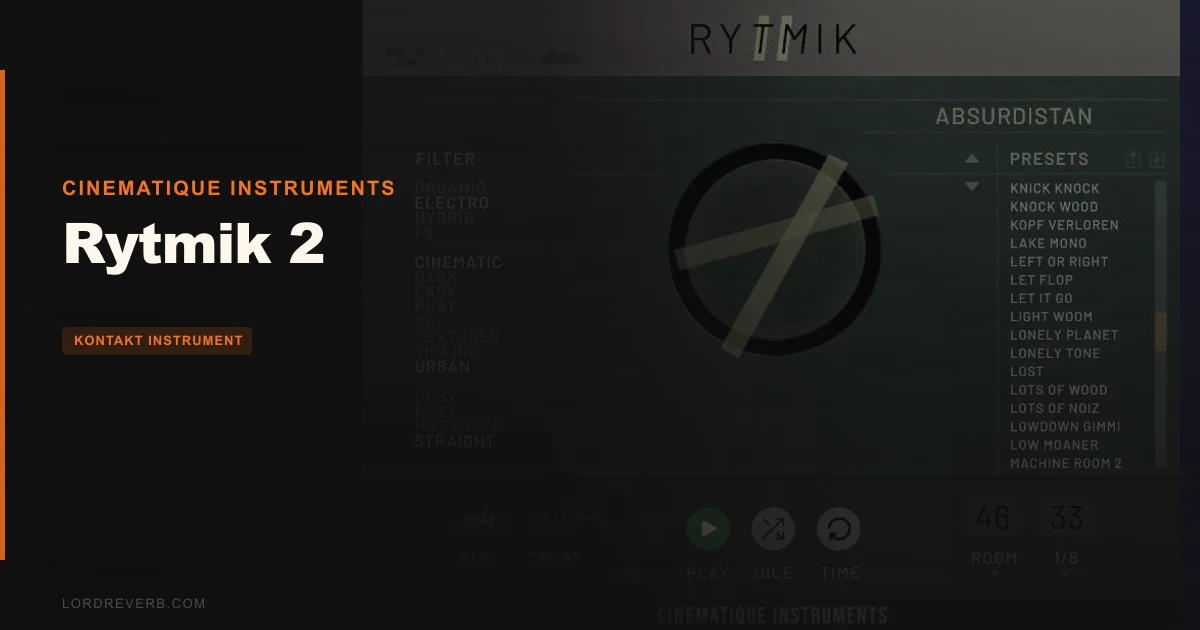
Rytmik 2 is a serious beat engine for media composers and producers who want hybrid percussion depth without stitching together five separate libraries. It's priced at $215, it runs in the free Kontakt Player, and it earns most of that asking price through sheer breadth. But it's not for everyone, and the "super easy" claim on the product page is doing a lot of heavy lifting.
Cinematique Instruments built this on the skeleton of the original Rytmik, then pushed the sound count past 350 sources, added roughly 215 new ones, and rebuilt the FX architecture. The result is an instrument that sits comfortably between a cinematic percussion library and a production-ready beat sequencer.
We'd buy this for scoring work and hybrid beat production. We'd skip it if you need a straight acoustic drum kit. Here's why.
What You're Actually Getting
Rytmik 2 is a Kontakt instrument built around a 14-track step sequencer. It does not play audio loops. Every beat is generated in real time, which means you can push the tempo from 70 to 160 BPM without pitch artifacts or timing drift. That's a meaningful workflow win.
The library ships with 528 pre-built beats spanning urban grooves, cinematic booms, hybrid FX layers, and pop patterns. Each beat arrives with its own pre-configured FX chain, which you can then reprogram across 13 effect slots in real time. Filters, volume tools, saturation, each slot is assignable per track.
The 350+ sound sources pull from field recordings, modular systems, drum machines, and acoustic percussion of various sizes. That range is what gives the library its hybrid character. A download of 587 MB gets all of it to your drive. The MIDI drag-to-DAW export means whatever you build inside the sequencer can leave as editable MIDI rather than a committed bounce.
The Good
The real-time FX chain is where Rytmik 2 separates itself from competitors. We loaded the "Cinematic Storm" preset, dropped a high-pass filter onto the snare track at around 300Hz, then automated the cutoff with the mod wheel during a cue. The result moved from a full, dense hit to a filtered, tense texture without touching the DAW. That kind of live manipulation in a scoring session is genuinely satisfying.
The 528 beats is a number that sounds like marketing until you actually browse the category tags. Urban, cinematic, industrial, pop, hybrid. The Preset Dice feature randomly surfaces a beat when you're stuck. We found two we'd have never clicked to manually. Both were usable immediately.
The randomisation tool is clever. It scrambles sound assignment, velocity, and effect settings per slot. Not every result is brilliant, but the hit rate is high enough that it functions as a real creative tool rather than a gimmick.
Running in Kontakt Player means the barrier to entry drops considerably. No full Kontakt licence needed. NKS support for Maschine and Komplete Kontrol hardware adds hands-on control for anyone already in the NI ecosystem.
The Not-So-Good
The "super easy" claim on the product page frustrated us. It's not difficult, but the 14-track sequencer with per-step FX programming takes real time to learn. Reviewers across multiple platforms flag the same thing: the interface looks minimal, but the depth beneath it isn't beginner-friendly.
The library skews heavily toward hybrid-cinematic and electronic textures. If you're after a realistic jazz brush kit or a dry, natural acoustic snare for a folk session, Rytmik 2 won't serve you well. The sound sources are processed and characterful by design. That's a feature for some producers and a blocker for others.
There's also no standalone mode. You're inside Kontakt for the entire session. For composers who work across multiple platforms or need a more portable setup, that dependency is annoying. CPU usage is reasonable for a library of this size, but we haven't stress-tested it against large template sessions, and users in forums report it behaves well under load.
One more thing: the upgrade path from Rytmik 1 is not documented clearly enough. If you own the original, you deserve a straight answer on what's genuinely new rather than a feature list that blurs the line.
Compared to the Alternatives
Spitfire Audio's Drumline Expanded covers the cinematic marching percussion space with more acoustic realism and a simpler playback engine. It's the better pick if you want convincing live ensemble feel with less programming. Rytmik 2 wins on electronic hybrid versatility and sequencer depth.
Tonehammer's Damaged Grand competes in the textural percussion space but focuses on prepared piano sounds rather than beat construction. Different category, honestly.
Within the Kontakt ecosystem, Loot Audio Palm Mute Piano shows how Kontakt instruments can occupy a narrow, brilliantly executed niche. Rytmik 2 takes the opposite approach: wide genre coverage rather than depth in one area.
For pure beat-making, Native Instruments' own Battery 4 offers more mixing headroom per kit piece and a cleaner cell-based workflow. But Battery 4 requires you to source your own sounds. Rytmik 2 gives you a curated library plus the sequencer in one package. If you want to open a project and produce immediately, Rytmik 2 wins that race.
Who Should Buy This
- ✅ Buy if you score to picture and need a single library that covers cinematic booms, hybrid textures, and urban grooves without switching between five tools.
- ✅ Buy if you want a real-time programmable beat engine that exports MIDI and integrates directly with Maschine or Komplete Kontrol hardware.
- ✅ Buy if you already use Kontakt Player and want to expand into serious percussion production at the $215 mark.
- ❌ Skip if you need an acoustic drum kit that sounds like it was recorded in a room, not processed through a modular system.
- ❌ Skip if you're a complete beginner who expects to be up and running in ten minutes. The sequencer rewards patience, not instant gratification.
- ❌ Skip if you're primarily a live performer who needs standalone operation outside a DAW environment.
Specs & Technical Details
| Developer | Cinematique Instruments |
| Price | $215 |
| Plugin Format | Kontakt Instrument (VST3 / AU / AAX via Kontakt host) |
| OS Support | Mac / Windows |
| Activation | Native Instruments Native Access (serial) |
| CPU Usage | Light to Medium |
| Trial Available | No |
| Version Reviewed | Rytmik 2 (2024 release) |
| Download Size | 587 MB |
| Kontakt Compatibility | Kontakt 5.6.8 or higher / Kontakt Player (free) |
| NKS Support | Yes (Maschine, Komplete Kontrol) |
| Sound Sources | 350+ (215 new) |
| Presets / Beats | 528 beats, 500+ presets |
| Sequencer Tracks | 14 |
| FX Slots per Chain | 13 |
Score Breakdown
| Category | Score | Notes |
|---|---|---|
| Sound Quality | 4.5/5 | Hybrid character is distinctive; pure acoustic realism is not the goal and it shows |
| Value for Money | 4.0/5 | 350+ sources and a built-in sequencer at this price point is a fair deal for the target user |
| Ease of Use | 3.5/5 | Interface looks minimal but 14-track sequencer programming takes real time to master |
| Features | 4.5/5 | Real-time FX chains, MIDI export, randomisation, and NKS support cover the bases well |
| CPU Efficiency | 4.0/5 | 587 MB download, real-time sequencer, reports well-behaved under moderate session load |
| Overall | 4.2/5 | A deep, versatile hybrid beat engine that rewards the time you put into learning it |
Alternatives to Consider
If you want a focused Kontakt instrument that does one thing brilliantly, Loot Audio Palm Mute Piano Review is worth reading before you decide. Different category, but a useful reference for what single-purpose Kontakt instruments can achieve at their best.
New to the Kontakt ecosystem entirely? Our Kontakt Instruments Guide: 5 Things Beginners Must Know covers activation, NKS setup, and how to get the most out of Player-compatible libraries before you spend anything.
Spitfire Audio's Drumline Expanded is the strongest alternative for composers who need acoustic realism over electronic versatility. It's less programmable but more convincing on naturalistic cues. If your work sits closer to orchestral scoring than hybrid production, it's the smarter spend.
Native Instruments Battery 4 is the alternative if you want total control over your kit construction and don't need a pre-built sound library. It's a sampler first, a library second. Rytmik 2 is the opposite. Know which workflow you actually live in before you buy either.
Rytmik 2 sits at $215. It's not an impulse purchase, but it's not a hard sell either. If hybrid cinematic percussion with a real sequencer is what your productions need, the library earns its place. If you're chasing acoustic realism or you hate working inside Kontakt, save the money. Those use cases have better homes elsewhere.

Related reviews: Method 1
Frequently Asked Questions
Do I need the full version of Kontakt to run Rytmik 2?
No. Rytmik 2 runs in the free Kontakt Player, so you don't need to own a full Kontakt licence. You'll need Kontakt 5.6.8 or higher, either the Player or full version. Download Native Access from Native Instruments, install the Player for free, then activate Rytmik 2 through your serial.
Does Rytmik 2 use audio loops or is it sample-based?
It uses no audio loops at all. Every beat is generated in real time by the 14-track step sequencer triggering individual samples. This means tempo changes don't affect audio quality, and you get organic variation from round robins and velocity layers rather than a static loop playing back on repeat.
How does Rytmik 2 compare to the original Rytmik?
The second version adds roughly 215 new sound sources on top of the original palette, bringing the total past 350. The FX chain has been expanded to 13 programmable slots, and the beat library has grown to 528 patterns. The UI has been refined for cleaner navigation with category tag filtering. It's the same core concept, pushed significantly further in scope and programmability.
Is Rytmik 2 good for beginners?
The Kontakt Player compatibility and the Preset Dice feature lower the barrier to entry. You can load a beat and start hearing results quickly. But the full 14-track sequencer with per-step FX programming takes time to learn, and the "super easy" marketing undersells that reality. Reviewers with intermediate DAW experience get the most out of it fastest.