The Ancient Greek Compendium by Soundiron is the most comprehensive sampled library of ancient Greek instrumentation currently available, and for film composers scoring anything from a Greek tragedy to a Spartan battle sequence, there is no comparable alternative.
We loaded the Trigonon, a triangular harp variant from the Strings module, into a sparse cue, no other instruments running. One note. The attack was wooden and immediate, with a midrange transient sitting around 900Hz. The decay was long, uneven, alive. It didn't sound like a sample library. It sounded like someone plucked something in a stone room two thousand years ago and we caught it on tape.
That was the moment we knew this library meant business. But it also told us who this is for: composers with a specific brief, not producers hunting general-purpose texture. This is not an ambient sound design grab-bag. It's a scholarly instrument collection with a DAW interface bolted on.
Three Products in a Trench Coat: What the Compendium Actually Contains
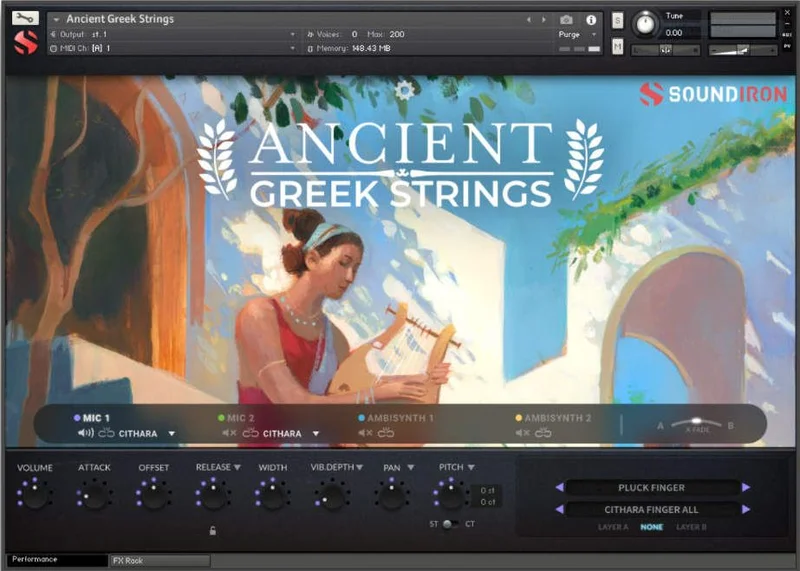
The Compendium bundles three separate Kontakt libraries: Ancient Greek Strings, Winds, and Percussion. All three were performed by LyrAvlos, an Athens-based historical research group led by Panagiotis Stefos, who hand-built every instrument using period-accurate materials and methods.
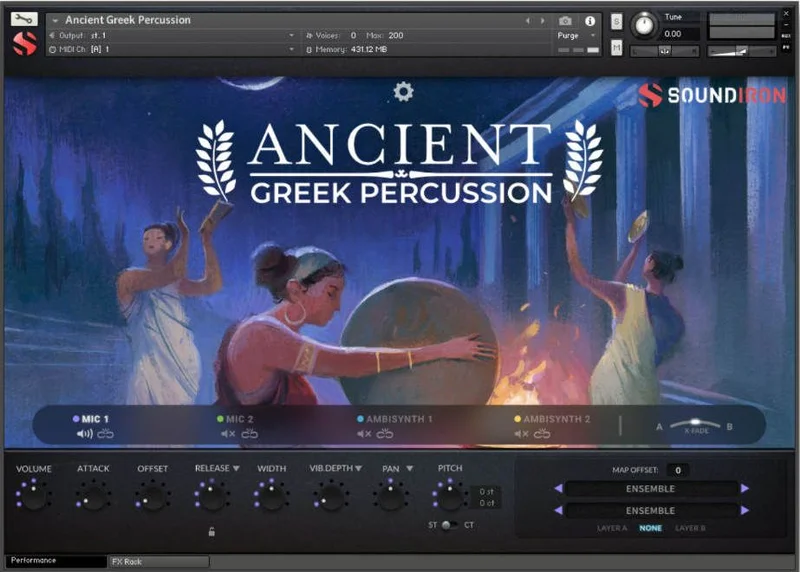
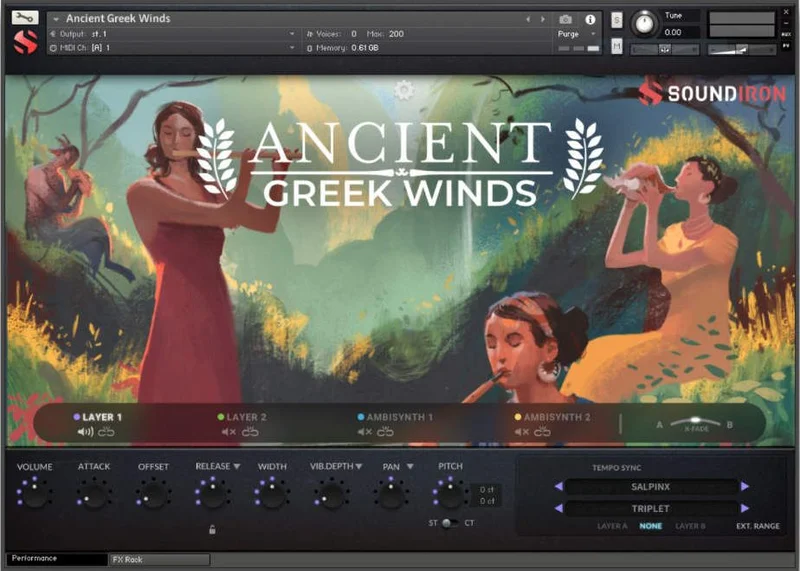
Strings covers 7 instruments: Barbiton, Cithara, Lyre, Goat Horn Lyre, Pandura, Phorminx, and Trigonon. Winds delivers 8 voices: single and double-reeded aulos flutes from bass to alto range, conch shell horns, brass salpinx, pan flute, and plagiaulos. Percussion brings 6 instruments: Crotalum, Kymbalon, Sistrum, 15-inch Tympanon, 22-inch Tympanon, and Tympanon Zill.
Total sample count: 22,773 stereo files at 24-bit/48kHz, uncompressed. Installed size hits 15.5GB. You get 84 .nki presets across the whole bundle, plus 60 ambient pads and drones derived from the source material.
What it's NOT good for: modern pop scoring, quick texture layering, or anything where you need phrases and loops. Every instrument plays as a performed multi-sampled instrument. You compose with it. You don't drag and drop.
Also: if you only own Kontakt Player, stop reading and close the tab. The full retail version of Kontakt 6.2.2 or higher is required, and there's no workaround.
Living With It: A Week of Sessions
Setup is clean. Download via your Plugin Boutique account, run the installer, enter your serial, point Kontakt's Files tab at the instruments folder. We were playing within 12 minutes. No Kontakt library is the annoying part, this one handles it as well as any.
Day two: we tried to build a drone cue using the Aulos double-reed sustains layered over Tympanon rolls. We hit a wall immediately. The Aulos sustained beautifully, a nasal, harmonically dense tone sitting between 400Hz and 2kHz. But the Tympanon rolls had a wide dynamic range baked in, and riding the mod wheel to control the swell felt imprecise at first.
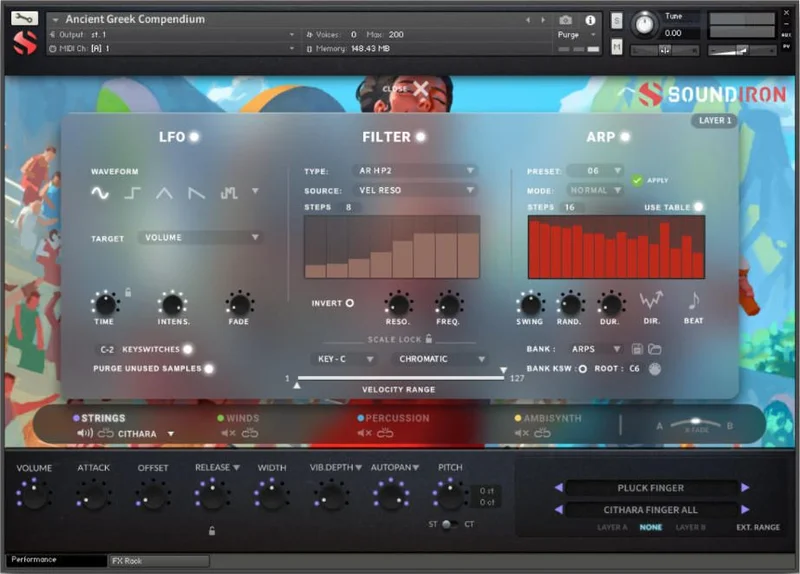
We spent 20 minutes dialling in the LFO system, tempo-synced, targeting volume, with a slow fade-in time set around 3-4 beats. Once that was locked, the combination breathed on its own. Satisfying, once you find it. Frustrating until you do.
The 27-module FX rack is where the Compendium earns its keep for non-historical productions. We ran the Barbiton plucks through the amp and cab simulator with 30% wet, then hit them with one of the 99 convolution reverb IRs, a medium stone hall. The result sat under a synth pad like it had always been there. That's the library's hidden value: the sounds are alien enough to be interesting but natural enough to blend.
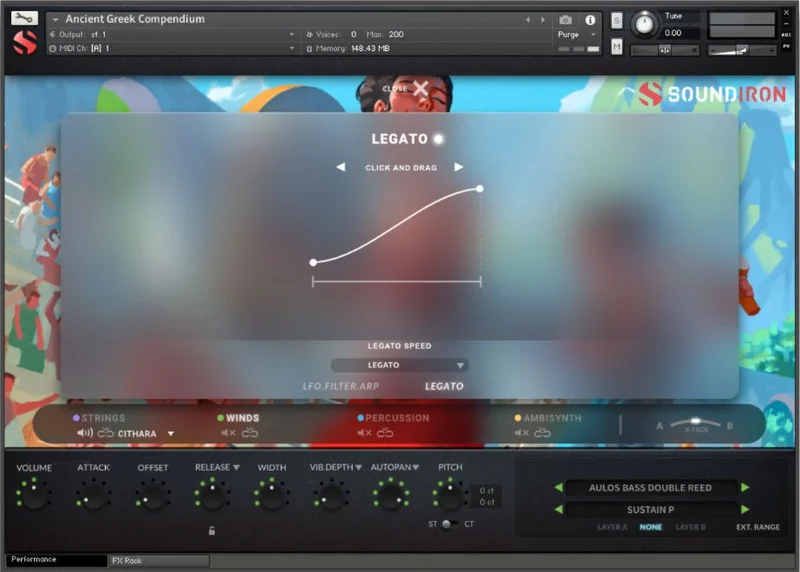
The 12 filter types are genuinely useful for carving space. A high-pass at 180Hz on the Pandura cleaned up the low-mid boxiness fast. The arpeggiator with swing control and randomisation gave us something we didn't expect: a percussive Crotalum sequence that felt like it was performing itself.
One persistent annoyance: loading all three modules simultaneously on an older machine pushes RAM. We had a session with 8 other instruments open, and two of the Kontakt instances hit their pre-load buffer limit. An SSD and 16GB of RAM minimum is the real-world floor here, not the official 2GB spec.
The Trade-Offs
The authenticity of this library is both its greatest strength and its hardest limitation. LyrAvlos built these instruments from gut strings, goat skin, and wood using ancient-world construction methods. You hear it. The Lyre has natural tuning inconsistencies. The Aulos has breath noise at -28dBFS on quiet passages. The Tympanon has shell resonance that no EQ fully tames.
Those aren't defects. But they mean you'll spend time fitting these sounds into modern mixes in ways you wouldn't with a Spitfire or Native Instruments library built for seamless orchestral integration.
The 60 included pads and drones are an honest attempt to bridge that gap. Several of them are brilliant: slow-evolving textures derived from the source recordings that work as underscore without any further processing. But 60 presets across a 15.5GB library feels thin. We'd love at least double.
The full price of $149 is the other honest conversation. For a niche historical library with no user reviews on ADSR or KVR at the time of writing, that's a commitment. At the introductory price, the value proposition is sharper. At $149, you need to be certain this fills a gap nothing else can fill for you. For most users, it does. For producers who just want "ancient-sounding" colour, a cheap sample pack might get you close enough.
Against the Field
The closest competitor in concept is Sonuscore's ancient-world instrumentation work. If you want vocal-forward ancient textures with more compositional hand-holding built in, check out Can Mongolian Voices Ancient Phrases Feel Compositional?, it's a different approach but scratches an adjacent itch.
For purely percussive ancient/ethnic work, Soundiron's own catalogue has isolated instrument options at lower price points. Those work better if you only need one instrument family.
For the full acoustic instrument sampling experience at this build quality, Spitfire's LABS series offers free individual instruments, though nothing remotely ancient Greek. If you want Kontakt-based ethnic stringed instruments with modern playability at a lower cost, Native Instruments' Spotlight Collection titles are worth comparing. They offer more polished playability but far less historical accuracy.
The Compendium wins where specificity matters. No other library gives you a sampled Barbiton. That's not marketing copy. It's just true.
The Real Verdict
The Ancient Greek Compendium is a brilliant, underrated library that deserves far more attention than its zero-review status on major platforms suggests.
Buy it if you score film, games, or media that touches ancient Mediterranean worlds, or if you're a composer who loves texture nobody else in the room has. The 22,773 samples, 27 FX modules, 99 reverb IRs, and full LyrAvlos instrument roster justify the introductory price without hesitation.
Skip it if you need Kontakt Player compatibility, if your sessions are already RAM-constrained, or if you want "ancient vibes" rather than genuine ancient instruments. There's a meaningful difference.
Rent the full version of Kontakt before you buy anything else. That's the actual prerequisite here.
Score Breakdown
| Category | Score | Notes |
|---|---|---|
| Sound Quality | 4.5/5 | 22,773 samples at 24-bit/48kHz with real instrument character; organic inconsistencies are a feature, not a flaw |
| Value for Money | 3.5/5 | The introductory price is fair for this depth; the regular price of $149 is a harder sell for a niche audience with no trial option. |
| Ease of Use | 3.5/5 | Kontakt UI is well-designed once you know it, but the LFO and FX rack have a learning curve; non-Kontakt users blocked entirely |
| Features | 4.5/5 | 27 FX modules, 12 filters, 99+40 IRs, arpeggiator, scale lock, LFO, overbuilt in the best way |
| CPU Efficiency | 3.5/5 | Medium load per module; loading all three simultaneously demands 16GB+ RAM and SSD streaming in practice |
| Overall | 4.0/5 | The only sampled library of its kind; technically accomplished and historically credible, held back only by access barriers and price |
Alternatives to Consider
Sonuscore Mongolian Voices: Ancient Phrases, if you want ancient-world vocal texture with phrase-based composition tools built in, this wins on workflow speed. Can Mongolian Voices Ancient Phrases Feel Compositional?
Loot Audio Palm Mute Piano, nothing to do with ancient Greece, but if you're after a unique acoustic instrument with a strong individual character and a lighter footprint, this is worth a look. Palm Mute Piano Review: A Unique Kontakt Instrument 2026
Soundiron M1 Garand Rifle, also from Soundiron and shares the same sampling philosophy: hyper-specific, deeply recorded, built for composers who know exactly what they need. Soundiron M1 Garand Rifle Review: Still Holds Up in 2026 Different category entirely, but it shows what Soundiron does when they commit.
The Ancient Greek Compendium costs $149. No other library will give you a sampled Barbiton, a double-reeded Aulos, and a 22-inch Tympanon in the same session. If that sentence didn't immediately tell you whether to buy it, nothing else will.
Frequently Asked Questions
Does the Ancient Greek Compendium work with Kontakt Player?
No. This is a hard stop. The full retail version of Kontakt 6.2.2 or higher is required. Kontakt Player does not support the open-format .nki files included in this library, and there is no workaround or alternative activation path. If you don't own the full version of Kontakt, factor that purchase into your total cost.
How much hard drive space does the Ancient Greek Compendium need?
The library installs to 15.5GB. All samples are uncompressed 24-bit/48kHz PCM WAV files, which is why the quality is high but the footprint is large. An SSD is strongly recommended for smooth streaming, a traditional SATA hard drive will introduce loading lag when switching between instruments in a live session.
Can I use Ancient Greek Compendium for modern music production, or is it only for historical scores?
You can use it for anything. The 60 ambient pads and drones derived from the source recordings sit comfortably under electronic music, and the 27-module FX rack means you can reshape these sounds dramatically. The Barbiton plucks processed through the amp/cab simulator and a reverb IR are genuinely usable in contemporary electronic and cinematic contexts. The instruments are ancient; your compositions don't have to be.
Who is LyrAvlos, and why does it matter for the quality of this library?
LyrAvlos is an Athens-based historical research group led by Panagiotis Stefos. They hand-built every instrument in this library using period-accurate construction methods, materials, and tools, then performed them for Soundiron's recording sessions. That heritage translates directly into sample authenticity: the tuning quirks, breath noise, and resonance characteristics are those of real historical reconstructions, not modern instruments designed to sound ancient.