The honest question buyers are asking about Cherry Audio's Mercury-8 isn't "is this a good synth plugin?" It's "is this actually better than the Jupiter-8 emulations I already own?" The answer, based on what we've heard and tested, is yes for most users, and we'd buy it at $69 without hesitation.
This is Cherry Audio's most ambitious release. It's built for producers who want the thick, breathing pad sounds and creamy oscillator stacks of the Roland JP-8 without paying hardware prices or settling for sample-based recreations that don't respond dynamically to your playing.
It's also built for sound designers who want to go further than the original ever could. Dual layers, a 16x4 step sequencer, four-slot modulation matrix, and three independent effect chains put this well past "clone" territory.
If you live in vintage-inspired synthwave, ambient, or cinematic production, you'll find it hard to close this plugin and go back to whatever you were using before.
Does It Actually Deliver on the Jupiter-8 Promise?
Cherry Audio built Mercury-8 on advanced circuit and behavior modeling, not samples. That matters because every filter sweep, every envelope movement, every oscillator drift responds the way analog hardware does: dynamically, with small imperfections that make a sound feel alive.
The JP-8's high-pass and resonant low-pass filters are both here, with accurate 12dB and 24dB slope options. The legendary Jupiter curves survive intact.
We loaded one of the original JP-8 factory patch recreations and played a slow chord. The filter opened with that warm, slightly sticky quality the original is famous for. It didn't just sound like a Jupiter. It breathed like one.
MusicRadar gave it five stars, calling it their sixth five-star in 2025 and Cherry Audio's 14th consecutive five-star plugin. That's not a streak built on hype. It's built on plugins that hold up in real sessions.
This one holds up.
Where Mercury-8 Shines Hardest
The Dual-Layer Architecture
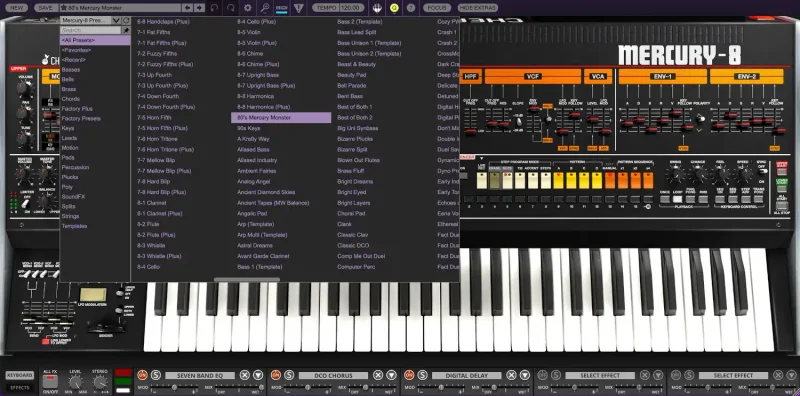
The original Jupiter-8 gave you 8 polyphonic voices. Mercury-8 gives you 16 per layer, with two layers available simultaneously in split or stacked modes. That's up to 32 voices of Jupiter-like texture at once.
We stacked a slow string pad on Layer A against a brighter, slightly detuned pluck on Layer B. Each layer has its own synthesis controls, its own modulation matrix, its own arpeggiator, its own sequencer, and its own effect chain. They're genuinely independent instruments running in parallel. The result was a massive, evolving texture that would've taken three separate plugin instances to build any other way.
For cinematic and ambient work, this is brilliant.
The Analog Drift and Condition Controls
This is one of the cleverer features in the plugin. Drift and Condition let you dial in how "old" the synth sounds. Separate controls for VCO, VCF, and VCA drift, plus envelope slop, mean you can go from pristine digital-clean to genuinely unstable vintage in fine increments.
We pushed Condition to around 70% on a lead patch. The oscillators started breathing slightly out of phase with each other. The filter tracking loosened. It stopped sounding like software and started sounding like something that needed servicing. In a satisfying way.
That level of character control is rare at this price point.
The Effect Chains
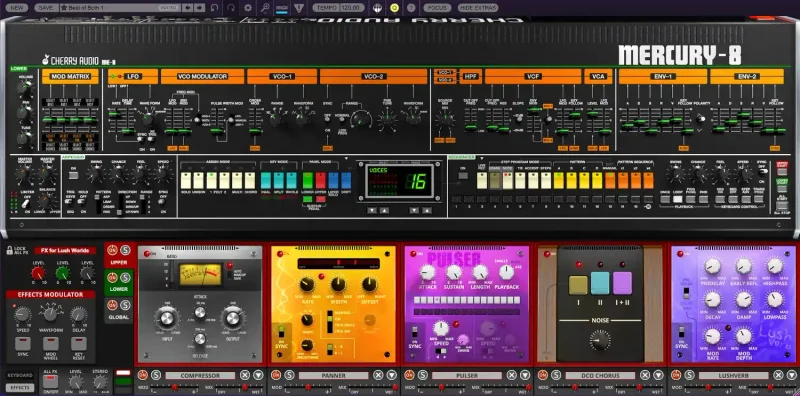
Three independent chains: one per layer, one global. Twenty effects total. New additions in Mercury-8 include DCO Chorus, Panner, and Pulser, which Cherry Audio didn't carry over from earlier plugins in the range.
The DCO Chorus is the one you'll reach for first. We ran it on a saw-based pad and got that classic JP-8 stereo shimmer without touching the modulation matrix. Accurate, immediate, and it doesn't add mud at the bottom end.
The SEM V's effects section doesn't come close to this depth. Mercury-8 wins the effects comparison easily.
Where It Falls Short
Six hundred presets sounds like a win. It is, until you're browsing at 2am trying to find that specific dark, evolving pad and the filtering options aren't granular enough to cut the list down fast.
The preset browser needs subcategory tags. "Pads," "Leads," and "Basses" are a start, but a collection this size needs more surgical sorting. Annoying when you're deep in a session.
CPU usage is our other concern. Cherry Audio's product page mentions user-adjustable oversampling, which is a good sign, but we don't have hard benchmark numbers to compare against competing Jupiter emulations. Reviewers report that heavy dual-layer patches with multiple effect chains running can be demanding. If you're on an older machine, test the trial before committing.
The SysEx compatibility with MIDI-modified JP-8 hardware via Encore Electronics format is a clever technical feature. Most users will never touch it. It's impressive, but it's not a selling point for the majority of buyers.
The effects chains are shared with Cherry Audio's Trident Mk III. That's smart engineering, but it also means the effects feel like a platform feature rather than something designed specifically around Mercury-8's voice architecture.
How It Stacks Up Against Competing Jupiter Emulations
The two main competitors in this space are Arturia's JUP-8 V inside the V Collection and Roland's own Cloud version of the Jupiter-8.
Arturia's JUP-8 V is solid. The modulation options are deep, and it integrates tightly with the rest of V Collection if you already own it. But its preset library is smaller, and it doesn't offer the dual-layer architecture Mercury-8 brings. The MiniFreak V's layering approach shows Arturia can do dual-voice tricks, but not in a Jupiter context.
Roland's Cloud version requires a subscription. Full stop. Mercury-8 is a one-time purchase.
If you want the most feature-rich Jupiter-8 plugin at a one-time price, Mercury-8 wins. If you need tight V Collection integration, Arturia makes sense. If subscriptions don't bother you, Roland's own version has obvious brand heritage. We'd still pick Mercury-8.
Is the Price Fair?
At $69, Mercury-8 is underpriced for what it delivers. Sixteen voices per layer, dual-layer architecture, 600+ presets, 20 effects across three independent chains, a 16x4 step sequencer, and virtual analog accuracy built on real circuit modeling. Any one of those features alone would justify a significant portion of that price in isolation.
Cherry Audio's pricing has always been aggressive relative to feature depth. Mercury-8 continues that pattern. For the JP-8 sound at a fraction of hardware or even some competing plugin prices, this is fair money. Very fair.
Specs & Technical Details
| Developer | Cherry Audio |
| Price | $69 |
| Plugin Format | VST / VST3 / AU / AAX + Standalone |
| OS Support | Mac / Windows |
| Activation | Cherry Audio account (online) |
| CPU Usage | Medium to heavy (oversampling adjustable) |
| Trial Available | Yes |
| Version Reviewed | 1.0 (launched November 2025) |
Score Breakdown
| Category | Score | Notes |
|---|---|---|
| Sound Quality | 5.0/5 | Circuit-modeled JP-8 filters are the real deal |
| Value for Money | 4.5/5 | Underpriced relative to feature depth |
| Ease of Use | 4.5/5 | Preset browser needs better tagging for 600+ patches |
| Features | 4.5/5 | Dual layer, 20 effects, step sequencer, modulation matrix |
| CPU Efficiency | 4.0/5 | Adjustable oversampling helps; heavy patches demand headroom |
| Overall | 4.7/5 | Best Jupiter-8 plugin available at this price point |
Alternatives to Consider
Arturia JUP-8 V (inside V Collection): Works best for producers already deep in the Arturia ecosystem. The modulation is deep, but dual-layer architecture isn't there. Check our MiniFreak V review for Arturia's current synthesis approach.
Cherry Audio Trident Mk III: If you want something from the same Cherry Audio family but oriented toward the Trident mixing console sound rather than JP-8 synthesis, this shares the same effect chain platform. The SEM V review covers a different vintage analog flavor worth comparing.
AudioThing SX1000: A different flavor of vintage Italian synthesis. Not a Jupiter competitor, but if you're building a vintage synth toolkit, read our SX1000 review before you decide where to spend next. For anything outside the Jupiter family, Chromaphone 3 covers physical modeling territory worth exploring alongside virtual analog.
Our Verdict
Mercury-8 is the Jupiter-8 plugin we'd keep if we could only keep one. The circuit modeling is accurate enough to make you stop and listen. The dual-layer architecture genuinely expands what the original hardware was capable of. The effects chains are deep. The presets are plentiful, even if they're hard to navigate at scale.
Skip it if you're purely after a strict 1:1 historical clone with zero modern additions. That's not what this is, and Cherry Audio isn't pretending otherwise.
Buy it at $69 if you want Jupiter-8 tone in a plugin that also works as a primary sound design tool in 2026. It earns its place in the signal chain and then stays there.
We've tested a lot of vintage synth emulations. Most of them sound like plugins. This one sounds like the room.
Related reviews: SkyDust Stereo | Educational Version
Frequently Asked Questions
Is Mercury-8 a sample-based emulation or virtual analog?
Mercury-8 uses virtual analog synthesis built on Cherry Audio's circuit and behavior modeling. It's not sample-based, which means every parameter responds dynamically, the way analog hardware does. You get real filter sweeps, real oscillator drift, and real envelope behavior rather than static recorded snapshots.
Can Mercury-8 communicate with a real Jupiter-8?
Yes, if your hardware has been MIDI-modified using the Encore Electronics format. Mercury-8 can import original JP-8 patch bank SysEx data via drag-and-drop and export preset data back to SysEx format. It's a niche feature, but for hardware JP-8 owners it's a clever bridge between the two worlds.
How does the dual-layer architecture actually work in practice?
Each layer runs independently with its own oscillators, filters, envelopes, LFO, modulation matrix, arpeggiator, step sequencer, and effect chain. In split mode, you can assign each layer to a keyboard zone. In stack mode, both layers play simultaneously across the full keyboard. Each layer gets 16 polyphonic voices, so stacked patches have access to 32 voices total.
Is Mercury-8 CPU-heavy? Will it work on older machines?
Cherry Audio includes a user-adjustable oversampling control, which lets you trade sonic accuracy for CPU headroom depending on your system. Reviewers report that heavy dual-layer patches with multiple effect chains running are demanding. We'd strongly recommend trying the free trial on your specific machine before purchasing, especially if you're running older hardware or a loaded session.