If you're comparing SkyDust 3D to Pigments, Serum, or any other synth you'd load on a normal stereo session, you're already comparing the wrong things. SkyDust 3D is what you'd buy instead of building a spatial audio routing chain from scratch around a conventional synth. That's the comparison that matters, and that's where this review lands: not "is it a great synth?" but "does it justify owning a spatially-native instrument when you're working in immersive formats?" For students and educators who qualify for the educational licensing, the price varies by version, which changes the calculation significantly.
Sound Particles built this for film composers scoring in Atmos, ambient producers mixing for spatial platforms, and educators teaching immersive audio. If none of those describe you, read the "Skip if" section and move on.
How It Compares Out of the Box
Load SkyDust 3D next to something like Arturia MiniFreq V and the interface difference is immediate. Where MiniFreq V gives you a workflow built around performance and sound design speed, SkyDust gives you a spatial audio console that also happens to synthesize. It's deeper, more complex, and slower to navigate on day one.
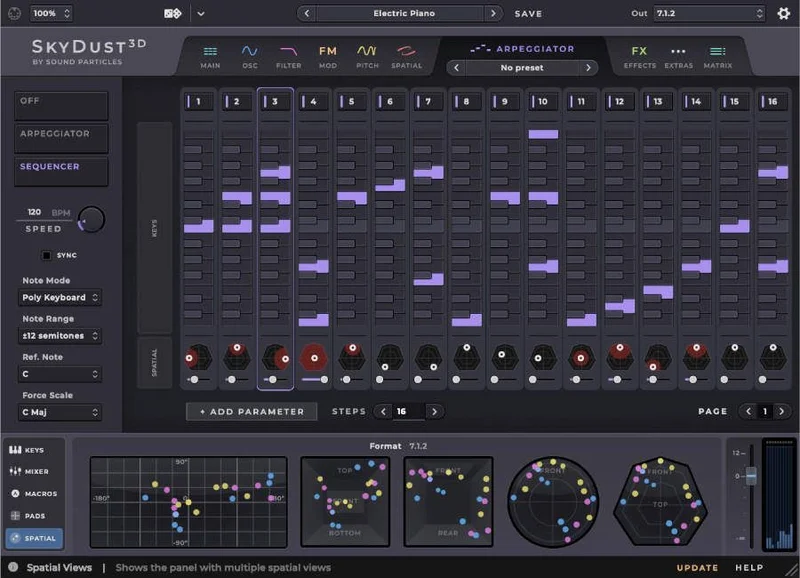
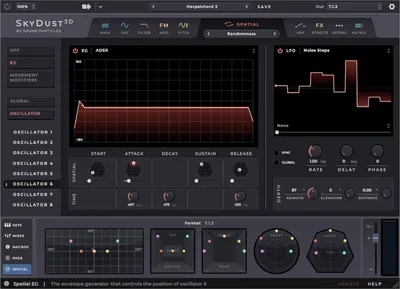
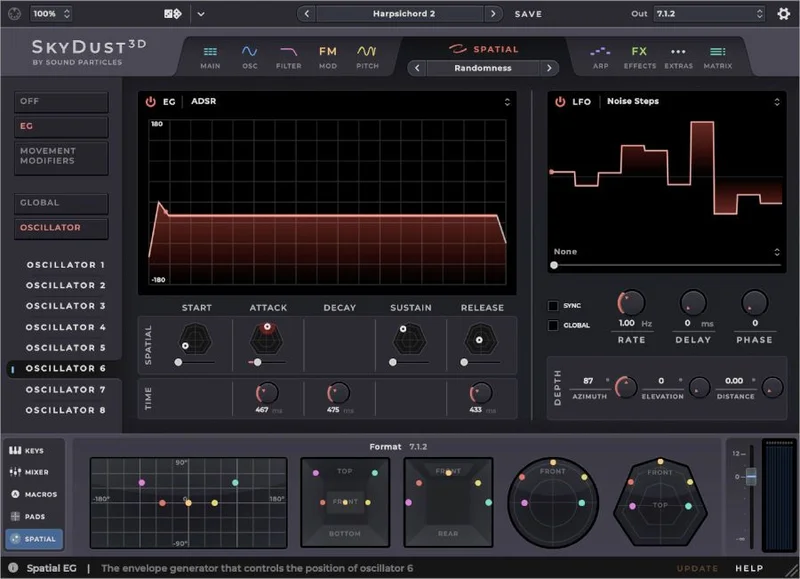
Compared to trying to route a standard synth through a spatial panner externally, SkyDust removes that entire step. The 3D engine is baked in. Each of the 8 oscillators has its own starting position in 3D space, its own spatial EG, and its own LFO controlling azimuth and elevation independently.
No other synth plugin does this natively at this level. That's not hype. That's just the current market.
Performance Deep Dive
We loaded SkyDust 3D into a session running at 48kHz, 256 samples, on a 10-core Apple Silicon machine. In stereo mode, CPU usage sat around 8-12% for a single instance with full polyphony active. Reasonable.
Switch to 7th-order Ambisonics output (which SkyDust supports, up to 6th order Ambisonics formally) and that number climbed fast. At 6th-order Ambisonics, we were pushing 35-40% on a single instance. On a 4-core machine, which is the minimum spec, that's a problem. You're not running two of these in an Atmos session on older hardware without bouncing.
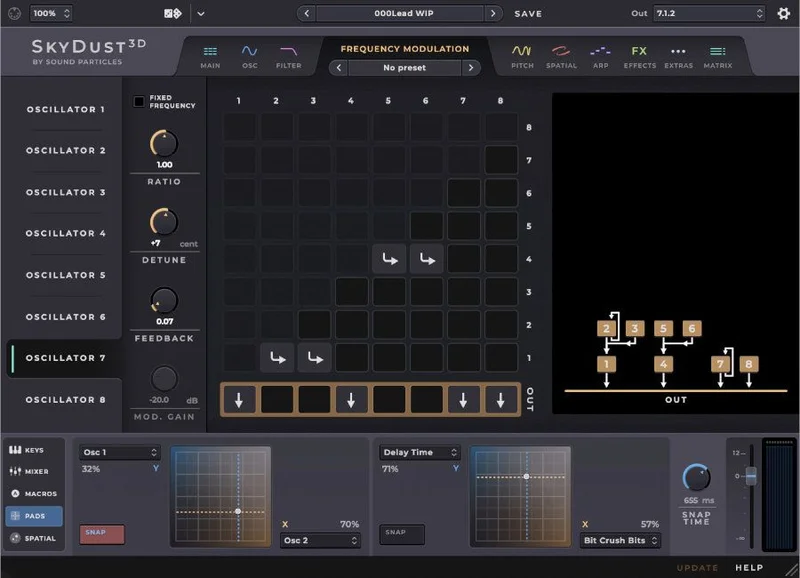
The synthesis engine itself is genuinely powerful. 8 oscillators per voice, up to 256 voices, 40 EGs and 40 LFOs per voice, FM with a full 8-operator matrix, and a 128-step polyphonic sequencer with 3D panning assignable per step. The ±36 semitone range on the sequencer's pitch control covers most musical applications. The FM matrix is the highlight: you draw custom connections between operators, which means you can build hybrid subtractive/FM tones that sit in spaces most synths can't reach.
We built a pad starting two oscillators at opposite sides of the rear hemisphere, with a spatial EG pushing them forward over 4 seconds while FM modulation added texture. In an Atmos-enabled playback room, that patch was striking. On headphones with the binaural engine active and a matched SOFA file loaded, it translated better than we expected.
Where It Wins
The spatial sequencer is the thing. We're not aware of another synth that lets you assign a 3D position to each of 128 steps in a polyphonic sequence. We programmed a 16-step arpeggio where each note came from a different point in the room. In a 7.1.4 session, that sequence moved like a physical object orbiting the listener. Frustrating to dial in initially, satisfying when it locks.
The binaural engine deserves credit too. Five built-in HRTF datasets, support for custom SOFA files, and the result is usable on headphones without additional processing. For students who don't have access to an Atmos monitoring room, that's a real lifeline.
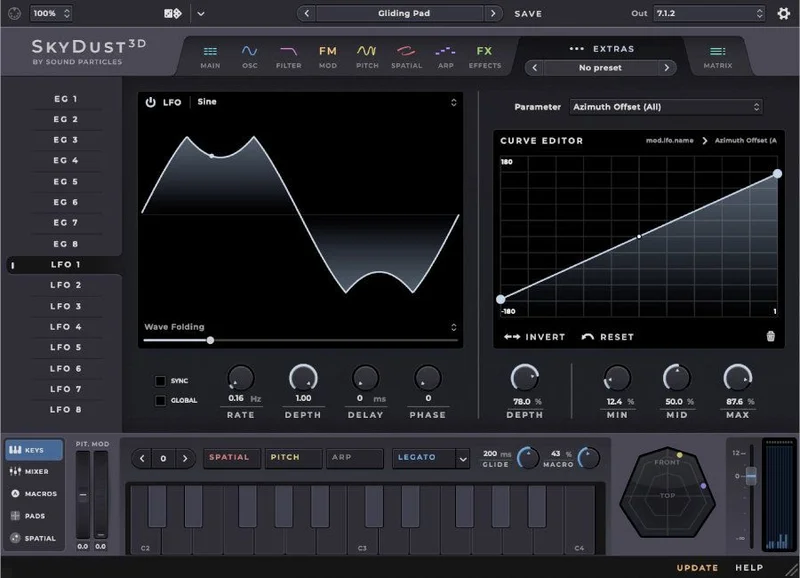
The modulation matrix is deep. Any source to any destination. Pitch-bend controlling elevation. A filter LFO driving spatial azimuth. The curve editor for each matrix connection means you can shape the relationship precisely rather than accepting a linear response.
The educational pricing is the honest closer here. Full-time students and faculty get access to a tool that professionals are billing project budgets against. That's a real advantage for anyone learning immersive composition in a structured programme.
Where the Competition Wins
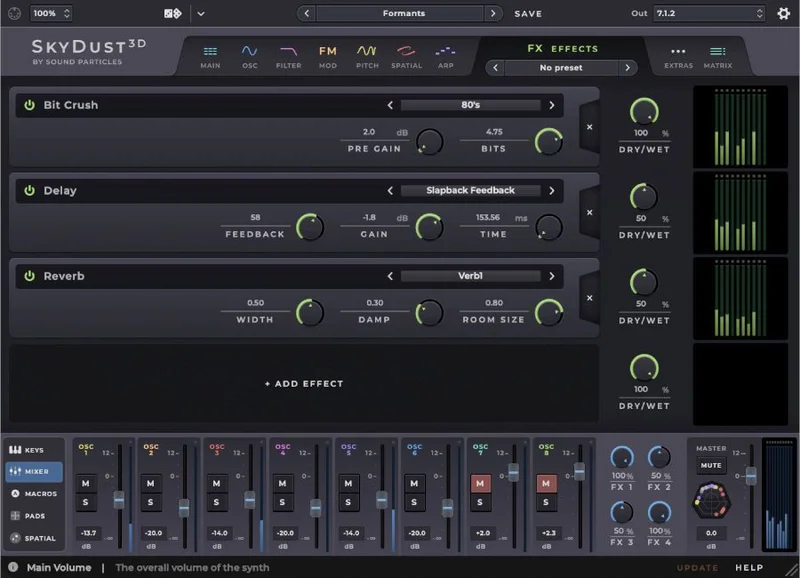
The effects section is thin. Four FX slots. Delay, reverb, bit-crusher, distortion, EQ with 3 bands, and a single-band parametric. That's it. For a synth at this price, it's underwhelming. You'll need external processing in your signal chain.
There's no sample import. Zero. If your sound design workflow involves loading a recorded texture and spatialising it, SkyDust won't do that. You need a separate sampler. For comparison, Chromaphone 3's physical modelling approach gives you timbres that synthesis alone can't easily replicate, and it doesn't have this gap.
The preset library is a specific kind of annoying. Most presets were clearly designed and auditioned in a 3D playback environment. Load them in a stereo session and a significant portion sounds underwhelming. Thin pads. Static textures. Without the spatial dimension, the preset's reason for existing disappears. That's a real problem for students who may not have 24/7 access to an immersive room.
The learning curve is steep. This is not a synth you'll dial in quickly. The UI is dense, and the documentation, while present, assumes you already understand both synthesis and spatial audio. New producers will be overwhelmed.
Who Should Buy Which
- ✅ Buy if you're studying or teaching film scoring, game audio, or immersive music production and need a native Atmos/Ambisonics instrument at educational pricing.
- ✅ Buy if you're working in Dolby Atmos music and want to stop manually routing synths through spatial panners in your DAW.
- ✅ Buy if you're doing experimental sound design and want a modulation matrix this deep paired with spatial movement as a compositional tool.
- ❌ Skip if you're primarily making stereo music. The stereo version at the educational price is more defensible, but you're still paying for a spatial engine you won't use.
- ❌ Skip if your machine is running a 4-core CPU. The Ambisonics CPU load will cause you problems on anything below a modern 8-core setup.
- ❌ Skip if you want a do-everything synth with a strong effects section and quick preset browsing. Load something like LOW for bass-focused work or an ABX3-style performance synth instead.
Score Breakdown
| Category | Score | Notes |
|---|---|---|
| Sound Quality | 4.5/5 | FM matrix plus spatial modulation produces sounds no standard synth can touch in an immersive context |
| Value for Money | 4.0/5 | Educational pricing makes a professional-grade spatial tool accessible; full retail is harder to justify for non-professionals |
| Ease of Use | 3.0/5 | Dense UI, steep learning curve, and documentation that assumes prior knowledge of both synthesis and spatial audio |
| Features | 4.5/5 | 40 EGs, 40 LFOs, 128-step 3D sequencer, and 6th-order Ambisonics support in one plugin is a serious feature set |
| CPU Efficiency | 3.0/5 | Stereo is fine; 6th-order Ambisonics on a single instance pushes 35-40% on modern 10-core hardware |
| Overall | 4.2/5 | The most capable native spatial synthesizer available at any price, let alone at educational rates |
Alternatives to Consider
If you want synthesis power without the spatial focus, Arturia MiniFreak V gives you a faster workflow and a stronger effects section for stereo production at a lower price point.
For textural sound design where physical modelling is more relevant than spatial positioning, Applied Acoustics Chromaphone 3 produces acoustic-adjacent textures that synthesis can't replicate. No spatial engine, but a very different kind of depth.
If bass is the focus and you don't need immersive formats, BeatSurfing LOW is a tighter, faster, more focused instrument for that specific job. Less CPU. Quicker results.
None of these offer what SkyDust does for Atmos work. There's no direct replacement. That's both its greatest strength and the reason to think carefully before buying outside its use case.
The Honest Close
SkyDust 3D Educational Version is a brilliant tool for a specific problem. That problem is: how do I write and produce music that lives natively in three-dimensional space without building a kludged routing chain every session?
It's not the synth you load for a quick stereo hook. It's the one you load when the deliverable is a Dolby Atmos stem and the sound needs to move.
At the educational price, it's a legitimate steal for anyone enrolled in a film scoring, game audio, or spatial music programme. Buy it, expect the learning curve, plan for the CPU hit in Ambisonics mode, and don't expect the effects section to carry your processing needs.
If you're not doing immersive work: don't. There are better synths for less money that will serve a stereo workflow more efficiently. This one earns its price tag only when the room around the listener is part of the instrument.
Related reviews: Rave Station 2 Review
Frequently Asked Questions
Who qualifies for the SkyDust 3D Educational Version?
The educational licence is available to full-time students and faculty at accredited educational institutions only. After purchase through Plugin Boutique, you'll need to email support@pluginboutique.com with your order number and proof of educational status, such as a student ID or faculty verification. Part-time students don't qualify. The full retail version is available separately if you don't meet the criteria.
Can SkyDust 3D be used for stereo music production, or is it only useful for immersive formats?
It works in stereo and Sound Particles offers a dedicated stereo version at a lower price. The synthesis engine is capable in stereo: 8 oscillators, full FM matrix, 128-step sequencer. But a large portion of its value comes from the spatial engine, and most presets were designed with 3D playback in mind. In a stereo-only workflow, you're paying for capability you won't fully use.
How bad is the CPU usage in Ambisonics mode?
It's heavy. On a 10-core Apple Silicon machine at 48kHz and 256 samples buffer, a single instance at 6th-order Ambisonics output pushed 35-40% CPU. On the minimum-spec 4-core machine, that's enough to cause problems. Sound Particles recommends a 4-core minimum, but for serious Ambisonics work we'd say 8 cores is the real floor. In stereo or binaural mode, CPU usage is manageable at 8-12%.
Does SkyDust 3D support custom HRTF profiles for binaural monitoring?
Yes. The plugin includes 5 built-in HRTF datasets covering over 100 HRTF profiles. It also supports custom SOFA files, which means you can load a personalised HRTF profile if you have one measured or generated for your ears. This makes the binaural monitoring meaningful for students without access to a full immersive speaker setup. It's one of the more thoughtful features in the plugin for educational environments.