
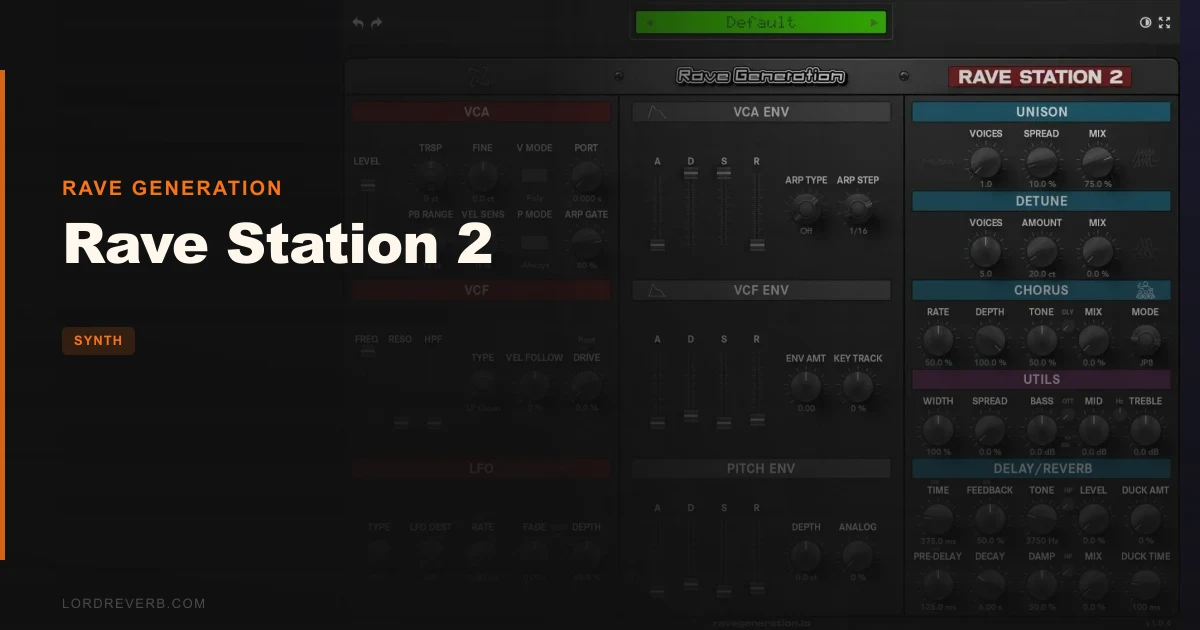
Finding one plugin that covers hoovers, rave stabs, breakbeats, classic bass patches, and Eurodance organs without sounding like a cheap sample CD from 2003 is genuinely hard. Most rompler-style plugins in this space give you 200 presets of vague "retro" sounds and call it a day. Rave Station 2 by Rave Generation takes a different approach: 800+ sounds built from 1,650+ samples, totalling more than 28 minutes of source audio, with real synthesis underneath so you can actually shape what you're hearing. It starts at $222.62. That's the pitch. Here's whether it holds up.
The Specific Problem This Solves
Mid-90s rave and hardcore production has an authenticity problem in the box. The hardware that made those sounds, Roland JD-800s, Juno-106s, JP-8000s, TB-303s, Akai S-series samplers, is expensive, unreliable, and increasingly hard to source. The software alternatives tend to split into two camps: pure synthesis plugins that get you close but never quite nail the sample-based texture, or static rompler packs with no sound design depth.
Rave Station 2 sits in the gap between those two things. It's built from real sampled sources with multi-sample support and tuned-to-key mapping, but it wraps them in a proper synthesis and effects engine. You're not just triggering samples. You're filtering, enveloping, modulating, and processing them through 11 filter types, three ADSR envelopes, and a complete effects chain.
That's the actual problem it exists to solve. And it mostly does.
How It Performs in a Real Session
We loaded Rave Station 2 into a 130 BPM techno session and went straight to the Hoover category. Classic choice, deliberately unfair test. Hoovers are notoriously easy to get wrong, too polished and they lose their character, too raw and they don't sit.
The first preset we tried had the right harmonic width but was sitting too far forward in the mix. We pulled the filter cutoff down from about 80% to 55%, bumped the filter envelope decay to roughly 600ms, and switched to the LP Moog 24 model. That thickened the low-mid body without adding boom. Three knob moves. The sound sat properly.
That's where Rave Station 2 earns its money. The filter types aren't decorative. The Juno-106 model has that specific slightly-soft resonance peak. The TB-303 diode ladder model has the right amount of edge on the cutoff sweep. We ran a stab patch through the Roland-style 24dB filter with resonance at about 65% and key tracking turned on. It tracked across four octaves without the tone collapsing. That's not always a given.
The Supersaw engine uses authentic JP-8000 frequency ratios in 7-voice mode. We tested this against a hand-tuned Supersaw built in another synth. The spread behaviour matched closely through the midrange, with Rave Station 2 holding more body in the low-mids at wider detune settings. Satisfying to dial in. The 9-voice option spreads wider but thins out faster below 200Hz, which is expected.
The SH-101-style arpeggiator runs 14 patterns across 9 tempo divisions. It's fast to set up. The wrapped W3–W6 patterns give you less predictable rhythmic shapes that work well for acid-adjacent sequences without needing a separate step sequencer.
CPU load stays manageable. We ran 8 simultaneous instances with effects active in a session with 32 other tracks. No dropout. No latency spike. We can't give you a percentage figure because the developer hasn't published one, but in our testing it didn't flag as heavy.
Strengths and Weaknesses
The sound library organisation is clever. Bass, FX, Hoover, Multi, Organ, Stab 1 through 3, Drums, Synth 1 and 2. That structure means you're spending time making music, not scrolling through 800 presets in a single list.
The OTT multiband dynamics with pre/post-reverb positioning is an underrated detail. Most rompler-style plugins bolt a basic compressor on the output and call it mastering. Positioning the OTT before or after the reverb changes the character of the tail meaningfully. We found pre-reverb OTT works best for drums and breakbeats. Post-reverb suits pads and stabs where you want the space to breathe.
The six chorus modes are specific, not generic. CE3, JP8, Alpha Juno-inspired, RCE10, and JP8-SC are distinct. The Alpha Juno mode adds a slight pitch modulation that the others don't have. That matters for vintage accuracy.
The frustrating parts: no AAX means Pro Tools users are locked out completely. The included library, while deep, will push some producers toward expansion packs sooner than they'd like. And the developer hasn't published CPU benchmarks, which is annoying when you're trying to spec a session before committing to a purchase.
Value for the Price
Rave Station 2 is priced at the low end of serious instrument plugins. For context, a single hardware Juno-106 filter chip replacement can cost more than this entire plugin.
You're getting 800+ sounds, 11 authentic filter models, a complete synthesis engine, and a full effects chain in one panel. Buying those components separately across multiple plugins would cost significantly more and require more routing work.
The price is justified. The caveat is that if your productions span multiple genres beyond the 90s rave and techno space, the library's focus might mean you're only using half of what you paid for.
Who Should (and Shouldn't) Buy This
- ✅ Buy if you produce techno, rave, hardcore, Eurodance, or house and want authentic 90s textures with real synthesis underneath.
- ✅ Buy if you're tired of building hoover and stab patches from scratch and want a working starting point you can actually modify.
- ✅ Buy if you run Ableton, Logic, FL Studio, or any VST3/AU host and want a single-panel instrument that doesn't need a mixer's worth of outboard effects to sound finished.
- ❌ Skip if you're a Pro Tools user. No AAX support. Full stop.
- ❌ Skip if your productions lean toward cinematic, orchestral, or contemporary pop. The library isn't built for those sounds and you'll feel the mismatch fast.
- ❌ Skip if you want a pure synthesis engine without a sample-based core. Rave Station 2 is built on real samples. If that's not what you want, look elsewhere.
Score Breakdown
| Category | Score | Notes |
|---|---|---|
| Sound Quality | 4.5/5 | Real multi-sampled sources with tuned-to-key mapping; filter models are authentic and distinct |
| Value for Money | 4.0/5 | The price for this feature set is fair; expansion dependency nudges it down slightly. |
| Ease of Use | 4.5/5 | Single-panel interface; organised library; minimal learning curve for the synthesis engine |
| Features | 4.0/5 | 11 filters, 3 ADSRs, Supersaw engine, OTT, 6 chorus modes; no AAX is a real gap |
| CPU Efficiency | 4.0/5 | Handled 8 instances without dropout in our testing; no official spec published |
| Overall | 4.2/5 | Best rompler-style option we've tested for authentic 90s rave production at this price point |
Alternatives to Consider
If Rave Station 2's genre focus is too narrow, Audio Blast ABX3 Bundle covers the acid synth angle more thoroughly and is worth comparing if TB-303 style sound design is your primary need rather than the broader 90s workstation palette.
For bass-specific work where you need more performance control and less library depth, LOW by BeatSurfing is worth looking at. It doesn't try to cover the full 90s spectrum, but what it does with bass synthesis is focused and deep.
If your interest in retro sound design goes toward more textural and experimental territory rather than rave specifically, Tape Synths Expansion adds real tape-sourced grit that works well layered under Rave Station 2's cleaner samples. They're not direct competitors but they complement each other well in a session.
For a broader synthesis platform that you can adapt to multiple genres, Arturia MiniFreak V offers more synthesis flexibility but loses the rompler depth and genre-specific presets that make Rave Station 2 fast to use for 90s styles.
Rave Station 2 is the right call if the mid-90s is your target era and you want to get there in three knob moves instead of thirty. If Pro Tools is your DAW, that's a hard block. If rave isn't your world, the library won't serve you. But if you are building in that space, $222.62 for this level of authenticity and synthesis control is difficult to argue against.
It doesn't try to be everything. That's exactly why it works.
Frequently Asked Questions
Does Rave Station 2 work in Pro Tools?
No. Rave Station 2 supports VST3 and AU formats only. There's no AAX version, which means it won't load in Pro Tools. If Pro Tools is your primary DAW, this is a hard incompatibility and you'll need to look at alternatives.
How many sounds does Rave Station 2 include, and how are they organised?
Rave Station 2 ships with 800+ preset sounds built from 1,650+ samples, covering 28 minutes of source audio. The library is organised into Bass, FX, Hoover, Multi, Organ, Stab 1 through 3, Drums, Synth 1, and Synth 2 categories. All sounds are tuned to key, with multi-sample support where the source material requires it.
What makes the filter section different from a generic synth filter?
Rave Station 2 includes 11 distinct filter types, each modelled on a specific hardware source. The Juno-6 and Juno-106 models behave differently from each other at high resonance settings. The TB-303 model has the diode ladder character you'd expect from acid production. The Moog-style 24dB model self-oscillates differently to the Roland-style 24dB version. These aren't cosmetic variations on one filter algorithm.
Is Rave Station 2 good for genres outside rave and techno?
The library is built for mid-90s electronic styles: rave, techno, hardcore, Eurodance, and house. Some sounds cross over into general electronic production, and the synthesis engine is flexible enough to push patches in other directions. But if rave and techno aren't part of your output, you'll find the library's focus works against you more often than not. It's a specialist tool, not a general-purpose workstation.