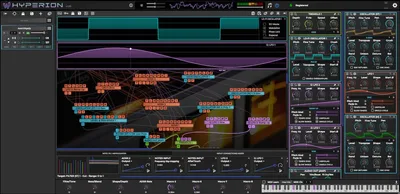
Hyperion by Tracktion gets compared to Falcon constantly, and after months of working with it, that comparison is mostly fair but cuts both ways. Falcon is deeper. Hyperion is cheaper, patchable from day one, and ships with six synthesis engines that most producers won't fully explore in the first year. At $129 regular price (offered at an introductory discount), it targets sound designers who want workstation-level layering with a modular signal chain, without spending more on UVI Falcon or building a semi-modular hardware rig. It's not for everyone. If you want fast analog character or a wavetable synth that loads your own tables, keep walking. If you want to build an 80s polysynth layer on top of a plucked string model on top of a 4-operator FM bass, all within one patch, this is your lane.
How Does Hyperion Stack Up Against Falcon and Pigments Out of the Box?
Open Hyperion cold and the first thing you notice is that it doesn't hold your hand. The interface is clean but dense. Falcon greets you with a polished browser and thousands of presets. Pigments shows you exactly what each module does with colour-coded routing. Hyperion drops you into a layered patch editor and assumes you know what a velocity zone is.
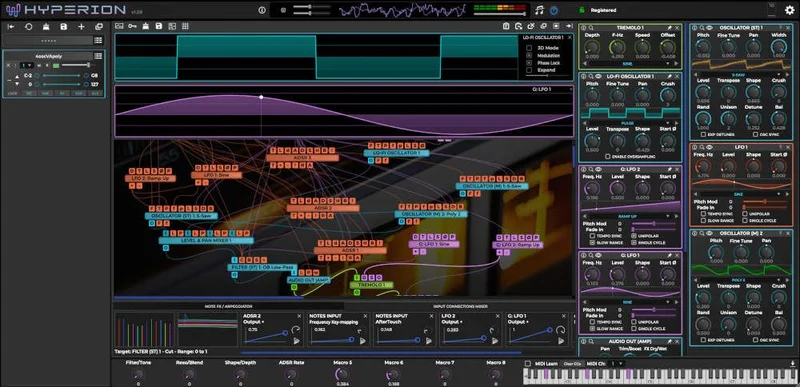
That said, the architecture is immediately logical once you spend 20 minutes with it. Each of the 16 layers has its own synthesis engine, filter, envelope, arpeggiator, and effects chain. Layers stack as chords, splits, or crossfades. You can have a classic subtractive bass covering C1 to C2 and a flute physical model covering the rest of the keyboard, all in one patch.
Arturia Pigments can't do that natively. Falcon can, but costs nearly three times as much.
Performance Deep Dive: Six Engines, One Patch, Real CPU Numbers
We built a test patch: 4 layers active simultaneously, one per engine type. Classic oscillator running two detuned saws through a Moog-inspired ladder filter. A 4-operator FM layer doing a DX7-style electric piano. A plucked string model on a short percussive line. Sample playback triggering a single-cycle waveform stretched across three octaves.
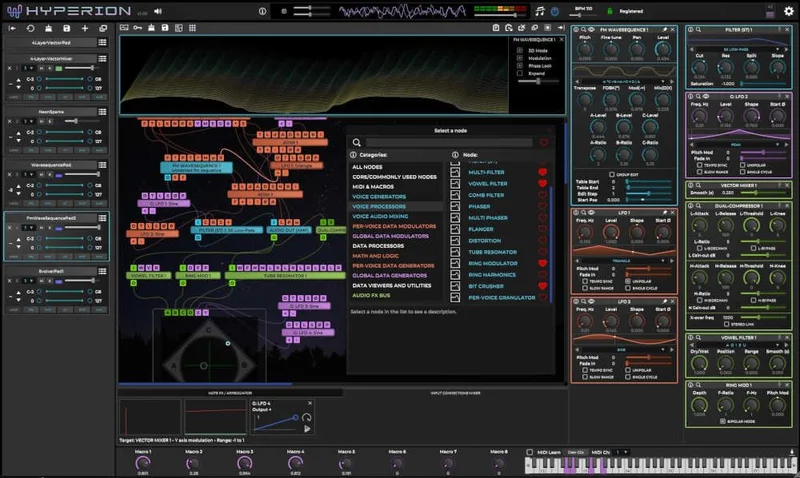
CPU hit in Reaper on an Apple M2 Mac Mini: approximately 8-12% with all four layers playing a 4-note chord. That's reasonable. Not light, but not the 25-35% we've seen from some complex Falcon patches at similar complexity. The standalone version runs even leaner because it's not sharing resources with a DAW host.
Version 1.59 added a LoFi oscillator and animated LFO phase points. The LoFi oscillator is genuinely useful, bit-depth and sample-rate reduction baked into the oscillator stage rather than bolted on as an effect. We dialled the sample rate down to 11kHz on a pad layer and left the other layers clean. The grit sits underneath without smearing the top end.
The modular patching system lets you route up to 16 modulation sources to a single target pin. We ran the mod wheel, an LFO, velocity, and aftertouch all into filter cutoff simultaneously with different scaling amounts. That level of control at this price is hard to find check how Bleass handles multi-source modulation.
Where Hyperion Wins the Argument
The layering system is the headline feature and it actually delivers. We built a Vangelis-style brass patch by stacking a saw wave through a slow-attack filter, a subtle FM layer adding digital sheen, and a quiet flute model giving the attack a breath. It took about 40 minutes. The result was something we'd actually use on a track.
That kind of cross-synthesis layering inside a single plugin instance is rare at this price range. Falcon does it better with more oscillator types and deeper modulation, but Hyperion does it well enough that most producers won't hit the ceiling quickly.
The free update record matters too. Sixty-plus releases since launch. The LoFi oscillator, animated LFO phase display, and ongoing UI improvements all arrived free to existing owners. That's the kind of developer relationship you want how Tape Synths expansion handles ongoing value.
MPE support across all 16 layers is also legitimately clever. Per-note pitch, pressure, and slide working across independently configured layers is not something most workstation synths handle gracefully.
Where the Competition Still Wins
The wavetable situation is frustrating. Hyperion includes wave-sequencing oscillators that morph between built-in waves, but you cannot load external wavetables in Surge XT, Vital, or Serum format. If your workflow involves collecting and dropping in custom wavetables, that's a real limitation. Vital does this for free. Serum does it well at a higher price. Hyperion doesn't do it at all.
Falcon's preset library is also significantly larger and more polished out of the box. Hyperion's factory content skews hard toward cinematic pads and atmospheric textures. If you need leads, basses, or plucks that sit in a mix without heavy editing, you'll be building from scratch more often than you'd like.
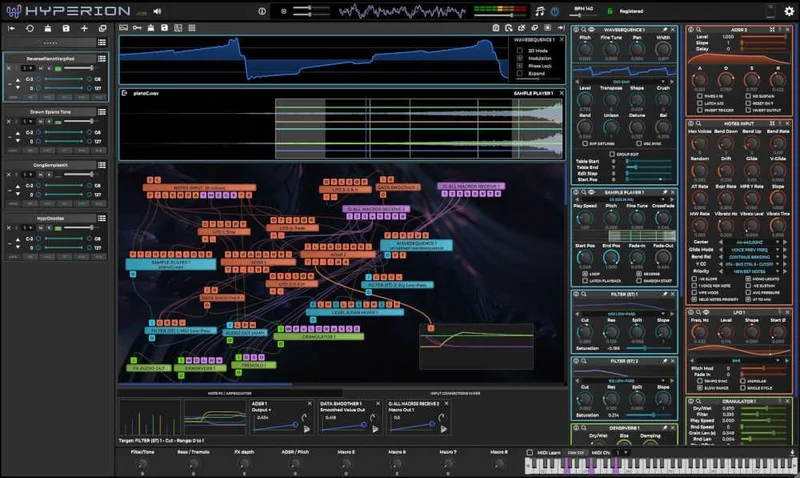
Ease of use is an honest concession. Pigments is friendlier. Even Falcon's browser is more navigable. Hyperion's patching interface rewards patience but punishes impatience if
you want a friendlier bass synth starting point.
Who Should Actually Buy Hyperion?
- ✅ Buy if you work in cinematic, ambient, or experimental electronic music and need deep layering control without a larger budget.
- ✅ Buy if you're an MPE user who wants per-note expression across multi-engine patches.
- ✅ Buy if you've outgrown single-engine synths and want to start building complex hybrid sounds without moving to hardware.
- ❌ Skip if your workflow depends on loading external wavetable content. This isn't that tool.
- ❌ Skip if you want plug-and-play presets. The factory library won't cover your bread-and-butter needs.
- ❌ Skip if you're new to synthesis. The architecture is not beginner-friendly, no matter what the UI looks like at first glance a gentler entry point into physical modelling.
Score Breakdown
| Category | Score | Notes |
|---|---|---|
| Sound Quality | 4.0/5 | Cross-engine layering produces genuinely interesting textures; filters are solid if not boutique-level character |
| Value for Money | 4.5/5 | Six synthesis engines, 16 layers, MPE, and 60+ free updates at $129 is hard to argue with. |
| Ease of Use | 3.0/5 | Logical architecture but real learning curve; not a weekend pickup for newcomers |
| Features | 4.0/5 | Exceptional layering and modulation depth; wavetable import gap is the main miss |
| CPU Efficiency | 3.5/5 | Reasonable for the complexity; heavier patches with 8+ layers will test mid-range machines |
| Overall | 4.1/5 | A serious sound design tool at an honest price, buy it for layering, not for presets |
Alternatives to Consider
UVI Falcon: Deeper oscillator library, better preset browser, more polished workflow. Worth the extra spend if sound design is your primary income. If it's not, Hyperion does 80% of what Falcon does at 28% of the price.
Arturia Pigments: Friendlier interface, better factory presets, wavetable import that actually works. Loses on layering depth. If you want multi-engine per-patch control, Pigments doesn't compete. FM synthesis compared across price points
Vital: If wavetable synthesis with external table import is your main need, Vital at any tier is the honest answer. It won't give you 16 layers or physical modelling, but the wavetable engine alone embarrasses what Hyperion offers in that specific area. synth bundle value compared
Our Verdict
Hyperion is underrated in exactly the way that tools with steep learning curves always are. Most reviews write it off as "complex" and move on. That's lazy. The complexity is the point.
Spend a weekend with the layering system and the modular patching, and you'll build sounds you can't get from anything else at this price. We love the LoFi oscillator, we love the MPE implementation, and we wish, genuinely wish, it handled external wavetables.
Buy it if you make cinematic, ambient, or experimental music and you're willing to learn the tool. Skip it if you need a quick-deploy synth for session work or if external wavetable support is non-negotiable for your process.
It's not Falcon. It is also not priced like Falcon. At $129, that trade-off is your call to make, not ours.
Frequently Asked Questions
Is Hyperion good for beginners?
Honest answer: no. The architecture is logical but not intuitive without synthesis experience. If you understand oscillators, filters, envelopes, and basic modulation routing, you'll get productive within a few sessions. If you're still learning those concepts, start with something like Vital or Surge XT and come back to Hyperion when you're ready for the depth it offers.
Can Hyperion load external wavetables from Serum or Vital?
No. This is one of the genuine limitations. Hyperion's wave-sequencing oscillator morphs between its own built-in waves. You can't import .wav wavetables in Serum, Vital, or Surge format. If external wavetable import is a core part of your workflow, Vital or Serum are the right tools for that job.
How does Hyperion compare to Falcon on CPU?
In our tests on an Apple M2 Mac Mini, a 4-layer Hyperion patch running a 4-note chord drew 8-12% CPU in Reaper. Complex Falcon patches at similar layer counts can push 25-35% depending on the oscillator types used. Hyperion is meaningfully more efficient at comparable architectural complexity, though heavily modulated 8-16 layer patches will still push mid-range machines.
Does Hyperion get regular updates?
Yes, and this is one of the strongest arguments for buying it. Tracktion has shipped 60+ updates since launch, all free to existing owners. Version 1.59 added a LoFi oscillator and animated LFO phase points. The development pace is active and the feature additions have been substantive, not just bug fixes.