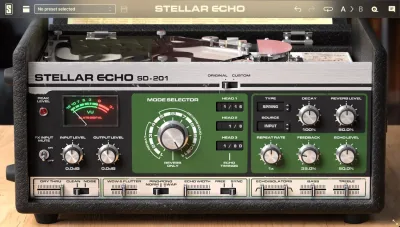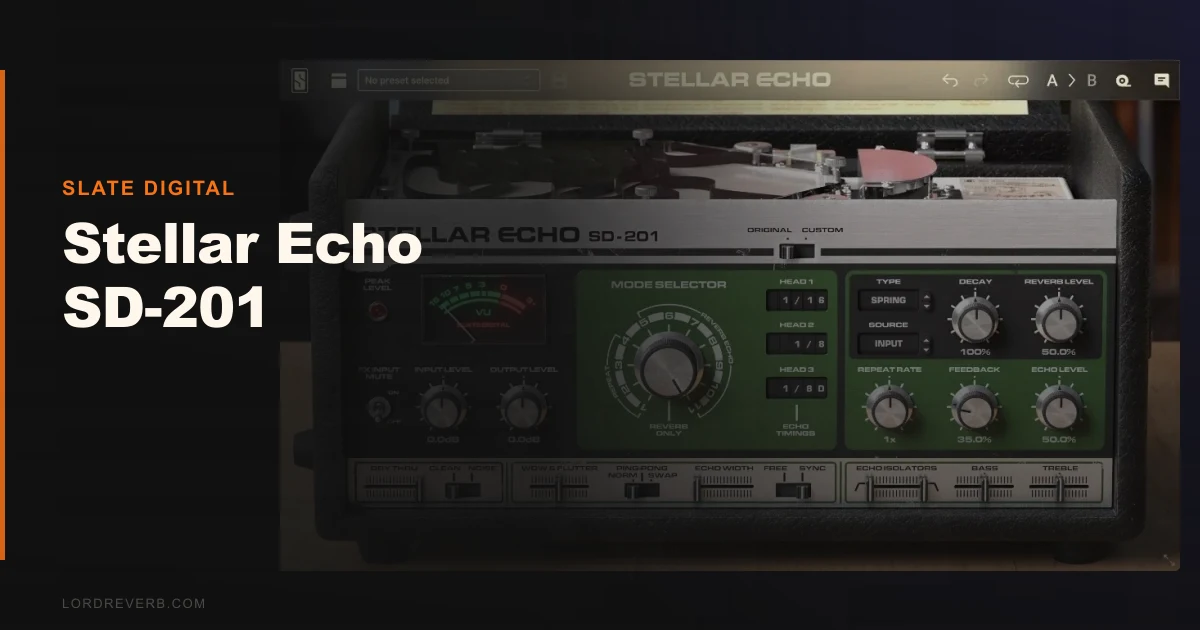
The Stellar Echo SD-201 is Slate Digital's emulation of the Roland RE-201 Space Echo, launched in November 2024, and it's one of the better tape delay plugins in a category that's genuinely overcrowded.
We loaded it on a dub reggae session. Rhodes on the right, one-drop kick sitting in the pocket, and a bassline that needed air without getting muddy. We pulled up the SD-201 on a send, set it to three-head playback, engaged the spring-style reverb trail, and turned the repeat rate knob until the delays started stacking into each other. The oscillation built slowly. Then it ran away from us completely.
That runaway moment, where feedback tips into self-oscillating chaos, felt right. Not approximate. Not close. Right.
But we've heard that story before from a half-dozen other developers. So the question here is whether the SD-201 earns its price tag when EchoBoy, the Arturia Tape MELLO-FI, and IK Multimedia's Space Delay are all fighting for the same wallet.
This review is for producers who need a tape delay that behaves in a modern DAW without losing the psychedelic grit that made the original RE-201 worth copying in the first place.
What It Is (and What It's Not)
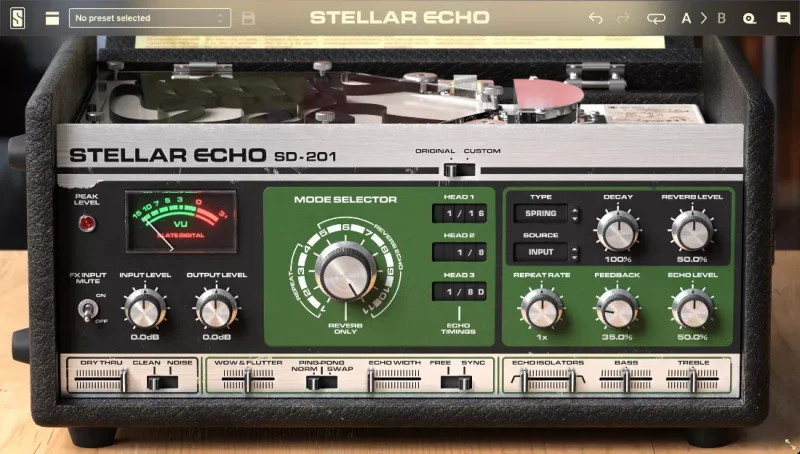
The SD-201 is a Roland RE-201 emulation built around three-head tape delay playback. Head 1 handles short slap delay. Head 2 sits in the middle. Head 3 reaches further out. You can combine them for multi-tap rhythmic patterns the original could produce, plus a custom fourth modeled playhead Slate added for extended range.
Beyond the delay, you get plate, chamber, and hall reverbs alongside the spring reverb the RE-201 had. You also get ping-pong mode and full stereo operation. The hardware never did either of those things.
What it's not: a creative sound design tool on the level of Halo Delay's modulation toolkit. It's not built for rhythmic stutter effects or 3D spatial placement. It does one thing well. Classic tape delay character, dragged into a workflow that actually functions in 2026.
Skip it if your music doesn't need vintage tape flavor. There's no reason to reach for this on a pop vocal that just needs clean quarter-note repeats.
Living With It
Setup took about four minutes. VST3 on Windows 11, AAX in Pro Tools. No drama. Slate's iLok-based activation worked first time, which isn't always the case with their suite.
The UI reads clearly on a single monitor. The motor speed control for wow and flutter sits front and center, and we kept it between 15 and 30 percent on almost every session. Below 15, it sounds too clean. Above 40, it crosses from vintage into broken.
We ran a vocal through it with tempo-sync locked to 120 BPM at dotted eighth on Head 3. The sync held the rhythm without making the delays sound quantized or stiff. That's harder to do than it sounds with tape emulation because the wow and flutter should introduce natural drift. The SD-201 drifts without losing the grid. Satisfying.
The EQ and filtering controls on the feedback path are genuinely useful. We rolled off above 4kHz on a snare send and let the delay tail go dark. Each repeat got a little duller than the last. That darkening is what separates tape delay from digital delay. The SD-201 does it well.
One annoying discovery after a few weeks: there's no A/B comparison built into the plugin. You change a setting, you can't instantly flip back to where you were. For a plugin in 2026, that is an oversight.
CPU usage landed around medium. We ran six instances on a dense session without hitting red. Not light, but not the kind of CPU-hungry beast that forces you to bounce before you've finished arranging.
The Trade-Offs
The tape emulation wins on feel. The oscillation behavior, the way feedback builds and tips over, the subtle pitch drift on each repeat. It's all modeled with enough care that we didn't reach for another delay plugin in three weeks of regular use. That's a strong signal.
The reverb modes are where it loses ground. Plate and hall are usable but thin. We ran a kick tail through the plate setting at 1.4 seconds and compared it directly against our go-to plate reverb. No contest. The SD-201's plate added some air but lacked body below 200Hz. Treat the reverb section as a utility bonus, not a selling point.
Price is the real trade-off. At list price, you are paying for a plugin that does one thing excellently and a few other things adequately. The Arturia Tape MELLO-FI and SoundToys EchoBoy both compete directly at lower or comparable prices with broader feature sets. The SD-201 justifies its cost if you're already in the Slate ecosystem, where it's free with the All Access Pass. Outside that ecosystem, the math is harder.
We also wish the fourth custom playhead had more documentation. What does it actually model? Slate's materials are vague on this, and for producers who want to understand their tools, that's frustrating.
Against the Field
SoundToys EchoBoy is the benchmark for tape delay plugins. Broader sound engine, more filter options, better for creative sound design. If you need one tape delay for everything, EchoBoy wins on versatility. Check the manufacturer's site for current pricing.
Arturia Tape MELLO-FI costs less and leans more lo-fi. Good for hip-hop and cassette aesthetics. Not as accurate on RE-201 character.
Universal Audio's RE-201 Space Echo requires a UAD interface, which is an automatic disqualifier for most ITB producers. The emulation is arguably the most accurate available, but the hardware dependency is a deal-breaker for many.
For producers who want something more spatially experimental, Sound Particles inDelay pushes delay into 3D territory the SD-201 won't touch.
The SD-201 wins on RE-201 authenticity without hardware requirements. That's a specific niche. If that's your niche, it's the right call.
The Real Verdict
Buy the Stellar Echo SD-201 if you're already a Slate All Access subscriber. Free is an easy price to beat. It earns its place on a dedicated tape delay send and holds up across genres that need that gritty RE-201 character.
At full standalone price, we would tell you to look at EchoBoy first. The SD-201 is better at being a Space Echo than EchoBoy. EchoBoy is better at everything else. For producers who only need the RE-201 sound, the SD-201 is worth it. For everyone else, the field is competitive and the SD-201 doesn't clearly win on price or breadth.
If you're after a broader understanding of what the best tape and digital options look like together, our delay plugins guide covers the full category.
Score Breakdown
| Category | Score | Notes |
|---|---|---|
| Sound Quality | 4.5/5 | RE-201 character is convincing; oscillation behavior feels physically real |
| Value for Money | 3.5/5 | Great value inside the Slate ecosystem; harder to justify at $149 standalone |
| Ease of Use | 4.0/5 | Clear UI, quick setup; missing A/B comparison is a frustrating omission |
| Features | 3.5/5 | Stereo and ping-pong add real value; reverb section doesn't pull its weight |
| CPU Efficiency | 4.0/5 | Medium load; ran 6 instances without bouncing |
| Overall | 4.1/5 | Excellent at one thing; priced against plugins that do more |
Alternatives to Consider
SoundToys EchoBoy: Our pick if you want one tape delay that covers every use case. More filter character options, better for creative sound design. See how EchoBoy compares in our delay plugins guide. Check SoundToys' site for current pricing.
Antelope Audio Halo Delay: Wins on modulation depth and harmonic complexity. Read our full Halo Delay review to see where it beats and loses to other options in the category.
United Plugins Mirror: If reverse delay textures are part of your sound, Mirror handles that specific use case better than anything at its price. Different tool, different job.
The SD-201 beats all three on pure RE-201 accuracy. None of them do that one thing as well. Know what you need before you buy.
Three weeks with the Stellar Echo SD-201 left us with one clear impression: Slate Digital built the plugin for people who love the Roland RE-201 specifically, not for people who just want a tape delay. That's a smaller group than they might think, but if you're in it, the SD-201 is the easiest recommendation we've made all year at its sale price. At full retail, make sure you are actually in that group.
Frequently Asked Questions
Is the Stellar Echo SD-201 worth buying if I already own EchoBoy?
Probably not at full price. EchoBoy covers the RE-201 territory well enough for most sessions, and the SD-201's primary advantage is deeper accuracy on that specific hardware character. If you are already happy with how EchoBoy handles tape delay on your mixes, the SD-201 does not add enough to justify the list price. It's worth it if you're a Slate subscriber and it costs you nothing extra.
Does the Stellar Echo SD-201 work without a UAD interface?
Yes. It runs natively in VST3, AU, and AAX formats on any compatible Mac or Windows machine. No external hardware required beyond iLok license manager. This is the main practical advantage it has over Universal Audio's Space Echo emulation, which requires UAD hardware to run.
What does the fourth custom playhead actually model?
Slate Digital describes it as an extended playhead position beyond the three found on the original RE-201, designed to give longer delay times and a different tonal character. The specific modeling target isn't clearly documented in their materials. We'd love a clearer answer on this. For now, trust your ears on it rather than the marketing copy.
Can I use the Stellar Echo SD-201 for live performance?
Not easily. There's no standalone application, so you'd need a laptop running a DAW host to use it live. It's built as a studio plugin. If you need a live-friendly Space Echo emulation, look at hardware alternatives or DAW hosts designed for stage use. The SD-201 is a recording and mixing tool.