Softube says the TSAR-1 Reverb sounds better than established traditional reverb products, and that claim holds up in specific situations, but it doesn't hold up across the board. At $149, this is a plugin that does one thing beautifully, trips over a few things it should handle with ease, and costs enough that you'll want to know exactly where the line is before you buy. This TSAR-1 Reverb review lays that out plainly.
If you mix strings, ambient vocals, or lush pads and you want a reverb that puts things in a believable room without much fuss, the TSAR-1 lands well. If you work in hip-hop, need tight gated snares, or want the kind of aggressive low-end smear control that a proper high-pass gives you, this one will frustrate you inside twenty minutes.
Let's get into what the plugin actually is, what it promises, and where the gap between those two things costs you money.
The Claim: A Better-Sounding Alternative to Everything You Already Own
Softube is direct about this. The TSAR-1 is not an emulation of a hardware unit, and it's not a stock design. The developer calls it "alive, vibrant, gentle, dreamy, natural, and believable." They say the True Stereo Algorithm is what makes it work, and that the plugin has "sophisticated sound and versatility across strings, brass, drums, and vocals."
That's a broad claim. Versatility across that many sources at that price point is an ambition most reverbs don't meet cleanly.
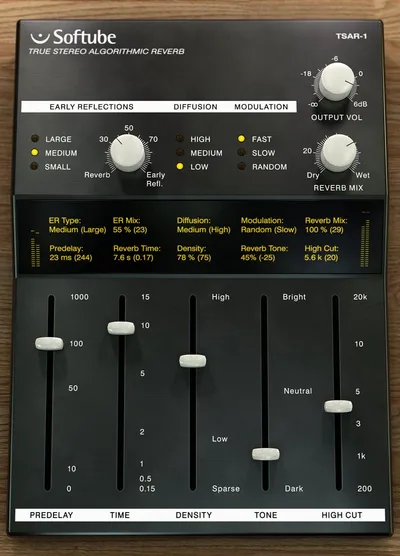
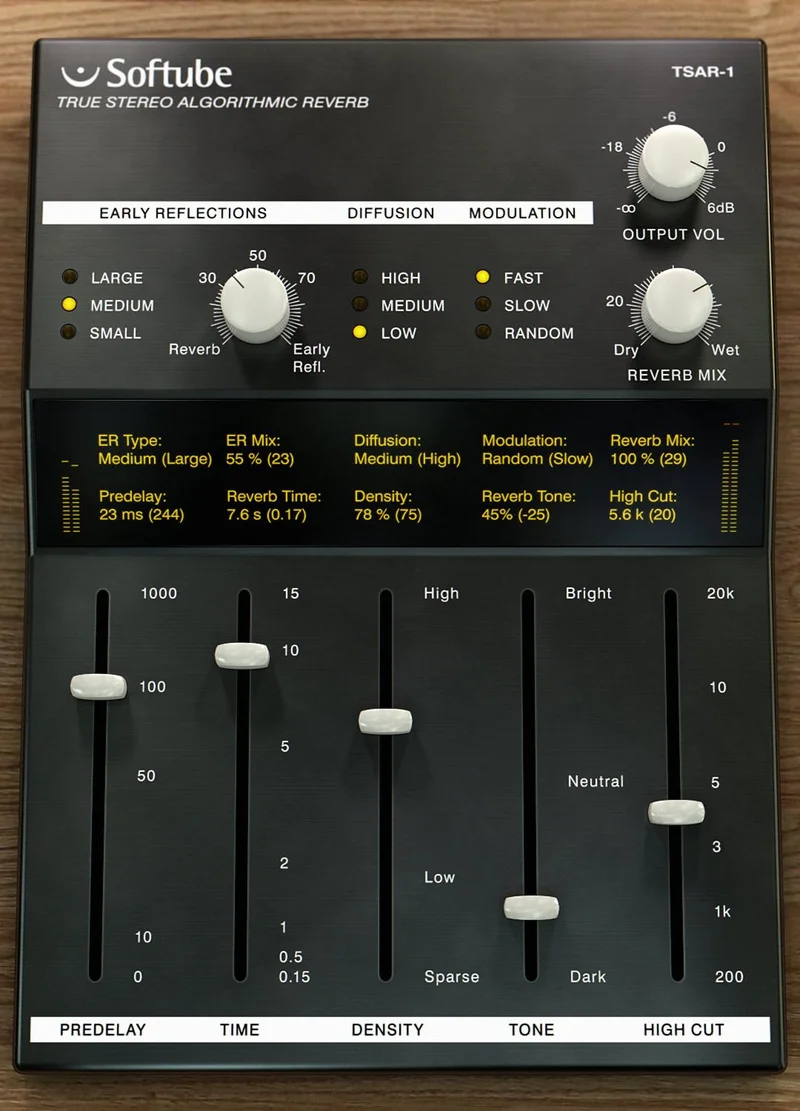
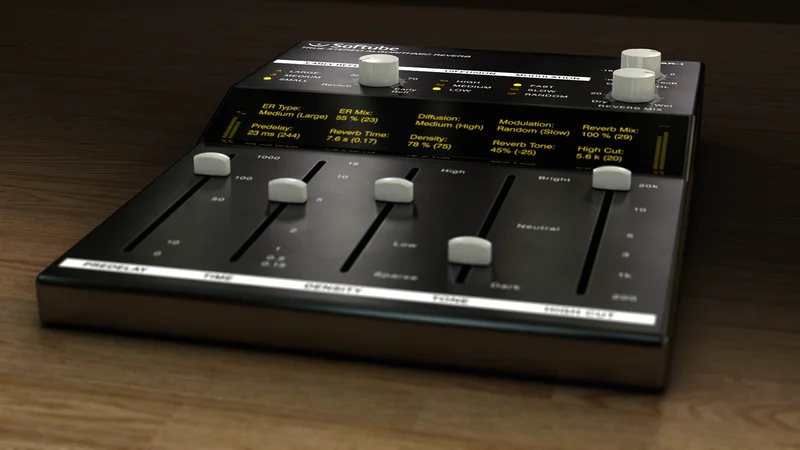
They also say the interface is "unparalleled in other high-end reverb products" for ease of use. That part is easier to evaluate. Eleven controls. A single interactive display. Two preset sets. It's genuinely minimal, and whether that reads as elegant or limited depends entirely on what you need from a reverb plugin.
The pitch positions TSAR-1 against Lexicon-style reverbs and convolution units. The True Stereo Algorithm is the technical foundation: real stereo processing that treats the left and right signals as a genuine stereo pair rather than two mono signals summed together. That matters for stereo sources. You can hear it on wide synth pads and orchestral strings, where a mono-summing reverb can collapse the image.
What Actually Holds Up: The Sound of the Thing
Owners describe the reverb as "gorgeous, organic, and live." That's not marketing language echoing back: that comes from people who paid for it and put it in sessions.
Where the TSAR-1 sounds its best is on shorter reverb times. Load it on a vocal, set the decay somewhere between 800 milliseconds and 2 seconds, pull the High Cut down to roll off the fizz above 6 kHz or so, and the result sits in the mix without fighting for space. It sounds like the singer is in a real room. Not a specific room, not a great hall anyone would recognise, but somewhere plausible and physical.
The Tone control is underrated. It shapes the overall colour of the reverb tail in a way that's more musical than a parametric EQ band. Push it toward the brighter end on acoustic guitar and the reverb opens up. Pull it dark on brass and the decay gets heavy and satisfying without turning washy. This kind of single-fader tone sculpting is what the "easy to use" claim is actually built on, and it delivers.
Density is worth spending time with. It controls how thick the early build of the reverb feels. Low Density on a snare gives you a sparser, rattier tail. High Density on a synth pad turns into a cloud. Neither extreme sounds broken, which isn't always true of density controls on cheaper plugins.
The Modulation control offers two flavours: a vintage chorus-style wobble and a modern, cleaner movement. The vintage setting is genuinely useful on long pad reverbs where you want a slightly unstable, living quality in the tail. The modern setting keeps things tighter and cleaner. Neither is subtle at high settings, so dial in small amounts.
Predelay up to one full second is a wide range. Most of the time you'll sit between 10ms and 60ms, but having the full second available means you can use TSAR-1 for rhythmic, tempo-synced reverb throws when a session calls for it. That flexibility earns its keep on creative work.
The 41 presets are well-built. They're split into modern and vintage sets, named clearly for their intended use, and each one has documented examples of where it fits. That's a level of care most reverb developers skip entirely. You can drop onto a preset and be 70% of the way to a usable sound without touching a fader.
The Early Reflections Section: Clever but Limited
Early reflections are what your ear uses to judge the size and shape of a room. The TSAR-1 gives you a selector with three room types: Large, Medium, and Small. Then an Early Reflections Mix fader to blend them into the tail.
For natural reverb applications this works fine. Choose from Large, Medium, or Small room types, adjust Early Reflections Mix to keep them integrated, and the sound coheres into something believable.
But here's where one of the real complaints comes from. Gated reverb presets on the TSAR-1 sound unconvincing, and the Early Reflections design is partly why. When you try to shape the plugin into a tight, punchy, classic gated snare sound, the discrete early reflections don't blend into the gate effect the way they would on a unit built for that sound. The reflections stay audible as separate events instead of fusing into that compressed, chopped tail.
If gated reverbs are part of your toolkit, this will annoy you. It's not broken, but it's not the right tool for that job. And at $149, you'd reasonably expect it to cover more ground.
What Doesn't Hold Up: The Gaps That Cost You
Start with the missing low-cut filter. This is the complaint that appears most consistently from owners, and it's legitimate.
Every reverb tail picks up low-frequency content. On a kick drum reverb, that muddies your low end fast. On a bass instrument, it's worse. The TSAR-1 gives you a High Cut fader to roll off the top, but nothing to touch the bottom. You're forced to either add an EQ after the reverb in your signal chain or reach for a different plugin entirely.
On a bus send that's fine: add a high-pass after the reverb return. But it's an extra step, it's a real workflow gap, and it's a surprising omission for a plugin at this price. Frustrating is the right word for it.
The CPU situation is harder to dismiss. A single instance pulling 23% CPU on a Core 2 Duo is a period-specific data point, but the principle holds: this plugin has a real CPU cost. On modern Apple silicon or a current Intel/AMD system you'll have more headroom, but run several instances across a session and you'll feel it. If your system is older, test before you commit.
The installation process is genuinely annoying. You're required to download a 1.3 GB Softube library to use one reverb plugin. That's the full Softube installer package, not a targeted TSAR-1 download. On a slow connection or a system with limited storage, this matters. It's not a dealbreaker but it's a real cost that doesn't show up in the $149 tag.
Automation behaviour is another gap. Some owners report output muting or artifacts when automating parameters, with Digital Performer specifically called out. If your workflow involves heavy automation of reverb parameters mid-track, check compatibility before you buy.
The eleven-control interface has two readings. For users who want to dial in a reverb quickly and move on, it's clean and efficient. For users who want surgical control over the reverb algorithm, it's a ceiling. You cannot shape the tail in the way a more complex plugin would let you. If you come from deep reverb workflows where you're modifying individual early reflection timings or shaping the decay envelope with precision, the TSAR-1 will feel like it's keeping information from you.
One owner tested it against Sonnox, R2, and others and found it uninspiring. Another described a 2D character versus hardware plate. These aren't majority opinions, but they're not outliers either. The TSAR-1 has a character: smooth, even, organic. If that's not the reverb sound you're after, no amount of preset browsing will fix it.
The Predelay and Decay Controls in Practice
Predelay and Time are the first two faders you'll reach for. Get these right and the reverb sits. Get them wrong and everything sounds glued to a wet surface.
For vocals, the Predelay can be adjusted to separate the dry voice from the reverb onset. That gap separates the dry voice from the reverb onset, and the TSAR-1 handles that separation cleanly. The vocal stays up front and the tail follows without competing. At longer Predelay settings, an audible echo effect emerges, which can work on effect sends but muddy a lead vocal.
Decay ranges from 150 milliseconds to 15 seconds. The shorter end, 150ms to 500ms, is where the plugin sounds most convincing on percussive material. Longer decays, above 8 seconds, move into ambient and drone territory. They're smooth, and the modulation parameter earns its keep at those lengths. But at 15 seconds you're making a textural choice, not a mixing one.
The interactive display shows your current settings against your previous ones with a toggle function. This is one of the cleverer UI choices. Set a reverb, toggle back to your previous settings, compare, then decide. On a minimalist interface like this, A/B comparison within the plugin itself is worth more than it sounds.
High Cut, Tone, and Frequency Shaping (What You Have and What You Don't)
You get two tools for frequency shaping: the Tone fader, which shapes the overall colour of the reverb, and the High Cut fader, which rolls off the top end of the tail.
The High Cut is a surgical tool for removing fizz and presence from a reverb that's sitting too bright. Pull it down to remove brightness from a reverb that's sitting too bright, and the reverb steps back into the room without disappearing. Push it high, and the tail gets airy and open, which suits pads and synths where you want the reverb to breathe.
But there's no corresponding tool on the low end. You cannot high-pass inside the plugin. If you're sending a piano into TSAR-1 and the reverb is picking up 80 Hz room boom, you'll need to address that outside the plugin. An EQ on the reverb return, high-passed at whatever frequency clears the mud.
This is a workflow annoyance, not a catastrophic flaw. But it's the kind of thing that makes you wish for one more fader, and on a plugin that markets its "comprehensive easy-to-use interface" as a selling point, the absence feels like a choice someone will eventually regret. We wish they'd put it in.
Presets: Useful, Named Well, Not a Substitute for Learning the Controls
Forty-one presets across two sets. The modern set targets clean, contemporary reverb sounds. The vintage set goes for character: older, warmer, less defined tails that reference hardware reverb aesthetics rather than emulating any specific unit.
Each preset is named for its use case. Not "Reverb 14" but something that tells you where to drop it. That matters when you're working fast and you need to audition reverbs without reading a manual.
The presets are a genuine starting point, not throwaway templates. Load one, adjust the Time fader to match the tempo of your session, pull the High Cut if the tail is too bright, and you're usually within reach of something that works.
Honestly? The preset browser is where most people will spend the majority of their time with this plugin. The controls reward tweaking, but the presets get you there faster. Use both.
The documented use cases for each preset are a nice touch that most developers skip. Small detail, meaningful effort.
The TSAR-1R: What Comes in the Box
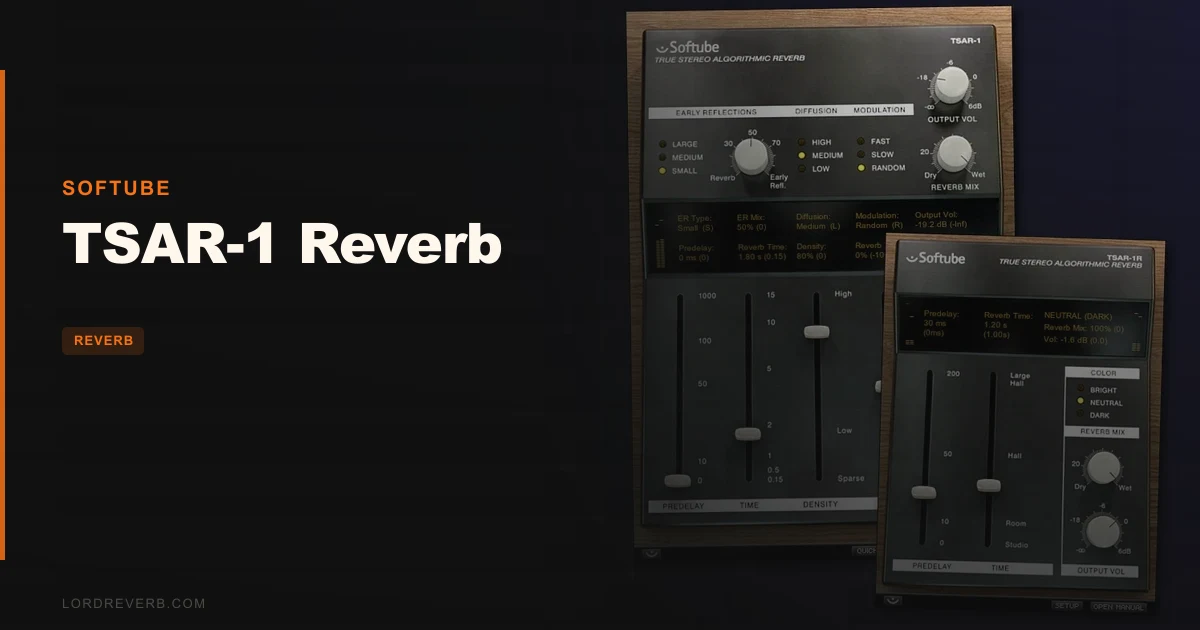
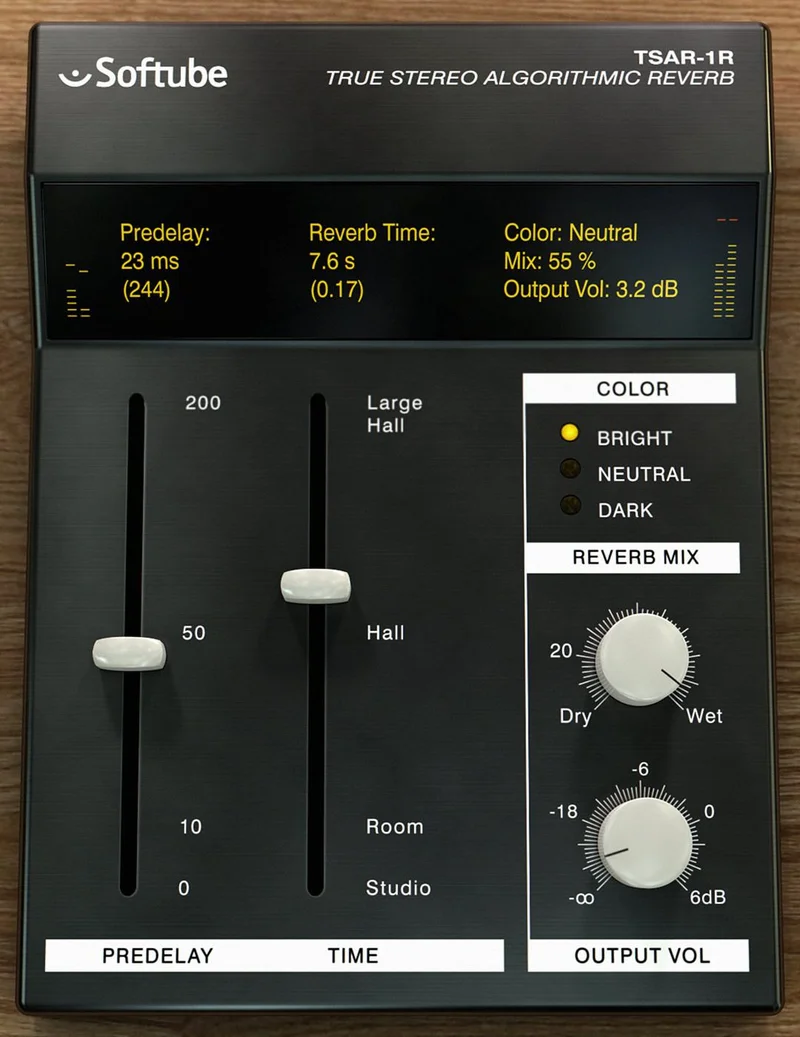
The package includes TSAR-1R, a simplified version of the same algorithm. Think of it as the same reverb with fewer options exposed. If you need the TSAR-1 sound on a track but don't need to adjust anything beyond the core parameters, the TSAR-1R lets you drop it in faster.
Having both versions available is a smart inclusion. Simple reverb tasks get the TSAR-1R. Sessions where you need to dial in the exact Density and Modulation behaviour get the full TSAR-1.
Setup, Compatibility, and That 1.3 GB Download
Compatible with macOS Big Sur, Monterey, and Ventura. Windows 10 and 11 in 64-bit. Supports AU, VST, VST3, and AAX. Sample rates from 44.1 kHz up to 192 kHz in both mono and stereo. Officially tested in Pro Tools, Logic Pro, Cubase, Ableton Live, Studio One, and Reaper.
Note that AAX DSP is not in active development. TDM, VENUE, and RTAS are no longer supported. If you're on a legacy Pro Tools HDX rig that relies on DSP cards, check your exact setup before buying.
Softube recommends VST3 over the older VST format for full feature access. If your DAW supports VST3, use it.
The activation chain requires a Softube account, an iLok account, and the latest iLok License Manager. Internet access is needed to download and manage licenses. iLok Cloud support means you don't necessarily need a physical dongle, but the requirement for two separate accounts before you hear a note of reverb is a bureaucratic hurdle that feels disproportionate for a single plugin.
Then there's the 1.3 GB download. Softube packages their plugins in a central library installer, which means installing TSAR-1 downloads the full Softube library even if this is the only Softube plugin you own. On a fast internet connection it's a time cost. On a slow one, it's a real problem. If storage is tight on your primary drive, plan for this before you click purchase.
Who It Suits and Who Should Skip It
If you mix orchestral strings, cinematic pads, ambient vocals, or any source where a natural, organic room sound matters more than surgical control, the TSAR-1 earns its place. The True Stereo Algorithm is the real value here. It handles stereo sources without collapsing the image, and the believable short-to-medium decay times are a genuine strength.
Film composers, ambient producers, and anyone running dense orchestral templates will find things to love. The sound is clean in a way that doesn't draw attention to itself, and that's the right quality for reverb that needs to sit underneath a mix rather than define it.
You should skip it if your sessions are heavy with percussive material, gated reverb effects, or bass instruments that need a properly high-passed reverb tail. The missing low-cut filter will become a daily irritation.
Skip it if you're on older hardware. The CPU cost is real, 23% from a single instance on a Core 2 Duo, and you need your system to run multiple instances without grinding.
Skip it if your workflow involves heavy automation of reverb parameters. The reported artifacts in Digital Performer aren't universal, but they're documented enough to be a risk if automation is central to how you work.
And skip it if you want deep control over the algorithm. Eleven controls is the limit. If you love editing reverbs the way some producers love editing drums, the ceiling here will frustrate you.
The Verdict
The TSAR-1 does what it promises on a narrow but important band of tasks. Put it on a vocal, a string section, or a synth pad, and the True Stereo Algorithm delivers a natural, believable tail that sits in the mix without fighting. The presets are useful. The Tone and Density controls make fast work of shaping the character. And the TSAR-1R bonus plugin adds genuine value for quick sessions.
But at $149, the missing low-cut filter is hard to defend. The CPU draw on anything older than a current-gen machine is a real concern. The 1.3 GB install for a single plugin is a real annoyance. And the gated reverb shortcomings and automation artifacts push this out of universal tool territory and into specialist use.
The core sound is genuinely strong. The feature set doesn't match the asking price as honestly as it should. If you're a film or ambient producer who needs a clean, musical algorithmic reverb and you've already got a tight-sounding verb for percussion tasks, the TSAR-1 fills a specific role well. If you need one reverb to cover everything in your sessions, look harder before committing to this one.
Specs & Technical Details
| Developer | Softube |
| Price | $149 |
| Plugin Format | AU / VST / VST3 / AAX |
| OS Support | macOS Big Sur 11, Monterey 12, Ventura 13 / Windows 10 (64-bit) and Windows 11 |
| Activation | Softube account + iLok account + iLok License Manager (internet required) |
| CPU Usage | Heavy on older systems; 23% reported on Core 2 Duo from a single instance |
| Trial Available | N/A |
| Version Reviewed | N/A |
Score Breakdown
| Category | Score | Notes |
|---|---|---|
| Sound Quality | 4.0/5 | Organic, believable short-to-medium tails; less convincing on gated and percussive material |
| Value for Money | 3.0/5 | Missing low-cut filter and heavy install requirement weigh against the price |
| Ease of Use | 4.0/5 | Eleven controls and well-named presets make getting started fast; ceiling hits quickly for advanced users |
| Features | 3.0/5 | No low-cut filter, no deep algorithm editing, and automation artifacts limit the feature score |
| CPU Efficiency | 3.0/5 | Heavy on older hardware; runs adequately on current-gen systems but not lightweight |
| Overall | 3.5/5 | A natural-sounding algorithmic reverb with real strengths and a short but frustrating list of gaps |
Alternatives to Consider
If the TSAR-1's sound interests you but the feature gaps give you pause, a few alternatives are worth checking before you decide.
Valhalla Reverbs come up repeatedly in owner comparisons with TSAR-1. Some users specifically switched to Valhalla products for creative effects and preferred character. best Valhalla reverb plugins for music production They sit at a lower price point and offer considerably more parameter control, which matters if the minimalist interface feels too restrictive to you.
Relab LX480 is another point of comparison for producers who want a more precisely defined reverb character. The LX480 draws on Lexicon heritage and has different sonic territory to the TSAR-1, but it's a natural step for anyone who finds the TSAR-1's organic sound appealing and wants something with more documented reference points.
Altiverb and TL Space are convolution reverbs that offer a different sonic approach entirely. If you need to place a source in a specific, sampled acoustic space, convolution is the right tool. The TSAR-1's algorithmic approach doesn't do that job.
None of these are straight swaps. Each one covers different ground. But if the TSAR-1's gaps are the thing holding you back, one of them probably closes the hole.
Should You Buy the TSAR-1 Reverb?
Here's the plain version. The TSAR-1 is a brilliant reverb for a specific type of work and an overpriced one for everything else.
If you're producing ambient music, scoring for picture, or mixing orchestral tracks where a natural room sound is the whole game, the True Stereo Algorithm delivers something real. The organic character that owners consistently describe isn't marketing copy. It's audible, and it matters for those applications.
But the plugin leaves too many gaps open for a general-purpose reverb at this price. You're going to want a high-pass somewhere in that signal chain every single session. You're going to hit the ceiling of the interface the moment a track needs something the eleven controls can't give you. And you're going to download 1.3 GB before you hear a note.
If you can set up a session with a synth pad playing a long, evolving chord, and drop TSAR-1 on the reverb send, and the tail opens up in a way that makes you stop what you're doing and just listen for a second. That feeling has value. Whether it's worth the asking price at $149 is a judgment call that depends entirely on how much of your work lives in that kind of sound.
For producers who don't, there are more versatile options at this price and below. The TSAR-1 knows exactly what it is. The question is whether what it is matches what you need.
Related reviews: Temperance Pro Upgrade from Temperance Lite
Frequently Asked Questions
Does the TSAR-1 Reverb require an iLok dongle?
You need an iLok account and the latest iLok License Manager installed, but a physical dongle isn't required. Softube supports iLok Cloud licensing, which lets you manage the license online without hardware. You do need internet access for downloading and managing the license, so fully offline activation isn't available.
What's the difference between the TSAR-1 and the TSAR-1R?
The TSAR-1R is a simplified version of the same algorithm included in the package. It exposes fewer controls and is designed for quick drops where you don't need to adjust detailed parameters. The TSAR-1 is the full version with all eleven controls. Both use the same True Stereo Algorithm under the hood.
Does the TSAR-1 Reverb work on Apple silicon Macs?
Yes. The plugin is compatible with Apple silicon M1 and newer. It also supports Intel Core i3, i5, and i7 processors on macOS. Supported operating systems are Big Sur 11, Monterey 12, and Ventura 13. If you're running macOS Sonoma or later, check Softube's current compatibility page before buying.
Is the TSAR-1 Reverb good for drums and percussion?
It's workable for natural room sounds on drums, but owners report that gated reverb presets sound unconvincing due to how the discrete early reflections behave. If tight, punchy, or gated drum reverbs are a major part of your workflow, the TSAR-1 isn't the strongest choice at this price. Shorter decay settings perform better than longer or gated effects on percussive material.