If you already own Empirical Labs Lil FrEQ and you're wondering whether the Complete Collection 2 upgrade is worth the step up, the short answer is yes, with one condition: you need to actually use compression in your chain, because that's where the real value lands.
This upgrade adds Mike-E Comp, Professor Punch-Knuckles, and Trak Pak to your existing Lil FrEQ licence. It does not replace Lil FrEQ. It builds a fuller signal chain around it, and at $159, it's priced as an upgrade rather than a fresh purchase.
Quick verdict: Complete Collection 2 is a legitimate upgrade for Lil FrEQ owners who want a Distressor-adjacent compressor, a vintage preamp stage, and proper saturation tools without shopping around. Mike-E Comp alone carries the bundle. Trak Pak is brilliant if you own Console 1 hardware, frustrating if you don't. Professor Punch-Knuckles is fine, but it's the one you'll load least. Score: 4.0/5.
What You're Actually Getting on Top of Lil FrEQ
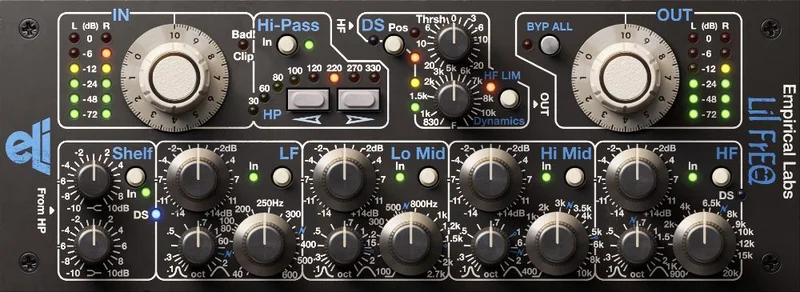
Lil FrEQ is already a capable EQ. Eight processing sections, four fully parametric bands covering LF, Lo Mid, Hi Mid, and HF each at ±14 dB, individual bypass on every band and section, a vintage British-style EQ mode flagged in blue, and a 18 dB/octave high-pass filter with a DS de-esser tucked in at the end of the chain. If you've been using it, you know what it does.
The upgrade doesn't touch that. What it adds is a complete compressor with a preamp stage, a dedicated saturation plugin, and a Console 1 channel strip that borrows from both.
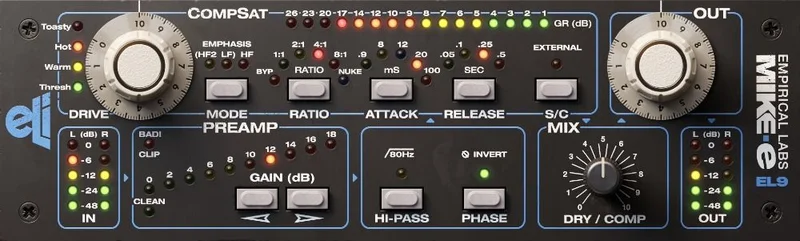
Mike-E Comp is modelled after the Empirical Labs Mike-E hardware. It brings up to +18 dB of gain from its preamp section, a 18 dB/octave high-pass filter at 80 Hz with phase control, and a CompSat section that runs multistage soft-clipping saturation with three emphasis modes: HF, HF2, and LF. The compressor itself is based on the Distressor circuit, which means NUKE mode is in here.
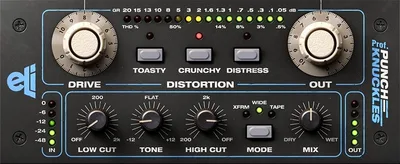
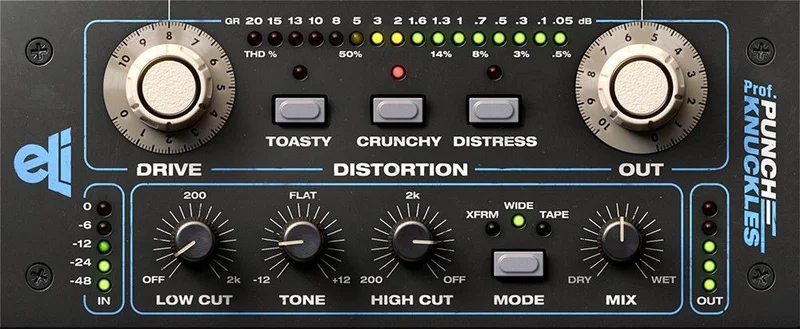
Professor Punch-Knuckles handles saturation separately, with three flavour options, Distressor-based distortion character, and some tone shaping via emphasis filters. It's Console 1-ready.
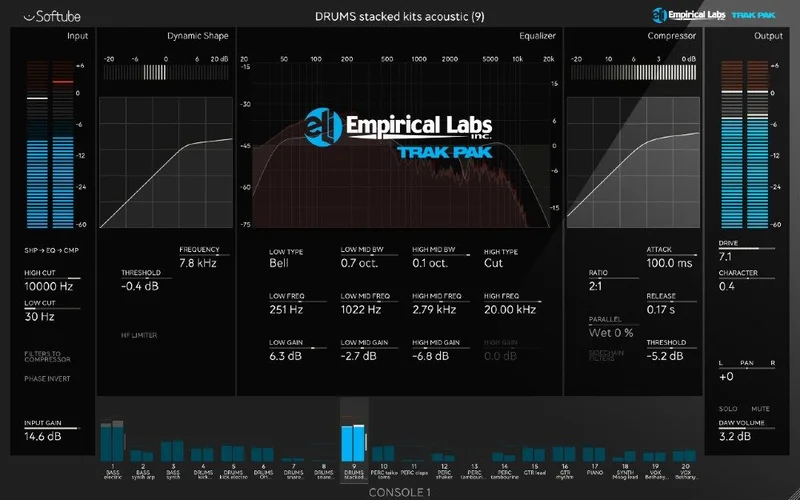
Trak Pak is a Console 1-exclusive strip that pulls together high and low-pass filters from Lil FrEQ, the 4-band parametric EQ at ±14 dB, a shape section drawn from Lil FrEQ's DS section, Mike-E's multistage soft-clipping drive, and a compressor with the same ratio and timing options as Mike-E Comp.
That's the bundle. Three tools on top of what you had.
Who Qualifies for This Upgrade
The Complete Collection 2 is an upgrade path for owners of Empirical Labs Lil FrEQ. If that's not your starting point, this isn't the right entry. You'd want to look at the full collection rather than this upgrade tier.
Practically, you need an active Softube account with Lil FrEQ registered to it. The upgrade pricing at $159 is gated to that ownership. It's a straightforward check.
For Trak Pak, there's a second condition layered on top of that: you need Softube Console 1 hardware. Not a Console 1-compatible DAW. The actual hardware controller. If you don't own one, Trak Pak is a line item you're paying for and can't access.
So who qualifies in a meaningful sense? Lil FrEQ owners who want to add compression and saturation from the same developer, and ideally who already use Console 1. Everyone else is leaving part of $159 on the table.
Mike-E Comp: The Reason to Upgrade
Let's be direct. Mike-E Comp is why this upgrade exists. Without it, you'd have a saturation plugin of debatable necessity and a Console 1 strip you might not be able to use. Mike-E Comp is what moves the needle.
Start with the preamp. Up to +18 dB of gain before anything else in the chain. Push it and the top end turns gritty in the way a well-driven hardware preamp does, not in the digital-clip way that makes you wince. Add the 18 dB/octave high-pass at 80 Hz to clean up low-end energy before it hits the compressor, and you've got a front end that does actual work.
The phase control sits next to the high-pass, which is useful if you're stacking mics or working in a session where phase relationships matter. It's a small thing but it's the kind of detail that shows the hardware origin of the design.
The CompSat section is where Mike-E Comp gets interesting. You've got a multistage soft-clipping saturator running in parallel with three emphasis modes. HF brightens the saturation character, HF2 takes that further, and LF pushes the weight and warmth lower in the frequency content. These aren't subtle switches. Changing the emphasis mode shifts the whole feel of how the saturation sits.
Then the compressor. Six ratio presets: BYP, 1:1, 2:1, 4:1, 8:1, and NUKE. Five attack times in milliseconds: 0.9, 8, 12, 20, and 100.
That's a specific, fixed set of options, not a fully variable knob. Some people find that annoying. The fixed preset approach suits a Distressor-adjacent compressor by encouraging decisive choices rather than endless fine-tuning. You can't fuss endlessly over 7.3 ms versus 7.9 ms.
NUKE mode is where you stop being subtle. It's a high-ratio, hard-limiting setting that's useful for specific effects: pumping overhead compression, aggressive parallel bus treatment, or just seeing how much you can bend a sound before it breaks. Use it intentionally. It's not a problem-solver, it's a creative tool.
External sidechain is included. So is a dry/wet mix control for parallel compression without needing a separate send. Both of those are decisions that make Mike-E Comp genuinely useful in real sessions rather than just impressive on paper.
Owners report the combination of preamp, saturation, and versatile compression gives you a lot to work with on a single channel. The developer says it delivers nary a hint of harshness at extremes. Those two descriptions line up: it's a compressor that can be pushed without turning unpleasant.
how to set up parallel compression in your DAW
Lil FrEQ in Context: Eight Sections, No Fuss
If you're coming to this review already owning Lil FrEQ, you know the layout. But it's worth spelling out how the EQ fits into the complete chain the bundle builds.
Eight processing sections in total. The 18 dB/octave high-pass filter handles low-end sculpting before the EQ bands touch anything. Then four fully parametric bands: LF, Lo Mid, Hi Mid, and HF, each at ±14 dB with bandwidth from super-wide to super-narrow. The generosity of that range matters on problem sources where you need to notch deep without surgical Q settings that ring.
Individual bypass on every band and section is satisfying to work with. You can isolate exactly what each section is doing to the signal, compare instantly, and make precise decisions about where the EQ is earning its keep.
Blue markings flag the vintage British-style EQ settings. These aren't random highlights. They show you specific frequency and bandwidth combinations that correspond to classic console sounds. Useful if you know what you're chasing. Not mandatory if you don't.
The DS section at the end of the chain handles de-essing. Users report it works well on vocals, rounding off sibilance with analogue character rather than the hard, obvious clamp you get from a linear phase de-esser. If your vocal is sitting bright and harsh in the mix, this is where you start. Not with a separate de-esser plugin. Not with a shelf cut. Here, first.
Input gain sits after the meter with a clip indicator. That's slightly unusual positioning but it's practical: you're gain-staging into the EQ bands, not just trimming the input level. Keep an eye on the clip indicator early in your session and you'll avoid the gain problems that make EQ decisions harder than they need to be.
The developer describes Lil FrEQ as warm and punchy. Users report it sounds great with a sheer amount of options. We'd add: the layout makes results quick to dial in, which is exactly what users say too. It's not a complex EQ. It's a comprehensive one.
Professor Punch-Knuckles: Honest Assessment
Let's not oversell this one. Professor Punch-Knuckles is the weakest piece of the bundle.
It's a saturation plugin with three classic flavour options and distortion character drawn from the Distressor circuit. There are tone shaping options through emphasis filters. It's Console 1-ready.
One reviewer characterises it as redundant saturation that rehashes an existing circuit with less flexibility than the source. That's a fair read. If you're already running Mike-E Comp with its CompSat section engaged, Punch-Knuckles is covering similar territory with fewer options.
The three saturation flavours are useful if you want to reach for a quick character option without building a full signal chain. On a drum room mic or a parallel saturation send, it does what you need. The Distressor-based distortion character means it's not completely inoffensive saturation either. It has grit.
But the limit is real. Less flexibility than the circuit it draws from means you're working with a simplified version of something that exists elsewhere in the bundle. If your saturation needs are simple, you'll probably love it. If you want control, Mike-E Comp's CompSat section with emphasis mode switching gives you more to work with.
It's not bad. It's just the one you'll load last.
Trak Pak: Brilliant If You Have Console 1
Trak Pak is the most exciting piece of this bundle and the most limited at the same time.
What it does on a Console 1 channel is genuinely clever. High and low-pass filters at 18 dB/octave from Lil FrEQ, the 4-band parametric EQ at ±14 dB, a shape section from Lil FrEQ's DS de-esser section, Mike-E's multistage soft-clipping drive, and a compressor with attack from 0.9 ms to 100 ms, release from 0.05 to 0.5 seconds, and ratio presets of BYP, 1:1, 2:1, 4:1, 8:1, and NUKE.
That's a full Empirical Labs channel strip mapped to a single hardware controller surface. Reach for your Console 1, touch the EQ section, hit the compressor, push the drive, and everything is right there under your hands. The developer says it stuffs obscene amounts of power, punch, character, and analogue warmth into a single channel. For Console 1 owners, that's a reasonable description of what Trak Pak actually delivers.
For everyone else, it's a line item you can't access.
This is the upgrade's most frustrating design decision. If Softube had made Trak Pak available as a standalone plugin for non-Console 1 users, even with a reduced interface, this bundle's appeal would be significantly wider. As it stands, the Console 1 requirement cuts a chunk of potential buyers off from one of the three tools they're paying for.
If you own Console 1 and you're a Lil FrEQ user, the upgrade becomes an easy call. Trak Pak alone makes the workflow case.
Dialling In the Workflow: How These Tools Connect
Load Lil FrEQ on a vocal channel. Use the high-pass to clear anything below 80 Hz, set the Lo Mid band to notch 2 dB at around 300 Hz with a Q tight enough to catch the mask without taking out the body, and bring the HF band up 1.5 dB with a wide bandwidth to add air. Then hit the DS section to catch the harsh upper-mid sibilance before it builds.
Now put Mike-E Comp after it. Drive the preamp just enough to add thickness before the compressor sees the signal. Set ratio to 4:1, attack at 12 ms to let the consonants through, release at 0.1 seconds to recover before the next phrase. Engage the HF emphasis in the CompSat section with the mix knob pulled back so the saturation adds sheen without weight. Your vocal now has shape, character, and sits in the mix without riding.
That's the chain working as designed. The tools connect logically. You're not fighting two different design philosophies. Lil FrEQ's analogue EQ character feeds into Mike-E Comp's analogue compression, and the output is coherent.
Users report the structured layout makes results quick to dial in. That tracks. Neither tool asks you to think too hard about where you are in the signal chain. The controls are where you expect them, and the signal path is left to right.
Where the workflow gets slower is on Punch-Knuckles. It sits outside the main signal chain logic because it's doing similar work to Mike-E Comp's CompSat. You'll figure out where it fits by what Punch-Knuckles adds that CompSat doesn't, and the honest answer is: not much, most of the time.
What the Bundle Sounds Like in Real Terms
Warm and punchy are Softube's words. Let's translate those into something more useful.
Warm, in the context of Lil FrEQ, means the high-frequency response has a slight softness at the top of the shelf that analogue gear tends to add. It's not a low-pass roll-off you'd measure easily, but when you push the HF band, the brightness has a ceiling that prevents it turning harsh. You'll notice it most on acoustic guitars and strings.
Punchy, in the context of Mike-E Comp, means the attack and release presets are fast enough that transient energy survives the compressor. At 0.9 ms attack and 0.05 second release, you're catching the signal very quickly but releasing it quickly enough that the source retains its hit. On snare, that's the difference between a compressed snare that cracks and one that thuds. Users report the plugins handle both obvious and subtle compression well, which matches what those timing options suggest.
The saturation from CompSat and Punch-Knuckles adds harmonic content in the upper-order partials without creating the dissonant edge that some saturation plugins introduce when pushed. The developer says Mike-E Comp delivers nary a hint of harshness at extremes. That's their claim. What owners report backs it up: the combination is described as pleasant to push, which for a saturation-forward compressor is what you want.
The de-esser in Lil FrEQ rounds off vocal tone with analogue character. Not surgical, not transparent. It has a feel to it. If you hate colouration in your de-essing, this will annoy you. If you love the way a well-set hardware de-esser shapes the vocal tone, this is the one to use.
Stability and Support: The Real Risk
We won't gloss over this. Users report stability issues with Softube plugins freezing. That's a real complaint from real owners. It's not isolated to this bundle, it's a Softube platform issue that gets mentioned across their catalogue.
The support response, according to those same owners, has been unhelpful. There are also reports of Softube ignoring reasonable feature requests from paying customers. These are the kinds of complaints that matter more than sound quality when you're building a working session around a plugin.
A plugin that freezes in the middle of a mix session is not a tool, it's a liability. If your workflow can't absorb that risk, either because you work fast, work live, or work without a safety net of saves, this is worth pausing over before you buy.
It doesn't mean every user experiences this. Many owners clearly use the bundle without issue, or they'd have returned it. But the complaints are consistent enough and the support response described as bad enough that we think you deserve to know before you spend $159 on an upgrade.
how to troubleshoot DAW plugin freezes and crashes
Who Should Skip This Upgrade
If your Lil FrEQ sits in a well-stocked plugin folder next to a capable compressor and a saturation plugin you trust, this upgrade doesn't move your ceiling. You'd be paying for tools that overlap what you already have.
If you don't own Console 1 hardware, Trak Pak is locked out. You're paying for three tools and getting two.
If stability is a hard requirement and you can't afford to risk a session-halting freeze, the user reports here should give you pause. It's not guaranteed, but it's documented.
If Professor Punch-Knuckles is a meaningful part of your reason for upgrading, stop. One reviewer calls it redundant saturation with less flexibility than the circuit it's based on. We think that's accurate. If saturation is your priority, the bundle's value case weakens.
And if you're primarily a Trak Pak buyer who also happens to own Lil FrEQ: check your Console 1 status first. If you don't have the hardware, this isn't your upgrade.
The Verdict
Complete Collection 2 is a focused upgrade that earns its place in a specific scenario: you own Lil FrEQ, you want a compressor with Distressor DNA, and either you own Console 1 or you're fine leaving Trak Pak unused.
Mike-E Comp is the real addition. It's a preamp-saturator-compressor with genuine depth, versatile ratio and timing options, and a parallel mix control that makes it usable on everything from vocals to drums to bus processing. Lil FrEQ was already good. Mike-E Comp makes the chain complete.
Professor Punch-Knuckles is the throwaway. Trak Pak is the wildcard, brilliant with Console 1, invisible without it.
At $159, the upgrade makes sense if you're buying it for Mike-E Comp with Trak Pak as a bonus. If you're buying it for Punch-Knuckles or primarily for Trak Pak without Console 1 hardware, that's the wrong reason and we'd say hold off.
One last thing: the stability complaints are real. Go in with saves enabled, autosave on, and backup open. The tools are good enough to work around that. Whether you should have to is a different question, and honestly, it's a frustrating one to have to raise about a paid upgrade.
Specs & Technical Details
| Spec | Detail |
|---|---|
| Developer | Softube |
| Price | $159 |
| Plugin Format | N/A |
| OS Support | N/A |
| Activation | N/A |
| CPU Usage | N/A |
| Trial Available | N/A |
| Version Reviewed | N/A |
| Sample Rate Support | 44.1, 48, 88.2, 96, 176.4, 192 kHz |
| Console 1 Required (Trak Pak) | Yes |
| Includes | Lil FrEQ, Mike-E Comp, Professor Punch-Knuckles, Trak Pak |
Score Breakdown
| Category | Score | Notes |
|---|---|---|
| Sound Quality | 4.5/5 | Mike-E Comp's preamp-to-compressor chain sounds coherent and pushable without turning harsh |
| Value for Money | 3.5/5 | Strong if you own Console 1; Punch-Knuckles and the Trak Pak lockout reduce the return for some buyers |
| Ease of Use | 4.0/5 | Structured layouts across all tools make dialling in quick; fixed ratio and timing presets speed up decisions |
| Features | 4.0/5 | Mike-E Comp's NUKE mode, CompSat emphasis modes, external sidechain and dry/wet mix cover serious ground |
| CPU Efficiency | N/A | Not reported in available data |
| Overall | 4.0/5 | A real upgrade for Lil FrEQ owners who need a compressor; weakened by Punch-Knuckles and the Trak Pak hardware requirement |
Related reviews: Mastering The Mix Bestsellers Bundle
Frequently Asked Questions
Do I need to own Lil FrEQ to buy Complete Collection 2?
Yes. Complete Collection 2 is an upgrade path for existing Lil FrEQ owners. It's priced and structured as an upgrade, which means you need Lil FrEQ registered to your Softube account before you can access the upgrade pricing. If you don't own Lil FrEQ, you'd want to look at a different entry point into the Empirical Labs Softube catalogue.
Can I use Trak Pak without a Console 1 hardware controller?
No. Trak Pak is a Console 1-exclusive plugin and requires the Softube Console 1 hardware controller to function. It doesn't operate as a standalone plugin in your DAW without the controller. If you don't own Console 1, Trak Pak is included in your licence but inaccessible, which is worth factoring into whether the upgrade makes financial sense for you.
Is Mike-E Comp similar to the Distressor plugin?
Mike-E Comp's compressor section is based on the Distressor circuit and includes NUKE mode, which is the Distressor's signature high-ratio hard-limiting setting. The ratio presets and the overall compression character draw from that same design. Mike-E Comp adds a preamp, a high-pass filter, phase control, and the CompSat multistage saturator on top of that compressor core, making it a broader channel tool rather than a straight compressor.
What sample rates does the Complete Collection 2 support?
The bundle supports sample rates of 44.1, 48, 88.2, 96, 176.4, and 192 kHz. That covers standard session rates as well as high-resolution formats, so you shouldn't run into compatibility issues with most professional session formats. Check your DAW's sample rate settings before loading the plugins to make sure you're operating within a supported rate.
Is Professor Punch-Knuckles worth using if I already have Mike-E Comp?
Honestly, it depends on how much saturation work you do and how simple your requirements are. One reviewer describes Punch-Knuckles as redundant saturation with less flexibility than the circuit it draws from, which is a fair characterisation given that Mike-E Comp's CompSat section already covers similar territory with three emphasis modes and full integration with the compressor. For quick and specific saturation flavours on secondary tracks or parallel sends, it earns its place. As your primary saturation tool, it's underwhelming compared to what Mike-E Comp already gives you.
Should I be worried about the stability issues users have reported?
The reports of Softube plugins freezing are worth taking seriously. They're consistent enough across user accounts to suggest it's a platform-level issue rather than an isolated incident, and the feedback on support responsiveness compounds the concern. The practical step is to run sessions with autosave enabled, keep regular manual saves during critical work, and test the plugins on a non-deadline session before you commit them to a live or client project. Many owners use the bundle without issue, but the risk is documented and you should go in prepared.