If you own Weiss Complete Collection and you're wondering whether this upgrade is worth $449, the honest answer is: it depends entirely on how much you need a world-class multiband compressor in your mastering chain, because DS5 is the headline addition, and everything else is refinement.
This isn't a fresh start. It's an incremental move. Softube and Weiss Engineering have added the DS5 multiband processor, made some improvements across the collection, and packaged it as Collection 3. The bones of the suite, DS1-MK3, EQ1, MM-1, Compressor/Limiter, Deess, Exciter, and the Gambit Series channel strip for Console 1, remain what they always were. Brilliant tools built from line-by-line code ports of Weiss hardware.
So who should actually click buy? Mastering engineers who regularly reach for multiband compression and want something cleaner and more surgical than FabFilter Pro-MB or Melda MBDynamics. If your current multiband situation is "working but annoying," DS5 will feel like a relief. If multiband isn't part of your workflow at all, skip this upgrade and save your money.
What You Are Upgrading To
Weiss Complete Collection 3 adds DS5 to the existing lineup of Exciter, DS1-MK3, Compressor/Limiter, Deess, EQ1, MM-1, and the Gambit Series channel strip.
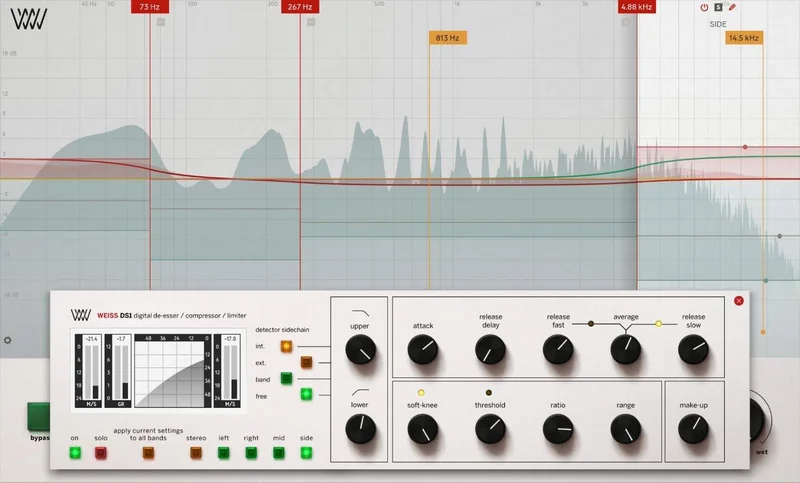
DS5 is a five-band multiband compressor and limiter where every band runs a line-by-line code port of the DS1. That's not marketing language. The DS1-MK3 is Softube's exact digital replica of the original Weiss hardware mastering processor, and DS5 gives you five independent instances of that engine stacked across a frequency spectrum with crossover control.
Three filter modes live inside DS5: Static Phase, Dynamic Phase, and Linear Phase with low latency. Static/Dynamic Phase latency sits at approximately 4.5ms. Linear Phase jumps to approximately 376ms. Keep that number in mind.
Beyond the basic band structure, DS5 adds per-band MS functionality, a tilt control, and a mix knob for parallel processing. Owners consistently flag these as the differentiating features from competing multiband processors. Unified macros also let you adjust behaviour across bands simultaneously, a workflow advantage that sets DS5 apart from competing multiband processors.
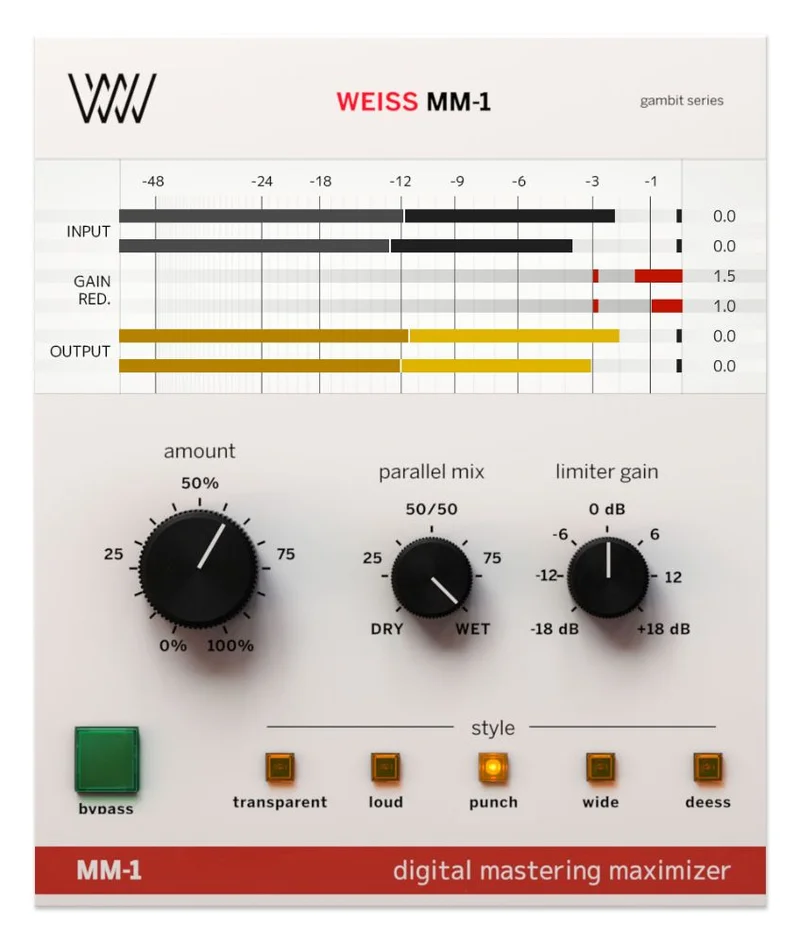
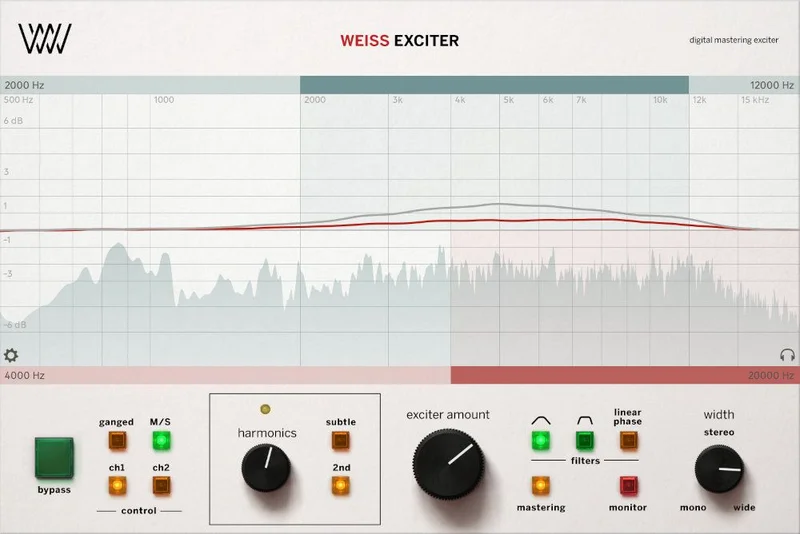
The rest of the collection remains unchanged in fundamental character: EQ1 with 64-bit internal processing and seven parametric bands, MM-1 with five limiting flavours, DS1-MK3 with two new limiter algorithms on top of the original Weiss algorithm, and the Exciter with its four Harmonic Modes and mastering-specific fundamental reduction setting.
Who Qualifies
This upgrade path is only open to owners of Weiss Complete Collection. If you don't already own Collection, you can't access the upgrade pricing. New users need to buy in at the full collection price, which is a separate consideration entirely.
For existing owners: you need to genuinely audit your multiband situation before spending $449. If you're already happy with your multiband processor, or if you mostly use single-band dynamics in mastering, the new DS5 won't change your life. It'll just sit on your hard drive looking impressive.
If you bought individual tools from the Weiss lineup piecemeal before the collection existed, the bundle economics get frustrating fast. Owners have reported this specific scenario as one of the more annoying aspects of how the collection is structured.
The Value Case
At $449, this upgrade is objectively steep for what amounts to one significant new plugin and iterative improvements. That's the honest position, and owners have said it out loud in reviews.
The counter-argument: DS5 isn't a generic multiband. It's five independent DS1 engines, which means every band shares the sonic character that makes the DS1-MK3 the reference-level de-esser, compressor, and limiter it is. Per-band MS processing is not standard in multiband compressors at any price. The tilt control and unified macro system genuinely change how quickly you can dial in results.
Owners comparing DS5 directly to Melda MBDynamics, FabFilter Pro-MB, and Multiplicity report DS5 as more transparent and easier to get right. If you're already paying for one of those and you're not satisfied, the upgrade math starts to close the gap.
But if you're satisfied with your current multiband tool, and the DS1-MK3 and EQ1 are already doing their jobs in your sessions, $449 is a hard ask. The improvements to the existing tools in Collection 3 are real but not dramatic enough to carry the upgrade cost alone.
Worth it only if DS5 fills an actual gap. Not worth it if you're buying on principle.
Who Should Skip It
Skip it if you don't work in mastering or if multiband compression isn't a regular tool in your sessions. The rest of the collection hasn't changed enough to justify the upgrade on its own.
Skip it if Linear Phase is non-negotiable for real-time work. The 376ms latency that comes with Linear Phase mode in DS5 makes it completely unsuitable for tracking or live monitoring scenarios. Static Phase at approximately 4.5ms is usable, but if Linear Phase is your default setting in other multiband processors, check whether that trade-off works for you before buying.
Skip it if you bought several Weiss tools individually before Collection existed. Run the numbers first. The frustration of calculating whether you're being double-charged for tools you already own is legitimate, and no amount of clever Weiss engineering makes that arithmetic less annoying.
Skip it if you need a broad creative toolkit. This collection is surgical and mastering-focused. It's not a creative effects rack.
DS1-MK3: Still the Core of Everything
The DS1-MK3 is the reason the Weiss name carries weight in the first place.
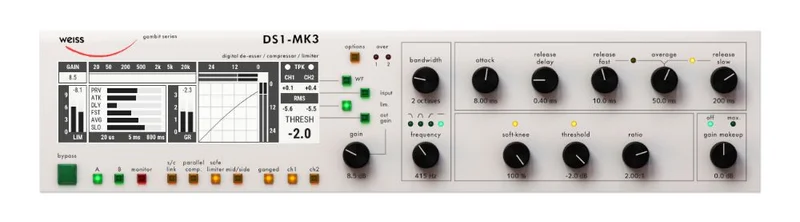
It's a line-by-line code port of the original Weiss digital hardware mastering processor. Same algorithms. Same processing decisions. Same sonic character. It handles de-essing, compression, and limiting in one unit at up to 32-bit/192 kHz resolution.
The compressor section is engineered to deliver transparency in measurable terms: transients pass through without smearing, high-frequency content doesn't thin out under gain reduction, and release behaviour avoids pumping artifacts that call attention to itself. That's the promise, and owners confirm it delivers.
Collection 3 brings two brand-new limiter algorithms alongside the original Weiss limiter. So you now have three limiter options inside a single unit that also compresses and de-esses. For a mastering engineer running a compact chain, that's genuinely useful flexibility.
The advanced metering and waveform view give you visual confirmation of what the processor is doing to the signal. Useful. Not revolutionary. But in a mastering context, seeing the waveform respond in real time is worth having rather than not having.
DS5: The Reason You're Considering This Upgrade
Everything in this upgrade argument leads back to DS5.
Five bands. Each one running the same processing engine as the DS1-MK3. That architecture means the character you trust in single-band mastering compression is now available across the frequency spectrum in a way that doesn't trade off transparency for range.
The three filter modes are where DS5 gets interesting. Static Phase is the default, lowest latency setting at approximately 4.5ms. Dynamic Phase gives you a different crossover behaviour that some engineers prefer on material with heavy mid-frequency content. Linear Phase is the precision option for mastering contexts where phase coherence across the spectrum matters, but it brings the 376ms hit. For mix-down work, Static Phase will cover most scenarios.
Per-band MS is the feature that separates DS5 from the competition most clearly. Compress the mid channel of your low-mids without touching the sides. Limit only the side signal in the highs. This level of control is exactly what mastering engineers reach for when a mix has specific spatial issues that a full-band processor can't address without collateral damage.
The tilt control and mix knob are clever additions. Tilt lets you adjust spectral balance without touching individual band gains directly. The mix knob handles parallel processing natively, which removes the need to set up a parallel bus just to blend your multiband compression against the dry signal. Annoying that this is rare in multiband compressors. Satisfying that it's here.
The macro system is what owners keep coming back to in reviews. When every band has the same underlying engine, macros that adjust behaviour across all bands simultaneously make sense in a way they wouldn't in a less unified system. You're not fighting the tool to get it to do something coherent. That's a real workflow advantage over building a band-by-band multiband setup from scratch.
With DS5, you can isolate a problem band, apply compression only there, and use the tilt and mix controls to blend the result back in without hearing a crossover artifact.
EQ1: The Mastering Standard-Bearer
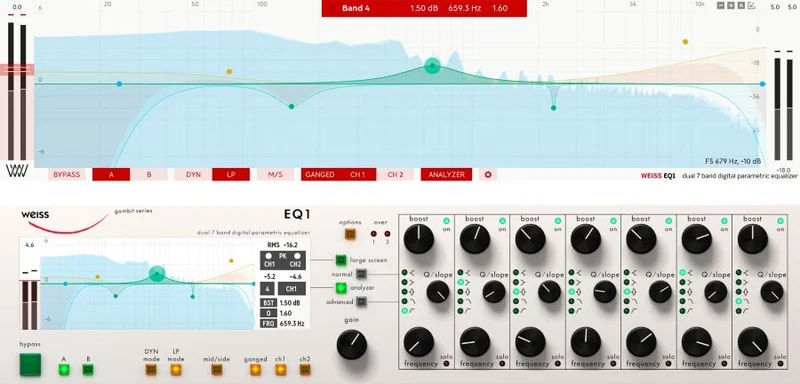
Seven identical parametric bands. Full frequency range coverage. Q parameter from 0.2 to 650. Cut/boost range from -39 to +18 dB. 64-bit internal processing at up to 192 kHz sample rates.
Those are the numbers. The sound is what mastering engineers describe as the benchmark for digital EQ transparency.
EQ1 operates in four modes: Minimum Phase, Linear Phase, Dynamic, and Dynamic Advanced. The Dynamic modes mean EQ1 isn't just a static corrective tool. You can dial in frequency-dependent dynamic behaviour, which is a different problem-solving approach from just cutting at a fixed point.
High and Low Cut, High and Low Shelving, and Peaking filters cover the full toolkit you'd expect in a mastering EQ. Nothing here is unusual in terms of filter types. What's unusual is the precision. A Q of 650 is an almost impossibly narrow surgical cut. Use it on a resonant frequency in a room-recorded snare that's been printed into a mix you're mastering, and you'll understand why that number matters.
Say you're handed a mix where there's a 1.2 kHz honk from a mid-range build-up in the guitars. A broad cut at 1.2 kHz affects too much. EQ1 at Q 8 or higher lets you notch exactly that problem without audibly affecting the instruments on either side. That's the kind of control EQ1 gives you that average mastering EQs can't match.
MM-1: Five Ways to Limit
The MM-1 contains the same technology as the original Weiss MM-1 hardware mastering processor.
Five limiting flavours: Transparent, Loud, Punch, Wide, and De-ess. Each one is a different intelligent processing approach rather than just a different character setting on the same algorithm. The developer's claim is that the carefully designed intelligent processes prevent the MM-1 from sounding bad, and owners don't report contradicting that claim.
Transparent is the obvious mastering starting point. Loud is for delivery formats where loudness targets matter more than dynamics. Punch preserves transient character under limiting. Wide affects the stereo field behaviour. De-ess integrates high-frequency control into the limiting stage.
Having all five in one processor means you can compare limiting approaches on the same material without switching plugins or reconfiguring a chain. That's a workflow advantage that sounds small but saves meaningful time in a full mastering session.
Exciter: Harmonic Addition Done Carefully
The Exciter is described by the developer as the world's first transparent mastering exciter. That's a claim worth interrogating.
Adaptive non-linearities mean the harmonic generation responds to the input signal rather than applying a fixed amount of harmonic content regardless of level. Four Harmonic Modes give you different flavour options without requiring you to understand the mathematics of harmonic distortion to use them effectively.
Independent Target and Output bands are the clever architectural decision here. You can specify which frequencies you're exciting and which frequencies you're sending to the output separately. That separation prevents the common exciter problem of harmonic content bleeding into frequency ranges you didn't intend to affect.
The mastering mode that reduces fundamental frequencies is an interesting tool for adding air and presence without reinforcing low-mid build-up. Linear Phase mode keeps the phase response clean if that matters for your context. And Console 1 readiness means Softube's hardware controller can access the Exciter's parameters directly if that's part of your studio setup.
Gambit Series: The Channel Strip for Console 1 Users
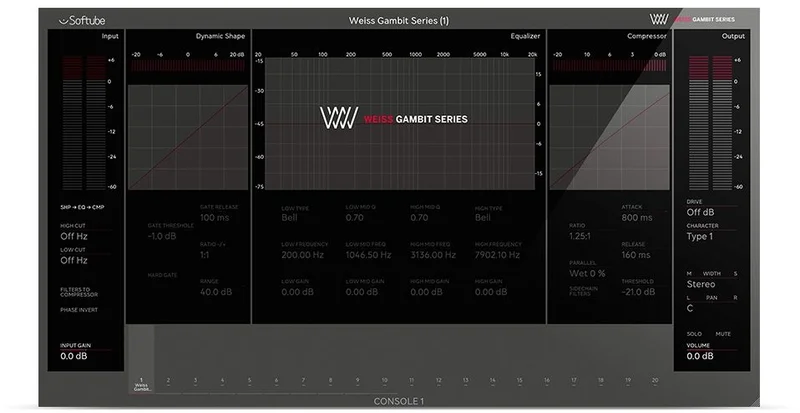
Gambit Series is the full channel strip built from 1:1 code ports of the DS1-MK3 and EQ1.
Gate, Expander, and below-threshold compression live in the Shape section. High and Low-Cut filters, four-band EQ, full Compressor and Limiter complete the strip. If you're running Console 1 hardware and you want Weiss-quality processing per channel rather than just on the master, Gambit Series is the reason to care.
For engineers not on Console 1, Gambit Series is still a fully functional channel strip plugin. But its design clearly prioritises the Console 1 workflow, and if that's not your setup, you may find the EQ1 and DS1-MK3 individually give you more direct access to the parameters you want.
Compressor/Limiter: Transparent Dynamics with Visual Feedback
The Compressor/Limiter is a separate dynamics processor from the DS1-MK3, though it shares the same quality ethos.
Two new advanced limiter algorithms plus the original Weiss algorithm give you three limiting options. Visualisations showing the precise effect on the signal are built in, which matters in mastering contexts where you need to verify exactly what the processor is doing to the dynamic range before printing.
Owners describe high transparency with minimal pre- and post-ringing artifacts. In limiting terms, pre-ringing and post-ringing are the artifacts that make a limiter sound like it's working, in the bad way. A limiter you can hear is one that's failing. The absence of that is what makes this worth using at the end of a mastering chain.
Deess: Surgical High-Frequency Control
Deess is the standalone de-esser in the collection, complementary to the de-essing functionality inside the DS1-MK3 and the De-ess mode of the MM-1.
It operates at the same 44.1 to 192 kHz sample rates as the rest of the collection and maintains the same transparency-first character. Having a dedicated standalone de-esser separate from the DS1-MK3 means you can apply de-essing at multiple points in a signal chain without loading the full DS1-MK3 unit on each instance.
If you're mastering an album where vocal sibilance is inconsistent across tracks, running Deess on individual stems before they hit the DS1-MK3 on the master bus is exactly the kind of layered approach the collection supports. Each tool is discrete enough to work alone but designed to work together.
The Verdict
Weiss Complete Collection 3 is a mastering engineer's upgrade, not a general production upgrade. If you're regularly doing final mastering passes and you want the best-sounding multiband processor you can put in that chain, DS5 is a genuinely satisfying answer to a problem that other tools handle less cleanly.
But the upgrade cost at $449 is steep relative to DS5 being the primary new feature. The rest of the collection hasn't changed in fundamental character. If you're already running Collection 2 and your multiband situation is sorted, there's no urgent reason to move.
The honest verdict: buy if DS5 fills an actual hole. If you're currently using FabFilter Pro-MB or Melda MBDynamics and finding the results less transparent than you want, DS5 is worth the conversation. If multiband isn't part of your mastering workflow at all, this money is better spent elsewhere. That's the full picture, and there's no softer way to put it.
Specs & Technical Details
| Developer | Softube |
| Price | $449 |
| Plugin Format | N/A |
| OS Support | N/A |
| Activation | N/A |
| CPU Usage | N/A |
| Trial Available | N/A |
| Version Reviewed | Collection 3 |
| Sample Rates Supported | 44.1, 48, 88.2, 96, 176.4, 192 kHz |
| Internal Processing | 64-bit (EQ1); 32-bit/192kHz (DS1-MK3) |
| Static/Dynamic Phase Latency | Approx. 4.5ms |
| Linear Phase Latency | Approx. 376ms |
| Included Plugins | DS5, DS1-MK3, EQ1, MM-1, Compressor/Limiter, Deess, Exciter, Gambit Series |
| Eligibility | Requires ownership of Weiss Complete Collection |
| Console 1 Compatible | Yes (Exciter, Gambit Series) |
Score Breakdown
| Category | Score | Notes |
|---|---|---|
| Sound Quality | 4.5/5 | DS1-MK3 and EQ1 are reference-level; DS5 brings the same transparency to multiband processing |
| Value for Money | 2.5/5 | Steep upgrade cost for one new plugin; existing tools haven't changed enough to carry the price alone |
| Ease of Use | 4.0/5 | DS5 macros and unified controls make complex multiband work faster than band-by-band competitors |
| Features | 4.0/5 | Per-band MS, tilt, mix knob, five MM-1 limiting flavours, and three DS5 filter modes cover mastering needs thoroughly |
| CPU Efficiency | N/A | Not reported in available owner data |
| Overall | 3.5/5 | Exceptional tools in a package that asks existing owners to pay again for one main addition |
Alternatives to Consider
FabFilter Pro-MB
Pro-MB is the most common direct comparison to DS5. Owners who have used both report DS5 as more transparent and easier to get coherent results from quickly. FabFilter Pro-MB's visual interface is excellent and may suit engineers who rely heavily on frequency display feedback. If you already own Pro-MB and you're satisfied, it's worth asking what specific problem DS5 would solve before spending upgrade money.
Melda MBDynamics
Melda MBDynamics is a deep, capable multiband processor that owners compare unfavourably to DS5 on sound quality and ease of use. If budget is the primary concern and you can live with a steeper learning curve, MBDynamics is a legitimate alternative. But owners who've run both are consistent: DS5 sounds cleaner and achieves results faster.
Multiplicity
Owners describe Multiplicity as top-shelf but less intuitive and less transparent than DS5. It's a serious tool for serious work, and it's worth auditioning if you can. The comparison goes DS5 for clarity and workflow speed, Multiplicity for a different sonic approach. Neither is wrong. The question is which fits how you work.
DS5 is the reason Collection 3 exists, and DS5 is the reason you either buy this upgrade or you don't. If you're a mastering engineer who takes multiband compression seriously and you want the same processing character across every band that DS5 delivers through its five bands of DS1-MK3 engine code ports, the upgrade argument is real. If you're anything else, $449 is expensive for iterative improvements on tools you already own. Know which category you're in before the purchase page loads.
Frequently Asked Questions
Do I need to own Weiss Complete Collection to access the Collection 3 upgrade?
Yes. The upgrade path requires existing ownership of Weiss Complete Collection. New users cannot access the upgrade price and need to purchase the full collection separately. If you're buying in for the first time, the upgrade pricing and eligibility don't apply to you.
What is DS5 and why is it the main new addition in Collection 3?
DS5 is a five-band multiband compressor and limiter where every band runs a line-by-line code port of the DS1-MK3 engine. That means the same processing character the DS1-MK3 is known for in single-band mastering is applied independently across five frequency bands. Per-band MS, a tilt control, a mix knob, and three filter modes set it apart from competing multiband processors.
How does the Linear Phase latency in DS5 affect my workflow?
Linear Phase mode in DS5 introduces approximately 376ms of latency. That rules it out for real-time tracking or live monitoring entirely. For offline mastering work where you're processing a bounced file, the latency is compensated by your DAW and doesn't present a practical problem. Static Phase and Dynamic Phase modes run at approximately 4.5ms, which is usable for most production contexts.
How does DS5 compare to FabFilter Pro-MB?
Owners who have used both consistently report DS5 as more transparent and faster to achieve coherent results. FabFilter Pro-MB has an excellent visual interface that many engineers love. The comparison isn't that one is objectively better across the board: DS5 wins on transparency and unified control, Pro-MB wins for engineers who rely on frequency display feedback as a primary working tool.
Is the Gambit Series channel strip useful without Console 1 hardware?
Gambit Series works as a standalone channel strip plugin without Console 1 hardware, and it includes below-threshold compression, Gate, Expander, High and Low-Cut filters, four-band EQ, Compressor, and Limiter. Its design is built around the Console 1 workflow, though. Engineers not running Console 1 may find the individual DS1-MK3 and EQ1 plugins give more direct access to the parameters they want.
Is the upgrade from Collection 2 to Collection 3 worth the cost?
Owners have been vocal that the upgrade price is steep relative to DS5 being the primary new addition. If multiband compression is a regular part of your mastering workflow and your current tool leaves you frustrated with transparency or control, the upgrade argument is real. If multiband isn't a frequent tool for you, the improvements to the existing collection don't carry the upgrade cost alone.