The AudioThing Type A & Type B Bundle is most often stacked against the Waves Aphex Vintage Aural Exciter, and this review is going to land clearly in AudioThing’s favour on every axis that matters: flexibility, refinement, and value. If you’ve been sitting on the Waves plugin because it’s the name everyone knows, this bundle at $79 is the argument to stop waiting. It combines two vintage enhancement emulations: Type A, inspired by the Dolby A encode-stage trick, and Type B, built on the circuit architecture of the classic Aphex exciter. Together they cover presence, air, harmonic generation, and dynamic high-end lift. They’re built for producers, mix engineers, and anyone who regularly pulls a dull recording off the shelf and needs to put life back in it without reaching for a corrective EQ.
How It Compares Out of the Box
The obvious competitor for Type B is the Waves Aphex Vintage Aural Exciter. It does one thing: runs a signal through a highpass filter and harmonic generator, then blends the result back in. Type B does that too, but it adds a bandpass option on the filter, a Color parameter for shaping the harmonic character, and the ability to swap the filter and harmonic generator positions in the signal chain. That last feature alone puts it in a different category.
Type A has less direct competition. The Dolby A encode trick has been done in hardware and occasionally in plugins, but a four-band dynamic brightener that adds presence without touching harmonic content is genuinely rare at any price. The closest ITB equivalent would be a multiband dynamic EQ set to boost only quiet signals, but building that from scratch takes ten minutes and still won’t sound the same.
Out of the box, both plugins are clean, legible, and small. The UIs are minimal without feeling stripped. Reviewers consistently note they’re fast to dial in, which matters when you’re on a session and don’t want to spend twenty minutes reading a manual.
The Type A Engine: Dynamic Brightening Without Distortion
Type A is the clever one. It’s easy to describe as “just a vintage enhancer,” but the mechanism is specific and worth understanding.
The original Dolby A unit was a noise reduction system. It worked by splitting audio into four bands and boosting quiet signals during recording, then attenuating everything on playback to bury the tape noise underneath. Someone figured out that running just the encode stage, without the decode, left you with a signal that was brighter and more present on quiet passages while loud passages stayed almost exactly the same.
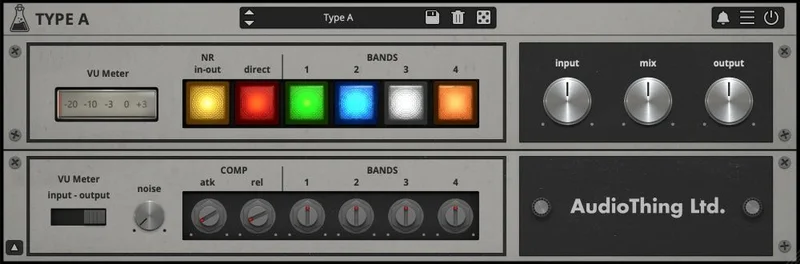
Type A emulates that encode stage precisely. Your signal splits into four overlapping bands. Each band gets compressed by an amount inversely proportional to its volume. Quiet moments get a dynamic high-frequency lift. Loud moments pass through essentially unchanged. The result behaves like a dynamic EQ that only boosts the top end of signals that need it, but it generates zero new harmonic content in doing so.
Why That Matters for Your Mix
Most exciters, including Type B, add harmonics. That’s the point of an exciter: manufacture high-frequency content that wasn’t in the original recording. Type A doesn’t do that. It only reorganises and emphasises what’s already there. That distinction matters on two kinds of tracks.
First: anything where distortion would be wrong. Acoustic piano, strings, solo woodwinds, full mix buses where harmonic buildup across multiple exciters creates congestion. Type A brightens these without adding anything new.
Second: anything where the high end is present but buried. A vocal recorded in a bad room at low gain, for instance. Load Type A, push it until the presence comes forward, and the result sounds like the singer got closer to the mic. You’re not manufacturing air. You’re uncovering it.
Controls on Type A
The interface gives you a small number of controls. You get an input level, a mix knob for blending the processed signal with dry, and an adjustable unit noise parameter that lets you add or reduce the noise floor characteristic of the original hardware. The noise control is a nice touch. Turn it up slightly and the plugin sits more naturally in an analogue-flavoured mix. Leave it at zero and it’s transparent.
Oversampling runs up to 16x. That’s not something most similar plugins bother with at this price point. It matters when you’re pushing the processing hard or working at lower sample rates where aliasing would otherwise show up.
The preset system includes a randomizer. Honestly? The randomizer is more fun than useful on a plugin this focused, but it occasionally lands somewhere surprising that you wouldn’t have dialed in by hand.
The window is resizable, which is a practical detail that reviewers actually mention. Small plugin UIs on high-DPI screens are a real annoyance, and AudioThing addressed it.
One Legitimate Gripe
The IN/OUT LED color scheme is inverted from what most engineers expect. In typical plugin convention, green means signal is passing and red means something is wrong or clipped. Type A flips this, which causes real confusion at first, especially when you’re working fast. It’s annoying. It’s not a dealbreaker, but it’s the kind of small design choice that makes you wonder who checked the UI before shipping.
The Type B Engine: Harmonic Generation You Can Actually Shape
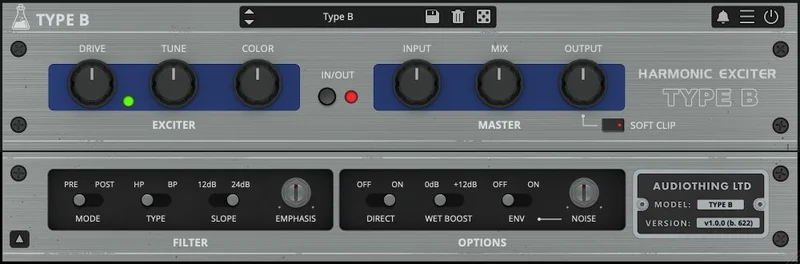
Type B does what an exciter is supposed to do: it manufactures high-frequency content that wasn’t in the original signal and blends it back in. The mechanism is filtering plus distortion. Your signal goes into a filter, that filtered signal feeds a harmonic generator, and the output of the generator gets mixed back with the dry signal at whatever level you choose.
That’s the standard exciter architecture. What Type B adds is control over every stage of that chain.
HP/BP Filter with Emphasis
The filter defaults to highpass, which is the standard exciter configuration. You pass only the high-frequency content of your signal into the harmonic generator, so the manufactured harmonics sit in the top end of the spectrum where you want them.
The bandpass option is more surgical. Instead of everything above a cutoff frequency, you’re feeding a specific frequency window into the generator. The harmonics that come back are shaped by that window. Used carefully, this gives you control over where exactly in the high frequency range the excitement lands. Used aggressively, it produces something that starts to sound saturated and forward in an interesting way.
The Emphasis control adds resonance to the filter. More emphasis means the filter itself is contributing character to the signal before it hits the harmonic generator. Think of it as pre-shaping the material that’s about to get distorted.
The Color Parameter
Color shapes the harmonic character of the generator output. The specifics of what Color does at each setting follow the behaviour of the original Aphex circuit. The result is that you can move between a brighter, more aggressive harmonic texture and a warmer, smoother one. Reviewers describe the range as genuinely musical rather than just “more or less” of the same thing.
This is the control that separates Type B from the Waves Aphex plugin in practical use. The Waves version gives you mix level and not much else. Type B gives you filter type, emphasis, color, and mix. That’s four dimensions of control versus essentially one.
Swapping the Signal Chain Order
The option to swap the filter and harmonic generator positions deserves its own paragraph. Running the signal through the harmonic generator before the filter gives you a different result than running it through the filter first. The generator processes a fuller signal, creates a broader harmonic picture, and then the filter shapes what comes out the other end. The texture is different. Fuller. Less obviously “excited” in the thin, fizzy way that bad exciter use can produce.
This is a circuit-level design decision that most exciter plugins don’t expose to the user at all. AudioThing made it a switch. That’s a smart move.
Adjustable Unit Noise, Oversampling, and Presets
Type B carries the same features as Type A on these points: adjustable unit noise for analogue character, oversampling up to 16x, a resizable UI, and a preset system with a randomizer.
The noise control is, if anything, more useful on Type B because exciters are often used to make something sound more alive and organic. A touch of unit noise reinforces that effect without being heavy-handed.
A Word About Format Support
Type B supports AAX, AU, CLAP, iOS, VST3, and native Linux with AAX. That Linux support with CLAP is worth flagging for anyone running a Linux-based DAW setup. It’s not common at this price level. Type A covers VST, VST3, AU, and AAX on Mac and Windows.
Both are 64-bit only. If you’re running a 32-bit host in 2026, that’s a separate conversation you need to have with yourself.
Performance Deep Dive
Both plugins hit the 4.7 out of 5 mark across a large number of ratings. That’s a meaningful number, not a small sample. Type A sits at 4.7 from 514 ratings. Type B at 4.7 from its own pool. The consistency across two separate plugins from the same developer suggests the quality isn’t a fluke on one product.
Oversampling at 16x will add CPU load. AudioThing doesn’t publish specific CPU figures, and we’re not going to invent them. At 16x, expect it to be heavier than running without oversampling. At 2x or 4x on most sessions, most machines handle it cleanly.
The v1.0 phase issues with oversampling and Direct mode were real. Users reported them, AudioThing fixed them in v1.0.1. If you bought early and haven’t updated, do that now. The issue is not present in current versions.
On format support: CLAP on both Mac and Windows is an increasingly relevant spec. CLAP offers lower latency and better parameter modulation support than VST2 in DAWs that have implemented it. It’s a bonus that costs you nothing.
Where It Wins
Type B is more versatile than the Waves Aphex equivalent. Reviewers are consistent on this point, and the feature set backs it up. The Waves plugin gives you a fixed architecture with minimal control. Type B exposes the filter, the emphasis, the color, and the chain order. You’re working with the circuit, not just adjusting the output.
Type A is close to unique at this price. A multiband dynamic enhancer that adds brightness without harmonic generation and includes adjustable unit noise, 16x oversampling, and resizable UI in a plugin that takes up almost no screen space is a strong proposition.
The bundle discount for Type A owners picking up Type B is another real win. The pricing structure rewards the people most likely to need both: anyone who already understood what Type A did and wanted to add harmonic generation on top of it.
Put Type A on a vocal, set a light mix, and let it pull presence forward on the quiet moments. Add Type B on a send bus with a long tail to generate some air on the same vocal. Stack them thoughtfully and you’ve built an enhancement chain with real depth. That’s the bundle’s strongest argument.
Where the Competition Wins
UAD’s vintage hardware emulations are more detailed. The UAD Neve 1073, the UAD Pultec, the UAD SSL channel: these are more complex emulations with more variables modelled and more nuance in the saturation and harmonic behaviour. If you want the deepest emulation and you’re already on a UAD system, AudioThing isn’t going to replace what you have.
For mastering and mix bus work, Type B has a documented weakness. One user reported artifacts at low mix settings of around 4%, described it as lacking the high fidelity needed for song finalization, and found the exciter underperformed on the mix bus. That’s one report in a mostly positive pool, but it points at a real limitation: Type B is a track-level tool. Load it on a vocal, a guitar, a synth, a drum bus. Using it across a full mix at mastering-level subtlety is pushing it past what it was designed for.
The Waves Aphex plugin, for all its limitations in flexibility, has wider recognition in professional sessions. If you’re sharing sessions with engineers who have Waves bundles, compatibility is a real-world consideration.
Three Scenarios Where These Plugins Actually Earn Their Place
You have a backing vocal that was recorded too quietly and sounds buried in the chorus. Load Type A on the channel. Push the mix to around 60-70%. Watch the vocal come forward without adding sibilance or harmonic grit. That’s Type A doing exactly what it’s built for.
You’ve got a guitar part that sounds fine at unity but disappears in a dense arrangement. Load Type B, set the filter to bandpass, dial the cutoff to focus on the 4-8kHz window, and blend the generated harmonics at 20-30% mix. The guitar gets definition without getting sharp. Now try swapping the chain order. The texture changes. One of those two will sit better in your arrangement.
You’re bouncing a synth pad that sounds beautiful in solo but loses its sheen in context. Load both plugins on the channel as an insert pair. Type A for dynamic presence, Type B for harmonic air. Ride the mix knobs until the pad feels like it has space above it. That’s the combination the bundle exists to enable.
Who Should Buy Which
- ✅ Buy if you regularly work with dull, buried, or tape-saturated recordings that need presence restored without added distortion
- ✅ Buy if you want more control over exciter behaviour than the Waves Aphex plugin gives you and you're not on UAD
- ✅ Buy if you work on Linux, iOS, or in CLAP-compatible DAWs and need format flexibility at this price level
- ❌ Skip if your primary use case is mix bus or mastering work where you need sub-1% subtlety without artifacts
- ❌ Skip if you're deep in the UAD ecosystem and already have vintage enhancer options covered
- ❌ Skip if you need 32-bit plugin support, because both plugins are 64-bit only
Specs & Technical Details
| Category | Detail |
|---|---|
| Developer | AudioThing |
| Price | $79 |
| Plugin Format | VST2, VST3, AU, AAX, CLAP (64-bit only) |
| OS Support | Mac (OS X 10.9 – macOS 12 Monterey, Universal 2 Binary), Windows 7/8/10, Linux (Type B), iOS (Type B) |
| Activation | AudioThing license system |
| CPU Usage | Light to medium depending on oversampling setting |
| Trial Available | Check AudioThing website |
| Version Reviewed | v1.0.1 or later (v1.0 phase issues fixed in v1.0.1) |
| System Requirements | 2GHz CPU, 4GB RAM minimum |
| Oversampling | Up to 16x (both plugins) |
| Presets | Yes, with randomizer (both plugins) |
| Resizable UI | Yes (both plugins) |
| Type A Mechanism | 4-band multiband compander, encode-stage emulation, no harmonic generation |
| Type B Mechanism | HP/BP filter, harmonic generator with Color control, swappable chain order |
Score Breakdown
| Category | Score | Notes |
|---|---|---|
| Sound Quality | 4.5/5 | Type A is genuinely distinctive; Type B is flexible and musical, with a documented limit on mastering bus use |
| Value for Money | 4.5/5 | Bundle pricing plus the Type A owner discount makes the combined package a strong deal against single-purpose alternatives |
| Ease of Use | 4.0/5 | Fast to dial in overall, but the inverted IN/OUT LED colours are a real design misstep |
| Features | 4.5/5 | Type B's filter options, Color control, and chain-swap are above class; Type A's four-band dynamic approach is close to unique at this price |
| CPU Efficiency | 4.0/5 | Light without oversampling; 16x oversampling will pull resources, which is expected and disclosed |
| Overall | 4.4/5 | Two focused, well-executed vintage enhancer emulations that work harder together than either does alone |
Alternatives to Consider
If you want more depth in the harmonic saturation modelling and you're already on UAD hardware, the UAD options are the honest recommendation. More complex emulations, higher price, better suited to mastering-level subtlety. They're not in the same category on price, but they cover the ground where Type B shows its limits on bus work.
For compression-adjacent dynamic enhancement, AudioThing's own Type X is worth looking at. It targets drum transients and squashed material specifically, and it's a natural companion in a session where you're using Type A for vocal presence and Type B for harmonic air.
The Waves Aphex Vintage Aural Exciter is the direct competitor to Type B. It's simpler, less flexible, and ships with most Waves bundles so you may already own it. If you do, Type B is still the upgrade: more control, more refined output, a more musical Color parameter. If you don't own it and you're comparing the two from scratch, Type B wins.
If you're exploring AudioThing's broader catalogue, their SX1000 sits at the synthesis end of the same Italian approach to vintage character. Different territory, but it shows the developer's consistency.
The Honest Buy or Skip
The Type A & Type B Bundle at $79 is a buy. Not a complicated buy. Not a “depends on your workflow” hedge.
Type A gives you a dynamic brightener that adds presence without generating harmonics, which is something very few plugins do at any price. Type B gives you an exciter with genuine circuit-level flexibility that outperforms the Waves alternative on every spec that matters for track-level use.
The two plugins work better together than they do separately. That’s what a bundle is supposed to be. These actually are.
The caveats are real. Don’t reach for Type B on your mastering bus if you’re working at sub-5% blend levels and need zero artifacts. The v1.0 phase issue is fixed, but make sure you’re running v1.0.1 or later before you trust the oversampling at high ratios. And somebody at AudioThing needs to fix the IN/OUT LED colors, because green for signal-off and red for signal-on is genuinely confusing and it keeps showing up in user feedback.
But those are specific, solvable problems. The core sound quality is there. The value at $79 for both plugins is there. Type A owners can add Type B at an additional discount that makes the math even easier.
If you’re still running the Waves Aphex on everything out of habit, this is the reason to try something better.
Related reviews: Dolby Atmos Composer & gravitas MDS Bundle
Frequently Asked Questions
What is the difference between Type A and Type B in this bundle?
Type A emulates the encode stage of the Dolby A noise reduction system. It splits your signal into four bands and dynamically brightens quiet parts without generating any new harmonic content. Type B emulates an Aphex-style exciter: it generates new high-frequency harmonics by running your signal through a filter and distortion circuit. Type A is a dynamic brightener. Type B is a harmonic generator. They solve different problems and work well together as an enhancement chain.
Is the Type A & Type B Bundle good for mastering?
Type A is reasonable for light mastering use given that it adds presence without generating new harmonics or distortion. Type B is less suited to mastering work. At least one user has reported artifacts at very low mix settings around 4% and found it underperforms for song finalization on the mix bus. For mastering-level subtlety on a full mix, both plugins are better used earlier in the signal chain, at the track or submix stage.
What formats do Type A and Type B support?
Type A supports VST2, VST3, AU, and AAX, all 64-bit only, on Mac and Windows. Type B extends that to include CLAP and iOS support, and adds native Linux compatibility. Both are Universal 2 Binary on Mac, which means native Apple Silicon support without Rosetta translation.
Were there any bugs in earlier versions of these plugins?
Version 1.0 of Type B had documented phase issues when using the oversampling feature and the Direct mode. AudioThing fixed these in version 1.0.1. If you purchased early and haven't updated, run the update before using oversampling at higher ratios. Current versions don't have this issue according to user reports following the patch.
How does Type B compare to the Waves Aphex Vintage Aural Exciter?
Type B gives you significantly more control. The Waves plugin offers a basic mix level and little else. Type B adds a highpass and bandpass filter option, an Emphasis control for filter resonance, a Color parameter for shaping harmonic character, and the ability to swap the filter and harmonic generator positions in the chain. Reviewers consistently find Type B more refined and more versatile. If you're comparing the two from scratch, Type B wins.
Do I need both plugins or can I just buy one?
They're genuinely complementary rather than interchangeable. If you need dynamic brightness without harmonic generation, Type A covers that alone. If you need harmonic excitation for presence and air, Type B stands alone. But the strongest use case for the bundle is running both on the same track or channel: Type A to lift quiet detail dynamically, Type B to add harmonic texture on top. The bundle discount makes buying both the logical choice if you're considering either one.