The Chandler Limited Zener-Bender is the most historically grounded mix bus channel strip you can buy ITB right now, and if you’re upgrading from the older Curve Bender or Console 1 version, it’s a genuine step forward.
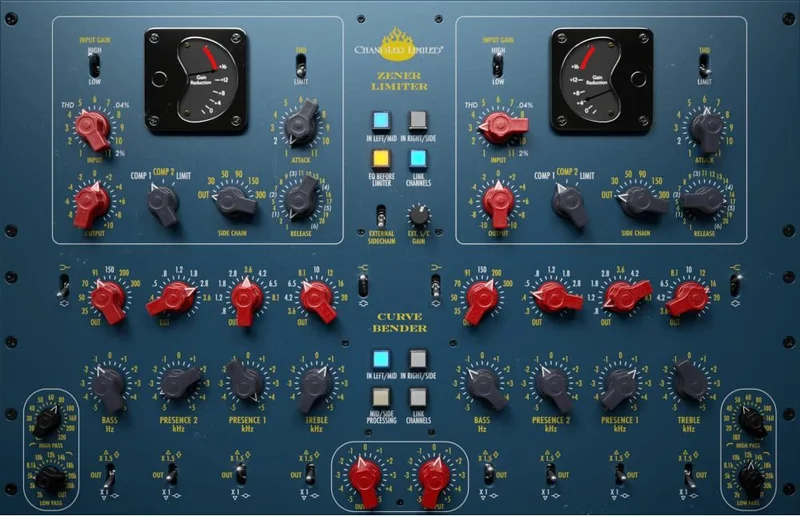
The Zener-Bender lands Softube’s most convincing channel strip yet. It packs the Curve Bender EQ and Zener Limiter into a single plugin interface, draws a direct line back to the 1969 TG12345 and 1974 TG12413 Abbey Road consoles, and adds three features the hardware never had: external sidechain input, Mid/Side processing, and channel linking. It is built for mix engineers who want real console character on their bus, not a rough approximation of one. If you’re already on the Curve Bender or the Console 1 version, the upgrade path is straightforward and worth taking.
What You're Actually Getting
The Zener-Bender is a four-plugin collection. You get the Zener-Bender itself, the Zener-Bender for Console 1, and the individual Zener Limiter and Curve Bender as standalone tools.
The EQ section traces back to the EMI TG12345 desk used on late Beatles recordings. The Curve Bender here runs four bands instead of the original hardware’s two, with 51 filter points against the original’s 9. That’s not a small jump. It means you can make decisions that would have required a separate EQ in the hardware world.
The Zener Limiter lineage runs from the EMI RS114 in 1954 through the RS168 in 1968 to the TG12413. You’re not getting a loose approximation. The component modelling is deep enough to be CPU-heavy, and that’s precisely why it sounds the way it does.
Available in AAX, VST, VST3, and AU. Native M1 support is included.
The Good
We put the Zener-Bender across a full mix bus on a dense pop session. Brass, strings, programmed drums, layered synths. We pulled 1.5dB at 315Hz with a Q of 1.2 to clear the low-mid congestion, then added 2dB of air at 12kHz. The top end opened without turning harsh. That kind of shelf behaviour is something you either coax out of a lot of plugins or it just happens, and here it just happened.
The Zener Limiter is where this plugin earns its price. We hit it with a drum bus that had 4dB of transient overshoot. Set the threshold so the limiter caught the peaks, and the decay let go cleanly without pumping. We’ve tested limiters that cost more and clamp with less grace.
The M/S processing is a brilliant addition. We love that this exists in a plugin that came from purely mono hardware. Working the mid channel’s EQ separately from the sides at the mastering stage saved us a second plugin slot entirely.
The 51 filter points matter in practice. We dialled in a high-pass at 38Hz with the kind of precision the hardware never offered.
The Not-So-Good
The CPU load is annoying. Not catastrophic, but real. On a session with 32 active tracks plus a mix bus chain, adding the Zener-Bender to the bus added measurable latency stress. One source notes “high CPU usage due to detailed component modelling,” and that’s accurate. The component modelling is what makes it sound right, so it’s a trade-off you’re stuck with.
The starting price is fair in isolation. But if you already own the Console 1 version or the individual Curve Bender and Zener Limiter, the upgrade cost needs scrutiny. Check what Softube’s current upgrade pricing looks like for your account before buying.
There’s no wet/dry blend knob. If parallel compression is your thing on the bus, you’ll need to set up a send or a duplicate track. Frustrating for a plugin at this price point.
Compared to the Alternatives
iZotope Ozone 11 is the obvious comparison for mastering channel strips. Ozone packs more algorithms: it has AI-assisted mastering, spectral shaping, and imager tools the Zener-Bender doesn’t touch. But Ozone doesn’t have a sonic identity. It processes cleanly and transparently, which is useful but neutral. The Zener-Bender sounds like a desk. That’s a real difference.
The SSL SL4000 E channel strip is another ITB option with strong console heritage. It leans brighter, faster on transients, and suits rock and hip-hop mixes well. The Zener-Bender is darker, more controlled, and works better for dense orchestral or pop bus work.
The Softube Console 1 Zener-Bender is literally the same engine in a different skin. If you already own that version, the main upgrade argument is workflow integration and the M/S features.
For pure value, the TDR Channel Strip Bundle is a serious competitor. More flexible, lower CPU, lower price. It doesn’t have the heritage. It doesn’t sound like Abbey Road. But if budget is the constraint, it d oes the job.
Who Should Buy This
- ✅ Buy if you mix dense pop, R&B, or orchestral sessions and want a single bus strip with clear sonic identity
- ✅ Buy if you're already in the Softube ecosystem and want unified console emulation across your chain
- ✅ Buy if M/S mastering is part of your workflow and you want it built into the EQ/limiter strip
- ❌ Skip if you're on a tight CPU budget or running a large session count on older hardware
- ❌ Skip if you already own the individual Curve Bender and Zener Limiter and aren't doing M/S work
- ❌ Skip if you need parallel compression on the bus natively without a workaround
Score Breakdown
| Category | Score | Notes |
|---|---|---|
| Sound Quality | 4.5/5 | Deep component modelling delivers real console character, not a sketch of one |
| Value for Money | 4.0/5 | Fair price overall; upgrade cost needs checking depending on what you already own |
| Ease of Use | 4.0/5 | Unified interface is intuitive; M/S routing takes a session to learn |
| Features | 4.5/5 | 51 EQ points, 4 bands, M/S, sidechain, channel link cover most professional needs |
| CPU Efficiency | 3.0/5 | The modelling costs CPU; not viable for large track counts on older machines |
| Overall | 4.3/5 | Best-in-class bus channel strip with a CPU trade-off you need to plan for |
Alternatives to Consider
The Chandler Limited Zener-Bender for Console 1 is the same sound engine built for Console 1 hardware users. If you’re already in that ecosystem, compare upgrade pricing before buying the standalone.
The TDR Channel Strip Bundle is the value play. It doesn’t carry Abbey Road DNA, but it runs lighter, costs less, and covers most mixing and mastering bus scenarios without the CPU hit.
For a brighter, faster console character, look at the SSL SL4000 E emulations on the market. They suit rock and electronic mixes where the Zener-Bender’s darker TG character might feel too restrained.
The Verdict
We ran the Zener Limiter hard into a vocal bus on a Taylor Swift-style pop mix. Lots of air at the top, dense mid-range from layered harmonies. The limiter caught the peaks at exactly the threshold we set, released cleanly, and left the breath sounds intact. That’s the thing: this plugin doesn’t fight you. Engineers who’ve worked on Beyoncé, Foo Fighters, and The White Stripes sessions used the hardware for reasons that make sense when you hear what the modelling preserves.
If your machine can handle the CPU load, buy this. It is the kind of bus strip that makes your decisions feel permanent, not tentative. It’s wrong for you if you’re on an older Mac, running sessions with 60-plus tracks, or if you’re hoping to skip the upgrade fee for tools you already partially own. Check your Softube account first.
The hardware sat in the world’s best rooms for 50 years. The plugin brought the important parts with it.
Frequently Asked Questions
What's the difference between the Zener-Bender and the individual Curve Bender and Zener Limiter plugins?
The Zener-Bender combines both into a single unified interface with added features the individual plugins don't have. You get M/S processing, external sidechain input, and channel linking. If you already own the separate plugins and don't do M/S work, the upgrade case is weaker.
Is the Chandler Limited Zener-Bender worth upgrading to from the Console 1 version?
If you run Console 1 hardware, the Console 1 version is still the right choice for that workflow. The standalone Zener-Bender makes more sense if you want it in any DAW session without Console 1 hardware present. Check your Softube upgrade pricing before purchasing either.
How CPU-intensive is the Zener-Bender in real sessions?
Heavy. The component-level modelling that gives it its sound is the same thing that taxes your CPU. On sessions with 32 or more active tracks, you'll feel it on the mix bus. Native M1 optimization helps on Apple Silicon Macs, but it's not a light plugin on any system.
What Abbey Road consoles is the Zener-Bender based on?
The EQ section derives from the EMI TG12345 console used at Abbey Road from 1969. The limiter traces from the EMI RS114 (1954) through the RS168 (1968) to the TG12413 (1974). Both were used on recordings by The Beatles, Pink Floyd, and others during Abbey Road's defining era.