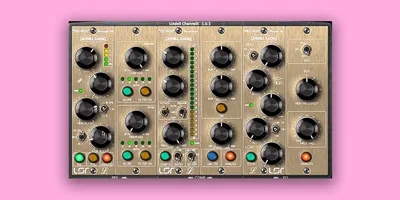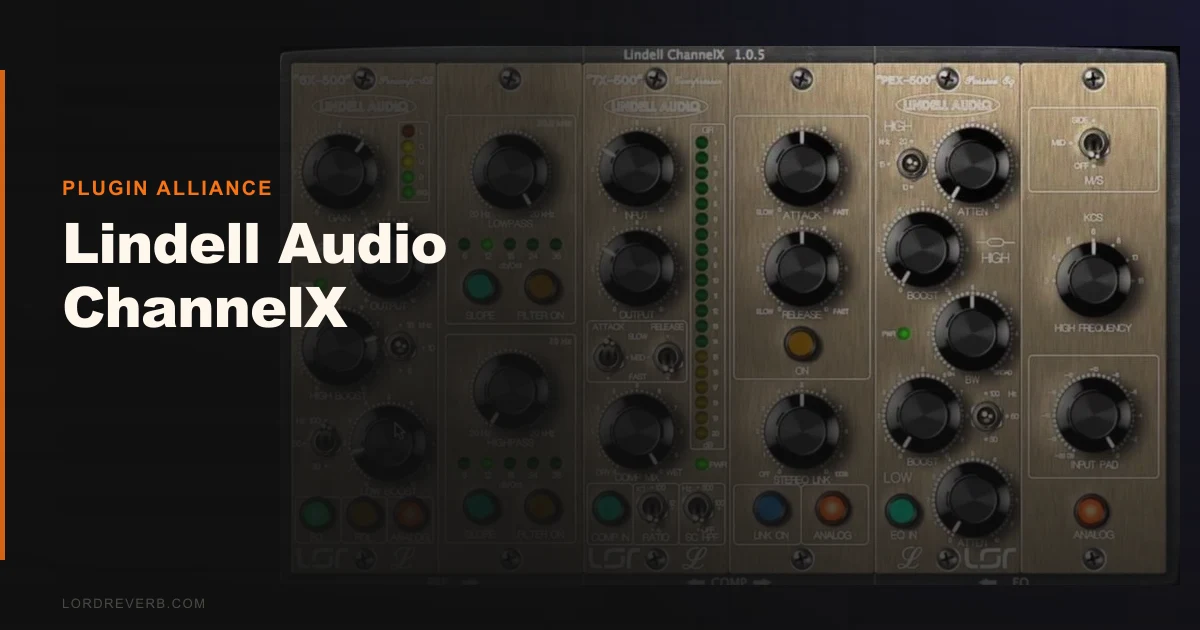
The Lindell Audio ChannelX is a solid character plugin that we’d genuinely recommend to the right producer, but if you need midrange control or surgical precision, you’re buying the wrong thing.
It’s a three-module channel strip by Plugin Alliance, modeled on Lindell Audio’s 500-series hardware. You get the 6X-500 preamp, PEX-500 passive EQ, and 7X-500 FET compressor in a single plugin, plus the option to run each module separately. At full price, it is not cheap. At the promotional prices that Plugin Alliance cycles through, it is almost unreasonable to skip.
This is a plugin for producers who want sound fast. It’s not for engineers who build static EQ curves from frequency analyzers. Those are two different jobs, and ChannelX was built for one of them.
What You're Actually Getting
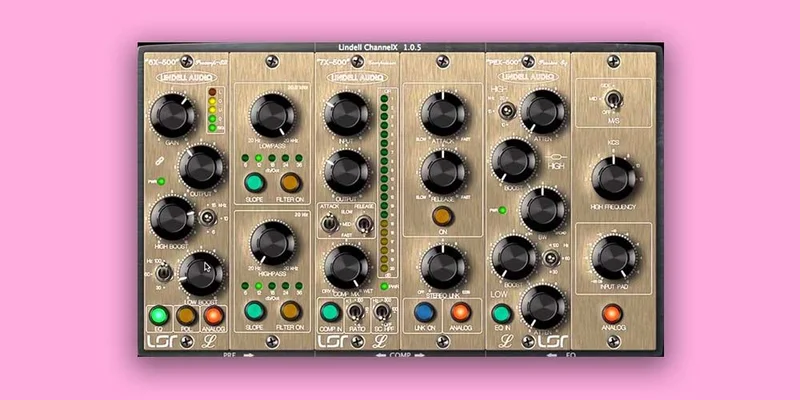
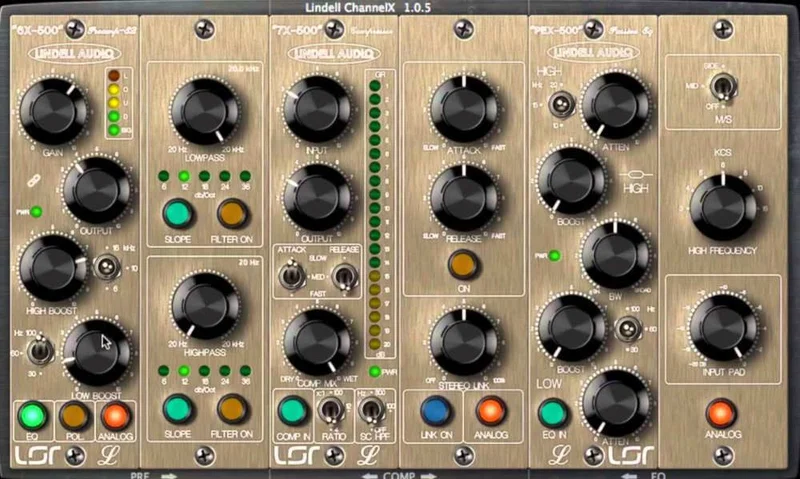
Three plugins in one bundle. You can run the ChannelX strip as a unified signal chain, or drop the 7X-500 compressor, PEX-500 EQ, and 6X-500 preamp onto separate tracks individually.
The PEX-500 is a passive EQ modeled on the hardware equivalent. It gives you high and low shelf controls, a high-pass filter, and up to 15dB of boost per band. No midrange. That’s not a bug they forgot to fix. That’s the design.
The 6X-500 preamp adds harmonic saturation plus a 2-band EQ with variable filter slopes from 6 to 36dB per octave. The 7X-500 is an 1176-style FET compressor with four ratio settings, a high-pass sidechain filter, and the 100:1 “all-buttons” mode that 1176 users already know.
Format support covers AAX, AU, VST2, and VST3 across Mac and Windows. Version 1.2.2, released March 2023, added full Apple Silicon support.
The Good
The passive EQ is the star. We pulled up a dull acoustic guitar recording, boosted the high shelf on the PEX-500 by around 8dB at the top of the range, and the result was airy without being harsh. That’s the character of a passive design. It rolls off naturally at the extremes instead of spiking. An active shelving EQ doing the same 8dB lift would have required more finessing to avoid brittleness.
We love the FET compressor for this reason: it’s honest. Fast attack, snappy release, and the 100:1 ratio hits hard without sounding like a limiter. We slapped it on a room mic return at a medium attack setting, and the punch came forward immediately. No tweaking for twenty minutes. That’s satisfying.
The 6X-500 preamp is worth a specific mention. We pushed the input gain on a clean DI bass recording, and the harmonic saturation added real low-mid weight. “Warm” in this case means roughly 2nd and 3rd harmonic content appearing below 500Hz that wasn’t there before. It fills space without muddying your low end if you keep the saturation under control.
The CPU load is light. On an M2 MacBook Pro running Logic Pro, we tracked no significant load increase when running ChannelX across 12 simultaneous tracks.
The Not-So-Good
No midrange EQ. We know we said that upfront, but it needs repeating because it’s genuinely frustrating once you hit that wall.
We had a vocal sitting in the low-midrange mud zone, around 350-500Hz, and the ChannelX had nothing to offer. We had to reach for a separate EQ plugin to fix it. That completely defeats the point of a channel strip workflow. Annoying is the right word.
The preamp gain staging feels non-standard. The relationship between the input trim and the output level on the 6X-500 confused us for longer than it should have. It’s not labeled the way most engineers expect. Competing strips from SSL and Neve emulations have a more intuitive gain structure. This one requires some learning time before it clicks.
At full price, the value case is hard to make. You get three plugins, and they sound good, but the feature set is deliberately limited. That’s a creative choice by Lindell, not a flaw exactly. But full price assumes you are buying into the philosophy completely.
Compared to the Alternatives
The McDAW 6050 Ultimate Channel Strip packs considerably more module variety and surgical control. If you want a channel strip that can genuinely replace a full console channel, the McDSP 6050 Ultimate Channel Strip review is the one to read next.
The TDR Channel Strip Bundle is our other reference point. At a similar or lower price, TDR offers a full parametric midrange, multiple EQ personalities, and arguably cleaner algorithm design. It’s harder to make TDR sound wrong.
The SSL G Bus compressor emulations from Waves or SSL themselves give you a better-known compression character for mix bus work.
Where ChannelX wins is feel. It has genuine analog attitude. Tracks processed through it have a recognizable texture. TDR is cleaner and more honest. ChannelX is more fun.
The Lindell Audio 7X-500 standalone review goes deeper on just the compressor if that’s your primary interest.
Who Should Buy This
- ✅ Buy if you work quickly by ear and want character baked i
n fast.
- ✅ Buy if you produce in genres where warmth and saturation matter more than precision: lo-fi, soul, vintage hip-hop, country.
- ✅ Buy if you catch it on sale. At that price, it's a no-brainer for the FET compressor alone.
- ❌ Skip if your mixing workflow depends on fixing specific problem frequencies with a parametric EQ.
- ❌ Skip if you're building a starter plugin collection and need one versatile strip to do everything.
- ❌ Skip if you're paying full price and you already own a capable FET compressor emulation.
Score Breakdown
| Category | Score | Notes |
|---|---|---|
| Sound Quality | 4.0/5 | Passive EQ and FET comp genuinely impress; preamp saturation adds real character |
| Value for Money | 3.0/5 | Excellent on sale; hard to justify at full price given the feature limitations |
| Ease of Use | 3.0/5 | Preamp gain staging takes adjustment; rest of the UI is refreshingly simple |
| Features | 3.0/5 | Three modules work well together but the absent midrange EQ is a real gap |
| CPU Efficiency | 4.5/5 | Light load across 12 simultaneous instances on M2 Mac with no measurable impact |
| Overall | 3.8/5 | A character-first strip that delivers exactly what it promises and nothing more |
Alternatives to Consider
If you want a channel strip that covers the full frequency spectrum, including a proper parametric midrange, the TDR Channel Strip Bundle is where we'd point most engineers first. It's more clinical than ChannelX, but you can actually fix a problem with it, not just color one.
For pure 1176 FET compression outside a channel strip context, read our Lindell 7X-500 standalone review before buying the full bundle. If the compressor is all you want, buy only the compressor.
The McDSP 6050 Ultimate Channel Strip is the professional's choice when budget allows. More modules, more routing options, and midrange EQ that actually works for post-production and mixing at the same time.
Our Verdict
ChannelX is a confident, opinionated plugin that refuses to be everything to everyone. We respect that. The passive EQ has a shelf shape you won’t get from a generic parametric, and the 1176-style compressor is one of the better FET emulations we’ve tested at this price tier.
But it’s a tool for coloring, not correcting.
If you catch this on a Plugin Alliance sale, buy it without overthinking. If you are weighing it at full price and you already own SSL or Neve alternatives, that is a harder conversation and the answer is probably no.
The producer who gets the most from ChannelX is the one who tracks through it live, builds vibe quickly, and doesn’t need to re-open the channel tomorrow to notch out a problem at 420Hz. That’s a specific kind of producer. You know whether you’re one of them.
Frequently Asked Questions
Is the Lindell Audio ChannelX plugin the same as the hardware 500-series modules?
The plugin is a software emulation of Lindell Audio's physical 500-series modules: the 6X-500 preamp, PEX-500 passive EQ, and 7X-500 FET compressor. The hardware units are actual rackmount 500-series modules requiring a lunchbox chassis. The plugin runs in your DAW and is modeled on the hardware circuit behavior, but they're separate products. If you're interested in the actual hardware, Lindell Audio sells the physical modules separately from Plugin Alliance.
Does ChannelX work on Apple Silicon Macs in 2026?
Yes. Version 1.2.2, released in March 2023, added native Apple Silicon support. It runs without Rosetta on M1, M2, and M3 machines. We tested it on an M2 MacBook Pro in Logic Pro with no compatibility issues and a very low CPU footprint across multiple instances.
Why doesn't the ChannelX EQ have a midrange band?
The PEX-500 is modeled on a passive EQ design, and passive hardware EQs historically focused on high-shelf and low-shelf shaping rather than parametric midrange control. That's a design philosophy inherited from the original hardware. It means ChannelX is built for tone shaping, not problem-fixing. If you need midrange control, you'll need a separate EQ in your signal chain.
Is the Lindell Audio ChannelX worth buying at full price in 2026?
At full price, you are paying a premium for a deliberately limited feature set. The sound quality is genuinely good, but competing strips like the TDR Channel Strip Bundle offer more surgical control at a comparable price. We would recommend waiting for a Plugin Alliance sale, where ChannelX regularly drops to a low promotional price, before committing. At that promotional price, the bundle is very hard to argue against.