
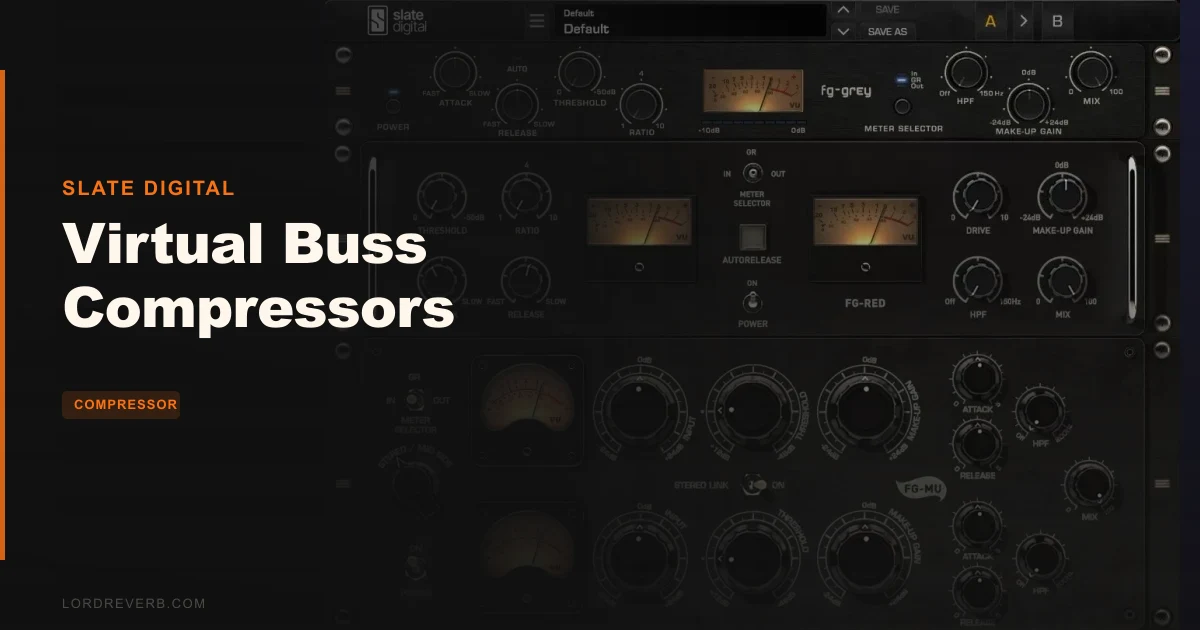
If you've been wondering whether Virtual Buss Compressors is just three compressors dressed up in vintage clothing or something that actually changes how your mixes feel, the answer is the latter, and the difference shows up the moment you drop the FG-Mu across a drum bus. At $149, this Slate Digital suite brings SSL, Focusrite, and Fairchild-inspired compression into one stacked plugin interface, and it's built for mix engineers who want the harmonic fingerprint of analog hardware without the rack space or the repair bills. It's not for producers chasing a perfectly clean, colorless buss. It's for the ones who keep asking why their mixes don't glue the way their references do.
Does It Actually Deliver What Slate Promises?
Slate Digital built Virtual Buss Compressors around one idea: that the tone of a mix buss compressor lives in its circuit, not just its gain reduction curve. That means transformers, tubes, VCAs, amplifiers, phase distortions, and harmonic content are all baked into the models.
The suite includes three compressors. FG-Grey is modeled after the SSL buss compressor. FG-Red pulls from Focusrite designs. FG-Mu is the Fairchild and Manley-inspired unit.
The developer says it was built for adding a professional final touch to mixes, and owners largely agree. Reports consistently describe mixes popping more, gluing better, and carrying a vibe that clean digital compression doesn't produce. That's not marketing language. That's the character of nonlinear circuit modeling doing what it's supposed to do.
All three compressors run inside the same rack plugin interface. You can stack them, run one, or combine two. That flexibility is genuinely clever for buss work.
Where Virtual Buss Compressors Actually Shines
The FG-Mu: A Drum and Mix Bus Weapon
Owners describe the FG-Mu as the jewel of the suite. Put it across your drum overheads, push the input so you're catching 2 to 3dB of gain reduction, and you'll hear the high-frequency sheen and low-end glue that owners consistently report. That's not compression doing all the work. That's the character of the circuit itself.
The FG-Mu includes separate attack and release controls plus a Mix knob and a sidechain filter, which gives it more flexibility than the hardware it's inspired by. If you've considered the UAD Fairchild for this job, note that the FG-Mu adds controls the original circuit never had.
Stack the FG-Mu underneath a lightly-set FG-Grey and you've got the kind of two-stage buss processing that mastering engineers have used for decades. Set the FG-Grey for moderate gain reduction with a slow attack and auto release, then let the FG-Mu add compression underneath it. Your mix will breathe differently.
Nonlinear Color Without Touching a Knob
This is the part that separates Virtual Buss Compressors from a utility compressor. Each of the three units has its own tonal character even when no compression is active. Pass your mix through the FG-Mu with the threshold pulled all the way up so nothing triggers, and the signal still comes back changed. Owners describe that coloring as subtle but noticeable when you bypass it.
That behavior is intentional. Slate modeled the full circuit path, not just the gain reduction element. Transformers color. Tubes add harmonic content. VCAs have their own nonlinear behavior. All of that is in these models.
The flip side: you cannot turn any of it off. There's no linear or bypass-the-color mode. If your application needs zero added harmonic content, this suite will frustrate you.
Stacking Within One Interface
The rack interface lets you load all three compressors and run them in sequence without chaining multiple plugin slots. For buss work, that's a satisfying workflow. You audition combinations quickly, set levels between units, and keep your session tidy.
It's a small thing, but when you're at hour nine of a mix session and your buss chain is already three plugins deep, having the whole suite in one window matters.
Where It Falls Short
The FG-Grey level issue is annoying and worth naming clearly. When you engage the FG-Grey, the plugin adds 1.5dB of level. That means engaging it makes your mix sound louder, and louder almost always sounds better. Owners recognize this as the oldest trick in the business, and some call it out as a reason you shouldn't trust your first impression of the plugin. Before you decide you love the FG-Grey, match levels properly.
CPU load is a real problem. Owners report Virtual Buss Compressors is very resource intensive compared to alternatives like Cytomic The Glue. On a loaded session with heavy VI use, stacking all three compressors could become painful.
There are no mono versions of the compressors. That limits the suite for producers who want to compress individual mono elements using the same models. And if you're in Cubase, you'll hit friction fast: Q-controls and AI-knobs don't function properly inside that DAW.
Non-linearities can't be switched off, which rules this suite out for ultra-clean mastering work where the client expects clinical transparency.
How It Stacks Up Against the Alternatives
The UAD Fairchild 670 emulation is more accurate to the original hardware than the FG-Mu. That's the honest answer. But accuracy isn't always what your mix needs, and the FG-Mu's Mix knob and sidechain filter give it more practical range than the UAD model.
The UAD 1176 and UAD LA2A offer distinct color signatures of their own, so if you're building a buss chain around one of those characters, they do what they do well.
Cytomic The Glue is the direct competitor for SSL-style buss compression. It's lighter on CPU, making it a more efficient choice for loaded sessions. If your only goal is SSL-style control with a small system footprint, The Glue is the smarter call. Virtual Buss Compressors earns its place by offering three different flavors plus the circuit-level coloring that The Glue doesn't try to replicate.
Is $149 a Fair Price for This Suite?
For three compressor models with this level of circuit modeling detail, $149 is fair. You're not paying for three simple gain reduction tools. You're paying for the nonlinear behavior, the harmonic character, and the stacking workflow.
Whether it makes sense for you depends on what you're buying it to fix. If your mixes sound clean but lifeless on the buss, this suite addresses exactly that. If you need a transparent utility compressor, you're paying for character you won't want.
Specs & Technical Details
| Developer | Slate Digital |
| Price | $149 |
| Plugin Format | AAX Native / AU / VST |
| OS Support | N/A |
| Activation | iLok authorization required |
| CPU Usage | Heavy |
| Trial Available | N/A |
| Version Reviewed | N/A |
Score Breakdown
| Category | Score | Notes |
|---|---|---|
| Sound Quality | 4.8/5 | Three distinct characters with deep circuit-level modeling; FG-Mu alone justifies serious attention |
| Value for Money | 4.0/5 | Three compressors with real harmonic modeling at this price is fair; CPU cost adds hidden overhead |
| Ease of Use | 4.0/5 | Stacking interface is clean, but the FG-Grey level mismatch and Cubase issues create friction |
| Features | 4.0/5 | Stacked rack workflow and Mix knob on FG-Mu are strong; no mono units and sidechain HPF limits hold it back |
| CPU Efficiency | 3.0/5 | Noticeably heavier than competing plugins on loaded sessions |
| Overall | 4.3/5 | A serious buss compressor suite with real character; the CPU cost and FG-Grey quirks are the only reasons not to love it outright |
Alternatives to Consider
Cytomic The Glue
The Glue is the CPU-friendly SSL buss compressor emulation. It won't add the same harmonic depth as the FG-Grey, but it won't chew through your processing budget either. If SSL-style control is all you need and you're running a packed session, The Glue is the smarter pick.
UAD Fairchild 670
The UAD Fairchild is the more accurate hardware emulation for that specific circuit. If accuracy to the original Fairchild 670 is the priority and you're already in the UAD ecosystem, it's a strong alternative for that one compressor type.
UAD 1176 / UAD LA2A
These are different flavors entirely. The 1176 is fast, punchy, and forward. The LA2A is slow, smooth, and warm with a distinct character that complements mix work differently. Neither replaces what the FG-Mu does, but if you want a single character compressor for bus work with a specific reference sound, these are the named alternatives worth checking.
Who Should Buy Virtual Buss Compressors?
The Working Mix Engineer
You're finishing tracks for other artists, you've got references that sound glued and alive in a way yours don't, and you've tried automation and sidechain tricks without fixing it. Load the FG-Mu across your mix buss and push maybe 1.5dB of gain reduction with a medium attack and a medium release. Bypass it. You'll hear the problem you've been chasing. That's what circuit-level modeling does that a clean digital compressor can't touch.
Buy it. This is what the suite was built for.
The Bedroom Producer on a Budget System
If your machine is already working hard with a full session of synths and samples, stacking all three compressors on your mix buss could push you into buffer-increase territory. Owners are clear: this plugin is resource intensive. You might love the sound and hate what it does to your CPU headroom.
Wait until you've got the CPU to spare, or consider The Glue as a lighter entry point for now.
The Mastering Engineer Chasing Transparency
The nonlinearities cannot be switched off. Full stop. If your client needs a completely colorless dynamic correction pass, this suite will add harmonic content whether you want it or not. It's a frustrating limitation if that's your workflow.
Skip it for clinical mastering work. It wasn't designed for that application.
The Cubase User
Q-controls and AI-knobs don't function properly with Virtual Buss Compressors in Cubase. That's not a minor integration issue. Those features are part of how Cubase users automate and interact with plugins in a session. Until Slate addresses it, running this suite in Cubase means working around a broken workflow.
Wait for a fix before committing at $149.
The Bottom Line
Virtual Buss Compressors is the kind of plugin that changes what you hear when you bypass it. That's the real test, and this suite passes it.
The FG-Mu alone is worth serious consideration for drum and mix buss work. The stacked rack workflow is genuinely useful. The circuit-level modeling does what Slate says it does: it adds the kind of character that separates a polished mix from a flat one.
The FG-Grey level trick is worth knowing before you fall in love with it. Match levels before you A/B. And if your machine is already running hot, think twice before stacking all three compressors across your mix buss in a heavy session.
But for mix engineers who've been trying to find where the glue went? This is where it lives.
Frequently Asked Questions
What compressors are included in Virtual Buss Compressors?
The suite includes three compressors: FG-Grey (modeled after the SSL buss compressor), FG-Red (inspired by Focusrite designs), and FG-Mu (based on Fairchild and Manley hardware). All three run inside the same rack plugin interface and can be stacked in sequence within a single session slot.
Is iLok required to run Virtual Buss Compressors?
Yes. iLok authorization is required to run the plugin. Check whether you need a physical iLok dongle or whether iLok Cloud is supported, as this can affect how you authorize across machines.
Why does the FG-Grey sound better when engaged than bypassed?
The FG-Grey adds 1.5dB of level when it's active compared to the bypassed state. Since louder almost always sounds better to our ears, this level boost can make the plugin appear to improve the mix when it's simply playing back louder. Match output levels before making any judgments about the FG-Grey's actual sonic contribution.
How does Virtual Buss Compressors compare to Cytomic The Glue?
The Glue focuses on SSL-style gain reduction with lower CPU overhead and a more transparent level-matching approach. Virtual Buss Compressors goes further by modeling full circuit nonlinearities across three different hardware references, adding harmonic content and character even without active compression. The Glue is the lighter, more surgical option. Virtual Buss Compressors is the choice when you want circuit-level color alongside compression.