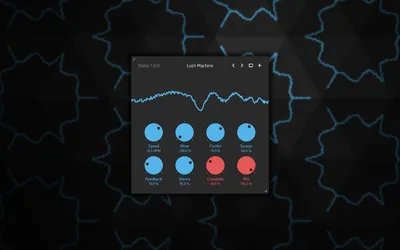
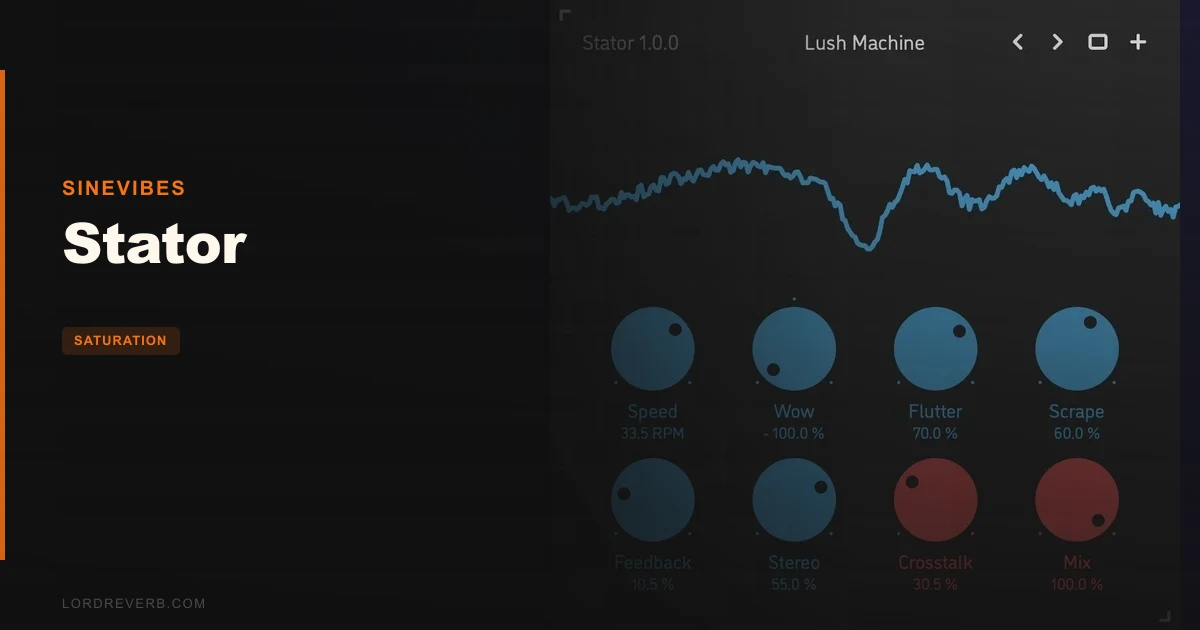
Stator gets compared to full tape emulators constantly, and that comparison misses the point. This isn't iZotope Vinyl or RC-20. It's a tape wobble simulator, narrowly focused on speed fluctuation, and within that lane it's one of the most thoughtfully engineered plugins at its price point, $29.
Where full-stack lo-fi plugins try to cover every degradation mode at once, Stator picks three: pitch wow, flutter, and scrape flutter. It models each with its own DSP algorithm set, its own depth control, and its own stereo widening formula. That specificity is either exactly what you want or completely beside the point for your workflow.
This review is going to land clearly: if tape wobble and phasing artefacts are what you need, Stator is a smart buy. If you need saturation, hiss, or dropout effects alongside it, look elsewhere first.
How Stator Compares Out of the Box
Put Stator next to RC-20 Retro Color and the difference is immediate. RC-20 gives you noise, wobble, distortion, and dropouts on one screen. Stator gives you nothing but wobble. That sounds like a loss until you start dialling the three modulation sources independently.
Pitch wow handles the slow, heavy drift. Flutter covers the faster mechanical jitter. Scrape flutter is the high-frequency friction artefact from tape-to-head contact. On most plugins, these are blended into one "wobble" knob. Here, they're separate, and that separation is where the creative flexibility lives.
Reviewers who came from iZotope Vinyl or Aberrant DSP Sketchcassette report a learning curve. The concepts are simple enough, but the interaction between three modulation sources, stereo phase offset, and crosstalk takes some sitting with. First impressions can be confusing. That's honest.
Performance Deep Dive
The engine runs 13 DSP algorithms in total across the three modulation sources. Sinevibes doesn't publish exactly how those 13 divide across wow, flutter, and scrape flutter, but the result is that each source behaves differently as you push its depth control.
Load Stator on a vocal and set flutter depth low. You get something close to a worn cassette playback, the kind where the pitch drifts half a cent and back. Push scrape flutter up while keeping wow minimal and the texture shifts toward VHS tracking noise without any added noise floor. That's a distinct sound most lo-fi plugins can't isolate.
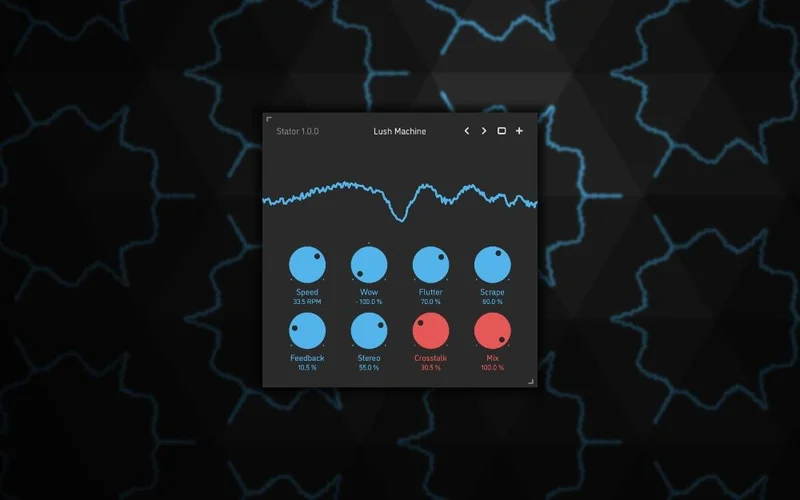
The stereo section is genuinely clever. Each of the three modulation components has its own stereo phase offset calibration, so wow, flutter, and scrape flutter can widen independently. Stack crosstalk on top and you're building chorus and phasing artefacts from the modulation itself, not from a separate effect. That's the part reviewers consistently call surprising.
The built-in feedback loop adds colour without being a saturation circuit. It's subtle. Don't come to it expecting harmonic drive. It reinforces the resonance of the modulation. Useful for pushing the effect into something more broken-sounding.
Lag filters on all continuous parameters mean no clicks when you automate in real time. Clean.
Where Stator Wins
The modulation architecture is the win. Three sources, three depth controls, three stereo offsets. No other plugin at this price gives you that level of independent control over tape speed physics.
You want a VHS-style widening effect on a synth pad? Set wow low, flutter medium, crank stereo phase offset on the scrape flutter source. That's a specific, useful trick that full-stack tape emulators won't let you build precisely.
The mono-to-stereo conversion is underrated. Run a dry mono synth or guitar through Stator and the crosstalk phasing alone can place it in a stereo field without any reverb or delay. For lo-fi and ambient work, that's satisfying.
Window scaling up to 200% matters. On a high-DPI display, small plugin UIs are annoying. Stator handles this cleanly. Colour-coded parameters make navigation fast once you've learned the layout.
The Korg Multi Engine version at a lower price point is a genuine bonus if you run hardware synthesis.
Where the Competition Wins
The gap is real and worth naming directly. Stator has no saturation, no tape hiss, no dropout simulation, no high-frequency rolloff. Full tape emulators cover all of that.
If you want a single plugin that makes a clean recording sound like it was played off a battered cassette, with hiss and crackle and harmonic warmth, Stator won't get you there alone. You'd need to chain it with a saturation plugin and a noise generator.
That's not a design flaw. It's a design choice. But some users find it frustrating, and we think that frustration is fair if you bought Stator expecting a full lo-fi solution.
The preset browser is fine, nothing more. If you're the kind of producer who lives inside preset libraries, this workflow will feel thin compared to RC-20 or Vinyl.
For producers who want a one-stop lo-fi box, Technocolor is worth a look first.
Who Should Buy Which
- ✅ Buy if you want precise, independent control over wow, flutter, and scrape flutter as separate modulation sources
- ✅ Buy if you're building stereo width from tape phasing artefacts rather than reverb or chorus
- ✅ Buy if you already have a saturation plugin and just need the wobble layer added on top
- ❌ Skip if you need saturation, tape hiss, or dropout effects in the same plugin
- ❌ Skip if DSP modulation concepts are unfamiliar and you want something you can dial in fast
- ❌ Skip if you rely heavily on preset browsing to find your sound quickly
Stator for the Sound Designer
This is where Stator earns its reputation. Load it on a pad, push the scrape flutter depth high, and dial the stereo phase offset to maximum. What comes out doesn't sound like tape anymore. It sounds like something alive and unstable in a way that's hard to produce with a standard chorus or flanger.
Try it on a drum bus with all three depth controls low, around 10-15% each, and crosstalk at around 30%. Compare the stereo image against the bypassed signal. Reviewers consistently call this effect beautiful, which is a strong showing for a sub-$29 plugin.
Automate the flutter depth over a long ambient section and you get movement without the mechanical regularity of an LFO. That's the specific appeal Sinevibes designed for, and it delivers.
Stator for the Working Mix Engineer
You're more cautious here. Mix engineers who want surgical lo-fi treatment need to know what Stator won't do.
It won't add harmonic warmth. It won't reduce high-frequency content. It won't make a modern recording sound vintage by itself. What it will do is add pitch instability and stereo width to a signal in a way that sounds organic rather than processed.
On a parallel bus, low settings, it can add the kind of instability that makes a mix feel less clinical. That's a real use case. But don't buy it as your primary colour tool.
For mix engineers: buy it as a specific tool, not a workhorse.
Stator for the Beginner Producer
Honest answer: wait.
Not because Stator is bad. Because the learning curve on modulation depth interaction, stereo phase offset, and crosstalk is real, and the preset library isn't deep enough to shortcut it. If you're new to lo-fi production, a plugin with a single wobble knob will get you to a result faster while you learn what each element actually does.
Come back to Stator when you know what you want from tape wobble specifically.
Specs & Technical Details
| Developer | Sinevibes |
| Price | $29 |
| Plugin Format | VST3 / AU / AAX |
| OS Support | macOS 10.9+ (Intel & M1) / Windows 8.1+ (64-bit) |
| Activation | N/A |
| CPU Usage | Light to medium |
| Trial Available | Check Sinevibes directly |
| Version Reviewed | Current as of 2026 |
Score Breakdown
| Category | Score | Notes |
|---|---|---|
| Sound Quality | 4.5/5 | Three-source modulation produces organic pitch drift that holds up on close listening |
| Value for Money | 4.5/5 | At $29, the modulation architecture is hard to match |
| Ease of Use | 3.5/5 | Colour-coded UI is clean but the DSP concepts take time to learn |
| Features | 3.5/5 | Deep within its lane, thin outside it. No saturation, hiss, or dropouts |
| CPU Efficiency | 4.5/5 | 13 algorithms, light footprint. No complaints from users on that front |
| Overall | 4.2/5 | A brilliant narrow tool. Wrong choice only if you needed a full tape suite |
Alternatives to Consider
RC-20 Retro Color (XLN Audio) is the obvious broader option. Wobble, noise, distortion, and dropout effects in one plugin. If you want all-in-one, it's the first place to look.
Aberrant DSP Sketchcassette covers more of the tape degradation spectrum including saturation and noise. Closer to a full tape suite than Stator is, at a higher price.
iZotope Vinyl is free and covers noise, mechanical issues, and some wobble. Less precise on the modulation side, but it costs nothing and pairs well with Stator if you already own one and want to fill the other's gaps.
If the Korg Multi Engine version interests you, that's a separate conversation entirely.
Stator at $29 is a specific buy for a specific need. If pitch wow, flutter, and scrape flutter done properly is the gap in your signal chain, it fills that gap better than anything else at this price. If you need saturation, hiss, or one-click lo-fi, start somewhere else and come back to Stator when you know what you're layering it on top of. That's the honest version.
Frequently Asked Questions
Is Stator a full tape emulator?
No. Stator focuses entirely on tape speed fluctuation: wow, flutter, and scrape flutter. It doesn't include saturation, tape hiss, noise, or dropout effects. If you need those, you'll want to chain it with a separate saturation or lo-fi plugin, or choose a different starting point like RC-20.
Does Stator work on Windows?
Yes. It supports Windows 8.1 and later, 64-bit, in VST3 and AAX formats. Mac users get AU format as well, and the plugin runs natively on both Intel and M1 Apple Silicon processors.
What's the difference between the plugin version and the Korg Multi Engine version?
The plugin version runs in your DAW as a standard insert effect. The Korg Multi Engine version is built for the Prologue, Minilogue XD, and NTS-1 synthesizers, letting you run the Stator engine as a hardware oscillator or modulation source. They serve different workflows entirely.
Is Stator good for creative sound design beyond lo-fi?
Yes, and this is where it surprises people. The stereo phase offset and crosstalk controls let you build widening and phasing effects that don't sound like tape at all. Reviewers use it on synth pads, drum buses, and ambient layers where the goal is organic movement rather than vintage texture. Push the scrape flutter depth high and you're well outside cassette territory.