
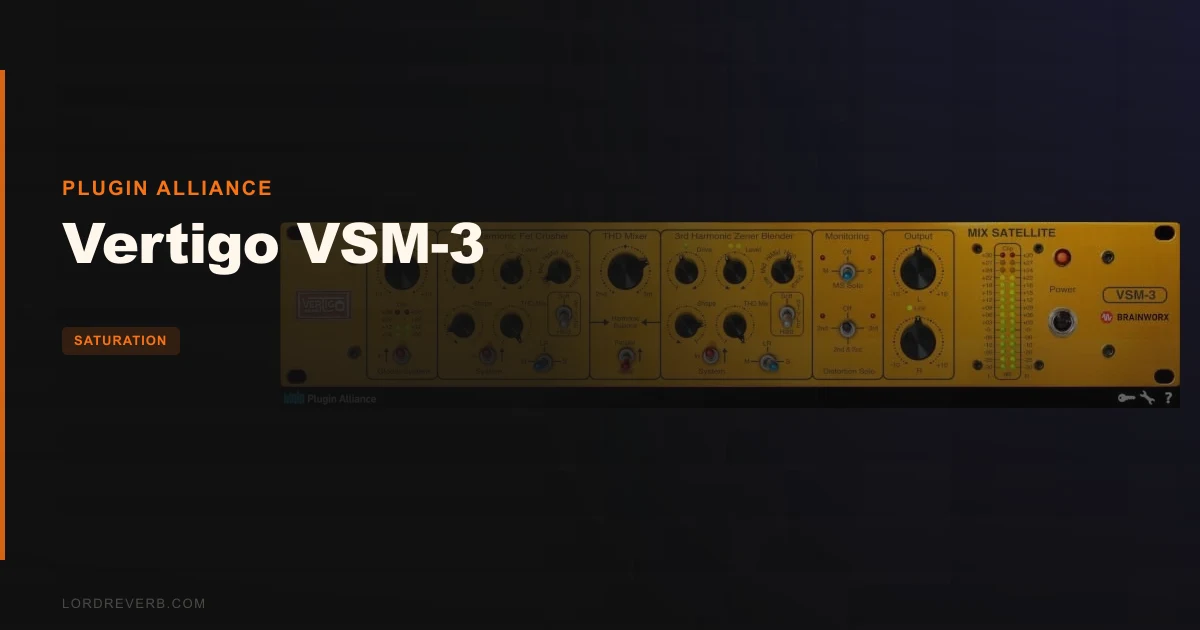
The Vertigo VSM-3 is one of the most sonically sophisticated saturation plugins available in 2026 at its price point, and it solves a specific, annoying problem: every mix you've worked on that felt "done" but somehow lifeless.
You've EQ'd it. You've compressed it. You've automated the fader. The mix is technically correct and emotionally flat. That's the gap the VSM-3 exists to fill. It adds harmonic density, the kind that makes your 2-bus breathe rather than just sit there.
Developed by Brainworx for Plugin Alliance, it's a plugin translation of the Vertigo Sound VSM-2 Mix Satellite hardware, a unit that costs multiples of what this plugin does. It's built for engineers who work at mastering depth but think in mixing terms. If you just want "more vintage vibe" for your bedroom pop tracks, there are cheaper options. This one rewards patience.
The Flatness Problem No Compressor Fixes
There's a specific moment most mix engineers know. You've hit your limiter ceiling, loudness is where it needs to be, and the track still doesn't compete. It lacks density in the upper mids. The low-mids feel unresolved. Nothing sounds broken, but nothing sounds alive either.
Saturation is the answer, but most saturation plugins give you one flavour. Tape emulation sits in the low-mids and 2nd harmonics. Amp sims clip harder than you want. Tube emulations add warmth (meaning a lift around 200-400Hz with even-order harmonics rolling into the 2-4kHz zone) but wash out transient detail on complex material.
The VSM-3 solves this with two separate circuits you can actually blend. The 2nd Harmonic FET Crusher adds warmth and richness; the 3rd Harmonic Zener Blender adds brightness and detail. That's the difference between filling in the body of a drum bus and adding air to a vocal group. You don't have to choose one or the other.
That design decision is what separates it from one-knob saturation. It's not just more versatile. It changes how you think about the problem.
How It Performs in a Real Session
We put the VSM-3 on a drum bus first. The session had a standard drum room kit: kick, snare, two overheads, one room mic, no samples. The bus was sitting in the mix but the snare felt polite. We ran it through the FET Crusher at around 30% drive with the THD Mixer's wet/dry around 40%. The snare body thickened. The harmonic content that appeared sat between 200Hz and 400Hz, filling the gap between the fundamental crack and the shell resonance. Satisfying.
Then we engaged the Zener Blender at 20% and switched to parallel operation. The plugin supports parallel or serial Crusher and Blender operation. In parallel, the Crusher and Blender sum independently before hitting the THD Mixer. The result: the snare kept its body from the FET stage but picked up presence in the 3-5kHz zone from the Zener stage. We got it to sit in the mix without pushing the overhead faders up at all.
We then tested it on a vocal bus with three stacked harmonies that were fighting for space. Using the Distortion Solo switch here is brilliant. The Distortion Solo lets you monitor the generator signal being added to the dry input as it runs through the Crusher, Blender, or both. You can hear exactly what harmonic content you're adding, in isolation, before it merges with the dry signal. That's not a feature many saturation plugins offer. It genuinely changes how precise your decisions can be.
On the 2-bus, we kept the Zener Blender doing the heavy lifting with the FET Crusher in light support at about 15% drive. In a mastering context, the precision and power of the VSM-3 is hard to beat. We'd agree with that. The plugin is quiet enough at low drive settings to not introduce audible artifacts, and the Shape knob, which gently filters high-order harmonics, kept the top end from turning brittle. The Shape knob is built specifically for gently filtering high-order harmonics.
CPU load is heavy. On a session at 48kHz/32-bit float in Pro Tools, one instance pulled around 8-12% CPU on a mid-spec M2 MacBook Pro. Two instances on separate buses pushed us into buffer issues at 128 samples. Don't spray this across individual tracks. Park it on AUX buses and the 2-bus and leave it there.
Strengths and Weaknesses
The monitoring tools are where we love this plugin most. The M/S Solo switch is genuinely clever for mastering work. The MS solo switch lets you monitor either the mid or side signal, which is useful when evaluating the coloration added by the VSM-3. Side-chain your saturation decisions to the mid signal on a dense mix and you'll stop accidentally widening distortion into the sides where it causes phase issues. That feature alone is worth the entry price.
The plugin-exclusive features are a real step up from the hardware VSM-2. The VSM-3 includes features not found on the VSM-2: the THD Mixer's Dry/Wet control, and the ability to run the Crusher and Blender in parallel or serial. Those aren't cosmetic additions. They change how surgical you can be.
The weakness is the interface. It's not ugly, but it's not obvious. First session, we spent 20 minutes not fully understanding what "serial" routing was doing to our signal chain versus "parallel." The manual helps. Most people won't read it. The plugin features a steep learning curve and a somewhat unintuitive interface, requiring a careful hand to find the sweet spot and avoid ruining a mix. That's an honest summary.
The CPU hit is also a real constraint, not just a footnote. If you're on an older Windows machine or a non-Apple Silicon Mac, a single instance of VSM-3 may consume 15% or more of your processing budget.
Value for the Price
At full retail, the VSM-3 is a reasonable ask for what it delivers. It's a specialised tool with genuine engineering depth, not a Swiss Army knife.
At the sale price (where it lands frequently), it's a clear choice for anyone working on buses and mastering chains. We've seen it drop even lower during Plugin Alliance sales. At that price, the CPU limitations and learning curve cost you nothing to discover.
Compare it to the Decapitator at full price: the VSM-3 is more precise and mastering-appropriate, while Decapitator is faster and more aggressive on individual tracks. They're not direct competitors in practice. If your work lives on the bus, the VSM-3 wins the value argument. Check the Plugin Alliance and Plugin Boutique sites for current pricing and active promotions before you buy.
For more context on how VSM-3 fits into a broader saturation toolkit, see our Saturation Plugins Guide: 5 Types Every Producer Needs.
Who Should (and Shouldn't) Buy This
- ✅ Buy if you work on 2-bus, drum bus, or vocal buses and want harmonic control without committing to a single sonic character.
- ✅ Buy if you do mastering or mix finalisation and want monitoring tools (M/S solo, Distortion Solo) that most saturation plugins don't offer.
- ✅ Buy if you catch it on sale at a deep discount. At that price, the CPU trade-off and learning curve are worth the experimentation.
- ❌ Skip if you're looking for a per-track saturation tool. The CPU load makes that workflow frustrating fast.
- ❌ Skip if you're new to saturation and want something immediate. The VSM-3 rewards experience. It'll confuse a beginner before it helps them.
- ❌ Skip if you need something equally capable on individual tracks and buses. Decapitator or Technocolor by Karanyi Sounds will serve you better across a full session.
Score Breakdown
| Category | Score | Notes |
|---|---|---|
| Sound Quality | 4.5/5 | Dual harmonic circuits cover more tonal ground than most competitors at this price |
| Value for Money | 4.0/5 | Excellent on sale; slightly harder to justify at full price against cheaper options |
| Ease of Use | 3.0/5 | Interface isn't intuitive; serial vs. parallel routing needs manual study to use correctly |
| Features | 4.5/5 | M/S Solo, Distortion Solo, Shape knob, and parallel/serial routing are genuinely useful for mastering |
| CPU Efficiency | 2.5/5 | 8-12%+ per instance on M2 Mac at 48kHz is too heavy for multi-track instancing |
| Overall | 4.2/5 | A brilliant bus and mastering tool held back only by its CPU cost and learning curve |
Alternatives to Consider
Decapitator by SoundToys (full price): Faster to dial in on individual tracks. Five drive modes cover tube, tape, transistor, and transformer character. It's more aggressive and less precise than the VSM-3. If you want one saturation plugin that works across every track in a session, Decapitator wins the argument.
Karanyi Sounds Technocolor: A more CPU-efficient and accessible saturation option. Read our Technocolor Review: Does It Beat Free Saturation in 2026 to see how it stacks up against both the VSM-3 and the free competition.
UAD Fatso Jr/Sr: If you're on a UAD setup and want a hardware-to-plugin translation with bus saturation and program-dependent compression in one unit, the Fatso is worth considering alongside the VSM-3. The VSM-3 gives you more precise harmonic control. The Fatso adds compression character the VSM-3 doesn't have. They do different jobs.
If you're still building your understanding of what saturation actually does at a circuit level, our Saturation Plugins Guide: 5 Types Every Producer Needs is worth reading before you commit to any of these.
You might also want to explore our Vertigo Viola Review: Worth It for Film Composers if you're deep in the Plugin Alliance ecosystem and building out your toolkit.
The VSM-3 is a plugin you'll either underuse or swear by. There's no middle ground. If you sit in mastering sessions, run complex bus structures, or obsess over harmonic density on your 2-bus, buy it on the next sale. If you're looking for an all-purpose track saturator you can slap on drums and guitars without thinking, this is the wrong tool. The right tool should still cost you less than a plugin subscription and not eat your CPU in the process. That's the honest version of this recommendation.
Frequently Asked Questions
Is the Vertigo VSM-3 good for beginners?
Honestly, it's not ideal as a first saturation plugin. The interface takes time to understand, and the difference between serial and parallel Crusher/Blender routing isn't obvious without reading documentation. If you're just getting started with saturation, something with fewer parameters will teach you the fundamentals faster. Come back to the VSM-3 once you understand what 2nd versus 3rd order harmonics actually sound like in a mix.
Can I use the VSM-3 on individual tracks, or only on buses?
You can technically load it on individual tracks, but the CPU overhead makes this painful. On a mid-spec modern computer, a single instance can draw 8-12% CPU at 48kHz. On a full session with 40+ tracks, instancing the VSM-3 on three or four individual channels becomes a real performance problem. Reserve it for your drum bus, vocal bus, and 2-bus. That's where it does its best work anyway.
How is the VSM-3 different from the hardware VSM-2?
The VSM-3 plugin is modelled on the VSM-2 hardware, but it adds features the hardware doesn't have. Specifically, you get a THD Mixer with a Dry/Wet blend control and the option to run the FET Crusher and Zener Blender in either parallel or serial configuration. The hardware runs them in a fixed signal path. Those additions make the plugin more flexible for in-the-box mastering work than the hardware it's based on.
Does the Vertigo VSM-3 have a free trial?
Yes. Plugin Alliance offers a free trial for the VSM-3, which lets you test it in your sessions before buying. We'd strongly recommend using the trial before purchasing at full retail price. The plugin has a distinct character and specific use cases, and a few hours with it on your own material will tell you quickly whether it belongs in your signal chain or not.