
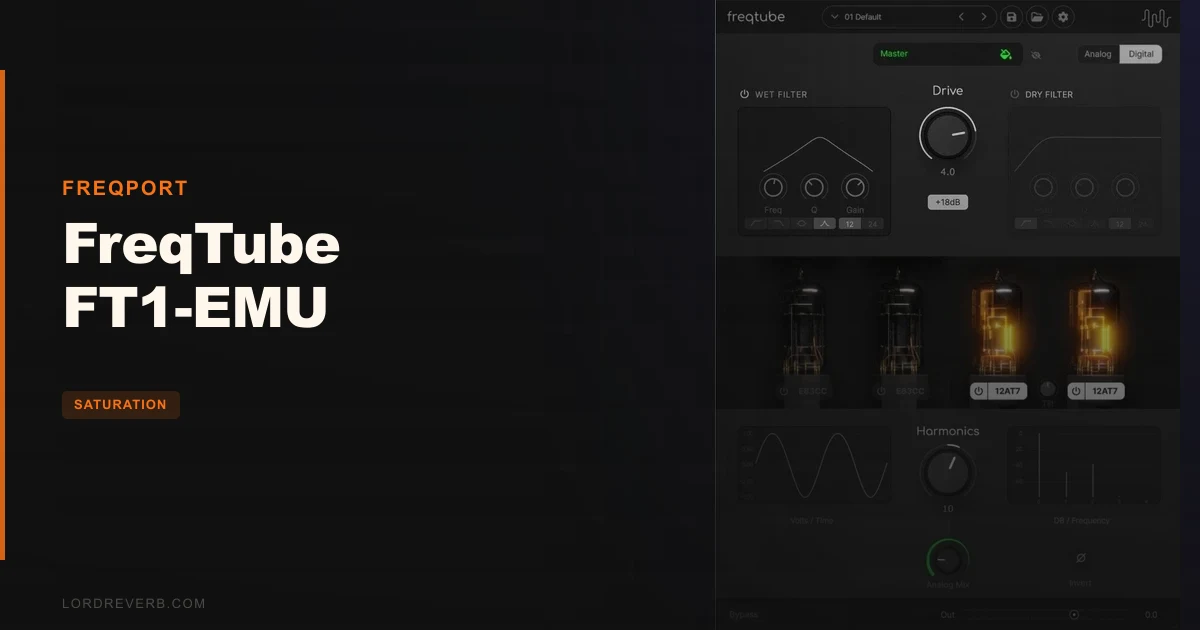
The claim Freqport makes about FT1-EMU is that it delivers true analog circuit behavior in a fully standalone plugin. That holds up, mostly, but only if you're ready to tolerate some frustrating workflow gaps to get there. At $99, it's a plugin for engineers who understand what component-level modeling means and care about the difference. If you just want to warm up a mix without the friction, there are cleaner options at similar prices.
This is not a skip-it product, and it's not a buy-without-hesitation one either. It depends on who you are and what you're chasing.
What Freqport Promises
Freqport built FT1-EMU around a quad tube engine: 2× E83CC and 2× 12AT7 tubes, modeled using a SPICE reference circuit. That means the plugin is trying to recreate the actual electrical interactions between components, not approximate the sound from a static impulse response or a simplified transfer function.
The developer says this preserves nonlinear behavior and dynamic response in ways conventional digital emulation skips. They also say the model was refined against hardware measurements. That's a specific, verifiable kind of claim, not vague marketing language about "warmth."
The hardware connection feature is real, too. If you own the FreqTube FT1 hardware unit, you can switch between the plugin emulation and the actual circuit with one click. That's a genuinely clever bridge between the analog and digital worlds.
What Actually Holds Up
Sound quality is where FT1-EMU earns its price. Owners report low CPU usage alongside sound that sits clearly above average for the category. The tubes sound decent, full stop.
The idea of running it across multiple channels simultaneously without a CPU spike is satisfying. Load it on drums, bass, and a few synths in the same session and your machine won't complain. For something doing component-level math, that's a real achievement.
Owners also describe it as capable of emulating a sophisticated tube device in natural, transparent ways. That's not empty praise. It means you can use this thing subtly, which a lot of saturation plugins genuinely can't do.
What Doesn't
The software polish is a problem. Not a small one.
UI labels are unresponsive. The GUI lags. Tube switching in software mode requires activating each tube one by one, manually, every time. If you're building sessions with several instances of FT1-EMU, that gets annoying fast.
The output trim issue is worse: every time you switch between software emulation and hardware mode, you need to readjust the trim manually. There's no automatic gain compensation. Manual loudness compensation in a session context is clumsy, and owners confirm it's tricky to get right.
Then there's the project recall problem. Load a session that was saved in analogue mode without the FT1 hardware connected, and the plugin doesn't auto-switch to digital. You have to do it yourself. In a professional context where recall needs to be reliable, that's not acceptable without a workaround baked into your session template.
One tube on a stereo track also doesn't work. That's a specific, annoying limit that affects real-world use immediately.
Owners are clear: the sound is excellent, the software is not finished. Those two things are both true at the same time.
Who Gets the Most From This
If you own the FreqTube FT1 hardware, FT1-EMU is almost a no-brainer at $99. The one-click hardware switching alone makes it a bridge tool worth having in your signal chain.
Component-level modeling delivers convincing, natural tube character with real harmonic complexity that experienced engineers with a sophisticated monitoring setup will appreciate. If you can't hear the difference between this and a simpler saturation plugin on a mid-priced system, you're paying for something you won't feel.
If you're looking for a workhorse saturation plugin that just works, loads fast, and doesn't ask anything of you, this is the wrong tool. The workflow friction is real. Beginners and producers who want plug-and-play warmth will hit those UI problems before they ever hear the sonic benefit.
The Verdict
FT1-EMU is a plugin with a genuinely impressive core and a frustrating shell around it. The sound is there. The engineering is real. But the GUI needs work, the recall behavior needs fixing, and the tube-switching workflow needs a redesign.
At $99, it earns its place for engineers already in the FreqTube ecosystem or those who need low-CPU, high-quality saturation and have the patience to work around its rough edges. Everyone else should check the alternatives below before committing.
Specs & Technical Details
| Developer | Freqport |
| Price | $99 |
| Plugin Format | VST3 / AU / AAX |
| OS Support | macOS / Windows |
| Activation | N/A |
| CPU Usage | Light |
| Trial Available | N/A |
| Version Reviewed | 1.10.0 |
Score Breakdown
| Category | Score | Notes |
|---|---|---|
| Sound Quality | 4.5/5 | Component-level modeling delivers convincing, natural tube character with real harmonic complexity |
| Value for Money | 3.0/5 | Sound justifies the price but software polish issues make it hard to recommend without caveats |
| Ease of Use | 2.5/5 | Unresponsive GUI, manual tube activation, and no auto-mode-switching on project load all hurt daily usability |
| Features | 3.5/5 | Hardware switching and quad tube engine are clever; stereo tube limitations and trim workflow are underdeveloped |
| CPU Efficiency | 4.5/5 | Low CPU load across multiple instances is a genuine strength for the complexity of the modeling |
| Overall | 3.5/5 | Excellent sonic foundation held back by software that needs another revision cycle |
Alternatives to Consider
Before you buy, here's how FT1-EMU sits against the plugins owners and engineers most often put next to it.
| Plugin | Strongest Point | Weakest Point | Best For |
|---|---|---|---|
| FreqTube FT1-EMU | Component-level tube modeling, low CPU, hardware bridge | Rough GUI, poor recall behavior, stereo limitations | FT1 hardware owners; experienced engineers who want real circuit character |
| Softube Harmonics | Comparable sound quality | Different workflow | Engineers who want similar quality with a more polished package |
| Pulsar P42 | Accomplishes similar tube saturation without any hardware investment | No hardware switching option | Producers who want tube color without the FT1 ecosystem overhead |
| Soundtoys Decapitator | Broad saturation versatility across many characters | Less focused on pure tube emulation | Producers who want a single saturation tool covering many styles |
If the hardware connection isn't part of your plan, Pulsar P42 is worth checking first. It covers similar tube saturation territory without asking you to manage mode-switching headaches. Softube Harmonics is also worth auditioning if sound quality is your priority and you want that quality in a more polished package.
Soundtoys Decapitator is a different animal: wider versatility, less commitment to authentic tube behavior. It's not trying to do what FT1-EMU does, but it's worth knowing it exists if you're unsure whether pure tube emulation is what your sessions actually need.
If you've tried the FT1 hardware and love it, the $99 plugin makes real sense. If you haven't touched that hardware and you're buying FT1-EMU purely as a software saturation tool, do that Pulsar P42 comparison first. The sonic gap between them is smaller than the workflow gap between FT1-EMU and a finished product.
Frequently Asked Questions
Does FreqTube FT1-EMU work without the FreqTube FT1 hardware?
Yes, it runs as a fully standalone plugin with no external hardware required. The hardware connection feature is an add-on benefit, not a requirement. That said, owners note that if you open a project saved in analogue mode without the hardware connected, you'll need to manually switch the plugin to digital mode yourself.
Is FT1-EMU CPU-heavy when running on multiple tracks?
No. Owners consistently report low CPU usage, which is one of the plugin's clearest strengths given the complexity of the component-level modeling underneath. You should be able to run it across drums, bass, and multiple synth channels in the same session without your CPU complaining.
What's the difference between FT1-EMU and a standard saturation plugin like Decapitator?
FT1-EMU models the actual electrical interactions between circuit components using a SPICE reference circuit, rather than approximating a sound from a static capture. In practice, that means the dynamic response changes in a way that tracks the input signal more naturally. Decapitator is more versatile across saturation characters but isn't built around a specific tube circuit model the way FT1-EMU is.