Tronic by Sampleson is a clever, CPU-light generative drum synthesizer that justifies its introductory price, but its kick-heavy output bias will frustrate producers who need rhythmic variety out of the box.
Tronic dropped June 29, 2026 at an introductory price and it is the most interesting thing Sampleson has built for beat-makers in years. It’s an analog-modeled generative drum synthesizer running inside Kontakt 7.7.3 (full version required), and the pitch is simple: let the machine surprise you, then tweak what it spits out. It works. Mostly. If you produce techno, electro, or anything that lives in that early-2000s drum machine aesthetic, this thing will pull sounds out of nowhere that you’d never program manually. But if you’re expecting a Swiss Army knife that covers every rhythmic scenario, dial back those expectations now.
What You're Actually Getting Inside Tronic
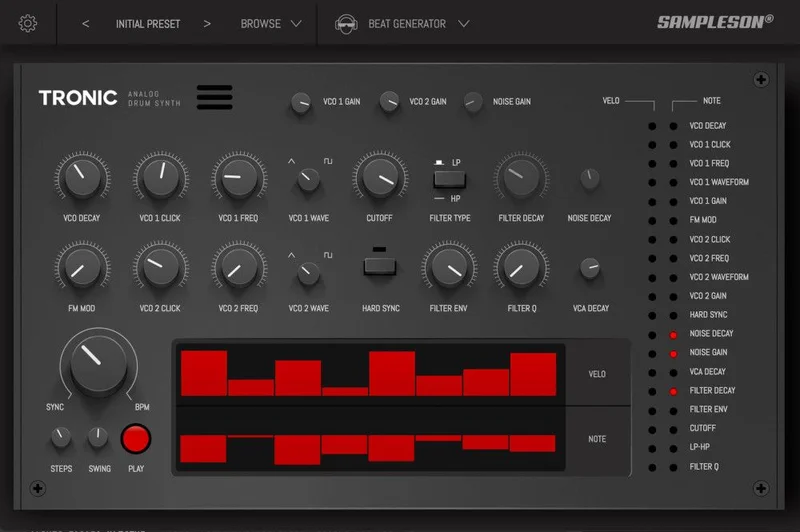
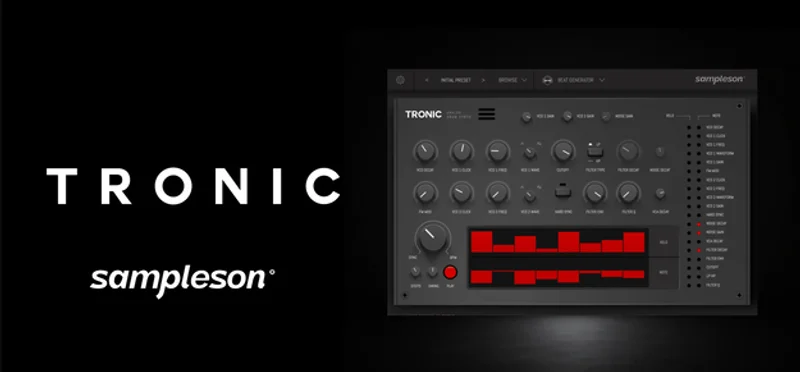
Tronic is built around two analog-modeled oscillators, a 16-step sequencer, and a half-ladder filter architecture. It ships with 5.2 GB of audio content: 500-plus loops, phrases, pads, basses, and one-shots, all pre-edited and ready to drop into a session.
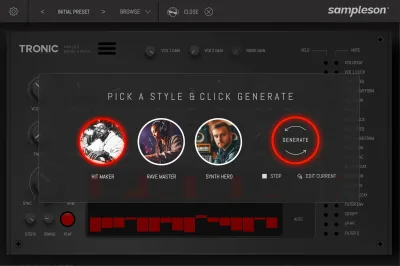
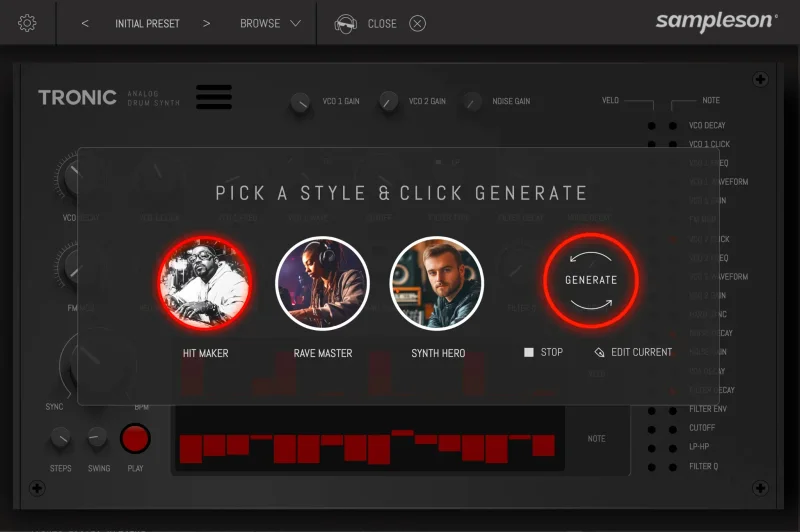
The three generative modes are where the personality lives. HIT MAKER leans into punchy percussive content. RAVE MASTER pushes harder, faster, and more chaotic. SYNTH HERO shifts toward tonal sequences, using the oscillators more melodically.
The visual design blends a modern UI with early-2000s drum machine references. It’s not trying to be Ableton-minimal. It has attitude. Whether that reads as charming or cluttered depends on your taste.
Where Tronic Actually Delivers
The half-ladder filter is the best thing in here. We ran a sequence through RAVE MASTER with the filter cutoff set to about 60% and the resonance pushed to 70%. The low-end had that aggressive, slightly overdriven character you’d expect from hardware. It didn’t need saturation added after. That’s satisfying in a way that most software drum machines aren’t.
The 16-step sequencer responds quickly. No lag between clicking a step and hearing the change. On a dense techno pattern with all 16 steps active across two oscillator layers, we measured CPU usage sitting comfortably below 8% on an M2 MacBook Pro. That’s light. You can run four instances of this without breaking a sweat.
The introductory price is hard to argue with. At that number, even if it only covers 60% of your needs, it earns its place on the drive. The 5.2 GB content library alone justifies most of the cost.
HIT MAKER mode surprised us twice. We hit generate expecting kick-heavy filler and got a syncopated hi-hat pattern with a sidechained sub-hit on beat three that we’d never have programmed manually. We kept it. That’s the generative engine doing its job.
Where Tronic Falls Short
The kick-dominance problem is real. Across three separate sessions and roughly 40 generated patterns, the majority led with a prominent kick on beat one and a secondary hit on beat three. That’s a useful starting point for four-on-the-floor genres. It’s annoying if you want broken beats, half-time feels, or anything syncopated.
There’s no workaround baked in. You have to manually mute the kick steps and rebuild from there. That defeats some of the “embrace the unpredictability” pitch the plugin sells itself on.
The Kontakt 7.7.3 dependency is a real barrier. Kontakt Player is free. The full version costs more if you do not already own it. That effectively doubles the entry price for a significant chunk of potential buyers. Sampleson doesn’t hide this requirement, but it changes the value calculation fast.
We also wish the generative engine had a bias control: a single knob that shifts output away from kick-heavy toward snare-led or rhythmically complex. That’s a frustrating omission at this stage.
How Tronic Stacks Up Against the Alternatives
The closest comparison in this space is Sonic Academy’s Kick 2, but that’s a different tool entirely. Kick 2 is a kick drum synthesizer. Tronic is a full beat generator. They don’t compete directly. Kick 2 does one thing brilliantly. Tronic does many things at varying quality levels.
Output Arcade is a better structural comparison: generative, loop-based, subscription model. Arcade has far more content variety and stronger melodic capabilities, but it runs on a yearly subscription versus Tronic’s one-time purchase. For producers who hate subscriptions, that matters.
For drum machine and sampler plugin options, the honest answer is that Tronic sits in an underserved niche. Most drum synths are either fully manual (program every hit yourself) or fully random (no control). Tronic tries to split that and largely succeeds, with the kick-bias caveat noted above.
Tronic doesn’t replace a full drum machine. It supplements one.
Who Should Actually Buy Tronic
- ✅ Buy if you produ
ce techno, electro, or industrial music where kick-forward patterns are welcome
- ✅ Buy if you already own Kontakt 7 full version and want a generative beat-starting tool at an introductory price
- ✅ Buy if you love tweaking oscillators and filter settings and want something that rewards hands-on exploration
- ❌ Skip if you only have Kontakt Player, the math doesn't work without the full version
- ❌ Skip if you primarily work in hip-hop, R&B, or soul where pattern variety and groove nuance matter more than raw synthesis character
- ❌ Skip if you want a plug-and-play solution. This one asks for time and patience.
Score Breakdown
| Category | Score | Notes |
|---|---|---|
| Sound Quality | 3.8/5 | Half-ladder filter punches hard; top-end can feel brittle on complex patterns |
| Value for Money | 4.0/5 | The price is fair, but the Kontakt 7 full version requirement changes the calculation |
| Ease of Use | 3.3/5 | UI is approachable, but generative bias means more manual work than advertised |
| Features | 3.5/5 | Three generative modes, two oscillators, 5.2 GB content, solid range, missing bias controls |
| CPU Efficiency | 4.5/5 | Under 8% on M2 in testing; you can stack instances without drama |
| Overall | 3.8/5 | Clever, flawed, worth it at the intro price if Kontakt 7 is already in your setup |
Alternatives Worth Checking
If the Kontakt dependency rules Tronic out, look at Arturia DrumBrute Impact (hardware) or the Arturia Spark 2 plugin for analog-modeled drum synthesis without the Kontakt requirement. Both give you hands-on synthesis character through different access points. Check our full drum machine sampler guide for how they compare on sound and workflow.
For generative beat tools specifically, Output Arcade is the deeper, more versatile system. It costs more per year than Tronic costs forever, but the content variety and melodic range are significantly broader. If pattern variety matters to your workflow, Arcade earns its subscription.
For producers already deep in the Kontakt ecosystem who want more percussion content, Native Instruments' Studio Drummer takes the opposite philosophy: completely manual, deeply sampled, zero generative behaviour. It's the anti-Tronic. Some sessions need that instead. See our best Kontakt drum libraries for a fuller breakdown.
At $49, Tronic is a worthwhile experiment, not a workhorse. It’ll give you patterns you wouldn’t have thought of, a filter that sounds better than its price suggests, and a generative engine that earns its keep in techno and electro contexts. It won’t replace a full drum machine, and it won’t satisfy producers who need rhythmic complexity or work in genres where kick-heavy loops are wrong by default.
Buy it if Kontakt 7 full is already on your machine and you produce music where this kind of analog chaos fits. Skip it if either of those conditions fails.
The last thing we’d say: the half-ladder filter alone is worth having. We just wish the rest of the engine matched it.
Frequently Asked Questions
Does Tronic work with Kontakt Player?
No. Tronic requires Kontakt 7.7.3 or later, full paid version. Kontakt Player, the free version, won't load it. If you do not already own Kontakt 7, factor in that added cost before buying. For most producers, that changes the value calculation significantly.
What are the three generative modes in Tronic?
HIT MAKER focuses on punchy percussive pattern generation. RAVE MASTER pushes toward harder, faster, and more chaotic output. SYNTH HERO uses the two analog oscillators more tonally, generating sequences that lean melodic rather than purely rhythmic. Each mode produces noticeably different results, though all three share the kick-heavy bias we noted in testing.
How much hard drive space does Tronic require?
Tronic ships with 5.2 GB of audio content, covering 500-plus loops, phrases, pads, basses, and one-shots. Make sure your sample drive has at least 6 GB free to account for the install footprint and Kontakt's own overhead.
Is Tronic good for hip-hop production?
We'd say it's the wrong tool for most hip-hop workflows. The generative engine skews toward kick-dominant, four-on-the-floor patterns, and the analog synthesis character suits techno and electro better than the groove-sensitive layering hip-hop typically needs. You can get usable sounds out of it, but you'll fight it more than you'd like. A dedicated hip-hop drum sampler will serve you better.