
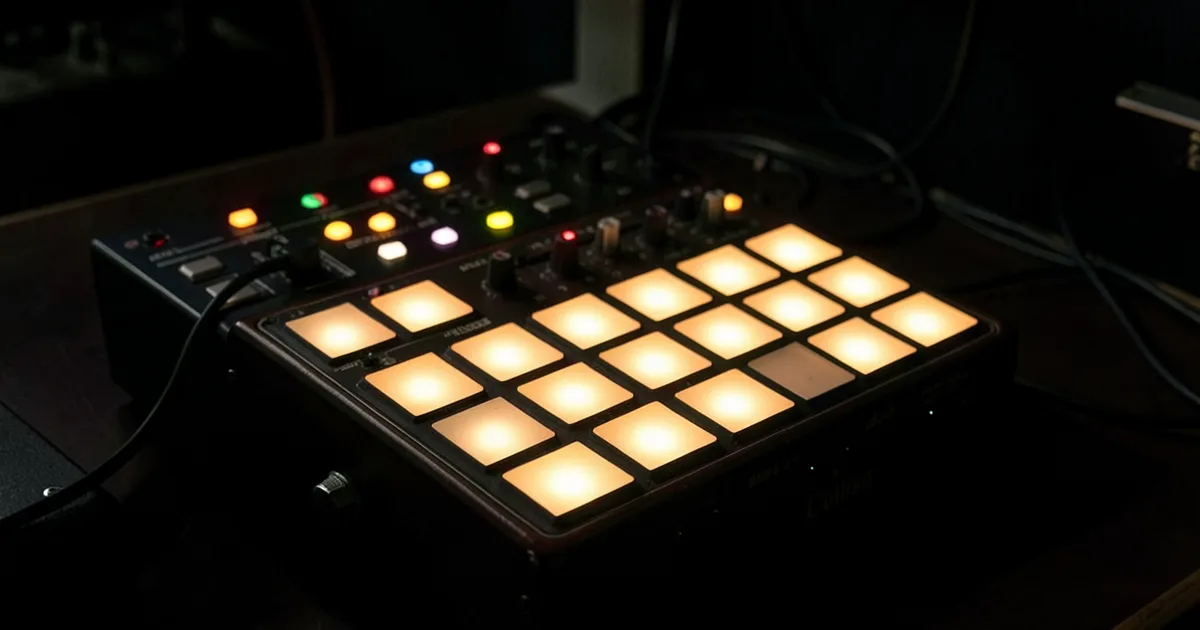
Drum machine sampler plugins let you trigger, sequence, and shape drum sounds entirely inside your DAW, combining sample playback with synthesis controls so you can build beats from scratch without touching hardware. The best ones for most producers are Battery 4 for deep sample manipulation, Superior Drummer 3 for acoustic realism, and XO by XLN Audio for AI-assisted pattern discovery.
Drum machine sampler plugins are the single fastest way to get professional-sounding drums into your mix, whether you're building a trap banger at 2am or a live-feeling jazz-brush kit for a podcast intro.
The category has exploded. You've got acoustic drum emulators chasing mic bleed and room sound, electronic beat machines with per-step synthesis, AI tools that suggest patterns based on your existing groove, and free options that genuinely hold up.
Picking wrong costs you time, money, and (if you're on an older machine) CPU headroom you can't spare. So we've broken down exactly how these tools work, what separates the good from the frustrating, and which direction you should go based on what you actually make.
We'll cover acoustic vs. electronic, deep-sampler vs. performance plugin, AI-assisted tools, CPU reality on low-spec machines, and the free tier that's better than it should be.
What Actually Is a Drum Machine Sampler Plugin?
A drum machine sampler plugin does two things in one interface: it stores audio samples (kicks, snares, hats, percussion) and plays them back triggered by MIDI, while giving you per-pad controls to shape the sound after the sample fires.
That "after" part is where the magic is. A basic sampler just plays the file. A drum machine sampler lets you cut the attack so the click hits harder, stretch the tail to push the room sound deeper, layer two samples so they trigger simultaneously, and run each pad through its own filter, envelope, and pitch controls.
Sampler vs. Synthesizer vs. Hybrid
Pure samplers (Battery 4, Sitala) play back audio files. Pure synthesizers generate drums from oscillators and noise (Sonic Academy Kick 2 for kicks specifically). Hybrids do both, and that's where most of the interesting tools live right now.
XLN Audio's Addictive Drums 2 layers real samples with a transient shaper built into each kit piece. Toontrack's Superior Drummer 3 goes further: it runs a full mix engine so you're blending multi-mic room samples, not just triggering single hits. Steven Slate Drums 5 uses a similar multi-mic model for $149 versus Superior's $399.
For electronic production, Arturia DrumBrute Impact's plugin counterpart or Native Instruments' Maschine software handle synthesis-based sound design alongside sampler duties. These let you modulate pitch, waveshape, and distortion per step in the sequencer.
How Do the Sequencers Actually Differ?
The sequencer is where you spend 80% of your time, and the differences between them are frustrating when you pick the wrong one.
A basic step sequencer gives you 16 buttons per row. Click the ones you want. Done. That's what you get with Sitala (priced at $20) and most entry-level tools. It works. It's fast. It's also the ceiling.
Step Sequencers with Probability and Randomisation
Playbeat by Audiomodern adds probability controls per step. Set a hi-hat step to 60% and it fires randomly on about 6 in 10 passes, giving you a humanised pattern without drawing automation. We ran a two-bar loop through it and had a convincing brushed-snare feel in under three minutes. That's the satisfying kind of efficiency.
Atlas 2 by Algonaut takes a different approach. It analyses your sample library, clusters sounds by timbre using a neural network, and maps them visually so sonically similar kicks end up near each other on screen. When you're searching 2,000 samples for the right thwack, that's not a gimmick. It's a 20-minute time save.
Piano-Roll vs. Step Programming
Tools like Superior Drummer 3 and EZ Drummer 3 lean into MIDI drag-and-drop. You get pre-built grooves from real drummers, and you drag them onto your DAW timeline. EZ Drummer 3 costs $99. It's the honest choice for producers who want realistic drums quickly without a steep learning curve.
The love/hate split here is real. Producers who came up on hardware step sequencers find piano-roll drum editing annoying. Producers coming from a songwriting background find step sequencers counterintuitive. Know which camp you're in before you spend money.
What Does CPU Performance Actually Look Like on Low-Spec Machines?
This is the gap nobody talks about honestly, so we will.
Superior Drummer 3's 230GB library streams from disk, which means your CPU stays relatively light (around 3-8% on a modern machine) but your drive speed matters enormously. On a 5400RPM spinning drive, you'll hit buffer issues mid-playback. On an NVMe SSD, it's flawless.
Battery 4 loads samples into RAM. A fully loaded kit with 8 velocity layers per pad can eat 800MB to 2GB of RAM depending on how many samples you've pre-cached. On a machine with 8GB total RAM running a DAW and a few other plugins, that's tight.
The Lightweight Options Worth Knowing
Sitala is brilliant for low-spec machines. It's a 16-pad sampler with basic envelope and filter controls per pad, and it runs so lean we've had it open on a 2013 MacBook alongside 14 other plugins without a spike. $20. No subscription.
Decent Sampler (free, open source) handles community-built drum kits distributed as .dspreset files. The CPU footprint is minimal. The Bedroom Producers Blog community has built hundreds of free kits for it, including vintage drum machine emulations that genuinely hold up in a mix.
API Drums (released 2025, free) takes a different angle: it models the analogue processing chain of an API console rather than the drums themselves. Drop your own samples in, run them through the modelled summing bus, and they suddenly sit in the mix with that mid-forward, slightly compressed character. Underrated. Genuinely.
Acoustic Realism vs. Electronic Creativity: Which Direction Is Yours?
This is the fundamental split in the category, and you need to pick a lane before you shop.
If you're producing rock, jazz, country, pop, or anything that needs to sound like a human hit a drum in a room: Superior Drummer 3, EZ Drummer 3, Addictive Drums 2, Steven Slate Drums 5, or GetGood Drums Modern & Massive. All of these use multi-microphone sample libraries. They're built around that acoustic-room feel.
For Acoustic Drums: What Separates the Top Tier
Superior Drummer 3 wins on raw depth. 230GB, multi-mic bleed between kit pieces, a full mixing engine inside the plugin. You can spend an hour just dialling in the overhead placement. That's overkill for most, and at $399 it should be your last drum plugin purchase, not your first.
EZ Drummer 3 at $99 covers 90% of what Superior does for normal songwriting use. The remaining 10% is deep bleed control and custom room mic positioning. If you're not recording a live band and mixing their kit against yours, you don't need it.
Addictive Drums 2 at $149 has the best per-kit-piece transient control in the acoustic tier. We pulled up a snare, cut 4dB of body around 250Hz, added 2dB of crack at 3kHz, and tightened the decay to 180ms. It sat in the mix immediately without needing a separate transient shaper on the bus.
For Electronic Drums: Where the Hybrids Win
Battery 4 with its 7,000+ samples and 143+ kits is the librarian's dream. Every pad gets an independent envelope with attack, hold, decay, sustain, and release, plus a built-in filter, saturation, and pitch LFO. It's complex. We'd be lying if we said the learning curve isn't annoying at first.
XO by XLN Audio maps your sample library into a galaxy-style visual browser where each dot is a kick, snare, or hat clustered near sounds that share harmonic content. We dropped 3,000 samples in, searched for "punchy kick with tail under 400ms," and it surfaced 40 usable options in seconds. Clever in a way that changes how you work.
Playbeat 3 is the experimental pick. It generates patterns using probability and algorithmic rules, and you can export MIDI or audio. It's not built for people who know exactly what rhythm they want. It's built for people who want to be surprised.
What Should Beginners Prioritise vs. Professionals?
Beginners need fast results and low frustration. Professionals need deep control and integration.
If you're six months in: EZ Drummer 3, Sitala, or the free Decent Sampler with a community kit pack. All three get you to a usable beat in under 10 minutes. EZ Drummer 3 includes MIDI grooves from real sessions, so you can drag a real-feel groove onto your track and focus on arrangement instead of drum programming.
If you're two years in and mixing full tracks: Addictive Drums 2 or Battery 4. Both reward the time investment in understanding gain staging per pad, send routing to parallel compression buses, and tuning each hit to sit in your specific mix.
The Workflow Optimisation Nobody Mentions
Most producers use their drum plugin's internal mixer wrong. They route everything to a stereo out and then try to shape the mix externally. Every serious drum plugin from Addictive Drums 2 upward supports multi-out routing, meaning your kick, snare, overheads, and room mics each land on separate tracks in your DAW.
We run our kick to a dedicated bus, chain an 1176-style compressor at 4:1 with a fast attack (1ms), and blend in 30% parallel signal from a copy hitting an API 2500 emulation. That separation is only possible if your plugin supports multi-out. Check before you buy.
For ADSR Drum Machine specifically: 50+ kits and 800+ patterns make it a legitimate pattern-first tool. You pick a style, browse patterns, and drag what you like. It's more like a library browser than a deep sound-design tool, and that's not a criticism. Sometimes you need beats fast, not flexibility deep.
Worth Bookmarking
- Battery 4 by Native Instruments, the deep-sampler standard
- Superior Drummer 3 by Toontrack, acoustic realism at the top tier
- EZ Drummer 3 by Toontrack, the smarter entry point for acoustic kits
- Addictive Drums 2 by XLN Audio, best transient control in the acoustic tier
- XO by XLN Audio, AI-assisted sample discovery for electronic producers
- Playbeat 3 by Audiomodern, algorithmic pattern generation with probability per step
- Atlas 2 by Algonaut, neural-network sample clustering for large libraries
- Sitala by Decomposer, $20, CPU-lean, genuinely great for low-spec machines
- Decent Sampler, free, open, with a huge community kit library
- Steven Slate Drums 5, $149 acoustic alternative with multi-mic depth
Summary
Drum machine sampler plugins split cleanly into two worlds: acoustic realism and electronic creativity. For acoustic, EZ Drummer 3 at $99 is the honest starting point, Superior Drummer 3 is the ceiling. For electronic, Battery 4 handles deep sample manipulation, XO handles fast AI-assisted browsing, and Playbeat handles generative experimentation. On low-spec machines, Sitala and Decent Sampler are the honest answers. Use multi-out routing. Gain stage per pad. And don't buy a 230GB plugin if you're running a 5400RPM drive.
Part of our complete Music Production Plugins Guide: Complete Beginner's Overview series.
Frequently Asked Questions
What's the difference between a drum sampler and a drum synthesizer plugin?
A drum sampler plays back recorded audio files triggered by MIDI. A drum synthesizer generates drum sounds from oscillators, noise generators, and filters without using pre-recorded samples. Most modern plugins are hybrids: they start with a sample and then give you synthesis controls (pitch, filter, distortion) to reshape it after it fires.
Can I use my own samples in these plugins?
Most allow custom sample import. Battery 4, Sitala, Decent Sampler, Atlas 2, and XO all accept standard audio files (WAV, AIFF). Acoustic-focused plugins like Superior Drummer 3 and EZ Drummer 3 are more closed, meaning their sound engines are built around their proprietary libraries and don't support drag-in replacement at the kit-piece level.
Which drum machine plugin uses the least CPU?
Sitala is the leanest paid option we've tested, followed closely by Decent Sampler. Both load samples into RAM and add minimal processing overhead. Superior Drummer 3 streams from disk, so its CPU usage is low but it demands fast storage. Battery 4's CPU load scales with how many samples you've pre-cached and how many effects you're running per pad.
Do I need a drum plugin if my DAW has a built-in sampler?
Your DAW's built-in sampler (Ableton's Drum Rack, Logic's Drum Machine Designer) handles basic triggering fine. Dedicated drum plugins earn their place when you need multi-velocity layers, built-in groove quantise, per-pad parallel routing, or AI-assisted pattern discovery. If you're past the point where your current tool is slowing you down, that's when to upgrade.
What VST/AU/AAX formats do these plugins support?
The major paid plugins (Battery 4, Superior Drummer 3, EZ Drummer 3, Addictive Drums 2, Steven Slate Drums 5) all support VST3, AU, and AAX, covering Ableton, Logic, Pro Tools, Cubase, and Studio One. Decent Sampler and Sitala support VST and AU. Always check AAX compatibility specifically if you're on Pro Tools before purchasing.
Are there drum machine plugins with AI features worth using?
Three stand out right now. Atlas 2 uses neural-network clustering to group your samples by sonic similarity, which saves real time when searching large libraries. XO does something similar with a visual galaxy browser. Playbeat generates patterns using probability algorithms per step, which produces humanised, non-repeating grooves without manual automation. These aren't novelty features. They change how fast you can work.