
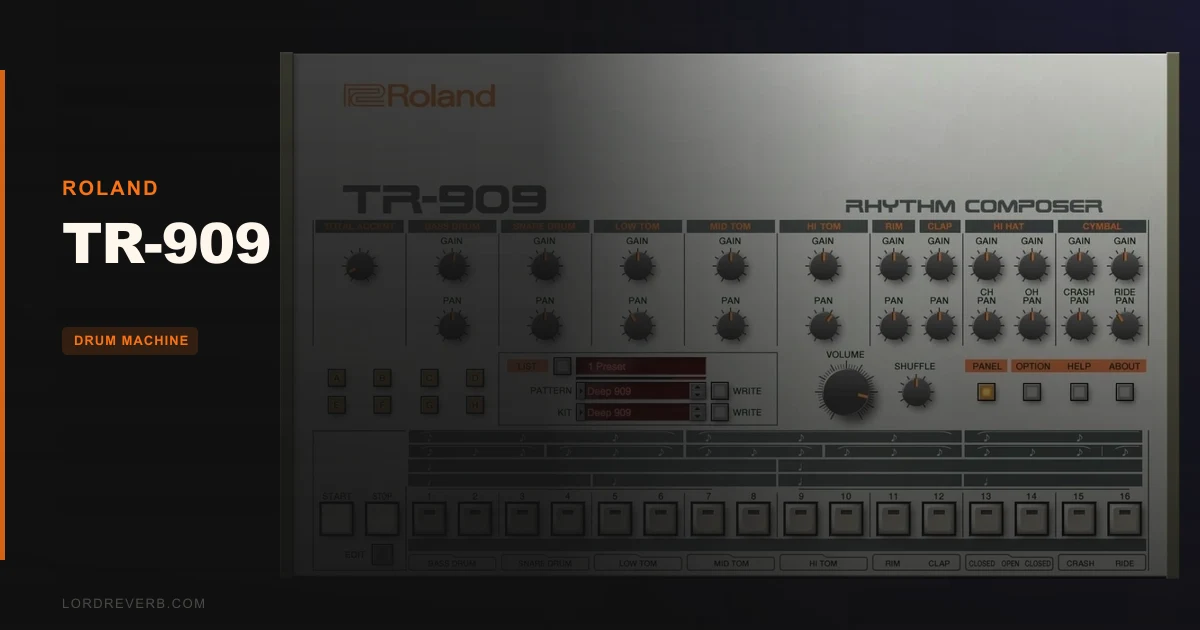
The honest answer to whether this TR-909 plugin is worth it depends entirely on one thing: how much the real 909 character actually matters to you. If you're after a modern drum plugin that sounds huge and loads fast, there are cheaper paths. If you want ACB circuit modeling built from the original 909's ROM, with Roland's own sequencer logic rebuilt for the DAW, the picture shifts. At $149, it's a defensible choice for the right producer and a frustrating one for everyone else.
The snare is the first conversation you need to have with yourself. Some owners love it. Others find it synthetic and thin compared to what the price implies. That split in the room is real, and it matters before you spend anything.
The Catch Up Front
The snare problem is the loudest complaint owners raise. Some describe it as synthetic and underwhelming, inconsistent in a way that feels odd given what the hardware version costs secondhand. That's not a dealbreaker for everyone, but if snare character is 70% of why you're buying a 909 plugin, you need to hear this one before you commit.
Beyond the snare, advanced sequencer functions like pattern copying aren't intuitive. You'll be in the manual for those. It's annoying, especially at $149, when competitors have figured out how to put that logic somewhere visible.
Some users also argue flatly that modern alternatives do enough of what this does for less money. That's a real position. We'll get to the specifics in the comparisons section.
What You Get If You Clear It
ACB, Roland's Analog Circuit Behavior technology, models the actual circuit path of the original 909. The kick, snare, clap, and toms were analog on the hardware. The cymbals were sampled. This plugin replicates that hybrid architecture, using the original sample ROM for the digital components and circuit modeling for the analog ones.
The sequencer is modernized but faithful to the 909's logic. Each instrument gets its own lane. You get adjustable flams, sub-steps, soft hits, last step per instrument, and shuffle. Eight pattern variations per kit let you build parts that evolve across a track rather than loop robotically.
Drag and drop lets you pull audio or MIDI patterns straight into your DAW. If you own a TR-8S or TR-09, patterns transfer directly between hardware and plugin. That integration is a real workflow advantage if you work across both.
Formats covered: VST3, AU, and AAX, with native Apple silicon support.
Where It Shines
The kick is where owners stop complaining. Push the drive control and the low end gets physical in a way that sits differently from most sampled 909 kicks. Owners specifically describe the bass drum as making spines tingle. That's not a phrase people reach for when they're describing a mediocre sample.
At 138 BPM in a techno context, the 909 kick sits well under a sub with the overdrive dialed up slightly, delivering controlled grit that doesn't blur into the low end. That's what it's built for, and that's where it delivers.
The hi-hats and clap also draw consistent praise from owners. The clap especially. 909 claps have a snap and a spread that's become a genre-defining sound in house and techno, and owners report that character translates well here.
The hardware integration is clever. If you're in a session and you've built something on a TR-8S, transferring that pattern into the plugin without re-programming is a real time saver. Few competitors offer that.
Against the Field
The Roland Boutique TR-09 is a physical alternative, not a plugin. It's compact, more affordable, and captures the original sound and workflow in a portable format. If you want hardware in a small footprint without the full 909 price, the TR-09 is the honest comparison. The plugin wins if you need DAW integration and don't want another piece of kit on the desk.
The Roland Cloud TR-909 is circuit-modeled and comes with a matching sequencer. It's the closest digital sibling. Worth checking whether that subscription model sits better with your budget than a one-time purchase at $149.
The RD9 comes up consistently in owner discussions. Some users find it replaces enough of what this plugin does to make the price gap meaningful. It's a newer model, and for producers who aren't emotionally invested in the Roland lineage, it's worth auditioning.
The Linn LM-1, historically, had limited programming and stored only 12 sounds. The 909 offered more options and sound storage. That gap doesn't apply to modern software comparisons, but it's part of why the 909 became the production standard it did.
Who Should Buy This
- ✅ Buy if you produce techno, house, or acid and the authentic 909 kick and clap character is a core part of your sound identity.
- ✅ Buy if you own a TR-8S or TR-09 and want seamless pattern transfer between hardware and your DAW.
- ✅ Buy if VST3, AU, and AAX support with native Apple silicon matters to your current setup.
- ❌ Skip if the snare is load-bearing for your productions. The complaints around it are consistent enough to take seriously.
- ❌ Skip if you need advanced sequencer functions to be discoverable without reading a manual. This one will frustrate you.
- ❌ Skip if you're price-sensitive and open to modern alternatives. The RD9 and others compete hard at this level.
Specs & Technical Details
| Developer | Roland |
| Price | $149 |
| Plugin Format | VST3 / AU / AAX |
| OS Support | Mac / Windows |
| Activation | N/A |
| CPU Usage | N/A |
| Trial Available | N/A |
| Version Reviewed | N/A |
Score Breakdown
| Category | Score | Notes |
|---|---|---|
| Sound Quality | N/A | Kick, hats, and clap are strong; snare divides owners and that split is real |
| Value for Money | 3.0/5 | At $149, competing options with fewer complaints make this a harder sell |
| Ease of Use | 3.0/5 | Basic sequencing is clean; advanced functions require manual consultation |
| Features | 4.0/5 | Per-instrument lanes, 8 pattern variations, drag-and-drop, hardware integration |
| CPU Efficiency | N/A | Not reported in available data |
| Overall | 3.5/5 | Brilliant in the right context, overpriced and uneven outside it |
Alternatives to Consider
Roland Cloud TR-909 is the subscription-model sibling. Circuit-modeled with a matching sequencer. If you already pay for Roland Cloud, check whether this overlaps enough to make the standalone purchase redundant.
Roland Boutique TR-09 goes in a different direction entirely: physical hardware in a compact format, more affordable, and built to capture the original sound and workflow. If you want something tactile and don't need deep DAW integration, the TR-09 is a legitimate alternative worth pricing up against this plugin.
RD9 keeps appearing in owner discussions as a replacement option. Some users argue it delivers enough of the core 909 character to make the price premium here hard to justify. If you're not committed to the Roland name, it deserves a listen before you decide.
The honest verdict: this plugin is satisfying if the kick, the clap, and the Roland hardware workflow are what you're buying. It's a frustrating spend if you need a great snare or intuitive pattern management. At $149, it earns its place for the producer who already lives in the 909's world. For everyone else, the alternatives are genuinely competitive enough that "just get the Roland" isn't the automatic answer it used to be.
Frequently Asked Questions
Is the TR-909 plugin an exact copy of the original hardware?
It uses ACB technology, which models the analog circuitry of the original hardware, combined with the actual sample ROM the 909 used for its cymbals. Roland describes the original 909 as a hybrid machine: analog circuits for kick, snare, clap, and toms, and digital samples for the cymbal sounds. The plugin replicates that same architecture rather than replacing everything with samples.
Does the TR-909 plugin work with Apple silicon Macs?
Yes. The plugin has native Apple silicon compatibility confirmed. It runs in VST3, AU, and AAX formats, so it covers the main DAWs on both Mac and Windows.
Can I use my TR-8S hardware with this plugin?
Yes, and that integration is one of the more useful features here. You can transfer patterns from a TR-8S directly into the plugin, and the TR-8S or TR-09 can be used as a hardware controller for it. If you already own either piece of hardware, that connection is worth factoring into your decision.
Why do some owners complain about the snare?
A consistent thread in owner reports describes the snare as synthetic and underwhelming relative to the price. The original TR-909 snare has a specific crack and body that became iconic in house and techno. Some users find this plugin doesn't fully deliver that character, though others disagree. It's the most divided opinion in the ownership community and worth auditioning specifically before buying.
How does the TR-909 plugin compare to the Roland Cloud version?
Both use circuit modeling and include a sequencer matched to the 909's original logic. The Roland Cloud TR-909 is available through Roland's subscription service. If you already subscribe to Roland Cloud, the overlap between the two is worth checking before buying the standalone plugin at $149.