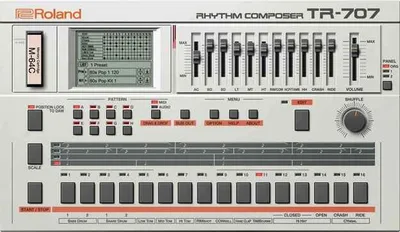
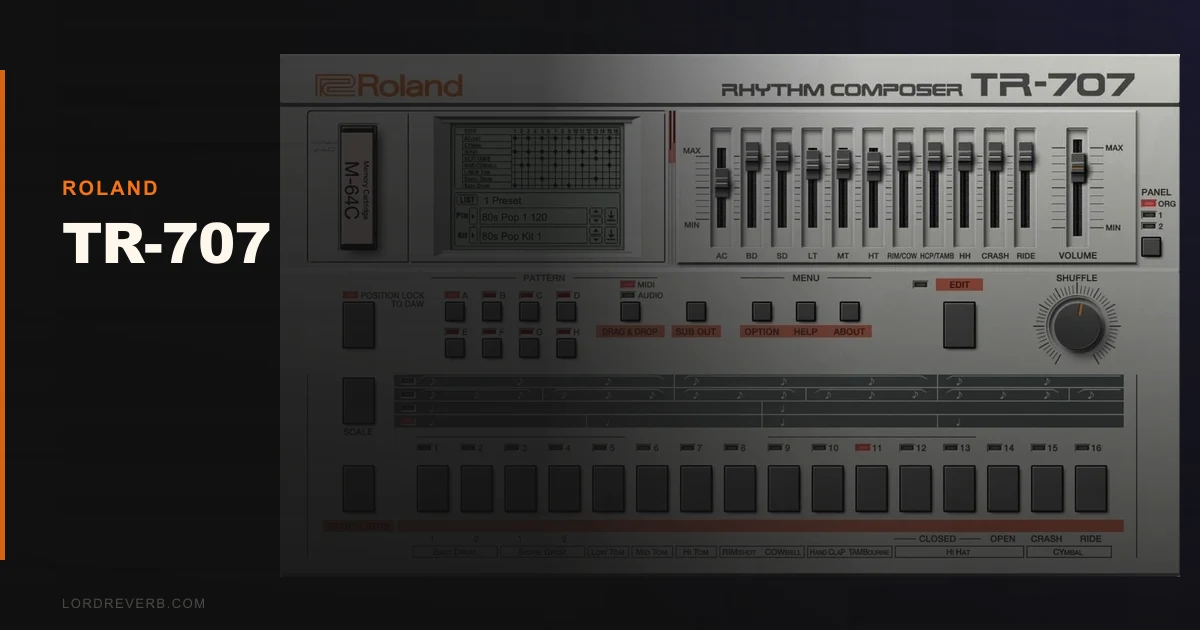
The Roland TR-707 is a legitimate piece of music history, and for most producers in 2026, that history is the only reason to buy one.
That’s not shade. It’s context. The TR-707 came out in 1985, lived until 1989, and left a fingerprint on early Chicago house that you can still hear today. But it shipped with one serious compromise baked in: you can only adjust the volume of each drum voice. Not pitch. Not decay. Just volume. That single limitation defines everything about this machine, and whether you can live with it determines whether you should buy one.
We’ve spent time with both the hardware and the Roland Cloud software emulation. Here’s the honest read.
What You're Actually Getting
The TR-707 is the first Roland drum machine to use exclusively sampled sounds rather than analogue synthesis. It runs on an 8-bit CPU managing 10 channels of polyphony across 15 drum voices.
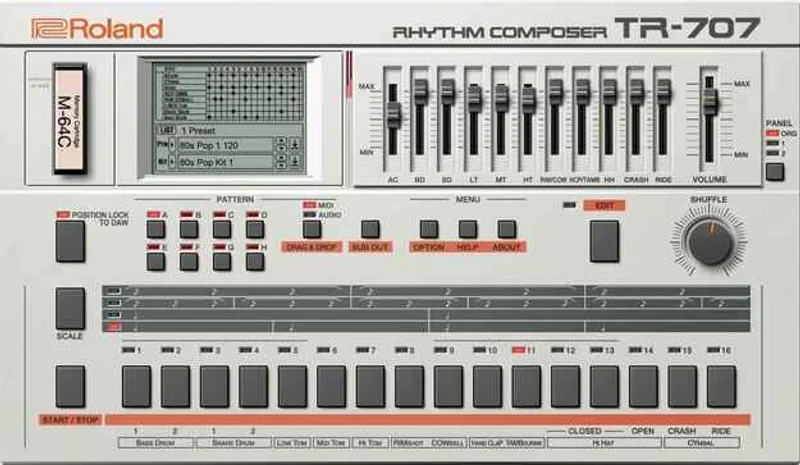
Those voices cover the standard kit: kick, snare, low/mid/high toms, rimshot, handclap, cowbell, tambourine, closed hat, open hat, crash, and ride. Each sits on its own individual output, which is genuinely useful in a recording context.
Programming happens via a step sequencer. You get 64 patterns split across 4 groups of 16, tempo range from 38 to 250 BPM, and song mode that handles 4 tracks up to 998 bars. The matrix LCD display still works fine decades on. MIDI in/out and DIN sync are both present.
It’s a complete, functional drum machine. Just don’t expect to sculpt sounds.
The Good
The individual outputs are the killer feature. We routed each voice to a separate channel in the DAW, pushed the kick through a Neve-style preamp emulation, and the low-end thickened up exactly the way you’d want. The 707 sounds thin from its stereo mix bus. Split it out and it breathes.
The step sequencer is satisfying to use in a way that most software recreations don’t quite nail. Entering patterns on the physical grid, shifting tempo in real time, dropping in a flam on the snare at step 9: there’s a directness to it that keeps you working fast instead of clicking around menus.
Shuffle feels right. Set it around 54-58% and the hi-hats swing in that loose, early-house way. That’s not nostalgia. That’s why the machine ended up on so many records.
The snare and hi-hat character genuinely sits closer to TR-909 territory than the price suggests. We ran a 707 hat pattern alongside a 909 reference. The frequencies were tighter on the 707 but the rhythmic feel tracked. For house and early techno, it works.
The Not-So-Good
Volume-only editing is frustrating. Full stop.
You can’t shorten the kick decay. You can’t pitch the snare up a semitone to cut through a dense mix. You can’t tighten the open hat tail when it’s clashing with a pad. Every tweak that matters sonically requires either external processing or a hardware modification.
That forces you into a specific workflow: treat the 707 as a fixed-sound machine and shape everything in the mix. That’s workable. It is also annoying when you are used to the kind of per-voice control you get on even a budget software drum machine.
The 8-bit samples show their age on headphones. The kick lacks sub weight below 60Hz. The cymbals have a crispness that tips into thin in modern high-resolution contexts. You’ll want to layer a 707 kick with something that has actual low-end mass.
At its current second-hand price, you are paying a heritage tax. The sound quality alone doesn’t justify that number.
Compared to the Alternatives
The TR-808 costs three to four times more on the vintage market and offers analogue synthesis per voice. Decay, tune, tone: all adjustable. If sound sculpting matters to you, the 808 wins by a large margin. It’s just a different budget conversation.
The TR-909 sits in a similar price bracket to the 707 on the high end, runs analogue synthesis for kick, snare, and toms, and has the same legendary house and techno credentials. If you can find one close to 707 pricing, take it.
The Roland Cloud TR-707 software emulation adds pitch and decay control that the hardware doesn’t have. It costs a fraction of the hardware. If you’re after the 707 sound ITB with actual editing flexibility, the plugin version is the smarter buy and we’d point you toward the full breakdown of Roland Cloud drum machine options before spending hardware money.
The Behringer RD-9 covers 909 territory at a lower price. The Arturia DrumBrute Impact gives you full analogue synthesis at a lower price. Both offer more hands-on sound control than the 707 hardware
Who Should Buy This
✅ Buy if you’re a collector and the TR-707’s specific place in house music history matters to you as an object, not just a tool.
✅ Buy if you have a hardware rig with DIN sync or MIDI and want a dedicated pattern-based drum machine that integrates without a computer.
✅ Buy if you’ve already auditioned the Roland Cloud version and specifically want the physical grid and hardware feel.
❌ Skip if you expect to sculpt drum sounds. You’ll hit the volume-only wall inside the first session.
❌ Skip if you’re on a budget and just want 707-style sounds. The plugin emulation exists and costs dramatically less.
❌ Skip if modern production is your context. The 8-bit character adds grit but also limits where this sits in a mix without significant processing.
Score Breakdown
| Category | Score | Notes |
|---|---|---|
| Sound Quality | 3.0/5 | 8-bit samples are thin at source; individual outputs save the session |
| Value for Money | 2.5/5 | Volume-only sound editing is a hard sell in 2026 at the going rate. |
| Ease of Use | 4.0/5 | Step sequencer grid is brilliantly fast and direct to program |
| Features | 3.0/5 | Pattern memory and song mode are solid; sound editing is brutally limited |
| CPU Efficiency | 5.0/5 | It's hardware. Zero CPU. |
| Overall | 3.8/5 | Love the history, hate the pricing relative to what the hardware can actually do |
Alternatives to Consider
If you want TR-707 sounds with proper per-voice editing, the Roland Cloud TR-707 plugin is the answer. Pitch, decay, tune: all there. Check our Roland Cloud drum machine plugin guide for a full comparison against the hardware.
The Arturia BeatStep Pro paired with a software drum sampler gives you the physical step sequencer feel at a lower price point and gives you total sound control in the box. It's a different workflow, but a clever one.
If the TR-909 sound is actually what you're after, read our complete drum machine and sampler plugin guide before committing to either piece of hardware. There are software emulations that get you 90% of the character at 10% of the cost.
The Behringer RD-8 MK2 covers TR-808 territory with full analogue synthesis, hands-on controls, and a current retail price that's a fraction of original hardware. If you're starting a hardware rig from scratch, that's where we'd look first.
The TR-707 is worth owning if you love the artefact. As a production tool in 2026, better options exist at every price point. If you're buying one, go in with both eyes open about the editing limitations, plan to use individual outputs into your interface, and budget for the processing you'll need to give it weight in a modern mix.
Frequently Asked Questions
Is the TR-707 worth buying in 2026?
For collectors and hardware enthusiasts, yes. For producers who want the TR-707 sound in a DAW, the Roland Cloud emulation is a smarter buy. The hardware is found used with volume-only sound editing, which is a serious limitation at that price. Know what you're paying for before you commit.
How does the TR-707 compare to the TR-909?
The 909 uses analogue synthesis for kick, snare, and toms, which gives you real-time control over decay and tune per voice. The 707 uses 8-bit samples with volume-only adjustment. The 909's sounds are punchier and more flexible to shape. The 707 is typically cheaper, but the gap between them in sound-editing capability is significant.
Can you use the TR-707 with modern DAWs?
Yes. The TR-707 has MIDI in/out, so it syncs with any DAW via MIDI clock. Each drum voice has its own individual output, so you can route each voice to a separate audio interface input and record them on separate tracks. You'll need an interface with enough inputs to take full advantage, but the routing works cleanly.
What is the Roland Cloud TR-707 and is it better than the hardware?
The Roland Cloud TR-707 is a software emulation that adds per-voice pitch and decay control that the original hardware lacks. For ITB production, it's more flexible and costs a fraction of the hardware price. If the physical grid and the hardware experience aren't important to you, the software version gives you more creative control. Check Roland's site for current subscription and perpetual licence pricing.