If you already own any UJAM product, the KAYA loyalty upgrade at $39 is an easy yes for Afrofusion drums. Skip it only if West African rhythms aren’t on your roadmap.
Eligibility is wide open. Any current UJAM product owner qualifies, and that’s the whole gate.
What you get is a drum machine built around afrobeat, amapiano and the intersecting rhythms of West African genres. It isn’t a general-purpose kit. That focus is both its pitch and its limit.
We haven’t put hands on it, so we won’t pretend this is a hands-on report. What follows is built from UJAM’s own description and what owners and reviewers say. The picture is consistent: ready-made beats, an easy layout, and sounds that feel authentic.
Who it’s for: producers who keep getting asked for afro house, afrobeat or amapiano grooves and don’t want to chop samples for an hour first.
What You Are Upgrading To
KAYA is UJAM’s rhythm engine for Afrofusion. The developer is clear that it’s not just an electronic drum plug-in. It’s built around the grooves and sounds of West African styles, from afrobeat to amapiano drum patterns.
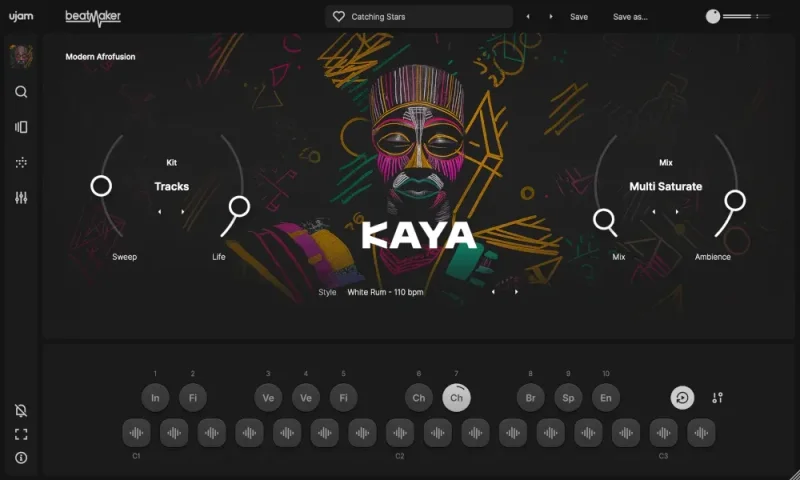
Inside: 10 drum kits with 16 instruments each, 20 Styles with 23 beats each, 12 Mix Modes, a control called Life, 75 Global Presets and 17 ambience and reverb effects. There’s also a built-in library of rhythmic patterns.
That’s a lot of ready material for one plugin.
What changes versus what you already own? Honestly, our material doesn’t spell out how the loyalty version differs from the full KAYA product. Check the product page before you buy and look for any listed differences. Nothing we’ve seen suggests a stripped-down version, but we can’t confirm it either.
Who Qualifies
Any current UJAM product owner qualifies. Not just Beatmaker owners. Any UJAM title in your account opens the loyalty route.
There’s one related perk worth knowing. A current Beatmaker purchase or upgrade automatically updates your owned Beatmaker titles to the new plugin. That’s separate from KAYA, but if you’ve got Beatmaker products, it’s a nice bit of housekeeping that costs you nothing extra.
If you own nothing from UJAM, this route isn’t for you. You’d be looking at the full product instead.
The Kits: 10 Sets, 16 Instruments Each
Start with the drum kits, because everything else rides on them. Ten kits, sixteen instruments apiece, so 160 individual sounds to build from.
UJAM describes them as a curated collection of drum sounds designed to be authentic. Reviewers back that up. One noted it filled a void in their sample collection, and another described authentic afrobeat sounds.
That’s the claim that matters most in this category. A drum plugin lives or dies on whether the kit sounds like the genre or like a Western kit wearing a costume.
Here’s the scene. You’ve got a half-built groove and the percussion layer feels stiff. Swap kits instead of swapping your whole arrangement. Sixteen instruments per kit means you can audition a full voicing in seconds.
We can’t tell you the sample depth, velocity layers or round-robin count, because none of that is in our material. Ask for those details before buying if layering is critical to you.
Styles and Beats: 460 MIDI Loops
This is the engine room. Twenty Styles, each holding 23 beats, for 460 MIDI loops in total.
MIDI matters here. You’re not locked into audio loops. Drag a pattern out, change the kit, nudge the notes, and the groove still belongs to you.
The developer says the patterns span afrobeat through amapiano. That’s a wide stretch of tempo and feel, and a good reason to own a dedicated tool rather than hunting for one-off loop packs.
Picture the usual dead end. You’ve got a bassline and a vocal idea, but the drums sound like a trap beat when the track wants something looser. Scroll the Styles, audition beats against your bass, and one of 460 patterns will probably get you moving.
Probably. We haven’t heard them in context, and we won’t claim to.
One honest gripe in advance: a big pattern library can turn into a time sink. Four hundred and sixty loops is plenty of rope. Pick a Style, commit, and work the groove.
Mix Modes and Life: The Fast-Start Controls
KAYA ships with 12 Mix Modes to kickstart projects. Think of them as pre-set mix personalities for the whole kit, so the drums arrive already sounding like a track instead of a pile of raw hits.
Then there’s Life. UJAM gives it a dedicated control, and the name tells you the intent: make the pattern feel less like a grid and more like a player. Our material doesn’t detail exactly what Life changes under the hood, so we won’t guess at the mechanics.
Here’s how to use it anyway. Start a beat, listen for that stiff, copy-paste feel, and push Life up slowly while the loop runs. If it’s doing what the name suggests, you’ll hear the groove loosen. Stop where it feels played, not sloppy.
We love controls like this in principle. One knob that fixes the biggest complaint about programmed drums is a clever idea. Whether KAYA’s version earns that praise is something you should check yourself on a loop you know well.
Presets and Ambience: 75 Presets, 17 Effects
The 75 Global Presets are your quickest route to a finished sound. Load one, play the pattern, decide if it’s close.
The 17 ambience and reverb effects handle the space around the drums. Seventeen is a decent menu for a drum plugin, enough to put a kit in a tight room or push it somewhere wide.
Here’s the scene. Your drums sound fine solo but flat against the vocal. Reach for an ambience effect before you reach for a separate reverb plugin, and see whether the built-in space gets you there. If it does, that’s one fewer insert and one fewer CPU hit.
Our material doesn’t describe the reverb algorithms, decay ranges or modulation. So we can’t tell you whether these tails are lush or merely fine. Audition them against your own mix.
Ease of Use and Workflow
Owners keep returning to one point: it’s easy to use. They report that all options are easily accessible and laid out in what one called a wonderful GUI.
That matters more than people admit. A drum machine that hides its Styles behind menu diving kills momentum. One where kits, beats and mix controls sit in view keeps you in the groove.
Owners also report ready-made beats of really high quality. Combine that with the MIDI loops and you can go from empty project to playable groove fast.
We’ll say it plainly. We haven’t verified the layout ourselves, so treat this as owner-reported, not tested by us. But the report is consistent, and “easy and fun” is a recurring theme. One reviewer called it a fun VSTi with African vibes. We’d love every plugin to earn that line.
Compatibility and Formats
Supported formats are VST 2, AAX, AU 2 and VST 3. That covers the major hosts.
On the Mac side, KAYA runs on Intel Macs and on Apple silicon, with both Rosetta and native support. If you’re on a recent M-series machine, you’re covered without workarounds.
What’s missing: CPU requirements and detailed technical specs. Our material gives none. If you’re on an older laptop or running big sessions, look for the minimum system requirements on the product page first. Nothing we’ve seen suggests trouble, but “nothing suggests trouble” isn’t a spec sheet.
The Value Case
At $39, you’re paying a loyalty price for a purpose-built Afrofusion rhythm engine. That’s 160 instrument sounds, 460 MIDI loops, 12 Mix Modes, 75 presets and 17 ambience effects in one plugin.
Count what you’d otherwise chase. Percussion samples. Pattern packs. A reverb for the kit. A handful of MIDI grooves. KAYA bundles the lot, and bundling is where the value sits.
The catch is that the value depends entirely on your taste. If afrobeat and amapiano are core to what you make, $39 is a bargain. If they’re a one-off curiosity, it’s a nice toy.
And the loyalty discount only makes sense because you already own a UJAM product. That’s the deal. You’ve already shown you like their workflow.
Who Should Buy It, By User Type
The Working Producer
You get requests for afro house or afrobeat drums and deadlines to match. KAYA gives you authentic kits and ready MIDI patterns so you start from a groove, not a blank grid. Buy it.
The Beginner
You want a beat that sounds right without learning West African rhythm theory first. The presets, Mix Modes and easy layout are built for exactly this. Buy it, as long as you already own a UJAM title to qualify.
The Songwriter Adding Rhythm
The developer says KAYA works for adding afrobeat rhythms to broader projects, not just full afro house tracks. If you want a groove under a pop or R&B idea, it’ll do that. Buy it if the sound fits your style, wait if you’re only curious.
The Drum Programmer Who Wants Total Control
If you build every hit by hand from your own samples, a pattern-led plugin may feel like a shortcut you don’t need. The MIDI loops help, but you may prefer your own sampler. Wait, and check the demos first.
Who Should Skip It
Skip it if you own no UJAM product. The loyalty route simply isn’t open to you.
Skip it if you rarely touch Afrofusion. KAYA is built for West African-influenced rhythms, and nothing in our material suggests it doubles as an all-round drum plugin.
Skip it if you need hard numbers before buying. CPU figures and technical detail aren’t in our material, and the direct reviews of the loyalty upgrade itself are thin. If you won’t buy without a long thread of user feedback, you’ll be waiting.
Annoying? A bit. But honest.
The Verdict
For a current UJAM owner who makes Afrofusion, this is a clear buy. The kits, the 460 MIDI loops and the quick-start controls add up to fast, authentic grooves at a loyalty price of $39.
The caveats are real. Details on the upgrade versus the full product are murky, there’s little direct feedback on the loyalty version, and no CPU data. Sort those out on the product page and you’re set.
Not a revolution. A very good rhythm tool with a very specific job.
Specs & Technical Details
| Spec | Detail |
|---|---|
| Developer | UJAM |
| Price | $39 |
| Plugin Format | VST 2 / VST 3 / AU 2 / AAX |
| OS Support | Intel Macs and Apple silicon Macs (Rosetta and native) |
| Activation | N/A |
| CPU Usage | N/A |
| Trial Available | N/A |
| Version Reviewed | N/A |
Score Breakdown
| Category | Score | Notes |
|---|---|---|
| Sound Quality | 4.5/5 | Owners and reviewers describe authentic afrobeat sounds |
| Value for Money | 4.5/5 | Large library at a loyalty price for UJAM owners |
| Ease of Use | 4.5/5 | Owners report an accessible, well-laid-out GUI |
| Features | 4.5/5 | 460 MIDI loops, 12 Mix Modes, Life control, 17 effects |
| CPU Efficiency | 3.0/5 | No CPU figures published, so this stays unverified |
| Overall | 4.3/5 | A focused Afrofusion engine, held back by thin detail on the upgrade |
Buy It or Skip It?
Buy it at $39 if you already own a UJAM product and Afrofusion drums are part of your sound. You get 10 kits, 460 MIDI loops and fast-start controls built for the genre.
It’s the wrong buy if you own no UJAM plugin, rarely touch West African-influenced rhythms, or won’t commit without CPU numbers and deeper reviews. Confirm what the loyalty version includes on the product page, then pull the trigger.
When the grooves start landing in your sessions, you’ll know whether it earned its slot.
Frequently Asked Questions
Who can buy the KAYA loyalty upgrade?
Any current owner of a UJAM product qualifies. You don't need a specific title. If you own nothing from UJAM, the loyalty route isn't available to you.
What's included in KAYA?
KAYA has 10 drum kits with 16 instruments each, 20 Styles with 23 beats each (460 MIDI loops), 12 Mix Modes, a Life control, 75 Global Presets and 17 ambience and reverb effects. It also includes a built-in library of rhythmic patterns.
Does KAYA run on Apple silicon Macs?
Yes. It works on Intel Macs and on Apple silicon Macs, with both Rosetta and native support. Plugin formats are VST 2, VST 3, AU 2 and AAX.
Is KAYA only for afrobeat?
It's designed for Afrofusion styles, covering rhythms from afrobeat to amapiano drum patterns. UJAM says it also works for afro house or for adding afrobeat rhythms to broader projects. It isn't positioned as a general-purpose drum plugin.