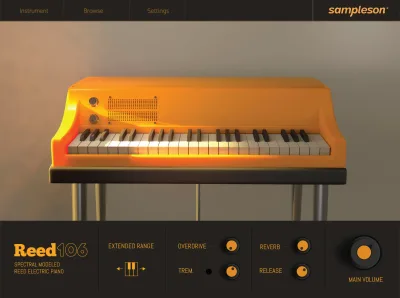
The question every skeptic asks about Reed106 is whether Sampleson's "ever-changing" spectral model is a real sonic innovation or just smart marketing copy. Our honest answer: it's somewhere in the middle, and that's worth unpacking before you spend $49 on it.
Reed106 is a modelled Wurlitzer 106P virtual instrument built around spectral synthesis rather than traditional multisampling. It's aimed at producers who want that classic 1970s reed-based electric piano tone without the machine-gun repetition that makes looped samples feel lifeless in a mix.
At $49, it slots into the "easy yes" budget territory for most producers. But the pitch here isn't really about price. It's about whether the living-model concept holds up under actual session conditions. That's what we're here to find out.
Does the Living Model Actually Live?
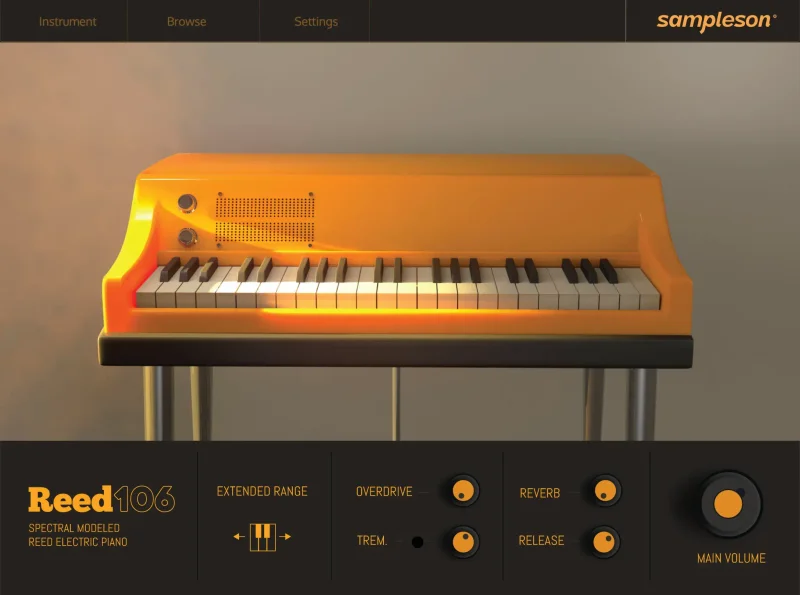
Sampleson built Reed106 around a real Wurlitzer 106P, a rare student-grade model from the 1970s with a 44-note keyboard and that unmistakable orange plastic aesthetic. They sampled it, then rebuilt the sound using spectral modelling to create what they call infinite round-robins.
Standard round-robin sampling cycles through a fixed set of recorded variations. Reed106's approach, in theory, generates unique micro-variations on every hit by simulating the environmental drift of a real physical instrument: temperature, humidity, power supply fluctuations.
Here's where we need to be straight with you. Multiple reviewers report that while waveform analysis on bounced takes does show small differences between repeated notes, those differences are nearly inaudible during playback. We loaded the plugin into a session, played the same middle-C phrase ten times back-to-back, and listened hard. The tone was consistent. Satisfying, yes. But not audibly "different" in any way your ear would catch in the context of a mix.
So the core claim works on a technical level. Whether it works on a musical level is a harder sell.
Where Reed106 Actually Shines
The real win here isn't the variation engine. It's the absence of velocity-switching artifacts.
We played a chord voicing at around 70% velocity, then nudged individual notes up to 85% while holding the chord. In a traditionally sampled instrument, that transition often triggers a new sample layer with a slight timbral jump. With Reed106, the model interpolates cleanly. No seams. That alone makes it feel more like playing an instrument than triggering samples.
The footprint is almost clever in how small it is. 45MB for a full virtual instrument, in all formats, is the kind of number that makes you check whether you misread it. That's smaller than some plugin installers. It loads fast, it idles light on CPU, and it doesn't ask for a Kontakt license or any third-party player. You install it, you open it, it works.
The extended 64-key range gives you more usable territory than the original 44-note source instrument. For comping parts or writing across a wider register, that matters. The built-in Reverb, Tremolo, and Drive effects are basic but honest. We ran the Drive into a simple two-chord R&B loop and got a warm, slightly gritty texture without touching a third-party saturator.
The interface scales well on high-DPI screens. Small thing. Annoying when it doesn't work. It works here.
Where It Falls Short
The "ever-changing" headline is the elephant in the room. If you buy Reed106 expecting to hear your instrument evolve audibly across a session, you'll be underwhelmed. The micro-variations exist in the waveform data. They don't exist in any meaningful perceptual sense during normal play.
That's not a disaster for the plugin. It still sounds good. But it means the primary differentiator Sampleson leads with is, in practice, more of a background technical feature than a sonic one.
No AAX support is a hard stop for Pro Tools users. The plugin ships as VST and AU only. If your studio runs Pro Tools as its primary DAW, this isn't your plugin.
Beyond the three built-in effects, tonal shaping options are thin. There's no EQ, no filter, no key noise or mechanical thump control. If you want to dial in specific Wurlitzer character, like pushing that metallic upper midrange around 2.5kHz or rolling off the low-end bloom, you're doing it in a separate plugin. That's fine at this price, but worth knowing upfront.
How It Stacks Up Against Real Alternatives
The two names that come up most often in this space are Lounge Lizard by Applied Acoustics Systems and Arturia's Wurli V, part of the V Collection.
Lounge Lizard is a full physical model of tine and reed electric pianos. It gives you deep tonal control: tine shape, tone bar decay, pickup distance. If you want to sculpt a Wurlitzer sound from its mechanical components up, Lounge Lizard wins. It's also a significantly larger investment.
Arturia's Wurli V models the 200A, not the rarer 106P student model. It has more presets, a deeper effect chain, and a more complete feature set overall. But it's part of a bundle, and the file size and system requirements are proportionally larger. Reed106 doesn't compete on features. It competes on simplicity, authenticity to a specific source instrument, and CPU cost.
If you're running a lean studio setup or building a track that needs a Wurlitzer texture without dedicating serious system resources to it, Reed106 slots in where Lounge Lizard and Arturia are overkill.
Is $49 Actually Fair Here?
Yes. Straightforwardly yes. For $49 you get a plugin with a legitimate tonal identity, a genuinely small footprint, and zero friction install with no third-party player dependency. The spectral modeling claim is overstated in marketing terms, but the underlying sound quality is real.
You're not buying the most feature-rich Wurlitzer plugin on the market. You're buying the one that works on a 2015 laptop without choking your CPU, sounds convincingly like the instrument it's modelled on, and doesn't require you to own Kontakt. That's a fair trade at $49.
Specs & Technical Details
| Developer | Sampleson |
| Price | $49 |
| Plugin Format | VST (32/64-bit) / AU / Standalone (No AAX) |
| OS Support | Mac (including Catalina & Big Sur) / Windows |
| Activation | No online activation required |
| CPU Usage | Light |
| Trial Available | N/A |
| Version Reviewed | N/A |
Score Breakdown
| Category | Score | Notes |
|---|---|---|
| Sound Quality | 4.0/5 | Convincing 106P character, clean velocity interpolation, no sample seams |
| Value for Money | 4.5/5 | Hard to argue with this price for a working spectral model with built-in FX |
| Ease of Use | 4.5/5 | Installs in minutes, no third-party player, scalable UI |
| Features | 3.0/5 | Three basic effects and no deep tonal control beyond them |
| CPU Efficiency | 4.5/5 | 45MB, light CPU draw, loads fast on older hardware |
| Overall | 3.8/5 | Solid budget Wurlitzer with an overstated headline feature, but genuinely usable |
Alternatives to Consider
Lounge Lizard by Applied Acoustics Systems is the go-to for producers who want deep physical modelling of reed and tine electric pianos. Full mechanical parameter control: tone bar, tine, pickup, damper. It's a serious electric piano engine for producers who need to sculpt, not just play.
Arturia Wurli V models the Wurlitzer 200A with a broader effect chain and more preset variety. The sound palette is wider. The system overhead is proportionally higher. Best for producers already in the V Collection ecosystem.
Sampleson's own catalogue includes other spectral-model instruments worth checking if you like what Reed106 does conceptually.
Reed106 doesn't beat either alternative on features. It beats both on simplicity, install size, and price. If your session needs a Wurlitzer texture and not a Wurlitzer workstation, it does the job without drama.
Buy this if you want a lightweight, no-fuss Wurlitzer 106P tone that sits cleanly in a mix without demanding Kontakt or chewing CPU. Skip it if you need AAX support, deep tonal shaping, or if you'll feel cheated discovering the "ever-changing" engine is something you'll never actually hear in a session. The sound is real. The headline is not quite.
Frequently Asked Questions
What is the Reed106, and what instrument does it model?
Reed106 is a virtual instrument by Sampleson that models the Wurlitzer 106P, a rare student-grade reed-based electric piano from the 1970s. Unlike the more common Wurlitzer 200A, the 106P has a distinctive tonal character tied to its smaller, simpler design. Sampleson recorded the physical instrument and rebuilt its sound using spectral modelling rather than traditional multisampling. The result is a 45MB plugin with no velocity-switching artifacts and an extended 64-note range beyond the original 44-note keyboard.
Does the "ever-changing" spectral model actually sound different each time you play?
Technically yes, audibly barely. Waveform analysis of bounced takes shows small variations between repeated notes, consistent with the plugin simulating temperature, humidity, and power supply drift. In practice, reviewers report those differences are not perceptible during normal playback. The real benefit of the spectral engine is the absence of sample-layer switching artifacts, not a dramatically shifting tonal character. Treat it as a bonus background feature, not the main reason to buy.
Does Reed106 work in Pro Tools?
No. Reed106 ships as VST (32-bit and 64-bit) and AU only, with no AAX version. Pro Tools requires AAX-format plugins, so Reed106 won't load in Pro Tools as of the current release. It's compatible with most other major DAWs including Logic, Cubase, Reaper, FL Studio, Ableton, Bitwig, GarageBand, Nuendo, and Cakewalk. If Pro Tools is your primary DAW, look at Arturia Wurli V or Lounge Lizard instead.
Do I need Kontakt or any other third-party sampler to run Reed106?
No. Reed106 runs as a standalone plugin with no dependency on Kontakt, UVI Workstation, or any other third-party player. You install it directly and it loads into your DAW like any standard VST or AU. No online activation is required either, which makes it one of the lowest-friction installs in this category. The full install size across all formats is 45MB.