Does the MELLOW 2 Review Settle the EZBass Debate in 2026?
By Salvatore Tomaselli·2 albums, 6 singles as Lord Reverb. Now I test the gear that made them.
·Updated October 4, 2026
Affiliate disclosure: Some links in this article are affiliate links. If you buy through them we earn a small commission at no extra cost to you. We only recommend products we genuinely believe in — our editorial opinions are never influenced by affiliate relationships. Full policy
⭐
Score4.1 / 5
⏱
Read time8 min read
4.1/5
★★★★☆
Best forProducers who need realistic bass phrases fast, without touching a MIDI editor
Price at Plugin Boutique, checked Oct 10, 2026. It can change. Affiliate link: we earn a commission at no extra cost to you.
✓ Pros
+1,380 phrases across 60+ genres gives you real creative range
+Player Mode makes it genuinely hard to get a bad result
+15 Finisher multi-FX cover most tone-shaping needs without leaving the plugin
+On sale, the value-to-output ratio is hard to argue with.
✗ Cons
−Instrument Mode MIDI control feels limited compared to Toontrack EZBass
−No standalone app, DAW required for every session
−Phrase library authenticity thins out in heavier rock and metal styles
MELLOW 2 is most often stacked against Toontrack EZBass, and that comparison is where this review is going to spend most of its time. The short version: MELLOW 2 wins on speed and price. EZBass wins on depth and realism. Which one you need depends on whether you’re sketching ideas at midnight or finishing a track for release.
MELLOW 2 is UJAM’s phrase-based virtual bass plugin. It ships with 1,380 pre-recorded phrases across 60+ styles, covers hip-hop, ambient, neo-soul, pop, and more, and runs in VST3, AU, and AAX. The regular price is $119. At the time of writing, it’s on sale. At the sale price, the conversation changes entirely.
This is built for producers who need usable bass in their session before the idea gets cold. Not for bass players who want a simulation of their instrument. That distinction matters.
How MELLOW 2 Compares Out of the Box
Load MELLOW 2 next to EZBass and the difference is immediate. EZBass opens with a blank slate and a MIDI editor. MELLOW 2 opens with playable phrases already assigned to keys.
We had a chord progression sketched in about 40 seconds the first time. That’s not marketing copy. That’s just what Player Mode does when it works.
EZBass has more articulations, more velocity layers, and a more convincing solo bass tone when you’re playing one note at a time. But it asks more of you. You need to program the groove yourself, or import a MIDI pack and edit it to fit.
MELLOW 2 doesn’t ask. It gives you 1,380 phrases and says pick one.
For UJAM plugin workflows that prioritize fast output, that philosophy runs across their whole catalog. MELLOW 2 is the cleanest version of it.
Performance Deep Dive
Player Mode is the headline feature and it holds up. You drop a chord track in or trigger chords via MIDI, and MELLOW 2 selects phrases that fit. The fail-safe logic means you’re not going to get a C# phrase playing over a G minor chord and wondering what went wrong.
We tested it across a 16-bar lo-fi hip-hop loop and a neo-soul progression with extensions. Both tracked correctly. The phrase selection wasn’t always our first choice, but nothing sounded wrong.
Instrument Mode gives you a MIDI fretboard layout so you can play specific strings and positions. It works. It’s not as expressive as we’d like. Bends and slides are present but limited to what’s baked into the phrase library, not freely assignable.
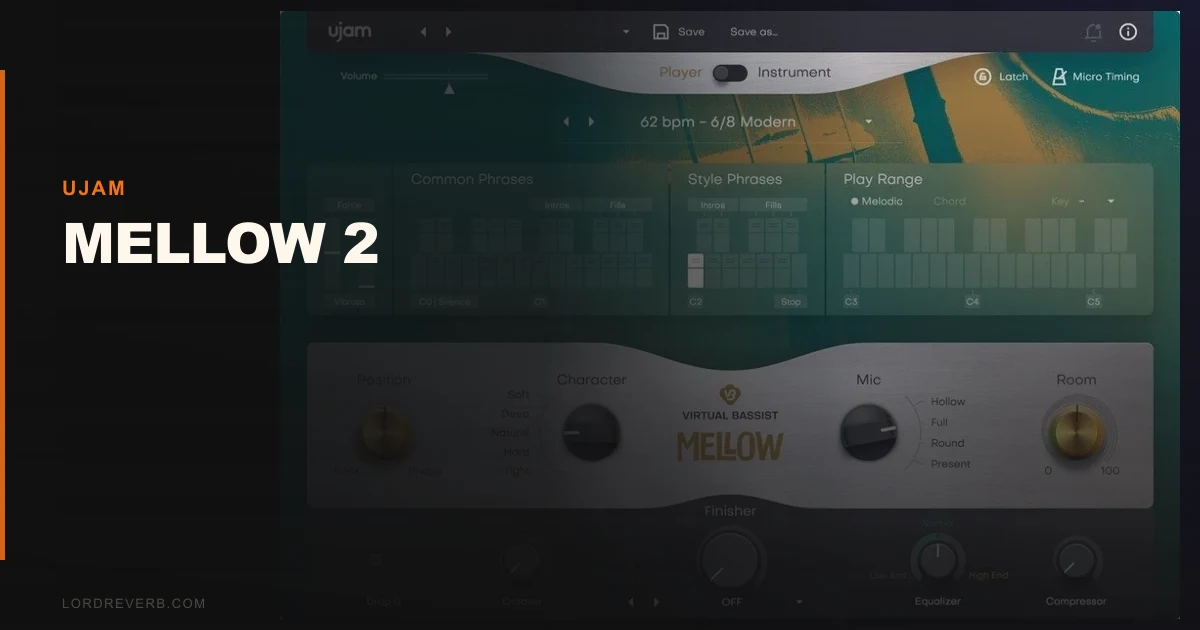
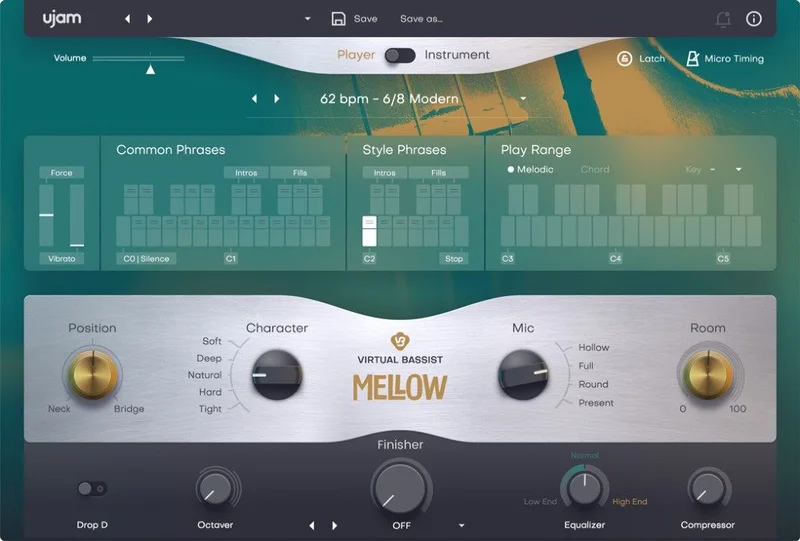
The 15 Finisher multi-FX are a genuine highlight. We ran the bass through the “Crunchy” character preset, pulled the pick position toward the bridge, and added a touch of room using one of the Finisher slots. The result sat in the mix without needing a separate EQ or saturation pass. That’s not nothing.
CPU load is light. We ran four instances simultaneously on a mid-spec laptop and didn’t break 12% CPU on a single core. No complaints there.
Where MELLOW 2 Wins
Speed is the obvious win. Thirty seconds from blank session to a locked bass groove is real. We timed it multiple times across different genres. It held.
The phrase library depth is the less obvious win. 1,380 phrases sounds like a marketing number until you start filtering by style. The hip-hop section alone has enough variation across 16th-note grooves, half-time feels, and syncopated patterns that you’re unlikely to repeat yourself across an EP.
The mic adjustment and pick position controls are satisfying in a way that most phrase-based plugins skip entirely. Moving the pick position from neck to bridge at 70% felt like changing the instrument, not just adding EQ. High mids pushed forward by about 3-4dB perceptually, and the low-end softened. That’s the kind of control that earns trust.
On sale, MELLOW 2 is the easiest call in virtual bass right now.
Where the Competition Wins
EZBass wins on articulation. If you need a palm mute on a specific beat, or a slide into the root on the downbeat, you can build that in EZBass. MELLOW 2 gives you what’s in the library. Full stop.
That limitation bites in heavier styles. We tried to build a driving rock bass line and the phrase selection felt thin. The tone was fine. The rhythmic vocabulary wasn’t there. Metal or hard rock producers should look elsewhere.
Instrument Mode also doesn’t compete with a proper bass sample library if you’re actually writing bass lines note by note. The fretboard layout is clever but the velocity response feels narrow. Loud and quiet are too close together.
MELLOW 2 is also not going to replace a real bassist on a professional session. EZBass probably won’t either, but it gets closer on isolated listening.
Who Should Buy Which
✅ Buy MELLOW 2 if you produce lo-fi, hip-hop, neo-soul, or ambient and want bass done in under a minute.
✅ Buy MELLOW 2 if you're building a beat-making rig on a budget. The sale price is not a gamble.
✅ Buy MELLOW
2 if you already own EZBass and want a phrase-first tool for sketching without loading a full session.
❌ Skip MELLOW 2 if you produce rock, metal, or any genre requiring precise articulation control.
❌ Skip MELLOW 2 if you need a note-for-note programmable bass that survives close listening on a released track.
❌ Skip MELLOW 2 if you want a standalone instrument. It requires a host DAW, always.
Score Breakdown
Category
Score
Notes
Sound Quality
4.0/5
Sits well in a full mix; isolated bass doesn't always survive close listening in heavier styles
Value for Money
4.5/5
The sale price makes this a near-automatic buy for most beatmakers.
Ease of Use
4.5/5
Player Mode is genuinely accessible; Instrument Mode needs more time to learn
Features
4.0/5
1,380 phrases and 15 Finisher FX slots cover most use cases
CPU Efficiency
4.5/5
Four instances at under 12% CPU is a clean result on mid-spec hardware
Overall
4.1/5
Outstanding for phrase-based workflow; limited for precise articulation programming
Alternatives to Consider
Toontrack EZBass is the obvious alternative if you need programmable articulation and a more convincing solo tone. It costs more and asks more of you, but the output on finished tracks is harder to pick apart. Worth checking if you're working in any live-instrument context.
UJAM Hype is worth looking at if you're already in the UJAM ecosystem and building hip-hop or trap productions. The UJAM Hype loyalty upgrade pricing makes expanding the toolkit cheaper if you already own MELLOW 2.
UJAM Score covers orchestral and cinematic territory that MELLOW 2 doesn't touch. If your sessions go beyond beat-based genres, the UJAM Score loyalty upgrade is another logical step inside the same ecosystem.
Also worth reading: our full UJAM Slap review if you want to understand how UJAM's design philosophy plays out across their drum and rhythm tools before you commit to the wider catalog.
Final Take
We’d buy MELLOW 2 at the sale price. We’d probably buy it even at a higher price. At $119, we’d tell you to wait for the next sale, because UJAM runs them constantly.
This plugin is brilliant for fast, low-friction bass in genres where the groove matters more than the articulation. It’s frustrating in styles that need more surgical control. It doesn’t pretend to be EZBass and it shouldn’t.
The thing we keep coming back to: after loading MELLOW 2, we’ve never once opened a MIDI editor to fix a wrong note that the phrase engine dropped in. That’s not a small thing. That’s the whole value proposition, and it delivers.
If you produce hip-hop, lo-fi, neo-soul, or ambient and you don’t own a virtual bass plugin yet, stop reading and go buy it. If you’re a rock producer who needs palm mutes and precise fret noise on a tight deadline, this isn’t your tool.
The sale price is what makes the decision easy. The 4.5-star average across 2,644 Plugin Boutique reviews is what tells you it’s not just cheap. It’s good.
Frequently Asked Questions
Is MELLOW 2 good for beginners?
Yes. Player Mode is the most beginner-friendly virtual bass approach we've tested. You don't need to know music theory to get a result that locks to your chord progression. The UI is clean and nothing is buried in submenus. Most producers are making sounds within five minutes of installation.
Does MELLOW 2 work with all DAWs?
It supports VST, VST3, AU, and AAX formats, so it covers Ableton, Logic, Pro Tools, FL Studio, Cubase, and most other major hosts. It's not a standalone app, so you do need a DAW running. Check the UJAM site for the full compatibility list before buying if you're on an older OS version.
How does MELLOW 2 compare to EZBass?
MELLOW 2 is faster and cheaper. EZBass is more detailed and more flexible. MELLOW 2 wins for phrase-based production in hip-hop, lo-fi, and neo-soul. EZBass wins when you need precise articulation control or a bass tone that holds up in isolation on a finished track. They serve different workflows.
Can you use MELLOW 2 without knowing how to play bass?
That's basically the point. Player Mode removes the need for any bass-playing knowledge. You trigger chords or feed it a chord track, and it selects fitting phrases automatically. The fail-safe logic means it won't generate phrases that clash with your harmony. You can go from zero bass knowledge to a locked groove in under a minute.
The short version
MELLOW 2 · 4.1/5
Buy it if:Producers who need realistic bass phrases fast, without touching a MIDI editor
1,380 phrases across 60+ genres gives you real creative range
Player Mode makes it genuinely hard to get a bad result
15 Finisher multi-FX cover most tone-shaping needs without leaving the plugin
Biggest drawback:Instrument Mode MIDI control feels limited compared to Toontrack EZBass
Salvatore Tomaselli has spent twelve years in studios as a producer, mix and mastering engineer. He's worked across genres, tested hundreds of plugins, and built more signal chains than he can count. Salvatore started writing for LordReverb because most gear coverage is either sponsored fluff or spec-sheet copy-paste. He tests everything before writing about it. No gear gets a pass just because it's popular.
Community
What's in your stack?
Every artist on LordReverb has a setup. Show yours. DAW, plugins, hardware, the lot. Free, takes 2 minutes.