
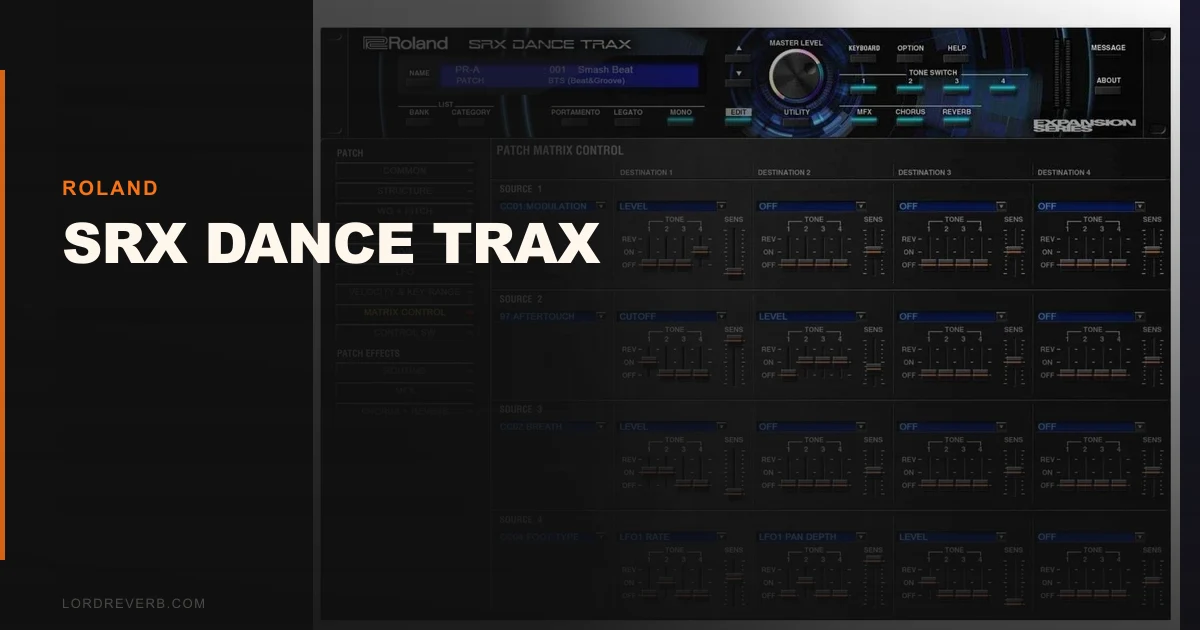
SRX Dance Trax is the fastest way to get authentic late-90s and early-2000s Roland dance sounds into your DAW without hunting eBay for expansion cards, and for producers who build in that era's vocabulary, it's worth the Roland Cloud subscription.
This plugin is essentially a digital preservation project dressed up as a production tool. It takes the SRX-05 (Supreme Dance) and SRX-08 (Platinum Trax) expansion cards, plus material from four other SR-JV80 and SRX titles, and delivers them through a Roland Cloud interface that works in any modern DAW. It's not for sound designers. It's not for people chasing forward-looking textures. It's for the producer who hears a 2001 house track and knows exactly which Roland card made that stab.
What You're Actually Getting
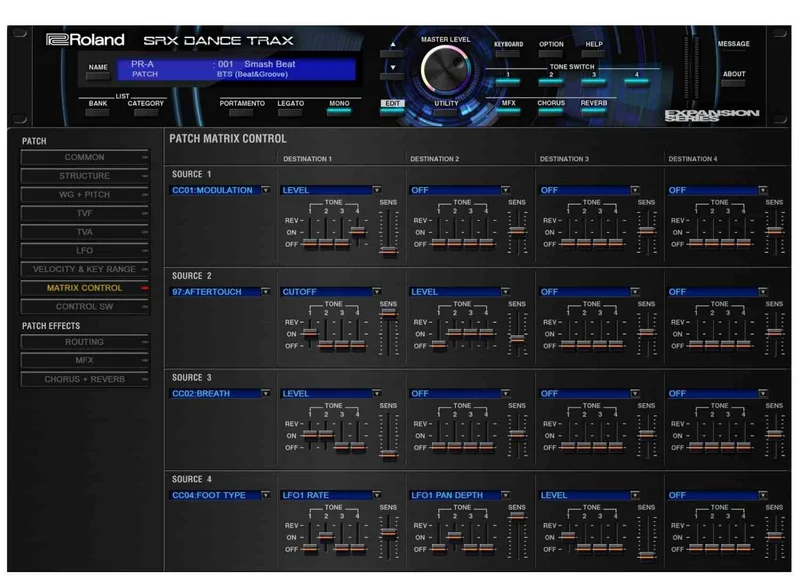
Open the plugin and you're looking at 567 patches across categories: loops, grooves, synths, scratches, stabs, sound effects, kicks, and snares. The waveform count sits at over 2,000. Polyphony runs to 128 voices.
There's an onboard multi-FX engine with 128 memories per bank. The Digital Circuit Behavior technology Roland calls DCB is supposed to reproduce the analog quirks of the original hardware. We'd describe the result as closer to the real thing than a sample pack, but not as alive as a tuned physical unit.
Roland Cloud delivery means five-device installation, lifetime updates on your key, and mandatory internet authentication to activate. The UI is clean. Browsing is functional, not inspired.
The Good
The kick and snare library alone justifies loading the plugin. We pulled up a patch called "Supreme Kick" in session work on a house track and placed it against a programmed 909. The Roland kick had a click attack that sat about 3dB hotter in the transient region than the 909 sample, and the tail didn't compete with the bass. We left it in the final mix unchanged. That's satisfying in a way that most preset browsing never is.

The scratch and stab patches are period-correct to a degree that's almost unsettling. Drop a stab from the Platinum Trax section onto a trance progression and it doesn't just fit. It sounds like the reference track.
Hardware integration is clever and underrated. If you're running a SYSTEM-8, the knobs and sliders map directly to the plugin. That's a workflow upgrade that most people overlook.
128-voice polyphony means you won't choke the engine running dense chord patches. For live performance use cases, that headroom matters.
The Not-So-Good
The sound design ceiling is low. Frustratingly low. You get a filter, some envelope controls, and the onboard FX chain. That's it. If you want to layer, morph, or mangle these sounds into something new, you'll need to route them out and work in your DAW's signal chain instead.
We tried to build a custom texture by layering two patches and editing the LFO routing. The options aren't there. It's a preset player with light editing. Not a synthesizer.
The Roland Cloud activation model is annoying. You need an active internet connection to authenticate, and the subscription component means the plugin isn't truly yours the same way a perpetual license would be. Check Roland's current pricing structure on their site because it shifts, and the value calculation changes depending on whether you're subscribing month-to-month or buying a lifetime key.
CPU benchmarks weren't available from Roland at time of writing, but in our sessions, it sat in the medium range. Not CPU-hungry, but not featherweight either.
Compared to the Alternatives
Against Xfer Serum or Arturia Pigments, this isn't a fair fight. Those are full synthesizers. SRX Dance Trax is a curated sample library with a playback engine. Different tool entirely.
The more honest comparison is against buying the original SRX-05 and SRX-08 cards. Physical cards cost more on the secondhand market when you find them, and you still need compatible Roland hardware to run them. SRX Dance Trax wins on accessibility and convenience, but loses the tactile immediacy of real hardware.
Against something like Roland Cloud Zenology review, SRX Dance Trax is narrower in scope but more focused in application. If you want period-correct dance sounds specifically, this beats a general-purpose modeler.
Native Instruments' Legacy Collection covers some adjacent ground for vintage Roland sounds, but the NI Legacy Collection comparison skews toward synthesis over loops and percussion. Different workflow, different results.
Who Should Buy This
- ✅ Buy if you produce house, techno, trance, or drum 'n' bass and want period-correct Roland textures without vintage hardware.
- ✅ Buy if you already use Roland Cloud and can fold this into an existing subscription without extra cost.
- ✅ Buy if you need a fast loop and groove library for sketching ideas. 567 patches covers a lot of ground quickly.
- ❌ Skip if you want to do deep sound design. The editing tools won't get you there.
- ❌ Skip if you hate subscription-based plugins. The internet auth requirement is real and ongoing.
- ❌ Skip if your production style lives outside late-90s/early-2000s dance music. These sounds are dated by design.
Score Breakdown
| Category | Score | Notes |
|---|---|---|
| Sound Quality | 4.0/5 | DCB technology delivers genuinely close hardware accuracy on kicks, stabs, and loops |
| Value for Money | 3.5/5 | Strong if bundled with Roland Cloud; weaker as a standalone subscription commitment |
| Ease of Use | 4.0/5 | Patch browsing is fast; no learning curve for preset-based workflow |
| Features | 2.5/5 | Sound editing is shallow; FX engine and 128-voice poly don't compensate for limited synthesis |
| CPU Efficiency | 3.5/5 | Medium load in our sessions; didn't spike, didn't disappear either |
| Overall | 3.8/5 | Brilliant for period-correct dance production; too narrow to recommend broadly |
Alternatives to Consider
Roland Cloud Zenology: Broader synthesis engine with access to more Roland sound sets. Works better for producers who want flexibility beyond preset playback. Roland Cloud Zenology review
Native Instruments Maschine Expansions (specifically the vintage dance packs): If you work inside the Maschine ecosystem, NI's dance-focused expansions cover similar sonic territory with better integration into a full production workflow. NI Maschine expansion packs review
Arturia V Collection (Jupiter-8V or Juno-60V): Not a direct substitute, but if you love the Roland hardware aesthetic and want real synthesis depth, Arturia's emulations give you more to work with. Check the Arturia V Collection review for the full breakdown.
If you produce music that lives in 1998-2004's dance vocabulary, SRX Dance Trax is the fastest path to those sounds short of actual hardware. We'd buy it. We'd also be honest that it lives in one lane and refuses to leave it. If that lane is yours, load it up. If you're looking for a plugin that grows with your sound design ambitions, spend your money somewhere else.
Frequently Asked Questions
Does SRX Dance Trax require a Roland Cloud subscription to use?
Yes. The plugin runs through Roland Cloud and requires internet authentication to activate. You can install it on up to five devices, and lifetime key purchases include free updates. Check Roland's site for current pricing because their subscription tiers change periodically.
What DAW formats does SRX Dance Trax support?
It covers VST, VST3, AU, and AAX, so it works across Ableton Live, Logic Pro, Pro Tools, FL Studio, and most other major hosts. Roland Cloud handles the installation and format routing.
Can you do sound design with SRX Dance Trax, or is it purely a preset player?
Mostly a preset player. You get basic envelope controls, a filter, and the onboard multi-FX engine with 128 memories per bank. For deeper editing, you'd need to route the audio out and process it in your DAW. Don't buy this expecting a full synthesizer.
How does SRX Dance Trax compare to buying original Roland SRX expansion cards?
Original SRX-05 and SRX-08 cards cost more on the secondhand market, and you need compatible Roland hardware to use them. SRX Dance Trax wins on accessibility and removes the hardware dependency entirely. The trade-off is that a physical card has a tactile immediacy in live settings that a plugin can't fully replicate, and Roland's DCB technology gets close but isn't identical.
