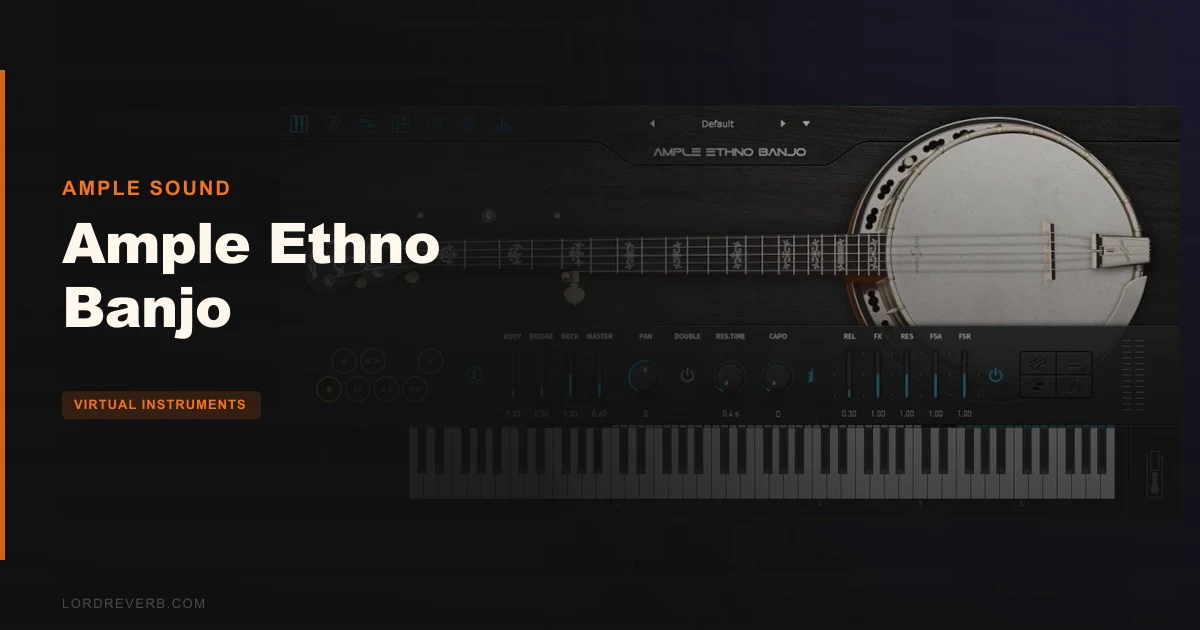
The real question with Ample Ethno Banjo is whether "another Ample instrument" is a reason to buy it or a reason to hesitate. For banjo specifically, it's a reason to buy.
Quick verdict: At $119, Ample Ethno Banjo is the most feature-complete banjo virtual instrument most producers will ever need. It scores 4.1 out of 5. The Derring Dierra sampling is convincing, the multi-mic system gives you genuine tonal range, and the Riffer engine alone is worth the admission for anyone building Americana or folk arrangements. The strumming engine is frustrating and the dynamics can get weird in the upper velocity range. Neither problem kills the instrument, but both are real. If your banjo parts are mainly picked lines and riffs, this is a confident buy at $119.
Does Ample Ethno Banjo Actually Deliver?
Ample Sound sampled a Derring Dierra banjo for this library. That's not a generic session-room instrument: it's a specific instrument with a specific character, and the depth of the sampling shows in how owners describe the result.
Users call it the best banjo virtual instrument they've played. That's not a small claim given how niche the category is and how easy it is to settle for something passable when you only need banjo on one track per year.
The 3.9 GB library ships with 9 articulations: slides, palm mutes, hammer-ons, strums, and additional techniques. It runs on Windows 7 through 11 and Mac 10.9 or higher, in VST2, VST3, AU, AAX, and Standalone formats. The 64-bit Windows requirement means legacy 32-bit sessions need a bridge, but that's standard practice now.
What Ample promises is a complete performance toolkit. For the most part, it delivers that. The developers say it captures every nuance of the banjo's natural sound, which is a bold claim. What owners actually report is more measured and more believable: the muted playing sounds more musical than competing banjo plugins, and Scruggs-style rolls come off convincingly. That's a narrower win than the marketing suggests, but it's a meaningful one.
The interface takes time to get comfortable with. Users flag an initial learning curve that fades with use. That's honest, and worth factoring into your first week with it.
Where Ample Ethno Banjo Shines
The Microphone System
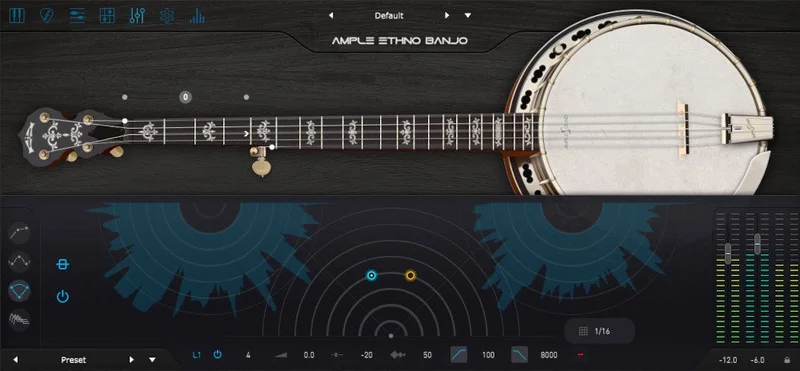
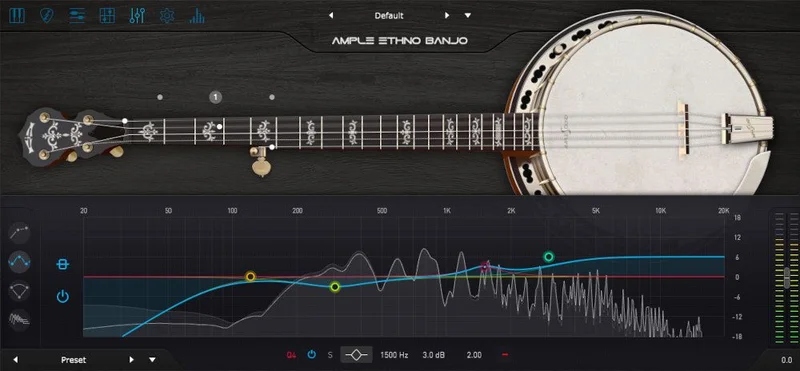
Four mic modes: mono, bridge stereo, body stereo, and neck stereo. Each one gives you a different physical perspective on the same instrument. Put the bridge stereo in your DAW and you get the bright, cutting banjo tone that sits forward in a mix. Dial in the body stereo for something warmer, with more of the resonator chamber in the sound.
If you're building a folk arrangement with acoustic guitar, mandolin, and bass, mic placement on the banjo matters as much as the part itself. Having four distinct positions without leaving the plugin is satisfying in a way that affects how you write for the instrument, not just how you mix it.
Polyphonic Legato, Capo, and Tuning Logic
Polyphonic legato with customizable capo and tuning logic is genuinely clever design. Set a capo position and the plugin constrains its articulations and pitch logic to match. You're not faking it with a transpose. The instrument behaves differently the way a real banjo does when you move the capo.
This matters most when you're writing in keys that don't naturally sit on a standard G-tuned banjo. D major with a capo at the second fret behaves differently than D major without one, and Ample Ethno Banjo knows that.
The Advanced Bend System
String bending on a sampled fretted instrument is usually where the cracks show. The Advanced Bend system in Ample Ethno Banjo simulates realistic string behaviour rather than just pitch-shifting a sample. Reviewers specifically praise the vibrato execution, which is one of the hardest things to get right on a banjo simulation.
Push a note into a bend in a picked riff and the character of the string changes the way it does on a real instrument: not just higher in pitch, but slightly brighter and more tense-sounding. That's the difference between a bend that sounds played and one that sounds processed.
The Riffer Engine and Tab Player
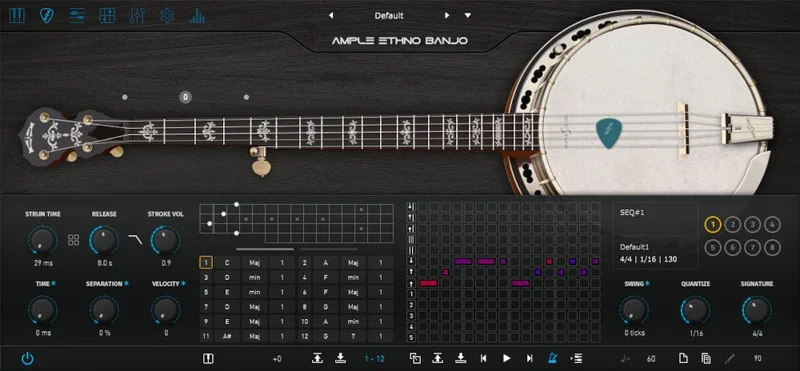
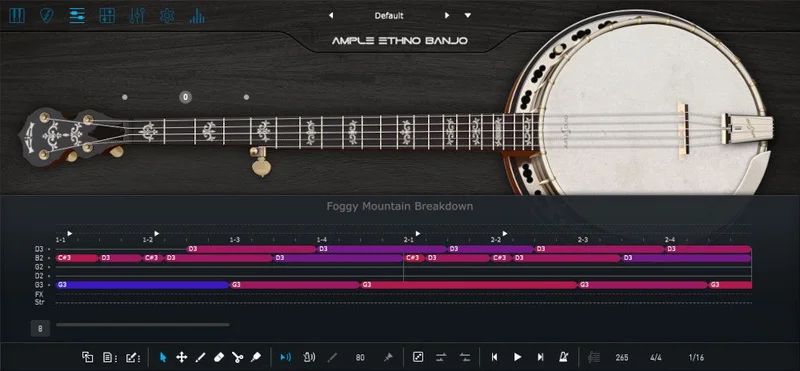
The Riffer engine is one of the most loved features in any Ample instrument. You build riff patterns with detailed note attributes, and the smart Dice generator randomises variations on demand. For a session player building a Scruggs roll pattern at 2am, this is the feature that makes the work go faster.
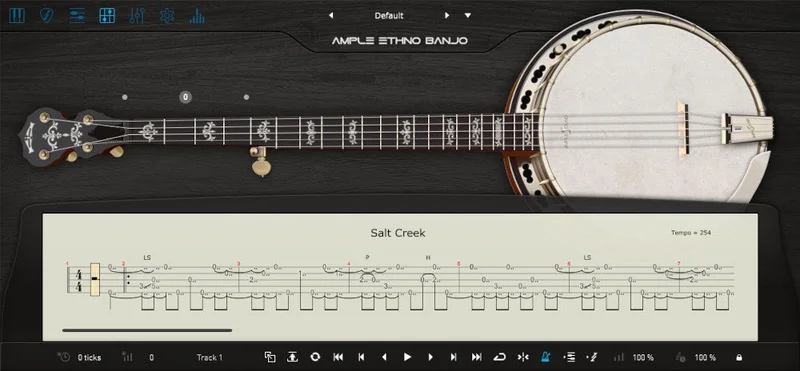
The Tab player supports multi-format tablature and exports to DAW audio. Load a banjo tab you found online, play it back through the instrument, and either keep the MIDI or bounce it straight to audio. That's a workflow that most competing instruments don't come close to offering.
Users appreciate both of these features specifically. It's not just marketing copy.
Where It Falls Short
The strumming engine is the most frustrating part of this instrument. It appears to be reused from Ample's guitar and ukulele plugins, and it shows. The 26 play styles per chord sound convincing on a guitar. On a banjo, the physics are different: a banjo doesn't strum like a guitar, and the humanization controls don't fully compensate for that.
If your banjo parts are rhythm-led, you'll notice this. The strum timing and feel lacks the natural bounce that banjo players know. It's not unplayable, but it's the section of the instrument where you'll spend the most time dialling in something that just about passes.
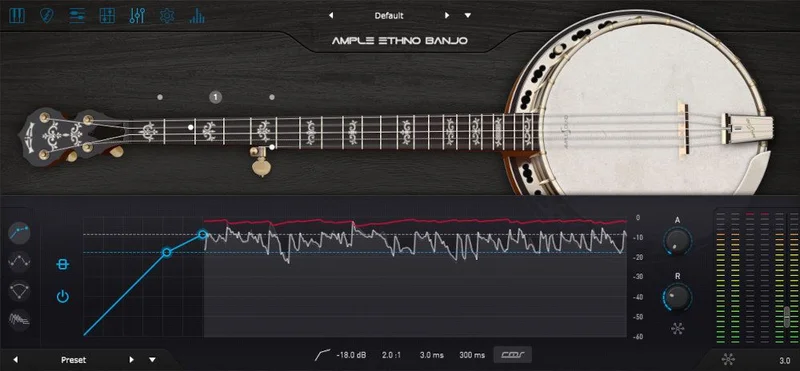
The dynamics issue is annoying in a different way. Some users report extreme velocity jumps that don't happen naturally on a real banjo: the transition from soft to loud doesn't follow a believable curve in certain ranges. This isn't constant, but it's the kind of thing that makes you re-examine every mezzo-forte note in a part.
And there's no clawhammer. The whole library is sampled with finger-picks. If you're writing old-time folk or clawhammer-driven Appalachian material, this instrument cannot help you. That's a hard limit, not a workaround situation.
How It Stacks Up Against the Competition
Orange Tree Samples Evolution Bluegrass is the name that comes up most often in comparison. Some players prefer it specifically for more natural dynamics and strum responsiveness, which maps directly to Ample Ethno Banjo's two main weaknesses. If your workflow is primarily rhythm playing or strummed accompaniment, Evolution Bluegrass may serve you better in those specific areas.
RealiTone RealiBanjo gets mentioned for higher responsiveness in the strum and picking engine. That's a narrower recommendation but a consistent one from players who have used both.
8Dio and Bolder Sounds also appear in the comparison conversation, though at a broader level. What Ample Ethno Banjo has that most of its competitors don't match is the depth of the Riffer engine, the Tab player, and the multi-mic system together. If you need a picking instrument with serious MIDI workflow tools, Ample's version is harder to beat. If you need a convincing strummer, the competition has the edge.
Is the Price Fair?
At $119, this is a mid-range instrument price for a niche category. The 3.9 GB library, four mic modes, polyphonic legato, Riffer engine, Tab player, and full MIDI CC support represent a genuinely deep feature set. You're not paying for surface area here.
The strumming limitation brings the value down slightly for rhythm-focused buyers. For anyone building Bluegrass lead lines, folk finger-picking, or Americana riffs, the price feels right. For producers who need a one-stop banjo that does everything, it's honest to say the strum shortfall is a $119 consideration.
Specs & Technical Details
| Spec | Detail |
|---|---|
| Developer | Ample Sound |
| Price | $119 |
| Plugin Format | VST2 / VST3 / AU / AAX / Standalone |
| OS Support | Windows 7/8/10/11 (64-bit) / Mac 10.9 or higher |
| Activation | N/A |
| CPU Usage | N/A |
| Trial Available | N/A |
| Version Reviewed | N/A |
| Sample Library Size | 3.9 GB |
| Articulations | 9 |
| Microphone Modes | 4 (mono, bridge stereo, body stereo, neck stereo) |
| System Requirements (Windows) | 64-bit, Intel i5 or higher, 10 GB hard disk space |
Score Breakdown
| Category | Score | Notes |
|---|---|---|
| Sound Quality | 4.5/5 | Derring Dierra sampling is convincing; Scruggs-style rolls and finger-picked riffs are genuinely strong |
| Value for Money | 4.0/5 | Deep feature set at a mid-range price, but the strum limitation is real for some buyers |
| Ease of Use | 3.5/5 | Interface has a learning curve; becomes intuitive but takes time to navigate at first |
| Features | 4.5/5 | Riffer engine, Tab player, multi-mic system, and polyphonic legato with capo logic are all standout tools |
| CPU Efficiency | N/A/5 | Not verified from available data |
| Overall | 4.1/5 | A strong picked banjo instrument with workflow depth that few competitors match, held back by a weaker strum engine |
Alternatives to Consider
Orange Tree Samples Evolution Bluegrass
Some players prefer Evolution Bluegrass for more natural dynamics and strum responsiveness. If your banjo writing is rhythm-led rather than melody-led, it's worth checking out before committing to Ample.
RealiTone RealiBanjo
RealiBanjo gets consistent praise for higher responsiveness in the strum and picking engine. If the strum feel is your priority above all else, this one deserves a close look.
8Dio and Bolder Sounds
Both appear in the conversation around banjo virtual instruments. Neither offers the same depth of MIDI workflow tools as Ample Ethno Banjo, but they're worth comparing if you're evaluating the full market before deciding.
The Bottom Line
If you're building a Bluegrass track and you need banjo that sounds like it was played by someone who actually plays banjo, Ample Ethno Banjo gets you there. The Derring Dierra sampling is specific and detailed in a way that generic banjo libraries aren't. Put a finger-picked riff through the bridge stereo mic mode and it sits in a mix without the plastic quality that plagues cheaper alternatives.
The Riffer engine is the hidden value here. You can build convincing Scruggs roll patterns in minutes, load a real tablature file and hear it played through a good-sounding instrument, and export directly to your DAW. For producers who don't play banjo and need to fake it convincingly, that workflow is worth a lot.
But you need to go in with clear eyes. The strumming engine is the instrument's weakest part, and it's not a subtle issue. If you need banjo for rhythmic strumming on a folk record, listen to Evolution Bluegrass or RealiBanjo before spending $119 here. The dynamics quirk is annoying but manageable. The clawhammer limitation is binary: if you need it, this instrument simply doesn't do it.
For what it is built for, specifically picked playing with real MIDI depth and multi-mic flexibility, Ample Ethno Banjo is one of the best options in the category. Buy it for the picking. Work around the strum. And don't expect clawhammer.
Frequently Asked Questions
Does Ample Ethno Banjo support clawhammer style playing?
No. The entire library is sampled with finger-picks, which means only finger-picked and Scruggs-style techniques are available. If you need clawhammer style, this instrument can't deliver it and there's no workaround. You'd need a different library built around that specific technique.
How many microphone positions does Ample Ethno Banjo include?
It includes four mic modes: mono, bridge stereo, body stereo, and neck stereo. Each gives a noticeably different tonal character. Bridge stereo is brighter and more cutting, while body stereo captures more of the resonator warmth. You can blend or switch between them depending on how the instrument needs to sit in your arrangement.
What DAW formats does the Tab player support, and can you export to audio?
The Tab player supports multi-format tablature and includes DAW audio export capability. You can load a tab, play it back through the instrument, and bounce it directly to audio from within the plugin.
Is Ample Ethno Banjo suitable for beginners to virtual instruments?
The instrument has a real learning curve at first. Users report that the interface can be confusing initially but becomes more intuitive with time. If you're familiar with other Ample Sound plugins, the layout will feel familiar. If this is your first Ample instrument, budget some time before your first session to get comfortable with the UI before a deadline.
How does the Riffer engine work in Ample Ethno Banjo?
The Riffer engine lets you build riff patterns with detailed note attributes: you control timing, velocity, articulation, and other per-note parameters. The smart Dice generator randomises variations on demand so you can explore pattern ideas quickly without programming everything from scratch. It's one of the most praised features of the instrument and works well for building Scruggs-style rolls and picking patterns.
How does Ample Ethno Banjo compare to Orange Tree Samples Evolution Bluegrass?
Some players prefer Evolution Bluegrass for more natural dynamics and strum responsiveness, which are two areas where Ample Ethno Banjo has known limitations. Ample's instrument has the edge in MIDI workflow depth, the Riffer engine, the Tab player, and the multi-mic system. If your banjo writing is primarily picked lead lines and riffs, Ample Ethno Banjo is competitive. If strumming and rhythm playing are central to your work, Evolution Bluegrass may be a better fit.