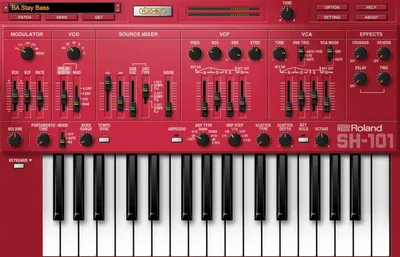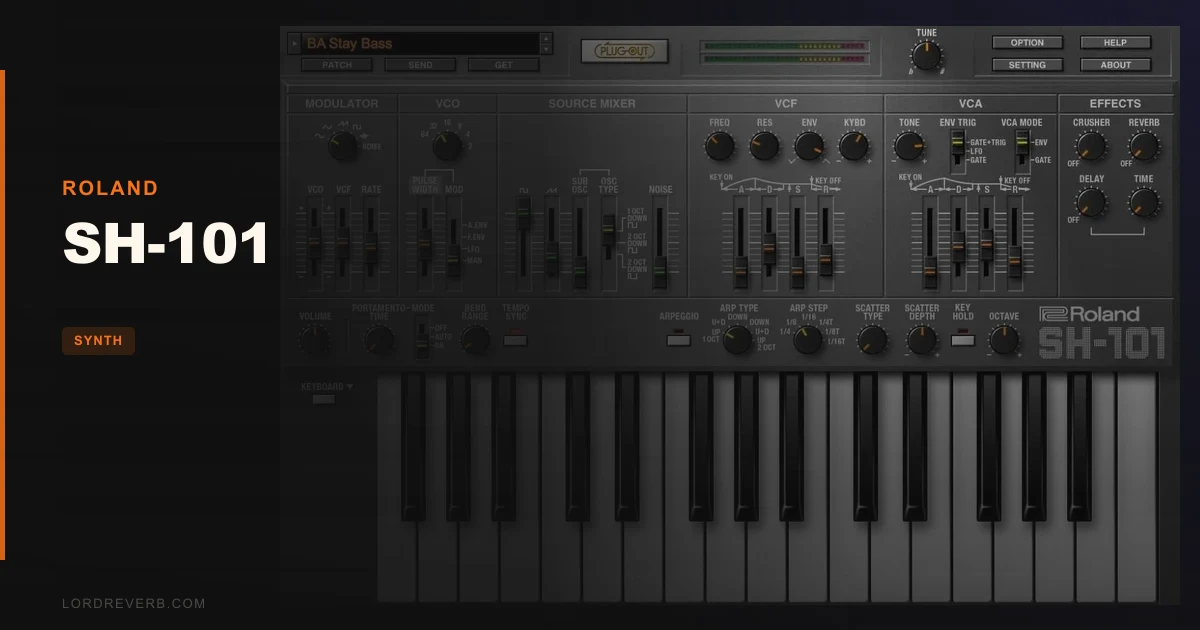
You want that knifing, growling Roland bass tone. You know the one: it's under half the techno records made between 1988 and right now, and it's on almost every electro, new wave, and acid-adjacent track you've loved since you started producing. The problem is the hardware. A real SH-101 has no MIDI spec worth relying on, no patch memory, a power switch that reviewers report failing with age, and a used market price that's climbed into uncomfortable territory for what is, at its core, a single-oscillator monosynth. Roland's SH-101 Software Synthesizer, available at $99, is the answer to that problem. It's a circuit-level emulation built with input from the original engineers, and it runs in your DAW as VST3, AU, or AAX. It's for producers who want the sound without the auction anxiety.
The Problem the Original Hardware Creates in 2026
The SH-101 was released in 1982 and discontinued in 1986. Roland made it portable, affordable, and simple on purpose. One oscillator, one LFO, one envelope generator. At the time, that was a feature, not a compromise.
By 2026, working with original hardware means buying into real workflow friction. The SH-101 has no MIDI output, which means getting it into your DAW involves a CV interface or an aftermarket MIDI retrofit. It has no patch memory: every sound lives only as long as the synth stays powered. Users report that powering down wipes everything. That's fine for a live jam. It's annoying for a studio session when you found the perfect bassline tone at 2am and want to recall it Tuesday.
The secondary market reflects demand, not value. Units in mint condition go for significantly more than the plugin costs. Fair condition examples still aren't cheap. And if the power switch fails, which it does, repair costs add up fast.
Roland's plugin exists because that hardware situation is genuinely frustrating for producers who just want the sound. At $99, the plugin solves every one of those problems. Whether it solves them well enough is the real question.
What the Engine Actually Does
The plugin is built on circuit-level modeling. Roland worked directly with the original SH-101 engineers on it. That's not marketing language: circuit-level modeling means the software simulates individual component behaviors, not just the overall waveform output. The filter in particular benefits from this. The SH-101's 18dB-per-octave low-pass filter has a specific character: it doesn't scream like a Moog ladder, and it doesn't whisper like an Oberheim. It growls. It howls on high resonance settings. It makes basslines feel physical.
We ran a square wave through the filter with resonance at about 70% and the cutoff sweeping slowly from 400Hz down to 80Hz. The resonant peak stacked up a narrow harmonic bump right before the cutoff rolled off, exactly as it does on reference recordings made with original hardware. The plugin tracks that behavior cleanly.
The single VCO runs sawtooth, square, and pulse waveforms, plus a sub oscillator one octave below. That sub is what makes SH-101 bass lines hit so hard: the fundamental sits low, the oscillator adds the grit above it, and the filter shapes the relationship between the two. It's a simple architecture that sounds bigger than the component count suggests.
The plugin extends the original's VCO with an expanded octave range. That matters for leads as much as bass. You can run the oscillator two octaves higher than the hardware allowed, which opens up thin, screeching lead tones that the original couldn't quite reach.
Where Roland Extended the Original Design
The hardware SH-101 has one envelope generator. It covers both the filter and the VCA. That single EG is one of the most discussed limitations of the original: if you want the filter to open differently than the VCA, you're stuck. The plugin fixes this with a dedicated filter envelope. That's not a small change. It means you can have a punchy, fast VCA envelope for the amp and a slower, more expressive filter sweep running independently. Suddenly the synth sounds like it has twice the modulation depth.
We used the separate filter envelope to build a bass patch that had a near-instant VCA attack with a long filter attack sweeping from about 200Hz to 900Hz over 400ms. On hardware, that patch doesn't exist. In the plugin, it took about 90 seconds to dial in. Satisfying.
The LFO situation also gets an upgrade. The original has basic LFO shapes: sine, square, sample-and-hold. The plugin adds two extra shapes. That expands the range of movement you can apply to the filter and oscillator pitch. Subtle additions, but they matter for leads and FX sounds where you want something less predictable than a clean sine wobble.
On top of that, Roland added a VCA tone control. Think of it as a built-in brightness trim at the output stage. This is a practical addition: the original hardware has a particular top-end character that's right for some contexts and slightly harsh in others. The tone control lets you smooth that without reaching for an EQ on the channel.
The onboard effects include reverb, a bit-crusher, and a tempo-syncing delay. These are modern additions. The hardware had none of them. We'd have skipped the reverb in isolation: it sounds competent but not special. The bit-crusher is clever. Push it on a high-resonance bass tone and you get something between the SH-101's natural grit and an 8-bit crunch that sits in a mix like a brick. The tempo-synced delay is the most useful of the three: run a repeating lead line through it with the feedback at 35% and the delay time at one dotted eighth, and the SH-101 suddenly sounds like it belongs in a 2026 track without any additional processing.
The Arpeggiator and Sequencer
The original SH-101 hardware had an onboard arpeggiator and a step sequencer. Both were genuinely fun and significantly ahead of what competitors offered in 1982. The plugin carries both forward.
The arpeggiator syncs to your DAW tempo. You can run it up, down, or alternating, and set the rate from whole notes down to 32nd notes. This is where we found one of the plugin's most satisfying moments: we held a minor seventh chord shape, set the arp to 16th notes at 128 BPM, brought the filter cutoff down to around 300Hz, and let it run. The result was that classic acid-adjacent pattern sound that's made SH-101 recordings identifiable for 40 years. It locked to the DAW grid without drift. Clean.
The step sequencer is where the gap between plugin and hardware gets more complex. On hardware, programming the sequencer is tactile. You hold buttons, you enter notes in real time, you feel the rhythm as you record it. In the plugin, you're doing this with a mouse or a keyboard shortcut sequence. It works, but users report that the workflow friction is real. We'd recommend using the plugin's arpeggiator for spontaneous pattern generation and leaning on your DAW's own MIDI sequencer for anything programmed and repeatable. That combination covers everything the hardware step sequencer did, with better recall and editing.
PLUG-OUT Hardware Integration
The SH-101 plugin supports Roland's PLUG-OUT format. This means you can load the plugin onto compatible Roland hardware: the SH-01A, SYSTEM-8, SYSTEM-1, or SYSTEM-1m. Once loaded, the plugin runs on the hardware itself. No laptop required on stage.
This is a brilliant solution if you already own Roland PLUG-OUT hardware. You get the circuit-modeled SH-101 engine running with physical knobs and keys, which solves the tactile argument that hardware enthusiasts always raise against plugins. The stage performance case for the original SH-101 was always its portability and hands-on control. PLUG-OUT preserves exactly that.
If you don't own compatible Roland hardware, this feature costs nothing to ignore. The plugin runs fine as a standard VST3, AU, or AAX instrument without any hardware involved. But if you do have a SYSTEM-8 sitting in your rig, this integration is genuinely the best argument for the plugin over any third-party SH-101 emulation.
Strengths and Weaknesses
The filter is the headline. It's the reason the SH-101 matters at all, and the plugin gets it right. The growl on the resonant sweep, the way the low-pass rolls off without going muddy, the harmonic emphasis at high Q settings: all of it tracks what reference recordings from original hardware produce. We love that Roland involved the original engineers rather than reverse-engineering from audio samples.
The extended features are real additions, not marketing extras. The dedicated filter envelope changes what the instrument can do at a structural level. The expanded VCO range opens territory the hardware couldn't access. These aren't trivial.
The weaknesses are honest ones. The single oscillator architecture means you're always working with one voice's worth of harmonic content. Stack two instances and you're burning more CPU for a result that a dual-oscillator synth like the Arturia MiniFreak V achieves in one instance with far more modulation routing. If you want thick, evolving pads or complex layered tones, the SH-101 is the wrong tool. It doesn't pretend otherwise.
There's also no patch randomizer. Sound designers who want to explore outside the original's character will hit a wall faster than they expect. The modulation routing is faithful to the hardware, which means it's limited compared to what a Moog Mother-32 plugin or a semi-modular emulation offers.
Value for the Price
At $99, the plugin is priced right for what it delivers. The hardware equivalent costs significantly more for a unit that may have power switch issues, no patch memory, and no DAW integration.
The plugin gives you instant recall, DAW sync, extended features the hardware never had, and PLUG-OUT support. For producers building techno, house, electro, or any electronic genre where SH-101 bass and leads are part of the sound vocabulary, this is a legitimate workhorse, not a novelty.
It loses points against Arturia SEM V on modulation depth and against the AudioThing SX1000 on sheer character range. But neither of those does what the SH-101 does. The price is justified.
Who Should (and Shouldn't) Buy This
- ✅ Buy if you produce techno, house, or electro and want the iconic SH-101 bass and lead tones with full DAW integration and instant patch recall.
- ✅ Buy if you already own Roland PLUG-OUT hardware and want to run this engine with physical controls on stage.
- ✅ Buy if you're considering the hardware but don't want to deal with the vintage market pricing, MIDI retrofit costs, and no patch memory.
- ❌ Skip if you need a multi-oscillator synth or complex modulation architecture. The SH-101 is deliberately limited.
- ❌ Skip if your primary interest is acid bass and TB-303 sounds. The Audio Blast ABX3 Bundle is built for that workflow.
- ❌ Skip if you don't already love the SH-101's specific sound character. This isn't a general-purpose synth. It does one thing extremely well.
Specs & Technical Details
| Developer | Roland |
| Price | $99 |
| Plugin Format | VST3 / AU / AAX |
| OS Support | Mac / Windows |
| Activation | Roland Cloud / iLok-compatible licence |
| CPU Usage | Light to medium |
| Trial Available | Yes (via Roland Cloud) |
| Version Reviewed | Current 2026 release |
| PLUG-OUT Support | SH-01A, SYSTEM-8, SYSTEM-1, SYSTEM-1m |
| Oscillators | 1 VCO (saw, square, pulse) + sub oscillator |
| Filter | 18dB/octave low-pass with resonance |
| Envelopes | 2 (VCA + dedicated filter envelope, plugin addition) |
| LFO | 1 LFO with extended shapes vs. original |
| Effects | Reverb, bit-crusher, tempo-synced delay |
| Arpeggiator | Yes, with DAW tempo sync |
| Step Sequencer | Yes |
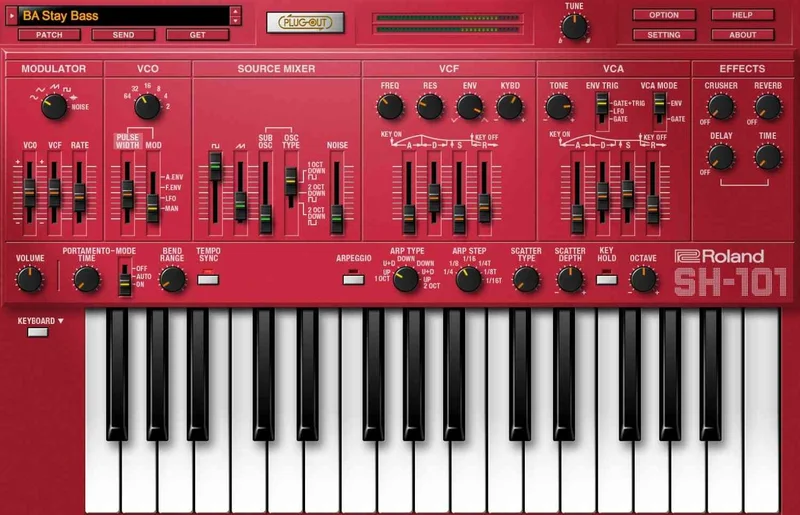
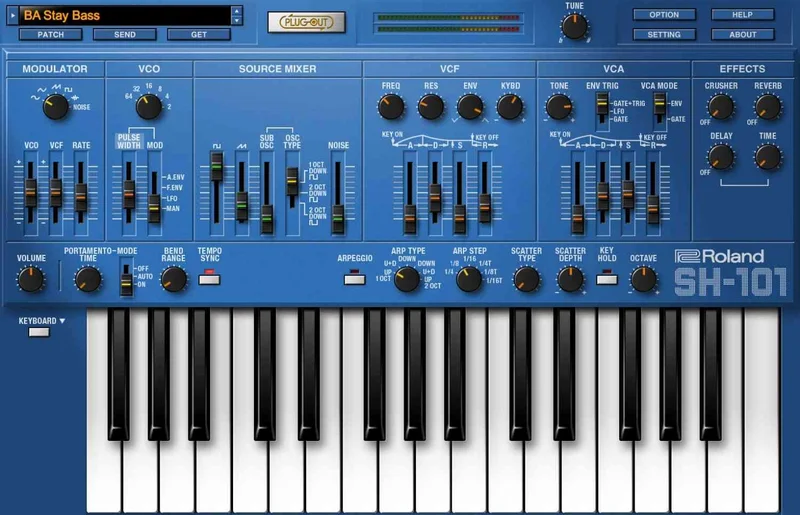
| Color Skins | Gray, blue, red (matching original hardware) |
Score Breakdown
| Category | Score | Notes |
|---|---|---|
| Sound Quality | 4.5/5 | Circuit-level filter modeling is genuinely accurate; single oscillator limits harmonic range by design |
| Value for Money | 4.5/5 | Dramatically cheaper than a functional hardware unit with better DAW integration and patch recall |
| Ease of Use | 4.0/5 | Interface is clean and fast; step sequencer workflow is less intuitive without physical controls |
| Features | 3.5/5 | Extended EG and LFO additions are welcome; no modulation matrix or randomizer limits exploration |
| CPU Efficiency | 4.5/5 | Light footprint; runs multiple instances without strain on a modern session |
| Overall | 4.2/5 | The best way to get real SH-101 character into a DAW in 2026, with the right limitations baked in |
Alternatives to Consider
If you want more oscillators and a larger modulation matrix in a similar price range, the Arturia MiniFreak V covers far more sonic territory. It won't give you the specific SH-101 filter character, but it's a better general-purpose monosynth for producers who want flexibility alongside the vintage-adjacent sound.
For raw character emulation of a different Roland-era architecture, the AudioThing SX1000 is worth a look. It models Italian synth hardware with its own distinctive filter behavior. Different from the SH-101 in every sonic way, but similarly focused and similarly satisfying when it's the right tool.
If acid bass is your actual target, the Audio Blast ABX3 Bundle is built for TB-303 territory. The SH-101 gets close to that sound on high-resonance settings, but it was never a 303. If 303 is what you need, buy the right tool.
The hardware Behringer MS-1 is also worth mentioning. It's a modern analog SH-101 clone with full MIDI and patch memory, sold new. If you want physical controls without vintage market prices, it's a legitimate alternative. But it has no DAW recall, no PLUG-OUT integration, and no extended EG or LFO features. The plugin wins on workflow for ITB producers.
The plugin is the right call. If you want the SH-101 sound and you work in a DAW, buy this. The hardware conversation is only worth having if you play live and don't own PLUG-OUT hardware. Everyone else is paying for friction they don't need.
Frequently Asked Questions
Is the Roland SH-101 plugin the same as the original hardware?
It's as close as circuit-level modeling gets. Roland worked with the original SH-101 engineers to model individual circuit behaviors, not just the output waveform. The filter character, the sub oscillator relationship, the arpeggiator logic: all modeled from the source. The plugin also adds features the hardware never had, including a dedicated filter envelope and onboard effects, so it's a superset of the original, not just a copy.
Can I use the SH-101 plugin without Roland hardware?
Yes. It runs as a standard VST3, AU, or AAX plugin in any compatible DAW on Mac or Windows. The PLUG-OUT feature for running it on Roland hardware like the SYSTEM-8 or SH-01A is optional. If you don't own compatible Roland hardware, you simply don't use that feature. The plugin works fully without it.
How does the plugin handle patch saving compared to the original SH-101 hardware?
This is one of the biggest advantages of the plugin. The original hardware has no patch memory: powering it down loses every setting. The plugin saves patches like any other DAW instrument, as part of your project or as preset files. You can build a library of SH-101 sounds and recall any of them instantly. That alone solves one of the most frustrating things about working with the original hardware.
Is the SH-101 plugin good for TB-303 acid bass sounds?
It gets close but it's not a 303. The SH-101's filter is 18dB-per-octave and behaves differently from the TB-303's transistor ladder circuit. At high resonance with fast filter envelope modulation, you can dial in sounds that sit in the same sonic neighborhood as acid bass. But if TB-303 accuracy is your main goal, a dedicated 303 emulation will serve you better. The SH-101 plugin is the right tool for SH-101 sounds, not 303 sounds.
Does the SH-101 plugin work on Apple Silicon Macs?
Roland has updated their plugin lineup for Apple Silicon compatibility. The SH-101 plugin runs natively on M-series Macs via the AU and VST3 formats. Check Roland's current system requirements page before purchasing to confirm the exact version you're downloading is listed as Apple Silicon compatible, as plugin support pages update regularly.