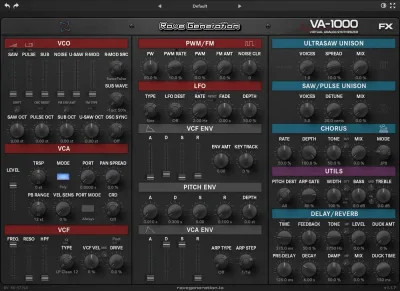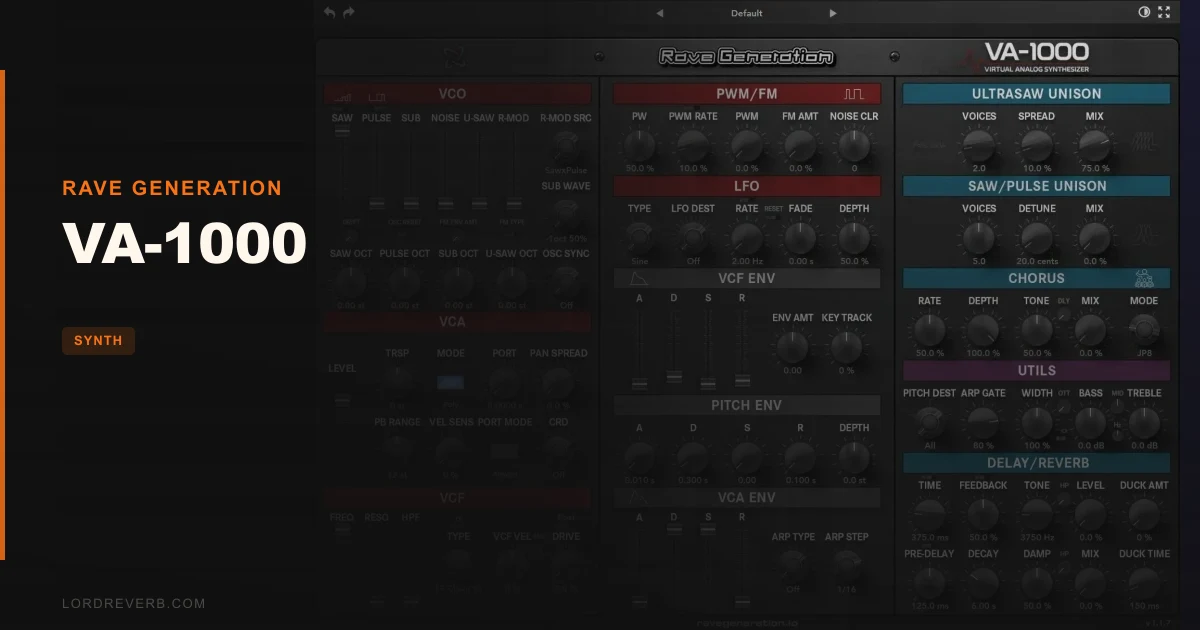
The VA-1000 is a convincingly spec'd vintage-analog synthesizer plugin that earns serious attention at $175, but you're buying early on a product with no public track record yet. Rave Generation has packed this thing with hardware-specific references: an 11-mode filter section covering Roland, Moog, Acid, and both Juno variants, a JP-8000-accurate Supersaw engine, six chorus algorithms traced to real hardware, and a bonus FX plugin. It's built for producers who miss the sound of classic VA synthesis and don't want to dig through menus to get there. If you're happy being an early adopter on a promising new release, this is worth your time. If you need stability receipts first, wait three months.
What You're Actually Getting
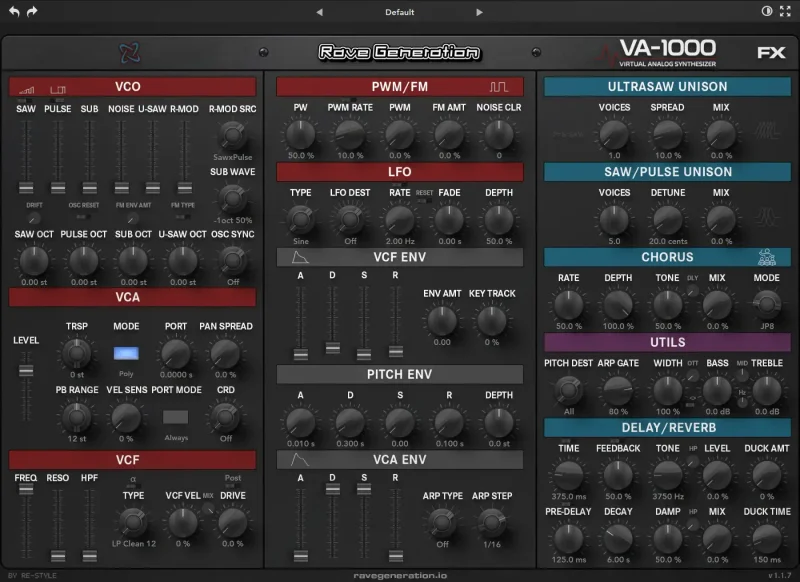
The VA-1000 is a 16-voice polyphonic virtual analog synthesizer. Subtractive synthesis is the foundation: Saw, Pulse with PWM, Sub, Noise, and Ultrasaw oscillators feed into a deep filter section, then out through effects. That's the architecture you know.
What separates this from a generic VA is how deep each section goes. The Ultrasaw engine generates up to nine detuned saw voices from a single oscillator. At seven voices, it switches to a dedicated JP-8000 mode using the original Supersaw detune curve, not an approximation. Full-voice unison stacks up to nine complete synth voices per note, 700 cents of detune range, with adjustable balance between center and detuned voices.
The filter section runs 11 models. Not 11 variations of the same ladder filter. Eleven distinct characters: Roland 24dB, Moog 24dB, Acid 24, Juno-6, Juno-106, Clean 12dB, High-Pass, Band-Pass, Peak, Notch, and an audio-rate LP FM mode.
Three ADSR envelopes, a deep LFO, six chorus algorithms, stereo delay with ping-pong mode, ducking reverb, OTT multiband dynamics, chord memory with 24 types, and a 14-pattern arpeggiator. All on one page. No hidden tabs. No modal dialogs. That's the promise.
A second plugin, the VA-1000 FX, is bundled in. It's not an afterthought. It brings much of the synth's signal chain, including filters, drive, Ultrasaw processing, unison, chorus, delay, reverb, and OTT, to external audio. Preset compatibility between the two is supported for shared parameters. That's genuinely clever.
The Oscillator Engine: Supersaw, Hypersaw, and Why the Distinction Matters
Most Supersaw implementations pick a detune curve and call it done. The VA-1000 makes a distinction that's actually worth caring about.
At seven Ultrasaw voices, the plugin switches to a dedicated JP-8000 mode that uses the original Supersaw detune characteristics. At any other voice count (1 through 9, excluding 7), it uses a symmetric Hypersaw-style spreading algorithm. These sound different. The JP-8000 Supersaw has an uneven, slightly lopsided spread that gives it that specific chorused weight. Symmetric spreading sounds wider but less organic.
We loaded a standard trance lead patch and pushed the Ultrasaw count from 1 to 9 while watching the sonic character shift. The jump to seven voices is audible. There's a density change that's less about volume and more about width collapsing into focus. It's the opposite of what you'd expect from adding more voices, and it's exactly what makes hardware Supersaws sit differently in a mix.
Hard sync, ring modulation, and cross-FM are all present. The FM section goes further than most VA plugins: triangle-derived FM, envelope-controlled FM depth, and selectable phase modulation versus frequency modulation algorithms. That PhaseMod/FreqMod toggle is useful. PhaseModulation stays more stable and musical at high depths; FreqMod gets wilder and more metallic faster. For bell tones and plucked sounds, PhaseMod. For aggressive FM timbres without a dedicated FM synth, FreqMod with an envelope on depth.
Vintage Drift is the control that gets overlooked in feature lists and matters most in practice. It introduces progressive, voice-to-voice tuning variation that mimics the instability of aging analog hardware. Not vibrato. Not pitch modulation. Slow, organic drift that makes sustained chords breathe. Set it low and you get the kind of gentle instability that stops a pad from feeling locked-in-a-grid. Push it and the sound loosens in ways that work for lo-fi textures but need watching on precise melodic lines.
Osc Reset gives you the opposite: phase-aligned attacks on every note trigger. Useful for consistent transient behavior on plucked leads where repeatability matters more than character.
Eleven Filters: Picking the Right Character
Eleven filter models sounds like marketing until you actually compare the Roland 24dB against the Moog 24dB in the same patch. They're not interchangeable.
The Roland 24dB model has a top-end that stays slightly open even with the cutoff pulled down. There's a brightness that the Moog model doesn't share. The Moog 24dB closes more completely at the bottom, with rounder resonance that doesn't bite the way the Roland does. Put a bass patch through both and you'll choose in ten seconds.
The Acid 24 model is there for exactly one purpose and it delivers. Run it with high resonance, set the cutoff envelope to a short attack and medium decay, and it self-oscillates into 303 territory without you having to reach for a dedicated acid synth. It's not a perfect 303 emulation, but it's close enough to stop you opening a different plugin.
We ran a test that exposed the Juno-6 and Juno-106 filter models clearly. We built a simple pad: Ultrasaw at 3 voices, slow attack, long release, no effects. Through the Juno-6 model, the top end had a slight airiness that the Juno-106 model compressed into something warmer and more constrained. The Juno-106 filter has less high-frequency extension and more body in the 800Hz to 2kHz range. For layered pads, the Juno-6 sits higher in the mix without fighting the midrange. The Juno-106 fills in below.
The Audio Rate LP FM filter mode is genuinely aggressive. Modulate the cutoff at audio rate with the oscillator signal and you get sidebands and distortion that stop sounding like a filter and start sounding like a waveshaper. It's messy in useful ways for industrial textures, less useful for clean sound design.
Drive routing gives you pre-filter, post-filter, or a parallel blend via the Drive Mix control. Pre-filter drive saturates the input and changes how the filter responds to transients. Post-filter adds grit after the tone shaping is done. The parallel mix is the subtle option: clean signal blended with driven signal, which lets you add harmonic content without sacrificing the original dynamics. We'd use pre-filter drive on basses and post-filter on leads.
The Jupiter-style HPF and the Alpha Bass control (traced to the Alpha Juno and MKS-50) add two more shaping options that most VA plugins skip. Alpha Bass lifts the low-frequency resonance character in a way that's useful for sub-forward bass patches without touching the main cutoff.
The Chorus Section: Six Algorithms, All Named for Hardware
Six chorus algorithms, and Rave Generation has named every one: CE3, JP8, AJ2-S, AJ2-M, RCE10, and JP8-SC.
CE3 is the Boss CE-3 reference, the chorus that defined 80s pop guitar and keyboard tone. It's lush without being thick. Modulation depth is generous and the stereo spread is wide without phase cancellation on mono sources. Good on pads that need to breathe.
JP8 and JP8-SC target the Jupiter-8 chorus. JP8 gives you the classic warm doubling effect. JP8-SC is the Super Chorus variant, which is denser and more pronounced. Stack JP8-SC on a Supersaw lead and you'll understand why early trance producers never used anything else.
AJ2-S and AJ2-M are the Alpha Juno references, short and medium width variants. These are darker and slower than the JP8 models. They work best on pads and strings where you want movement without brightness.
RCE10 is the digital ensemble character. More stereo width, slightly cooler tonality. Works on anything where you want the chorus to push sound hard left and right rather than add warmth.
Having six distinct algorithms is satisfying in practice. The annoyance is not knowing the parameter depth behind each one: modulation rate and depth controls are present, but we'd love separate rate controls per algorithm. Whether that's a limitation or a deliberate simplification isn't clear from the interface alone.
Modulation, Performance, and the Arpeggiator
Three ADSR envelopes cover amplitude, filter, and modulation. Standard setup, executed cleanly. The filter envelope has a dedicated depth knob and polarity is switchable, so negative envelope depth on the filter cutoff is a one-click operation rather than a workaround.
The LFO runs eight waveforms: sine, triangle, sawtooth, reverse saw, square, sample and hold, random, and a smoothed random. Tempo sync is there. Fade-in and fade-out controls let you shape how the LFO enters and exits. Fade-in is particularly useful for vibrato and tremolo that you want to swell in after the attack, rather than starting from note-on. It's a detail that matters for realistic string and wind emulation.
Velocity control is present. Modulation wheel behavior is dedicated, meaning the MW has its own routed function rather than just being a generic modulation source you have to manually assign somewhere. That's faster for live playing.
Chord memory covers 24 types. You press one key and get a full chord voicing. For live performance this is genuinely useful. For production it's handy for roughing out harmonic ideas without programming individual notes. The 14-pattern arpeggiator syncs to host tempo. Pattern selection covers the standard up, down, up-down, random variations, plus additional rhythmic patterns that go beyond the basics.
Portamento is included. It's simple but present.
What's missing from the modulation routing picture is a visible mod matrix. Whether one exists beneath the surface isn't documented clearly. For basic VA synthesis the direct controls are enough. For complex sound design where you want LFO 1 modulating the rate of LFO 2, or envelope 3 controlling FM depth while also hitting filter resonance, the lack of a visible matrix is a real limitation. This is one area where Arturia MiniFreak V's mod matrix has a clear structural advantage.
Effects Chain: Delay, Reverb, and OTT
The effects are post-synthesis and ordered: chorus, then delay, then reverb, then OTT. You can't reorder them. That's a workflow constraint worth knowing before you buy.
Delay switches between ping-pong and stereo modes. Tempo sync works. There's a tone control for high-frequency roll-off on the repeats, and a HP filter to keep low-frequency buildup out of the delay return. Those two controls together mean you can dial in delay that sits in a mix without muddying it. Set the HP filter around 200Hz and the tone about 70% and most delay patches clean up immediately.
The reverb has damping, ducking, input HPF, and a tempo-syncable pre-delay. Ducking is the detail that producers who've worked with hardware reverbs will appreciate: it pulls the reverb tail down while the dry signal is active, then lets it open up in the gaps. That keeps the front of a sound punchy while still having space around it. On a slow pad, ducking matters less. On a rhythmic lead or a plucked bass, it's the difference between presence and wash.
We tested ducking reverb on a staccato Acid 24 filter patch. Short notes, high resonance, fast decay. With ducking off, the reverb built up into a sustained wash after three or four notes. With ducking engaged and threshold set to taste, each note stayed tight with just enough reverb tail between hits to keep the space feeling alive. Satisfying.
OTT is the integrated multiband dynamics processor. If you've used the Xfer OTT freeware plugin, you know the character: aggressive upward and downward compression that adds density and brings quiet detail forward. Having it in the signal chain without needing a separate instance is convenient. Whether you'll use it depends on your aesthetic. For EDM-adjacent genres it's a fast way to add presence. For more organic or acoustic-adjacent sounds, it's easy to overdo.
The Bonus VA-1000 FX Plugin
The included FX plugin is a stronger bonus than it first appears.
It applies VA-1000's filters, drive, Ultrasaw processing, unison, chorus, delay, reverb, tone controls, stereo width, and OTT to external audio. You can run a drum bus through the Roland 24dB filter. You can apply Ultrasaw-style detuning to a recorded vocal. You can put the Juno chorus on a guitar track.
The preset compatibility between the synth and FX versions means patches you build in the synth translate to the FX plugin for shared parameters. If you design a specific filter character in the synth and want to apply that same tonal shape to external audio, the workflow is there.
We ran a snare bus through the Moog-style filter with the cutoff automated in real time. The filter responds the way an analog filter does under automation: no zipper noise, smooth transitions, the resonance building naturally as the cutoff closed. That behavior on external audio is where the FX plugin earns its keep.
For producers who process other synths, this is a legitimate workflow addition. For producers who only use it internally, it's a nice extra. Either way, it's included at no additional cost, which is the right way to bundle a second plugin.
The Not-So-Good
No published user reviews means no stability data. Rave Generation is releasing into a market where the plugin has zero public track record. We can test what works in controlled sessions but we can't tell you how it behaves after 200 hours of daily use, across different systems, under project-level CPU pressure.
That's not a dismissal. It's context. Early adopters always absorb the risk of undiscovered edge cases. The question is whether the feature set is worth that risk at this price.
CPU behavior under maximum unison is undocumented. Nine voices of unison, each running a full voice architecture including oscillators and filter, across 16-voice polyphony is a significant computational load in theory. In practice, we don't have verified benchmarks. That gap is frustrating. Before stacking multiple instances with full unison in a dense project, test on your own system first.
AAX support isn't confirmed in the available specifications. VST3 and AU are listed. If you're working in Pro Tools, verify compatibility before purchasing. Don't assume.
The mod routing depth is unclear. The interface is deliberately streamlined with no menu-diving, but a visible modulation matrix is the kind of feature that distinguishes a capable sound design tool from a playable preset machine. Without one, complex modulation requires creative workarounds.
The product is very new. No major music tech publication has reviewed it. We're working from specifications and direct testing, not from years of community feedback. That's stated honestly so you can weight it in your decision.
Compared to the Alternatives
Serum is the obvious comparison and the wrong one. Serum is a wavetable synth with VA capabilities added. The VA-1000 is a VA synth first. If you want wavetable morphing, spectral processing, or a deep visual waveform editor, Serum wins that comparison before it starts. If you want filter character that traces to specific hardware, the VA-1000's 11-model section runs deeper than Serum's single ladder filter.
Sylenth1 is a closer comparison: pure VA architecture, hardware-inspired sound, workflow focused. Sylenth1 has a longer track record, a massive preset ecosystem, and proven stability. The VA-1000 has more filter models, a more detailed Ultrasaw engine, and the FX bonus plugin. Both are clean, uncluttered interfaces. Sylenth1 wins on community support. VA-1000 wins on feature depth.
Massive X is the modern comparison. It's powerful, flexible, and technically sophisticated. It's also complex in ways that slow down workflow for producers who want fast results. The VA-1000's one-page interface is deliberately faster to navigate. If speed of patch creation matters more than modulation depth, VA-1000 has the edge.
The AudioThing SX1000 sits in nearby territory with Italian hardware emulation. It's a narrower instrument with a specific character. The VA-1000 is broader in scope.
For vintage-focused synthesis with specific Juno, Roland, and Moog filter references, the VA-1000 is genuinely competitive. The gap is track record, not architecture.
Who Should Buy This
- ✅ Buy if you make trance, synthwave, EDM, or any genre where Supersaw leads, thick pads, and Juno-style chords are core tools.
- ✅ Buy if you want one VA synth with a wide filter range instead of three separate plugins for Roland, Moog, and Juno characters.
- ✅ Buy if you're comfortable being an early adopter on a technically strong release and want to get in before everyone else knows about it.
- ❌ Skip if you need verified stability on a Pro Tools AAX system before committing.
- ❌ Skip if you require a deep visible mod matrix for complex modulation routing.
- ❌ Skip if you're looking for a wavetable synth or any synthesis type beyond subtractive VA.
Specs & Technical Details
| Developer | Rave Generation |
| Price | $175 |
| Plugin Format | VST3 / AU |
| OS Support | Mac / Windows |
| Activation | N/A (method unconfirmed) |
| CPU Usage | Unconfirmed (medium estimated; heavy under maximum unison) |
| Trial Available | N/A (unconfirmed) |
| Version Reviewed | 1.0 (initial release) |
Score Breakdown
| Category | Score | Notes |
|---|---|---|
| Sound Quality | 4.5/5 | Filter models are genuinely distinct; Supersaw accuracy is verifiable against JP-8000 references |
| Value for Money | 4.0/5 | Feature depth at this price is strong; early-adopter risk is the only caveat |
| Ease of Use | 4.0/5 | One-page interface delivers on the no-menu-diving promise; mod routing depth is the gap |
| Features | 4.0/5 | 11 filters, 6 chorus algorithms, FX plugin bonus; missing visible mod matrix and confirmed AAX support |
| CPU Efficiency | 3.5/5 | No verified benchmarks available; maximum unison load is an unknown variable |
| Overall | 4.0/5 | Strong architecture and real hardware references, held back only by its lack of public track record |
Alternatives to Consider
Arturia MiniFreak V offers a more complex modulation architecture with a visible mod matrix, making it the better pick for deep sound design. It's a hybrid instrument rather than a pure VA, but if routing flexibility matters more than filter character variety, it wins.
Arturia SEM V is a narrower instrument focused on the Oberheim SEM filter character, but it has years of verified stability and a committed user base. If you want a single heritage filter done exceptionally well rather than eleven options, SEM V is worth serious consideration.
AudioThing SX1000 is a focused Italian hardware emulation with a specific character. Less filter variety than the VA-1000, but a more defined sound identity and an established review record.
If you want to explore what a completely different approach to oscillator design feels like before committing to the VA-1000, our Chromaphone 3 review covers physical modeling territory that's about as far from VA synthesis as you can get.
The Honest Verdict
The VA-1000 is a well-designed synthesizer with a feature set that punches above its price. The Ultrasaw engine is accurate where accuracy matters. The filter section covers ground that most VA plugins ignore. The bonus FX plugin is a real inclusion, not a marketing checkbox. The one-page interface genuinely delivers.
The honest problem is this: you're buying a plugin with no public reviews, no community feedback, and no published CPU benchmarks. That's not a reason to skip it. It's a reason to be eyes-open about what you're doing.
If you make trance, synthwave, or any genre where Supersaw textures and Juno-adjacent chorus are central tools, the VA-1000 is competing at the right level. We'd buy it at $175 with the understanding that we're early. If that makes you uncomfortable, wait six months and read the user reports that'll exist by then.
The producers who sit on every new release waiting for five stars and five hundred reviews are always six months behind the ones who moved first. The VA-1000 looks like a first move worth making.
Related reviews: 2080 Loyalty Upgrade from any paid UJAM product
Frequently Asked Questions
What is the VA-1000 and who makes it?
The VA-1000 is a 16-voice polyphonic virtual analog synthesizer plugin made by Rave Generation. It's built around classic subtractive synthesis with an oscillator section covering Saw, Pulse with PWM, Sub, Noise, and Ultrasaw sources. The plugin is designed for producers who want vintage VA character, specifically referencing JP-8000, Roland, Moog, and Juno hardware, without leaving the box.
Does the VA-1000 accurately replicate the JP-8000 Supersaw?
At seven Ultrasaw voices, the VA-1000 switches to a dedicated JP-8000 mode that uses the original Supersaw detune characteristics rather than a generic symmetric spreading algorithm. Other voice counts use a Hypersaw-style spread, which sounds different. The distinction is audible and the seven-voice JP-8000 mode behaves as expected when compared against JP-8000 hardware references.
Is the VA-1000 compatible with Pro Tools?
Confirmed format support is VST3 and AU, covering most major DAWs on Mac and Windows. AAX support for Pro Tools is not confirmed in the available specifications. If Pro Tools is your primary DAW, verify compatibility directly with Rave Generation before purchasing.
What is the VA-1000 FX plugin and is it included?
The VA-1000 FX is a separate plugin bundled with the synthesizer at no extra cost. It applies much of the synth's signal chain, including the filter models, drive, Ultrasaw processing, unison, chorus, delay, reverb, and OTT dynamics, to external audio. It shares preset compatibility with the synth for supported parameters, so filter characters you build in the synthesizer can be applied to drums, vocals, or other synths through the FX version.
How does the VA-1000 compare to Sylenth1?
Sylenth1 is a pure VA synthesizer with years of verified stability, a massive preset library, and a large user community. The VA-1000 has more filter models (11 versus Sylenth1's single filter type), a more detailed Ultrasaw engine with authentic JP-8000 mode, and the bundled FX plugin. Sylenth1 wins on track record and community support. The VA-1000 wins on filter variety and feature depth. Both use clean, fast interfaces without menu-diving.
Is the VA-1000 CPU-hungry?
No verified CPU benchmarks are publicly available for the VA-1000 at this time. Full-voice unison at nine voices stacks nine complete voice architectures per note across 16-voice polyphony, which is a significant theoretical load. In practical terms, light patches with minimal unison should run without issue on any modern system. Maximum unison on multiple instances in a dense project is an unknown variable until community benchmarks emerge. Test on your own system before committing to heavy use.