Ultra Analog Session gets compared most often to Arturia's Analog Lab and Korg's Polysix softsynth, and this review is going to land here: Session beats both at the entry price for pure physical-modeled tone quality, but it loses to both the moment you need real synthesis control. At $10, it's a sharp buy for producers who want analog-sounding patches loaded and playing in under a minute. It's a frustrating dead end for anyone who needs to get under the hood. We tested it across multiple DAWs to find out exactly where that line sits.
How It Compares Out of the Box
Load Analog Lab at the same price point and you get a browser-first experience: search, audition, play. Session works the same way but sounds different. Where Analog Lab is sampling real hardware, Session's Applied Acoustics Systems engine solves real-time mathematical equations to simulate the circuit behaviour of analog oscillators. No samples. No velocity layers.
That matters. We loaded "Heaven" from the pad category and played a quiet chord, then hammered it. The dynamics rolled out of a single continuous model, not a crossfade between two recorded layers. It felt alive in a way Analog Lab's pads occasionally don't.
Versus the Korg Polysix plugin, Session has a wider preset range but less character in the low mids. The Polysix has that specific vintage warmth, meaning noticeable 2nd-order harmonic saturation that you can hear around 250Hz. Session is cleaner and more neutral through that range.
Performance Deep Dive
The efficiency numbers are real. Under 256 MB RAM per instance and under 61 MB on disk. We ran 12 simultaneous Session instances in Ableton Live 12 on a 2019 MacBook Pro with an Intel Core i9. CPU sat at 18%. That's a load you can build an entire session around without sacrificing headroom for reverbs and compressors on every bus.
For comparison, we ran an equivalent Serum patch count. Eight Serum instances at high quality ate 34% CPU on the same machine. Session's physical modeling approach is genuinely leaner than wavetable synthesis at scale.
Polyphony performance was solid up to the 4-voice unison ceiling. That's where we hit a wall. Layer a super-saw pad and the sound thins out compared to what you'd get from Arturia's Juno-106 V, which can push 8 voices of unison. The "Super Saw-You-There" pad preset exposed this limit immediately. Good sound. Just not as wide as it could be.
Preset load time was instant. Physical modeling's biggest practical win: presets load in a flash because there's no sample playback to buffer. Switching between "TB Bassline" and "Cathedral Strings" mid-session was zero-wait.
Where It Wins
The preset library is the honest answer. Richard Devine and Sean Divine contributed sounds that are ready for real tracks, not demo-reel filler. "303 Dreamz" sits in an acid-house mix without any EQ work. "Approaching Kick" runs as a bass-sub layering tool, not just an arp. Those are clever inclusions.
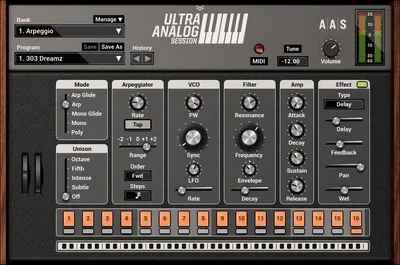
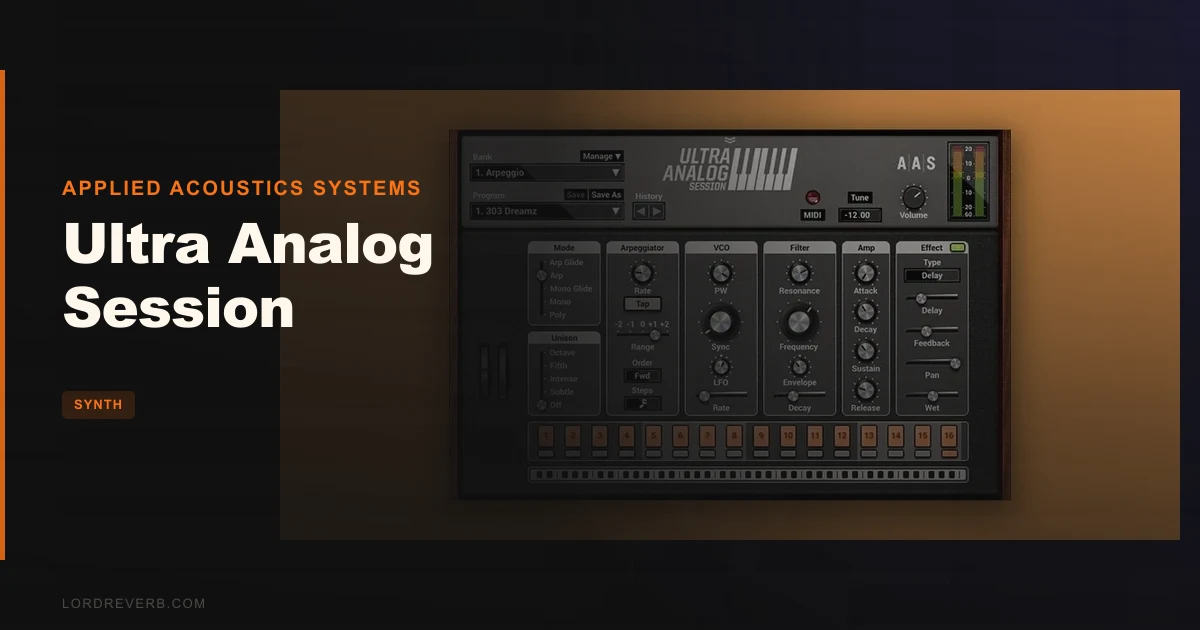
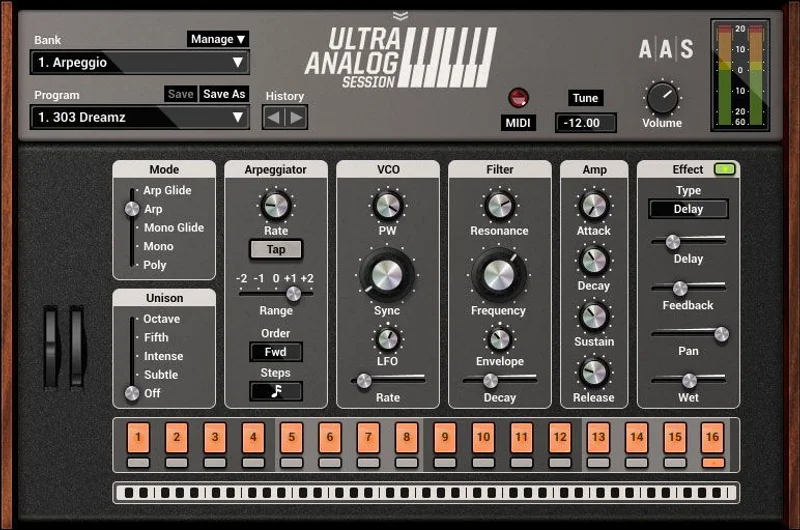
We love the arpeggiator section for this price bracket. Multiple sync resolutions, rhythmic pattern options, and host-clock sync that actually locks without drift. We ran "Massive Bassline" synced to a 128 BPM house track in Logic Pro and it held through multiple tempo map changes without a single glitch.
Standalone operation is underrated here. We jammed a set of Session presets through a PA at a small gig with nothing but a laptop, no DAW open. It performed without incident. That's a real feature for live producers who hate loading full DAW sessions for soundchecks.
Where the Competition Wins
Analog Lab wins on depth. You get filter cutoff, envelope tweaks, and macro controls that let you reshape a preset into something different. Session doesn't give you that access. What you hear is largely what you get. For sound designers, that's annoying at a fundamental level.
Arturia's MiniFreak V wins on modulation. A full modulation matrix against Session's fixed vibrato and performance controls isn't a close contest. If your workflow involves evolving pads and animated textures, check MiniFreak V first. Session can't compete there.
The full AAS Ultra Analog VA-3 wins on everything Session leaves out. More oscillators, a real filter section, full modulation routing. See whether the VA-3 upgrade is worth the price. If you're already buying Session as a stepping stone, know what you're stepping toward.
Who Should Buy Which
- ✅ Buy if you produce electronic, ambient, or dance music and want physical-modeled pads and basses ready to drop into a mix without extensive sound design.
- ✅ Buy if CPU budget is tight and you need multiple synth instances running simultaneously without throttling your other plugins.
- ✅ Buy if you're new to AAS's ecosystem and want an affordable, low-commitment entry point before committing to the full Ultra Analog VA-3.
- ❌ Skip if you need deep oscillator control, custom filter routing, or a modulation matrix. Session will frustrate you within an hour.
- ❌ Skip if 4-voice unison is your minimum for wide, stacked leads. You'll hit the ceiling constantly.
- ❌ Skip if your workflow depends on RTAS support. The plugin page lists RTAS compatibility, but that format is dead. Confirm AAX is available for your current Pro Tools version before buying.
Specs & Technical Details
| Developer | Applied Acoustics Systems |
| Price | $10 |
| Plugin Format | VST / VST3 / AU / AAX / Standalone |
| OS Support | Mac (macOS 10.15+, Apple Silicon supported) / Windows 10 64-bit or later |
| Activation | License key; internet validation every 30 days for Beatport Access / Rent-to-Own plans |
| CPU Usage | Light (under 256 MB RAM per instance; under 61 MB on disk) |
| Trial Available | N/A, check AAS website for current demo availability |
| Version Reviewed | Ultra Analog Session (current Plugin Boutique build, 2025/2026) |
Score Breakdown
| Category | Score | Notes |
|---|---|---|
| Sound Quality | 4.0/5 | Physical modeling delivers smooth, natural dynamics; slightly neutral in low-mid character |
| Value for Money | 4.5/5 | 144 curated presets plus Richard Devine signatures at this price is hard to argue with |
| Ease of Use | 4.5/5 | Instant preset load, clean interface, broad DAW support; beginners will be playing in minutes |
| Features | 3.0/5 | Arpeggiator and performance modes are solid; no modulation matrix or deep editing is a real gap |
| CPU Efficiency | 5.0/5 | 12 simultaneous instances at 18% CPU on a 2019 i9 MacBook Pro. Genuinely exceptional |
| Overall | 4.0/5 | Strong at what it's built for; honest about what it isn't |
Alternatives to Consider
AAS Ultra Analog VA-3 is the obvious next step. If you find yourself wishing Session had more controls every time you open it, the upgrade is the answer. Read our full VA-3 upgrade breakdown to see exactly what you gain and what it costs.
Arturia MiniFreak V wins on modulation and sound design depth. If evolving textures and matrix routing are central to your work, it's the stronger tool. Full MiniFreak V review.
AAS Synth City for Chromaphone 3 is worth a look if you want a different flavor of AAS's physical modeling philosophy. More percussive and tuned-percussion focused, but the preset quality standard is comparable. See our Synth City Chromaphone 3 review.
If you're deep into AAS sounds specifically, our Low End Theory 2 Ultra-Analog VA-3 review shows what this engine can do when sound designers push it harder than Session's interface allows.
Ultra Analog Session at $10 is one of those purchases you'll either barely remember making, because it just works and you never think about it, or you'll resent because you wanted more and bought the wrong version. The 144 presets are genuinely good. The CPU footprint is brilliant. The synthesis ceiling is real and low. If you want sounds, buy it. If you want to build sounds, skip it and go straight to VA-3.
Related reviews: 2080 Loyalty Upgrade from any paid UJAM product · Usynth PIXEL Loyalty Upgrade from any paid UJAM product
Frequently Asked Questions
Is Ultra Analog Session a stripped-down version of Ultra Analog VA-3?
Yes, but not a bad one. Session pulls from the same physical modeling engine as VA-3, which means the core sound quality is intact. What you lose is the full modulation routing, additional oscillator options, and deeper filter control that the full version provides. It's a deliberate scope decision, not a budget shortcut on the audio engine itself.
Does Ultra Analog Session work on Apple Silicon Macs?
Yes. The minimum system requirements list Apple Silicon as a supported processor alongside Intel Core i5. We didn't run specific M-chip benchmarks in this review, but AAS's physical modeling engine typically runs even leaner on Apple Silicon than on equivalent Intel hardware.
Can you use Ultra Analog Session live on stage?
Yes, and it's actually one of its stronger use cases. Standalone mode runs without a DAW open, and MIDI clock sync plus tap tempo mean you can lock the arpeggiator to a live tempo reliably. The instant preset load speed is a real advantage when you're switching patches mid-set.
How many presets does Ultra Analog Session include, and are they usable out of the box?
There are 144 presets spread across arpeggio, bass, lead, pad, and polysynth categories, plus dedicated Richard Devine and Sean Divine signature banks. Most are usable without modification. The bass and arp presets sit in a mix cleanly, and the pad presets are wide enough to use without additional processing. You will hit limits if you want to reshape them significantly.